


What if the "free" sourcing service you just signed is actually costing you 30% more on every single unit? Most importers feel a constant, nagging anxiety that their factory-direct pricing isn't actually direct. You've likely suspected that hidden markups are quietly eroding your margins, yet the lack of visibility makes it nearly impossible to prove. It's a valid concern in a global market where China's foreign trade reached over 45 trillion yuan in 2025, creating more opportunities for obscured costs than ever before.
Having a clear sourcing agent fee structure explained is your only structural defense against supply chain corruption. You deserve a procurement partnership that functions as an integrated extension of your own team, not a middleman looking to profit from your lack of regional presence. This guide will help you master the complexities of sourcing fees, identify hidden factory kickbacks, and secure a transparent agreement that protects your bottom line. We'll break down the mechanics of commission versus flat-fee models and provide a framework for evaluating your true procurement costs in 2026.
• Differentiate between commission and flat-fee models to select the most cost-effective oversight for your specific procurement volume.
• Identify the red flags of secret factory kickbacks and "double-dipping" that can silently inflate your unit costs.
• Use the sourcing agent fee structure explained in this guide to evaluate your total landed cost and verify the ROI of professional negotiation.
• Learn how on-site quality control and supplier vetting act as a financial safeguard against the risks of unmanaged international manufacturing.
• Secure your margins by transitioning to a transparent procurement model that rejects hidden intermediaries in favor of direct factory partnerships.
A sourcing agent fee is the professional compensation you pay for comprehensive supply chain oversight. It's the price of security in an increasingly volatile market. In the broader context of Procurement, these fees have undergone a significant transformation. By 2026, the industry has shifted from simple transactional interactions to deep, strategic partnerships. Your agent shouldn't just find a vendor; they should function as your regional defense against operational risk and financial leakage. This evolution means you're paying for expertise, proximity, and accountability rather than just a contact list.
Many businesses fall into the trap of seeking the lowest possible percentage. This is a strategic error that often backfires. The cheapest fee structure frequently results in the highest total landed cost because it lacks the rigor of professional vetting and aggressive negotiation. When ethical standards are managed by European leadership, you gain a level of transparency that traditional intermediaries simply can't provide. It's about financial optimization. You're investing in a stabilizing force that protects your brand's integrity and your company's bottom line.
"Free" is a marketing illusion that masks significant financial hazards. If an agent doesn't charge you a visible fee, they're likely adding 10-30% markups to your unit prices behind the scenes. This is where the sourcing agent fee structure explained in your contract becomes a liability if it isn't 100% transparent. These "no-fee" agents survive on hidden factory kickbacks. This creates a dangerous misalignment of incentives. When the factory pays your agent, the agent works for the factory's interests, not your margins. For high-volume brands, this model is the most expensive mistake you can make.
Not all projects require the same level of oversight. Sourcing a ready-made product is fundamentally different from managing complex OEM manufacturing. Technical requirements like custom tooling, rigorous sampling, and multi-stage inspections demand a more robust fee model to cover the increased man-hours and technical expertise required. Your order frequency also plays a role in the calculation. High-volume, recurring orders often allow for scaled commission rates that reflect operational efficiency, while one-off projects might suit a flat-fee structure. Understanding these variables ensures you're paying for the actual value delivered rather than a generic, unmanaged service.
Selecting a financial framework for your supply chain isn't just a matter of accounting; it's a strategic decision that dictates the level of protection your brand receives. A properly structured sourcing agent fee structure explained in your service agreement ensures that your partner's incentives align perfectly with your profitability goals. In 2026, the complexity of global trade requires move away from vague pricing toward models that reward efficiency and transparency. Most professional partnerships fall into one of four categories: percentage-based commissions, flat project fees, monthly retainers, or hybrid performance models.
The right choice depends on your order frequency, technical complexity, and long-term growth objectives. While some models favor one-off product launches, others are designed to support the continuous oversight required for high-volume manufacturing. By understanding the mechanics of each, you can eliminate the "black box" of procurement costs and secure a partnership that functions as a genuine extension of your team.
The commission model remains the most common approach for variable order volumes. Typically, industry rates fluctuate between 3% and 10% of the total order value. This fee covers the labor involved in supplier communication, production monitoring, and logistics coordination. However, a common critique of this standard model is a markup on the factory quote, which can inadvertently discourage agents from negotiating the lowest possible price for you. If your agent's income rises when your costs rise, the incentive structure is fundamentally flawed.
To counter this, elite agencies utilize a tiered approach. Under a sliding scale commission model, your percentage fee decreases as your total procurement volume increases, rewarding your brand's growth with better operational efficiency. This ensures that as you scale, your per-unit oversight cost remains competitive without sacrificing the quality of on-site inspections.
For brands focused on risk mitigation, project-based fees offer a clean, transparent alternative. This is the ideal structure for specific tasks such as supplier vetting and factory audits, where you pay a fixed amount for a documented outcome. It removes the ambiguity of "hidden" costs and allows for precise budgeting during the initial stages of product development. You get a clear report on factory capabilities without any long-term financial commitment.
Enterprise-level importers often graduate to a retainer-based model. By investing in a dedicated Asia procurement team, you secure 365-day-a-year oversight and priority service that transactional agents cannot match. Retainers transform your sourcing partner into a permanent regional office, providing a level of stability and control usually reserved for major corporations. This model is particularly effective for managing complex supply chains where constant factory-level presence is required to prevent production delays. If you're ready to move beyond transactional sourcing, you might consider how a structured partnership can stabilize your manufacturing costs.
The "Double-Dipping" trap is the most pervasive threat to your procurement margins. Many agents present a low upfront fee while quietly collecting a secret commission from the factory. This hidden markup, often ranging from 3% to 10%, is added directly to your unit price. When an agent is financially beholden to the manufacturer, their loyalty shifts. They are no longer your protective partner on the ground; they are a salesperson for the factory. This conflict of interest ensures that quality failures, production delays, and ethical violations are often suppressed rather than reported. You need a sourcing agent fee structure explained in a contract that defines the agent as your fiduciary representative in Asia, not a secondary sales channel for the vendor.
A kickback-heavy agent won't jeopardize their secret income by holding a factory accountable for substandard output. You ultimately pay for their silence through poor product quality and eroded brand trust. To protect your financial health, you must watch for specific red flags that indicate an unmanaged supply chain. These include:
• "All-inclusive" pricing models that refuse to break down service costs.
• Resistance to third-party quality inspections or independent audits.
• Refusal to share the original factory invoices or contact details.
• Pricing that remains static despite significant drops in raw material costs.
True financial optimization requires "Open-Book" sourcing. This means you see the exact price the factory charges, without any hidden layers or "padded" invoices. Achieving this level of visibility allows you to verify that your agent is negotiating for your benefit, not their own. You can verify factory-direct pricing through independent audits or by maintaining direct communication lines with the vendor. Establishing 100% transparency is the cornerstone of successful global sourcing in 2026. It's the difference between a transactional middleman and a strategic ally who treats your capital with the same respect as their own.
Corruption often hides in the technical details of moving goods. Unethical agents frequently profit from kickbacks on local transport, port fees, and consolidation services. They may present you with inflated shipping quotes while pocketing the difference from the carrier. As trade volumes continue to surge, reaching record levels in 2025, the complexity of shipping provides even more cover for these unethical practices. By utilizing professional logistics and shipping coordination, you gain a defense against these obscured costs. A transparent partner provides you with the actual carrier rates, ensuring that your landed cost remains predictable and competitive. You deserve a supply chain where every dollar spent is accounted for and every service rendered adds measurable value to your business.
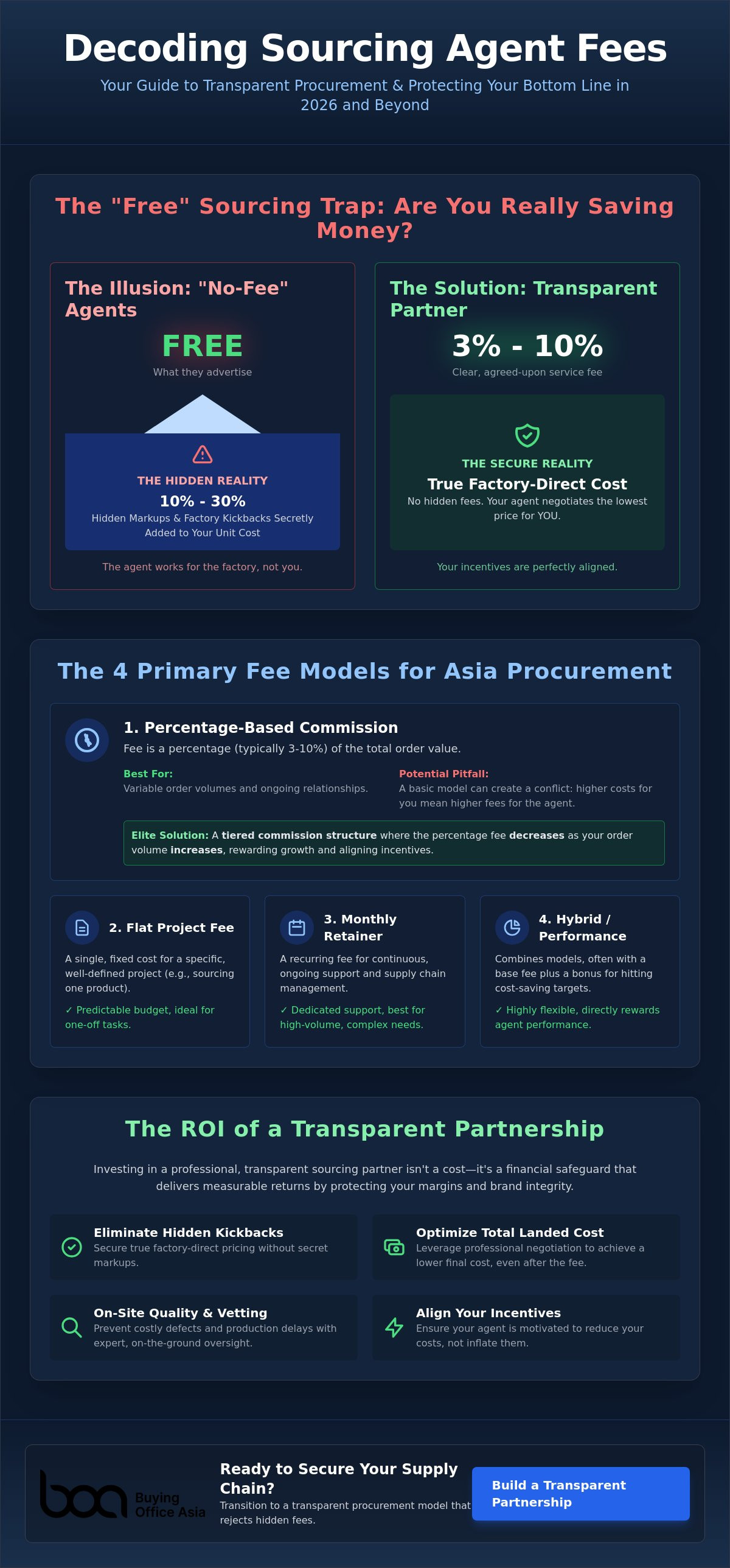
You shouldn't view your procurement partner's fee as a drain on your capital. It's a strategic investment in margin protection. When you have a professional sourcing agent fee structure explained in your financial plan, you can accurately calculate your Total Landed Cost. This metric includes the unit price, shipping, duties, and the often-overlooked cost of quality failures. By consolidating these variables, you move from guesswork to a data-driven supply chain that prioritizes financial viability. A transparent fee is the price of security in a market where unmanaged risks can quickly turn a profitable product into a liability.
Building an in-house procurement office in Asia requires significant capital; you have to manage local salaries, office leases, and complex labor laws. An external agency provides the same level of dedicated oversight without the fixed overhead. It allows you to scale your team up or down based on seasonal demand, providing an operational flexibility that an in-house team lacks. This lean approach to operation is what separates high-growth brands from those bogged down by administrative weight. You gain the regional expertise of a seasoned insider without the long-term liability of a physical office footprint.
On-the-ground presence is the ultimate leverage. Professional agents often secure unit cost reductions of 10-20% through aggressive, face-to-face bargaining that remote buyers simply can't replicate. They leverage multi-client volumes to command "Tier 1" pricing for smaller brands that would otherwise be ignored by major manufacturers. It's a simple reality that factory direct price negotiations can offset the agent fee entirely, turning your procurement team into a self-funding asset rather than an overhead expense. You aren't just paying for a service; you're paying for the market authority required to protect your margins.
Risk mitigation is the "Quality Insurance" factor of your supply chain. Consider the financial impact of a 30% defect rate discovered only after the goods have crossed the ocean; the loss of capital, time, and customer trust is catastrophic. A professional inspection fee is a fraction of that potential loss. Active mass production oversight ensures that errors are caught on the factory floor, before you pay the final balance. This level of vetting protects your brand reputation and ensures your ESG compliance stays intact. If you're ready to see how professional oversight can stabilize your bottom line, you can request a procurement audit to identify where your current margins are leaking.
Buying Office Asia (BOA) operates on a principle of absolute clarity. We've built our reputation by rejecting the "black box" intermediary models that have plagued international trade for decades. Our approach is rooted in a zero-kickback guarantee and a commitment to 100% open-book procurement. When you partner with us, you gain direct access to factory pricing, original invoices, and unvarnished quality reports. Having your sourcing agent fee structure explained through our transparent framework ensures that our incentives are perfectly aligned with your profitability. We aren't just a service provider; we're a stabilizing force in a complex global market.
Our unique leadership structure combines European strategic oversight with deep regional expertise. With our management based in Helsinki and our operational hub in Hong Kong, we provide the ethical rigor of Western corporate standards alongside the essential proximity required for effective Asia procurement. This synergy allows us to offer the high-level oversight usually reserved for major enterprises, making it accessible to serious international brands focused on high-volume, end-to-end sourcing. We manage the risks of international manufacturing so you can focus on scaling your business with confidence.
We position ourselves as an integrated extension of your own company rather than a third-party vendor. This structural difference is vital for maintaining control over your supply chain. Our dedicated Asia procurement team works directly with your internal stakeholders to understand your technical requirements and quality standards. This proximity allows us to act as your protective partner on the factory floor, identifying potential production bottlenecks and quality deviations before they impact your bottom line. You don't just get a contact person; you get a regional office that defends your margins 365 days a year.
Transitioning from an opaque, markup-based sourcing model to a transparent partnership is the most effective way to protect your long-term margins. It starts with a thorough audit of your current procurement costs to identify where hidden fees and kickbacks might be eroding your profitability. You can begin this process by reviewing a savings example for your specific product category to see the tangible impact of factory-direct pricing. If you're ready to eliminate supply chain uncertainty and secure a professional sourcing agent fee structure explained in a clear, written contract, it's time for a more rigorous approach. Schedule a consultation with Buying Office Asia to audit your current sourcing costs and establish a more resilient, transparent procurement partnership.
Navigating the complexities of international trade requires more than just finding a supplier; it demands a structural defense against financial leakage. You now have a comprehensive sourcing agent fee structure explained to help you distinguish between transparent partnerships and opaque intermediaries. By identifying the red flags of hidden markups and selecting a fee model that aligns with your volume, you protect your margins from the "double-dipping" traps that erode profitability.
Buying Office Asia offers a stabilizing force through our European-managed procurement standards and 100% transparent "Open-Book" pricing. Our on-the-ground presence in Hong Kong and major manufacturing hubs ensures that your interests are protected at every stage of the production cycle. It's time to move away from unmanaged risk and toward a partnership that functions as a direct extension of your team. Secure your brand's financial health by choosing a model defined by accountability and measurable outcomes.
Analyze Your Sourcing ROI with Buying Office Asia and take the first step toward a fully optimized procurement strategy. Your path to transparent, high-volume manufacturing starts with a professional audit of your current costs.
The average sourcing agent fee in China typically ranges from 3% to 10% of the total order value. For smaller orders under $10,000, rates often lean toward the 8-10% range. Larger procurement volumes exceeding $100,000 usually command lower rates between 3% and 5% as operational efficiencies scale. This sourcing agent fee structure explained through volume-based tiers ensures that your costs remain competitive as your brand grows.
Choosing between a flat fee and a percentage depends on your project's predictability and volume. Flat fees are ideal for one-off tasks like supplier vetting or factory audits where the scope is strictly defined. Percentage-based commissions align the agent's labor with ongoing production oversight and logistics management. For high-volume brands, a percentage model with a sliding scale often provides the best balance of cost and continuous protection.
You can identify potential kickbacks by requesting original factory invoices and comparing them against the quotes provided by your agent. If your agent refuses to share direct factory contact details or "all-inclusive" pricing remains static despite raw material price drops, they're likely taking a secret commission. Professional agents operate on an "open-book" basis, allowing you to verify every dollar of the unit price through independent audits.
Whether fees include quality control depends entirely on the specific service agreement you sign. Most professional agents include basic mass production oversight, but specialized on-site quality control and inspections may require additional per-man-day fees. It's vital to clarify these inclusions upfront to avoid "hidden" costs that can unexpectedly inflate your total landed cost during the shipping phase. Clarifying this ensures your margins stay protected.
Yes, you can and should negotiate your fee structure to reflect your specific procurement needs and order frequency. Agents are often willing to adjust rates for long-term partnerships or high-volume recurring orders that offer predictable workloads. Focus on creating a tiered commission structure that rewards your growth with lower per-unit oversight costs. This ensures a mutually beneficial strategic partnership that scales alongside your business requirements.
Agents offer "free" sourcing services because they're collecting a hidden commission from the factory rather than a transparent fee from you. This model creates a conflict of interest where the agent works for the factory's profit rather than your margins. These "zero-cost" services often result in markups of 10% to 30% added to the product's unit price, making them the most expensive option for serious brands.
A sourcing agent acts as your representative on the ground, while a trading company acts as a middleman that buys and resells products at a profit. Agents provide transparency into factory-direct pricing and prioritize your quality standards through mass production oversight. Trading companies often obscure the factory's identity and add significant markups, offering less control over the manufacturing process and long-term supply chain stability. Agents function as an extension of your team.
A professional sourcing agent can save you between 10% and 20% on total manufacturing costs through strategic negotiation and risk mitigation. These savings come from securing factory-direct terms and preventing catastrophic batch failures through on-site inspections. By optimizing your sourcing agent fee structure explained in your contract, you turn procurement oversight from an overhead expense into a self-funding asset that stabilizes your bottom line.

If your current sourcing agent claims their services are free, you're likely paying a hidden tax of 10% to 30% through inflated unit prices and factory kickbacks. This lack of transparency doesn't just erode your margins; it creates a dangerous barrier between you and the factory floor. Finding a re...

A perfect golden sample is often the most dangerous document in your supply chain. If a prototype is handcrafted by a master technician rather than built using scalable factory processes, your sample development phase isn't a success; it's a liability. This gap between a one-off masterpiece and a hi...

Scaling production to millions of units isn't a purchasing task; it's a high-stakes risk management discipline where a single percent of quality fade can liquidate your annual margin. You likely understand that the leap from mid-scale orders to massive procurement runs often exposes cracks in even t...