


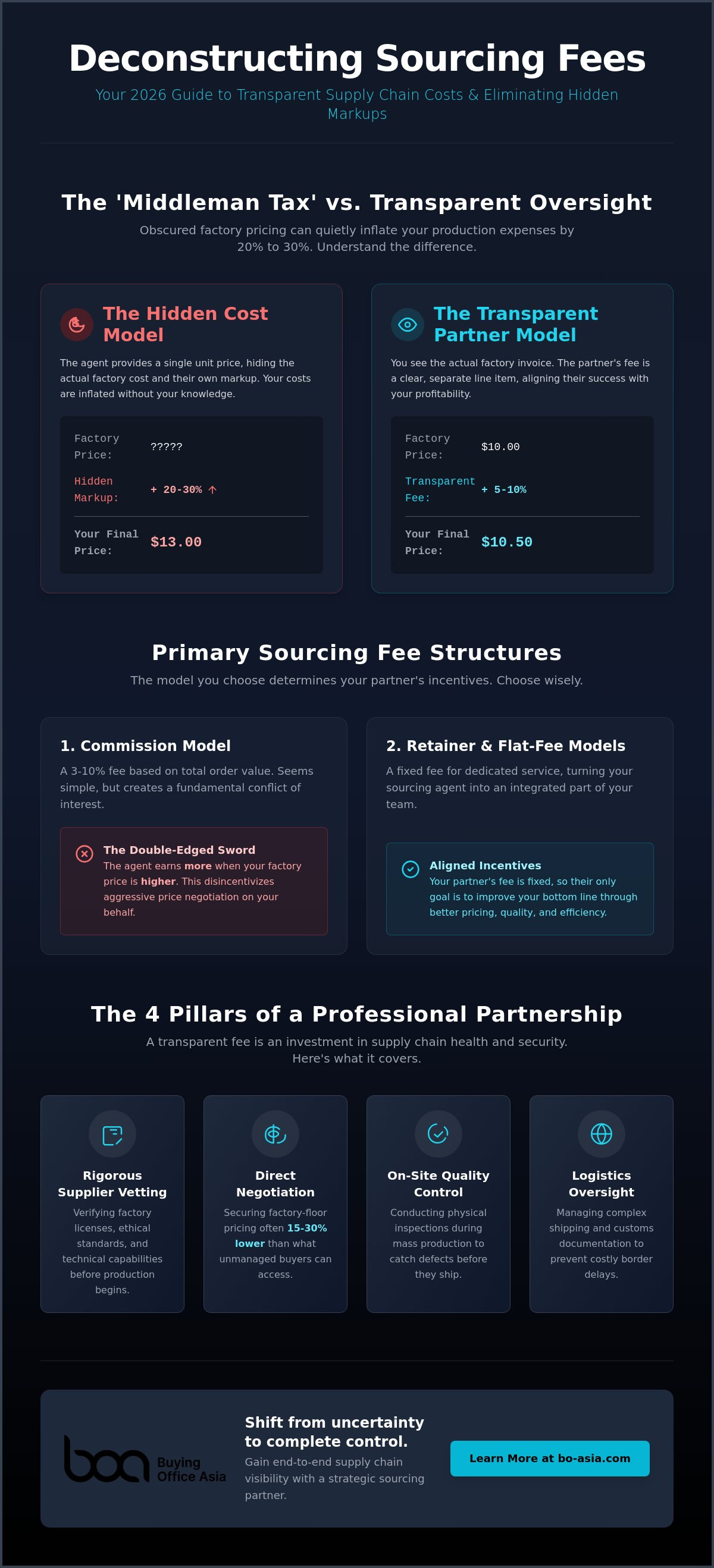
If you are paying a sourcing agent a flat percentage without total visibility into the factory invoice, you aren't just paying a fee. You are likely subsidizing a hidden network of kickbacks that erodes your margins. It's a common anxiety for importers who feel the middleman tax is eating into their profitability. You deserve to know exactly what you're paying for and why.
Understanding the modern sourcing company fee structure is critical as we move through 2026. With the recent Executive Order on Strengthening Customs Enforcement and proposed Section 301 tariffs of up to 12.5 percent, your supply chain costs are under more scrutiny than ever. It's no longer enough to just find a supplier. You need a financial model that aligns your partner's success with your own bottom line.
This guide provides a clear breakdown of transparent procurement costs and the hidden risks of legacy commission models. You'll learn how to calculate the true ROI of a sourcing partner and discover how a professional team can actually lower your factory-direct prices to offset their service fees. We will show you how to move from a place of uncertainty to a position of complete visibility and control over your Asian supply chain.
• Learn how a transparent sourcing company fee structure protects your margins by eliminating hidden markups and aligning your partner's incentives with your profitability.
• Identify the critical differences between commission, flat-fee, and retainer models to determine which pricing strategy fits your specific procurement volume and complexity.
• Uncover the true cost of the 'Middleman Tax' and how obscured factory pricing can quietly inflate your production expenses by 20 to 30 percent.
• Shift your focus from unit price to Total Cost of Ownership to measure the real impact of expert oversight on logistics and administrative overhead.
• Discover how a dedicated Asia procurement team functions as an integrated extension of your business to secure factory-direct pricing and end-to-end supply chain visibility.
A professional Procurement strategy in Asia is no longer just about finding a factory; it's about managing a complex ecosystem of financial optimization and risk. The sourcing company fee structure you choose represents the cost of having an expert, on-the-ground presence that protects your interests. In 2026, this structure has evolved from simple transactional commissions to sophisticated models that prioritize total supply chain visibility. It's the price of security in a market where regulatory shifts, such as the June 2026 Executive Order on Customs Enforcement, make compliance a non-negotiable business requirement.
A professional fee isn't an arbitrary markup. It's a calculated investment that covers four critical pillars of supply chain health:
Verifying factory licenses, ethical standards, and technical capabilities before a single dollar is committed.
Leveraging local language and market knowledge to secure factory-floor pricing that is often 15 to 30 percent lower than what an unmanaged buyer can access.
Conducting physical inspections during mass production to catch defects before they leave the factory gate.
Managing the complexities of international shipping and customs documentation to prevent costly delays at the border.
Many agents lure buyers with "free" services or commissions as low as 3 percent. This is often a trap. If you aren't paying the agent a fair professional fee, the factory is likely paying them instead. This creates a fundamental conflict of interest where the agent's loyalty lies with the supplier rather than your bottom line. They often secure their profit through hidden kickbacks that inflate your unit price without your knowledge. Black Box pricing is an opaque model where the intermediary provides a single unit price that hides the actual factory cost, service fees, and any internal markups from the buyer. You end up paying more while losing all control over your supply chain costs.
The industry is moving away from transactional middlemen toward integrated teams that function as a local extension of your own office. This shift is led by firms that combine European management standards with strategic operational bases in hubs like Hong Kong. By establishing factory-direct pricing as the baseline, these partners ensure that the sourcing company fee structure is transparent and justifiable to your stakeholders. This model aligns the partner's success with your profitability. It focuses on long-term financial health rather than one-off transactional gains. You get the same level of oversight usually reserved for major enterprises, but scaled for your specific business needs.
Choosing the right sourcing company fee structure is a strategic decision that fundamentally alters the behavior of your supply chain partner. It isn't just about the total cost; it's about alignment. A model that rewards your partner for higher factory prices is a model built on a conflict of interest. Conversely, a model that rewards efficiency and transparency turns your sourcing partner into a powerful advocate for your bottom line. In 2026, professional firms typically offer three primary frameworks to manage these dynamics.
The commission-based model remains the most visible structure in the market. While commissions ranging from 3 to 10 percent seem straightforward, they often hide a significant flaw: they can disincentivize aggressive price negotiation. If an agent earns a percentage of the total order value, their revenue actually decreases every time they negotiate a better deal for you. This often leads to commission creep, where your costs scale linearly with your volume even though the actual workload for the agent does not. Many high-volume enterprises are moving away from this transactional model to avoid subsidizing their partner's lack of negotiation incentive.
For businesses managing consistent, high-volume production, a retainer-based model is the gold standard. By securing a dedicated Asia procurement team on a fixed monthly basis, you decouple your service costs from your production volume. This creates massive scale efficiency. As your order sizes grow, your per-unit management cost drops significantly. This structure ensures your team stays focused on long-term supplier development rather than chasing the next transaction. These retainers typically provide comprehensive oversight, covering continuous quality control and inspection fees without the need for separate, unpredictable invoices for every factory visit.
Hybrid structures are gaining traction among sophisticated importers who want a balance of predictability and performance. These models combine a modest fixed management fee with a success-based incentive tied to documented savings. This approach ensures your partner has the resources to maintain a physical presence at the factory while remaining aggressively focused on lowering your total cost of ownership. It turns your procurement partner into a profit center rather than a cost center. If you're unsure which model aligns best with your 2026 growth targets, you can consult with a procurement expert to analyze your current supply chain spend.
The "Middleman Tax" is a silent drain on your corporate capital. Traditional trading companies often present a final unit price that masks the true cost of production; this lack of visibility is where your margins disappear. By contrast, a professional sourcing company fee structure is built on the principle of open books. You see the raw factory invoice. This transparency allows you to identify exactly where your capital is allocated, from raw materials to labor. Without this level of visibility, you are likely paying a 20 to 30 percent premium that adds zero value to your final product.
Transparency is more than an ethical choice; it's a financial strategy. It eliminates the "Black Box" pricing models that keep importers in the dark. When you have complete visibility into the Asian supply chain, you gain the power to optimize costs at every stage of the procurement process. This oversight ensures that your fees are an investment in performance rather than a hidden cost of doing business.
A fundamental distinction exists between a Trading Company and a Buying Office. A Trading Company acts as a reseller, seeking profit through the margin between the factory price and what they charge you. A Buying Office functions as an integrated extension of your own team. We leverage our regional presence to conduct factory-direct price negotiations on your behalf. This ensures the factory’s lowest price is your starting point. You can review our significant savings examples to see how this model transforms procurement from a cost center into a strategic advantage.
Quality control is a financial necessity, not an optional expense. Consider the impact of a 5 percent defect rate on a high-volume shipment. The loss extends beyond the physical goods; it encompasses lost sales, administrative overhead, and potential damage to your brand’s reputation. Professional inspection fees function as a high-yield insurance policy. Having an on-site presence in Asia is the only reliable way to enforce your standards during mass production. This proactive defense against operational setbacks is why we prioritize comprehensive supplier vetting and factory audits as the baseline for every partnership. We catch errors at the source, ensuring your capital is only spent on inventory that meets your exact specifications.
The per-unit price on a factory quote is a deceptive metric. It represents only a fraction of the capital required to land goods in your warehouse. To understand the true value of a sourcing company fee structure, you must shift your focus toward the Total Cost of Ownership. TCO encompasses every expense, from initial factory vetting to the administrative hours spent managing late shipments and the financial impact of compliance failures. In the wake of the June 2026 Executive Order on Customs Enforcement, the cost of a single documentation error can now result in significant penalties and bond forfeitures. Professional oversight isn't just a service; it's a defensive strategy that protects your total investment.
When you evaluate a sourcing partner, you are looking for a reduction in friction. A transparent fee model pays for itself by eliminating the hidden inefficiencies of unmanaged procurement. This includes reducing the time your internal team spends on vendor communication and mitigating the risk of mass production errors that could lead to a total loss of inventory. By professionalizing the process, you turn unpredictable supply chain variables into manageable, fixed costs.
Importers often compare a managed sourcing quote against a direct-to-factory price found on platforms like Alibaba. This is an apples-to-oranges comparison. An unmanaged factory quote often includes a "buffer" for the supplier's risk, whereas a professional partner negotiates based on raw material costs and actual labor. Furthermore, professional logistics coordination reduces international shipping costs by consolidating cargo from multiple factories and optimizing container utilization. These savings alone often exceed the service fees charged by a reputable procurement team, resulting in a lower final landed cost than if you had attempted to manage the process alone.
Scaling a brand requires more than just repeat orders; it requires technical evolution. Managing OEM and ODM contract manufacturing involves complex tooling and sampling phases where errors are most expensive. A professional fee structure covers the cost of having technical experts on-site to verify that custom molds and prototypes meet your exact specifications before mass production begins. This oversight prevents the costly production delays that occur when samples are shipped back and forth across the globe for revision. If you are ready to optimize your procurement math, you can request a TCO analysis to see the impact of professional management on your bottom line.
Buying Office Asia operates on a fundamental rejection of the opaque intermediary model. We believe that a professional sourcing company fee structure must be built on 100 percent transparency. This means zero hidden markups and an absolute prohibition on factory kickbacks. Our success is directly tied to your profitability. By positioning ourselves as an integrated extension of your own procurement department, we eliminate the conflicts of interest that plague traditional agencies. You gain a partner who works exclusively for you; your interests are the only ones we protect.
Our operational framework combines European strategic leadership from Helsinki with deep, regional roots in Hong Kong. This dual presence provides the high-level corporate consulting you expect alongside the hands-on factory oversight you need. It functions as a stabilizing force in a complex global market. We provide the level of rigorous oversight usually reserved for major multinational corporations. This ensures your supply chain remains secure, compliant, and financially viable regardless of market volatility. Our fee structure is designed to reflect this professional rigor.
Managing complex, high-volume supply chains requires a tailored approach rather than a one-size-fits-all price list. We customize our service models to match the specific technical requirements of your production. This includes integrating ESG and ethical auditing as part of our standard service fee. We don't treat regulatory adherence as an "add-on" cost. We verify that your suppliers meet global standards for manufacturing conditions and environmental certifications. The path from initial supplier vetting to mass production oversight is documented and methodical, ensuring you have complete visibility from day one.
We explicitly reject the commission-only agent model. As established earlier, that model often incentivizes higher factory prices and creates a "Black Box" around your real costs. Instead, we offer a professional partnership based on open-book accounting. Every factory invoice is available for your review. This commitment to factory-direct pricing ensures that our fees are an investment in your long-term growth rather than a transactional overhead expense. We prioritize reliability, transparency, and a protective nature in every engagement. It's time to move away from unmanaged risk and toward professional procurement. You can request a transparent pricing proposal for your Asian sourcing to see how we can secure your supply chain and protect your margins.
Navigating the complexities of Asian manufacturing requires more than just a list of suppliers. It demands a sophisticated sourcing company fee structure that prioritizes transparency over hidden markups. By moving away from the "Middleman Tax" and focusing on the Total Cost of Ownership, you transform your procurement from a source of anxiety into a measurable strategic advantage. You gain the clarity needed to justify every dollar spent to your stakeholders while securing the factory-direct pricing your margins require.
As a European-managed firm with over 15 years of expertise in the region, we provide the steady confidence of an established expert. Our on-the-ground presence in Hong Kong and China ensures that your standards are enforced at the factory floor. We operate with 100 percent transparency; there are no hidden commissions or obscured costs in our partnership. It's time to professionalize your supply chain with a partner who acts as a protective extension of your own team. Secure Your Transparent Sourcing Quote Today and take control of your manufacturing future. Your profitability depends on the strength and visibility of your procurement model.
Industry standards in 2026 typically range between 3 and 10 percent of the total order value. Small orders under $10,000 often incur fees at the higher end of that scale, while large-scale production exceeding $100,000 usually commands a lower rate between 3 and 5 percent. These percentages should represent the cost of professional oversight rather than a hidden markup on the goods themselves.
Hidden costs often appear in the form of factory kickbacks or "Black Box" pricing where the intermediary adds an undisclosed margin to the factory’s original quote. A transparent sourcing company fee structure prevents this by providing you with the raw factory invoice. Without this level of visibility, you may be paying a silent premium that erodes your profitability without adding any logistical value.
Alibaba often presents the lowest initial quote, but it rarely results in the lowest final landed cost. A professional sourcing partner reduces your Total Cost of Ownership by negotiating factory-direct prices that unmanaged buyers cannot access. They also mitigate the financial risk of mass production defects and shipping delays, which can quickly exceed any initial savings found on a digital platform.
A comprehensive fee typically covers supplier vetting, price negotiations, on-site quality inspections, and logistics management. In 2026, this also includes the critical task of ensuring compliance with new regulatory requirements, such as the June 2026 Executive Order on Customs Enforcement. Your fee is an investment in a local team that manages the entire lifecycle of your production on the ground.
The most reliable indicator is a lack of transparency regarding the factory's identity or the raw invoice. If your partner refuses to provide open-book accounting or prevents direct communication with the manufacturer, they're likely receiving undisclosed commissions from the supplier. A professional partner aligns their success with yours and has no reason to hide the factory's true pricing.
This depends on the chosen pricing model. Commission-based agents often bill for factory audits and inspections as separate line items for each visit. However, retainer-based models or dedicated procurement teams usually include these essential services within their fixed monthly fee. This ensures that quality control is a continuous process rather than a sporadic, additional expense.
A retainer is a fixed monthly management fee that decouples your service costs from your production volume. It's the best option for high-volume businesses that require constant oversight and long-term supplier development. This model provides the greatest scale efficiency; as your order volumes grow, your per-unit management cost decreases significantly while your level of protection remains constant.
Yes. Sourcing partners reduce expenses by consolidating cargo from multiple factories into single shipments and optimizing container utilization. They also provide the rigorous documentation required by the latest 2026 customs regulations. Accurate paperwork prevents the costly storage fees and penalties that occur when shipments are flagged for inspection due to administrative errors.

A technical drawing isn't just an engineering reference; it's your primary legal baseline against cost-driven supplier compromises. When sourcing abroad, vague manufacturing product specification sheets inevitably invite unauthorized material substitutions, delayed timelines, and sudden quotation in...

The traditional commission-based sourcing agent in India is no longer an asset; they're often your greatest financial risk in a market rapidly scaling toward a $2 trillion export target. You likely recognize the inherent conflict when an agent's income rises alongside your factory costs, or the anxi...

If your current sourcing agent claims their services are free, you're likely paying a hidden tax of 10% to 30% through inflated unit prices and factory kickbacks. This lack of transparency doesn't just erode your margins; it creates a dangerous barrier between you and the factory floor. Finding a re...