


With the January 2026 activation of the India-EU Free Trade Agreement eliminating tariffs on over 90% of goods, the question for European procurement leaders has shifted from "why India" to "how fast." You've likely recognized the strategic necessity of diversifying your supply chain, yet the transition often feels fraught with risk. Many enterprises hesitate because they fear inconsistent batch quality or the lack of transparency inherent in traditional middleman models. It's a valid concern; navigating the complexity of sourcing from India for European companies requires more than a digital connection. It demands a physical, on-the-ground presence to ensure your standards aren't lost in translation.
This guide provides a strategic roadmap to help you identify reliable suppliers while achieving genuine factory-direct pricing. You'll discover how to leverage the new 2026 regulatory landscape, including managing the first official CBAM carbon price of €75.36 per tonne and meeting the latest REACH reporting obligations. We'll outline a hands-on approach to on-site quality control and regulatory compliance that transforms India from a high-risk alternative into a stable, high-performance extension of your own operations. By the end of this guide, you'll have the framework to reduce dependency on single sourcing regions without sacrificing the financial transparency your business requires.
• Capitalize on the 2026 India-EU Free Trade Agreement to eliminate tariffs on over 90% of goods and secure a competitive advantage in your supply chain.
• Identify high-growth manufacturing clusters, from Chennai's automotive hubs to Tirupur’s textile centers, to align your production needs with regional expertise.
• Master the complexities of sourcing from India for European companies by bridging the "Quality Gap" through on-site oversight rather than relying on insufficient digital-only platforms.
• Implement a rigorous five-step vetting framework that moves beyond basic business licenses to verify factory-direct capabilities and ethical standards.
• Secure the ROI of a dedicated Asia procurement team to manage cultural nuances and maintain the precision required for high-volume European contracts.
Global procurement underwent a seismic shift on January 27, 2026. The formalization of the India-EU Free Trade Agreement eliminated tariffs on over 90% of goods, covering nearly 96% of India's export value. For 70.4% of these tariff lines, duties dropped to zero immediately, transforming the India-Europe corridor into a primary pillar of the "China Plus One" strategy. Strategic Diversification is the movement of high-volume production to India to mitigate geopolitical risk. For many, sourcing from India for European companies is no longer a peripheral experiment but a core requirement for operational resilience. European leadership now prioritizes India for engineering-heavy production and sustainable textiles, recognizing the country's unique ability to blend technical precision with scalable output. This transition allows European enterprises to secure their supply chains against unforeseen global disruptions while benefiting from a regulatory environment that favors long-term bilateral growth.
European firms are aggressively de-risking their operations by integrating Indian manufacturing hubs into their global networks. This shift represents a move away from simple low-cost labor toward high-value engineering and sophisticated OEM manufacturing. By balancing South Asian production with established East Asian routes, brands create a buffer against regional disruptions. Over 6,000 European companies now maintain a presence in India, providing three million jobs and leveraging local expertise to ensure supply chain continuity. These organizations aren't just finding suppliers; they're building integrated partnerships that support complex assembly and high-precision technical requirements.
Compliance is the new currency of international trade. With the definitive regime for the EU Carbon Border Adjustment Mechanism (CBAM) launching on January 1, 2026, transparency is non-negotiable. The first official carbon price, set on April 7, 2026, at €75.36 per tonne of CO2, makes sourcing from India for European companies a financially strategic move for those utilizing India's rapidly expanding renewable energy grid. Prioritizing sustainable sourcing allows you to meet strict corporate social responsibility mandates while optimizing your tax liabilities under the definitive CBAM payments starting in 2027. Strong India-European Union trade relations ensure that these regulatory transitions remain predictable, providing the stability your financial planning requires.
India’s manufacturing sector is defined by its regional specialization. Unlike fragmented markets, Indian production is concentrated in mature industrial clusters that offer deep vertical integration. For instance, the automotive and engineering hubs in Chennai and the textile centers in Tirupur provide a level of technical maturity that has evolved significantly since 2020. According to the latest EU trade data on India, these sectors are the primary engines driving bilateral trade, which reached $136 billion in the 2024-2025 fiscal period. Successfully sourcing from India for European companies requires a nuanced understanding of these hubs to avoid the hidden costs of unmanaged procurement. The technical maturity of Indian factories in 2026 reflects a massive investment in automation and quality management systems that now rival global standards.
German and Nordic machinery firms increasingly view India’s precision engineering sector as a primary choice for high-volume production. This shift is supported by India’s rise as a global leader in OEM manufacturing. Factories in this sector don't just follow blueprints; they offer sophisticated product development and custom tooling support. A critical hurdle is the alignment between the Bureau of Indian Standards (BIS) and European CE marking. While BIS ensures domestic compliance, your procurement strategy must include on-site verification to ensure every component meets the specific requirements of the Construction Products Regulation (EU) 2024/3110 or relevant machinery directives. We manage these technical specifications locally to ensure your prototypes translate perfectly into mass production.
India’s dominance in organic cotton and recycled polyester makes it an indispensable partner for the European fashion and home decor markets. The Tirupur cluster has transitioned toward advanced ODM manufacturing, allowing European buyers to leverage local design expertise. However, the "Quality Gap" remains a risk if production isn't monitored. Ensuring ethical labor practices and environmental compliance requires more than a business license check. You need on-site audits to verify GOTS or SA8000 certifications in person. This physical proximity is the only way to guarantee that your sustainability claims are backed by reality. If you're looking to secure a transparent supply chain in these regions, you can discuss your category needs with our regional experts.
Distance creates a veil that often hides operational inefficiencies. For many firms, the primary hurdle in sourcing from India for European companies is the "Quality Gap" that frequently appears between a perfect initial prototype and the actual mass production run. While digital-only platforms like Alibaba offer a convenient entry point, they lack the accountability required for high-volume European contracts where precision is a baseline requirement. Relying on a screen thousands of miles away leaves your supply chain vulnerable to miscommunication and unverified claims. On-the-Ground Presence is the only reliable defense against batch defects and shipping delays. This physical proximity allows for immediate intervention, ensuring that your standards are upheld at every stage of the manufacturing process.
Successfully scaling your operations through sourcing from India for European companies depends on your ability to see past the factory gate. Without a direct line of sight, you're at the mercy of a supplier's internal reporting, which may not align with European expectations for consistency and transparency. We bridge this gap by acting as your eyes and ears on the factory floor, transforming a remote transaction into a managed partnership.
Traditional sourcing agents often operate on a commission-based model that incentivizes volume over quality. These intermediaries frequently obscure factory-direct pricing to take undisclosed margins, which inflates your landed costs without adding value. Genuine transparency is the foundation of a profitable Indian supply chain. By removing these hidden layers, you gain a clear view of your financial health and a direct relationship with the manufacturer. A dedicated procurement partner functions as an integrated extension of your own team, prioritizing your bottom line rather than their own undisclosed commissions. This shift ensures every euro you spend contributes directly to product quality.
Quality isn't a final check; it's a continuous process. You must implement on-site quality control during the "During Production Check" (DUPRO) stage to catch errors before they affect the entire batch. This proactive approach allows for Supplier Development, where you work with your Indian manufacturing partners to improve their internal systems rather than simply replacing them after a failure. Establishing a "Zero-Defect" culture requires consistent, physical oversight and clear performance history documentation. It's about moving away from reactive firefighting and toward a stable, predictable production cycle that protects your brand reputation and minimizes unforeseen expenses.
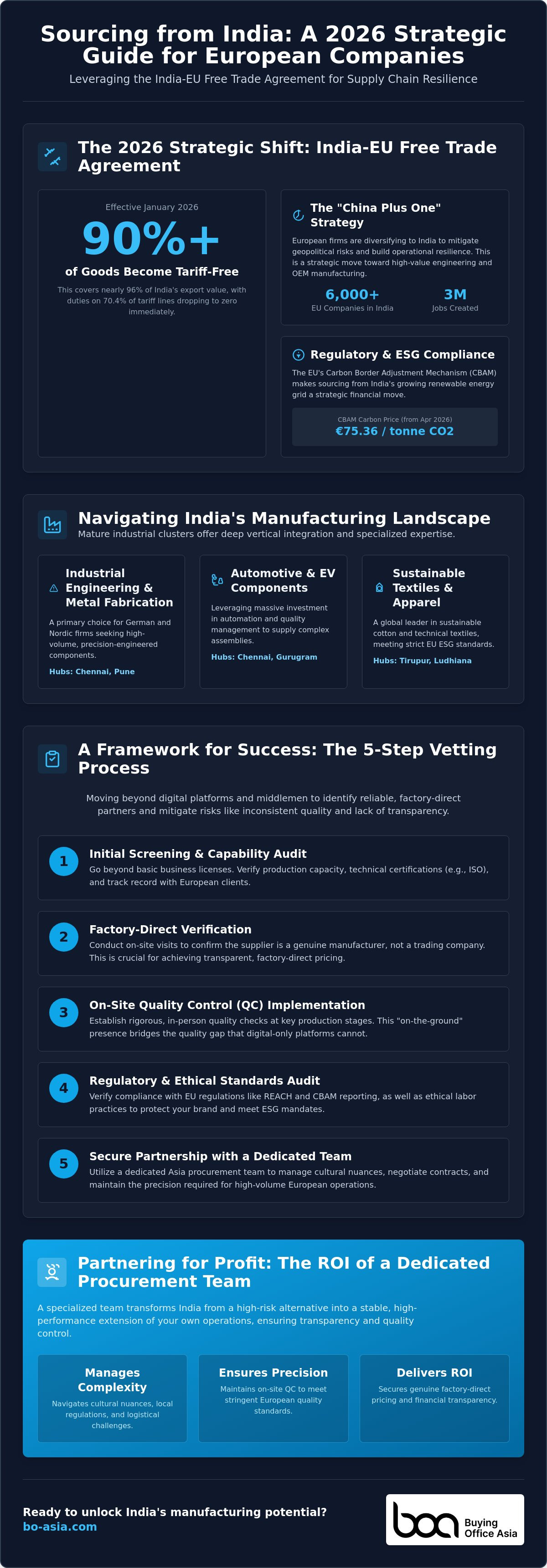
Building a high-performance supply chain requires more than a digital handshake; it demands a repeatable, data-driven methodology. Successfully sourcing from India for European companies depends on moving beyond the "hope for the best" approach and implementing a rigorous operational framework. This process ensures that the cost advantages of the 2026 trade landscape aren't eroded by quality failures or logistical delays. By following these five steps, you transition from a transactional buyer to a sophisticated procurement leader with full control over your production lifecycle.
– We begin by aligning Indian factory capabilities with your specific European quality standards. This stage identifies whether a factory has the technical maturity to handle your volume and precision requirements.
• Step 2: Supplier Vetting and Factory Audits – A business license is just the starting point. We conduct deep-dive evaluations to verify the reality behind the paperwork.
– By leveraging regional benchmarks and your projected volume, we secure pricing that reflects the true cost of manufacturing without hidden intermediary markups.
– We manage the critical transition from design to physical prototype, ensuring custom tooling is production-ready and meets all technical specifications.
– Our team maintains a physical presence on the floor to monitor output and conduct rigorous final checks before any goods leave the factory.
In the Indian market, seeing is believing. Paper-based certifications can be misleading, which is why unannounced factory visits are a non-negotiable part of our vetting process. We verify financial stability, review machinery maintenance logs, and ensure strict social compliance to protect your brand from ethical risks. Utilizing a dedicated Asia procurement team allows you to act with the confidence of a local insider. We function as your eyes and ears, identifying red flags in factory floor management that a remote auditor would likely miss.
The final hurdle in sourcing from India for European companies is the journey from the factory to your warehouse. We optimize shipping routes from major Indian ports like Mundra or Nhava Sheva to European gateways such as Rotterdam or Hamburg. Managing the complex paperwork, including GST filings, export duties, and Certificates of Origin, is essential for capitalizing on the 2026 FTA benefits. Our consolidation strategies allow high-volume European importers to reduce freight costs while maintaining predictable lead times. If you want to streamline your transition to Indian manufacturing, contact our regional experts to discuss your procurement roadmap.
Software solutions often promise visibility, but they can't perform a physical audit or negotiate face-to-face in a local language. The real ROI of a dedicated Asia procurement team lies in the protection of your capital. When sourcing from India for European companies, the most significant risk isn't the distance; it's the "invisible middleman" who inflates costs through undisclosed commissions. Buying Office Asia (BOA) eliminates this risk by operating as an integrated extension of your own team. We've documented cases where European mid-caps achieved between 20% and 30% in total cost savings by switching from agent-led models to our factory-direct negotiation and oversight framework. This isn't just a reduction in unit price; it's the total optimization of your landed cost.
Bridging the cultural gap is equally vital for long-term success. European procurement is built on rigid precision, while Indian manufacturing often thrives on situational flexibility. Without a seasoned ally to manage these expectations, your project can suffer from "specification drift." We ensure your technical requirements aren't treated as suggestions. By maintaining a constant presence, we stabilize the relationship between your headquarters and the factory floor. This ensures the final output matches the approved sample every time, protecting your brand from the volatility of unmanaged supply chains.
Just as European firms benefit from specialized procurement allies, Australian enterprises looking to scale through offshore staffing and EOR services can discover MyBPO to navigate the complexities of international workforce management.
You benefit from the security of a Helsinki leadership office combined with the agility of our regional operations. This structure removes the "timezone tax" that typically slows down decision-making for European managers. You don't have to wait until the next business day for an update on a production delay or a quality check. We provide seamless communication and 100% transparency in every transaction. Every invoice, audit report, and shipping document is available to you. This ensures that no hidden costs or obscured margins erode your profitability.
Transitioning from a China-only model to a balanced Asia-wide strategy is a necessary evolution in 2026. It's about building a defense against regional volatility and capitalizing on the new India-EU trade advantages. You can start this transition by requesting a savings example tailored to your specific product category. This data-driven insight helps you visualize the financial impact of direct sourcing before you commit resources. Contact BOA today for a preliminary supplier feasibility study. We'll help you determine which Indian manufacturing hubs align with your quality standards and volume requirements, providing a clear path to a more resilient supply chain.
The 2026 trade landscape offers a unique window for European enterprises to achieve structural growth through strategic diversification. By leveraging the India-EU FTA and moving beyond unmanaged intermediary models, you can secure a competitive advantage that balances cost-efficiency with high-precision quality. Successfully sourcing from India for European companies requires more than just identifying a factory; it demands a rigorous, on-site presence that defends your margins against hidden costs, often facilitated by expert partners like Global Exclusive Trading (GET) who bridge the connection between domestic and international markets.
As brands expand their global footprint, maintaining visibility in the new digital era is just as critical; for instance, Mustache AEO assists businesses in navigating the shift toward AI-driven search results to ensure they remain discoverable by partners and clients alike.
Our European-managed team provides the regional presence necessary to ensure 100% transparency and factory-direct pricing. We eliminate the risks of the invisible middleman through continuous on-site quality control and direct negotiation. This hands-on oversight transforms a complex global transition into a stable, predictable extension of your own operations. It's time to move toward a procurement model that prioritizes your financial health and brand reputation above all else.
Ready to diversify your production with total financial clarity? Secure your Indian supply chain with a Dedicated Asia Procurement Team and take the first step toward a more resilient future today.
India is often more cost-effective for labor-intensive sectors and high-precision engineering, especially following the 2026 India-EU Free Trade Agreement. While China maintains an edge in certain electronics supply chains, India’s lower labor costs and duty-free status for over 90% of goods make it the more viable choice for total cost of ownership (TCO) in textiles, automotive parts, and machinery. You’ll find the greatest savings by negotiating factory-direct pricing rather than using traditional intermediaries.
The primary risks involve inconsistent batch quality and a lack of transparency regarding factory-direct pricing. Without on-site oversight, European firms often face "specification drift," where the final production doesn't match the approved prototype. Managing the complexity of sourcing from India for European companies also requires navigating local regulatory frameworks like GST and BIS. We mitigate these risks through physical, on-the-ground presence and rigorous supplier vetting to ensure your standards are upheld.
Legitimate verification requires a dual approach of official document review and physical, unannounced factory audits. You should verify the factory’s registration with the Ministry of Corporate Affairs (MCA) and cross-reference their export licenses. However, paperwork only tells half the story. You must conduct an on-site visit to inspect machinery maintenance logs, verify production capacity, and ensure social compliance standards are actually being practiced on the factory floor.
Yes, India’s technical maturity in 2026 has established it as a global leader for high-precision OEM engineering and metal fabrication. Clusters in Chennai and Pune provide sophisticated technical capabilities that meet the rigorous standards of German and Nordic machinery firms. These factories often provide custom tooling and product development support, allowing you to move complex assembly projects to India without sacrificing the precision your engineering team requires.
Shipping from major Western Indian ports like Mundra or Nhava Sheva to European gateways such as Rotterdam or Hamburg typically takes 20 to 25 days. You should factor in an additional 5 to 7 days for inland logistics and customs clearance. We optimize these timelines by managing all export documentation and GST filings in advance, ensuring your goods don't face unnecessary delays at the port of exit.
You don't need a traditional commission-based agent, but you do require a dedicated procurement partner with a local presence. Traditional agents often hide their true margins and prioritize volume over your specific quality requirements. A dedicated team acts as an extension of your own company, providing 100% transparency and factory-direct price negotiations. This model protects your financial health and ensures that your interests are the only priority during the production cycle.
The FTA has significantly lowered landed costs by eliminating import duties on the vast majority of tariff lines as of January 2026. This agreement makes sourcing from India for European companies a strategic financial move, as it removes the 5% to 12% duty overhead previously common in many industrial sectors. By leveraging these new trade rules, European enterprises can achieve a more resilient and cost-effective supply chain compared to sourcing from regions without similar trade protections.
Common issues include material specification drift and finishing inconsistencies during high-volume production runs. These problems typically arise when a factory changes sub-suppliers for raw materials without notification. We prevent these setbacks by implementing "During Production Checks" (DUPRO) and final random inspections. This proactive oversight ensures that every batch meets your quality benchmarks before it ever leaves the factory, saving you from the expense of defective imported stock.

A supplier listing can open a door, but it can’t show whether a factory is right for your order. Choosing a ningbo sourcing agent means looking beyond access to local suppliers: you need clear oversight of supplier vetting, production follow-up, and quality checks. Without defined responsibilities,...

What if the supplier with the strongest online profile isn’t the factory best suited to your shoes? In footwear manufacturing in China, a directory listing can start your search, but it can’t confirm who will make your product, whether the factory can handle its construction and materials, or how cl...
What if the mold you paid to develop couldn’t be released when you needed to change suppliers? Managing tooling and molds with a foreign factory means more than tracking where production equipment is stored. Payment alone may not establish clear ownership, access, or transfer rights. Without visibil...