


You might think that moving production closer to home is the only way to reclaim control over your supply chain in 2026. While nearshoring dominates the headlines, the strategic advantages of sourcing from Asia have actually intensified for high-volume manufacturers who prioritize long-term viability. It's natural to feel anxious about distant factories or the hidden costs of unmanaged logistics. You need quality consistency and factory-direct pricing without the burden of an internal regional office. This is where the perceived safety of proximity often fails to match the sheer industrial power and efficiency of the East.
We'll show you why Asia's mature manufacturing ecosystems remain the superior choice for maximizing profitability and achieving massive scale. By leveraging current trade frameworks like the RCEP, which is now eliminating 90% of tariffs for signatories, you can secure a transparent, vetted supplier base that nearshoring simply cannot replicate. This guide breaks down the financial reality of 2026, comparing the "China Plus One" strategy against regional alternatives. You'll learn how to achieve professional oversight and total transparency, ensuring your brand is protected by on-site experts who act as a direct extension of your own team.
• Understand why Asia's unrivaled industrial clusters and technical labor force provide a competitive edge that nearshoring cannot match in 2026.
• Analyze the total cost of ownership to discover the long-term financial advantages of sourcing from Asia compared to high-cost regional alternatives.
• Learn how to eliminate hidden markups and brand risks by bypassing digital portals in favor of factory-direct negotiations and on-site quality control.
• Navigate the 2026 trade landscape by leveraging the RCEP framework, which is currently phasing out 90% of tariffs across major Asian manufacturing hubs.
• See how a dedicated, on-the-ground procurement team functions as a seamless extension of your business, providing elite oversight without the overhead of an internal office.
The conversation around global procurement has fundamentally shifted. In 2026, the primary advantages of sourcing from Asia are no longer found in the pursuit of the lowest possible hourly wage. Instead, the region has transitioned into a network of high-efficiency industrial clusters where raw materials, specialized components, and final assembly exist within the same province. This density creates a level of operational resilience that nearshoring regions haven't replicated yet. While many brands explore nearshoring to mitigate transit risks, the deep-seated infrastructure in the East provides a level of scale and precision that remains the gold standard for global trade.
You face a complex dilemma: balancing the need for cost-efficiency with the absolute necessity of supply chain security. Relying on unmanaged, distant factories creates anxiety regarding quality consistency and hidden costs. However, abandoning the Asian market often means losing access to the world's most versatile technical workforce. Successful Global sourcing strategies now prioritize ecosystem access over simple labor arbitrage. By integrating sourcing and procurement into a broader regional strategy, you can secure your supply chain while maintaining the high-volume capabilities required for market leadership.
Nearshoring involves bringing production closer to your end consumer, such as utilizing Mexico for the North American market or Eastern Europe for the EU. It offers shorter lead times but often lacks the deep component availability found in the East. Offshoring leverages the massive manufacturing infrastructure of Asia for global distribution. In 2026, the most resilient brands don't choose one over the other; they use a hybrid model. They nearshore high-turnover items while offshoring their core, high-volume production to capitalize on the advantages of sourcing from Asia.
Asian manufacturing hubs have maintained their dominance by aggressively integrating AI and advanced automation into their production lines. This technological leap ensures that even as wages rise, productivity stays ahead of the curve. For instance, as of January 2026, Shanghai’s minimum wage reached RMB 2,740, reflecting a shift toward a highly skilled, tech-enabled workforce. Hong Kong continues to serve as the critical strategic gateway, providing the legal and logistical framework necessary for transparent operations. The "China Plus One" strategy has also matured into a sophisticated regional network, utilizing the RCEP framework to move goods between hubs like Vietnam and Indonesia with minimal friction. Offshoring in 2026 is defined as a strategic pursuit of industrial ecosystem access rather than a simple search for labor arbitrage.
Many procurement managers still view the East through the lens of labor arbitrage. In 2026, that's a narrow perspective. The real advantages of sourcing from Asia lie in supply chain density. When your raw materials, secondary components, and final assembly are all located within a single industrial province, you eliminate the massive logistics friction found in fragmented nearshoring zones. This density creates a "tooling advantage" where custom product development is significantly faster and more cost-effective. You aren't just buying parts; you're accessing a legacy of industrial maturity that has been refined over decades.
This maturity is backed by a technical workforce that remains the world's most versatile, which is one of the primary advantages of sourcing from Asia in a competitive market. While labor costs have risen, with Shanghai's minimum wage hitting RMB 2,740 in early 2026, the productivity gains from a highly skilled population often offset these increases. Asian hubs have spent the last decade transitioning from manual labor to high-precision engineering. This ensures your mass production meets rigorous quality standards without the need for constant, expensive corrections at the tail end of the process.
Industrial clusters function as high-efficiency machines. For OEM and ODM contract manufacturing, this means you can move from a CAD drawing to a physical prototype in days. Prototyping in these established zones remains roughly 3x faster than in emerging nearshoring regions because specialized tooling shops are often located in the same district as the primary factory. Southeast Asia's Emergence as an advanced manufacturing powerhouse further diversifies these options, offering specialized hubs in Vietnam and Malaysia that provide high-volume scale. These clusters reduce internal logistics costs by minimizing the distance between each stage of production.
In 2026, smart factories are the new baseline for professional procurement. IoT sensors and real-time reporting provide a digital supply chain that offers absolute transparency into the production floor. You don't have to guess your production status; you can monitor it through verified data streams. This technological maturity extends to infrastructure. While some nearshoring regions struggle with power grid stability or port congestion, Asian hubs utilize automated logistics and digital customs to keep goods moving. This reliability is your best defense against the operational setbacks that plague unmanaged supply chains. To learn how these ecosystems can be integrated into your business model, you can consult with our Hong Kong-based team for a professional assessment.
Choosing between nearshoring and offshoring is no longer a simple logistics calculation. While nearshoring is often marketed as a risk-reduction strategy, it frequently introduces new operational hazards like high labor turnover and underdeveloped raw material networks. One of the most significant advantages of sourcing from Asia is the predictability offered by established manufacturing hubs. These regions have spent decades refining their regulatory compliance and IP protection protocols, providing a level of security that new, rapidly developed nearshoring zones often lack. You must weigh the perceived benefit of physical proximity against the proven reliability of an integrated industrial base.
Lower shipping costs in nearshoring regions are frequently a mirage. When you analyze the total cost of ownership, the higher unit prices and lower production efficiency of nearshoring facilities often negate any freight savings. There are several key advantages of global sourcing that contribute to this financial reality, reinforcing the advantages of sourcing from Asia, including the ability to leverage massive economies of scale. For instance, under the RCEP framework, 90% of tariffs between signatories are being eliminated in 2026, significantly lowering the landed cost of goods. Engaging in High-volume sourcing in Asia allows you to secure factory-direct pricing that nearshoring competitors simply cannot match due to their higher overhead and fragmented supply chains. Common hidden costs in nearshoring include:
• Higher labor turnover in new manufacturing zones leading to quality drift.
• Lack of local raw material availability requiring expensive component imports.
• Lower production efficiency due to a less experienced technical workforce.
The myth of "nearshoring speed" often ignores the infrastructure gaps and port congestion prevalent in emerging manufacturing zones. In contrast, 2026 shipping innovations have streamlined major Asia-Europe routes. As of September 10, 2026, the Drewry World Container Index shows a composite rate of $4,476 per 40ft container, with the Shanghai to Rotterdam route holding at $3,997. These predictable rates, combined with automated Asian port facilities, mean that the transit time gap is narrowing. Managing your "Source to Contract" timeline through an experienced team ensures that your production schedule remains precise. You don't just need a factory nearby; you need a factory that delivers at scale, on time, and within a transparent financial framework.
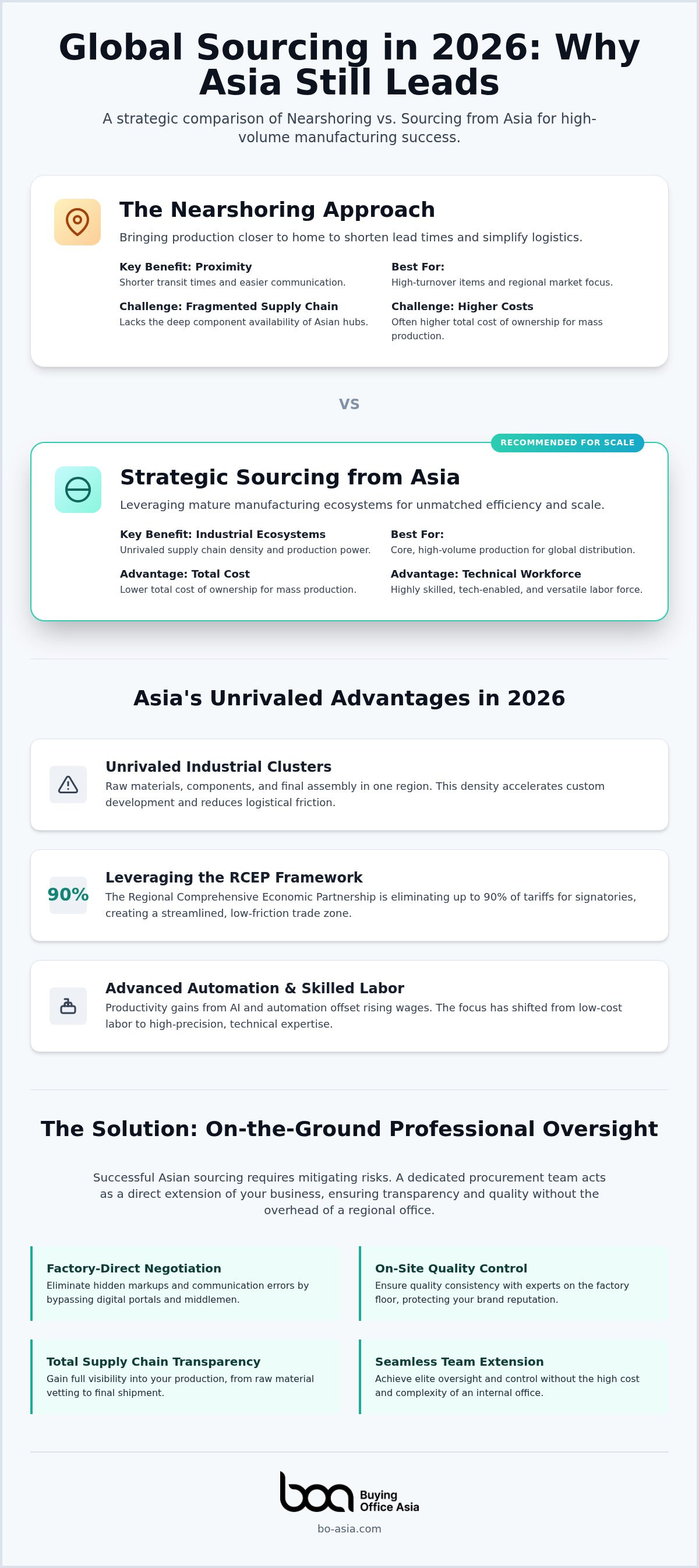
Relying on digital portals for international procurement is a strategy fraught with brand risk. While sites like Alibaba provide an illusion of accessibility, they often act as a veil for intermediaries who obscure the real advantages of sourcing from Asia. Without a physical presence, you're essentially blindfolded. You cannot verify if a "supplier" is a legitimate manufacturer or merely a trading company adding a significant markup for zero added value. This lack of visibility is where most unmanaged supply chains fail, leading to quality drift and unforeseen expenses that erode your margins.
True factory-direct pricing is only possible when you have a local, physical presence to conduct negotiations. One of the primary advantages of sourcing from Asia is the ability to build direct, transparent relationships with the people actually running the production lines. This level of intimacy allows for professional oversight that remote sourcing cannot replicate. It transforms your supply chain from a series of risky transactions into a stable, managed asset. To secure this stability, you must prioritize rigorous supplier vetting and factory audits as a non-negotiable first step in your procurement process.
Trading companies often complicate communication to protect their margins. They act as a filter, preventing you from speaking directly to the factory engineers who understand your product's technical requirements. Our 100% transparency model removes these barriers, giving you a clear view of the true factory-direct price. Because we're European-managed with an operational HQ in Hong Kong, we provide a bridge of trust that traditional intermediaries lack. Our physical proximity in Hong Kong ensures absolute accountability from manufacturers, as they know our team can be on-site at a moment's notice to resolve disputes or verify claims.
Waiting until a shipment arrives at your warehouse to check for defects is a recipe for financial disaster. In 2026, mass production oversight must occur during the entire cycle, not just at the end. Quality assurance is about preventing mistakes before they happen, while quality control is about catching them once they've occurred. By maintaining a constant presence on the factory floor, you can implement ESG and ethical standards that reflect your brand's values. This hands-on approach is the only way to prevent mass production defects and ensure your products meet the high standards your customers expect. If you're ready to move beyond the risks of unmanaged portals, connect with our on-site team to discuss a more secure sourcing strategy.
Establishing an internal office in Hong Kong or Shenzhen involves significant overhead, legal complexities, and cultural barriers that can stall your growth. A dedicated Asia procurement team provides the same high-level oversight as an in-house department without the fixed costs or administrative burden. You gain immediate access to an established network of manufacturers that has been vetted over two decades. This model allows you to focus on your core market strategy while we handle the technical rigors of factory-direct negotiations and on-site inspections. It's the most efficient way to secure the advantages of sourcing from Asia through a partner that acts as an integrated extension of your own business.
The financial impact of unmanaged production is often hidden until it's too late. When you factor in the cost of defective batches, delayed shipments, and the obscured markups of trading companies, the perceived savings of unmanaged sourcing quickly evaporate. Professional savings examples demonstrate that factory-direct negotiations typically reduce unit costs by 15% to 30%. This isn't just a price reduction; it's a gain in operational efficiency. Our team ensures your technical specifications are followed precisely, preventing the costly iteration cycles common in less mature nearshoring zones. You're investing in a robust defense against the operational setbacks that threaten your brand's financial health.
Buying Office Asia bridges the gap between European business standards and Asian industrial speed. With leadership based in Helsinki and an operational HQ in Hong Kong, we provide a seamless communication channel that eliminates the "lost in translation" risks of remote sourcing. You benefit from 20 plus years of regional networking and a pre-vetted supplier list that guarantees regulatory adherence and ethical standards. As you scale, this partnership enables rapid product expansion, allowing you to launch new lines with the same confidence as your flagship offerings.
The final verdict for 2026 is clear. While nearshoring offers physical proximity, the unmatched ecosystems and advantages of sourcing from Asia make it the gold standard for businesses prioritizing long-term profitability and scale. You don't have to navigate these complexities alone. Book a consultation with our Helsinki leadership team to audit your 2026 strategy and ensure your supply chain is a stabilizing force for your business.
The global manufacturing landscape of 2026 demands more than just proximity; it requires access to the world's most sophisticated industrial ecosystems. While nearshoring offers shorter transit routes, the advantages of sourcing from Asia remain unmatched for brands that prioritize high-volume scalability and technical precision. By leveraging mature regional networks and the latest trade concessions under the RCEP, you can achieve a level of profitability that newer manufacturing zones simply cannot support. Success isn't found in avoiding distance, but in managing it through professional, on-site oversight.
You don't have to carry the burden of unmanaged supply chain risks alone. Our Helsinki-led leadership and Hong Kong operational team provide a 100% transparent pricing model that eliminates hidden markups. With on-site inspections at every production stage, we act as your protective partner in the East, ensuring your quality standards are never compromised. It's time to transform your procurement from a source of anxiety into a strategic financial asset. Secure your 2026 supply chain with a Dedicated Asia Procurement Team and position your brand for sustainable growth.
The primary advantages of sourcing from Asia in 2026 include access to unrivaled industrial clusters and highly skilled technical labor at scale. Unlike fragmented nearshoring regions, Asian hubs offer a dense network of raw material suppliers and component manufacturers within single provinces. This ecosystem density, combined with favorable trade agreements like the RCEP which eliminates 90% of tariffs, ensures that your production remains cost-effective and highly efficient even as global competition intensifies.
No, nearshoring isn't always faster because emerging manufacturing zones often struggle with infrastructure gaps and port congestion. In contrast, major Asian hubs have invested heavily in automated logistics and digital customs. By 2026, shipping innovations have narrowed the lead time gap significantly. While nearshoring offers physical proximity, the speed of iteration and production scale in Asia often results in a faster total time to market for high-volume orders.
Ensuring quality requires a physical, on-the-ground presence to conduct rigorous supplier vetting and factory audits. You cannot rely on remote portals or end-of-line inspections alone. Establishing mass production oversight during the entire manufacturing cycle is the only way to prevent defects. Buying Office Asia provides on-site quality control and inspections at every production stage, ensuring that your technical specifications are followed precisely by the factory engineers.
A sourcing agent often operates as a transactional middleman, frequently hiding markups or working on commission from the factory. A dedicated procurement team, such as Buying Office Asia, functions as an integrated extension of your own business. We prioritize a 100% transparency model, providing factory-direct pricing without obscured costs. This professional partnership offers the same level of oversight usually reserved for major enterprises, but remains accessible for independent business owners.
Factory-direct pricing eliminates the hidden 15% to 30% margins typically added by trading companies. When you negotiate directly with the manufacturer, you gain transparency and clearer communication with the technical team. This direct relationship is one of the key advantages of sourcing from Asia, as it allows for better custom product development and faster resolution of production issues. Using a partner to secure these prices ensures you aren't paying for unnecessary intermediaries.
In 2026, the "China plus one" strategy has evolved from a simple backup plan into a sophisticated multi-country regional network. Companies now build redundant supply chains across hubs like Vietnam, Thailand, and Malaysia to mitigate geopolitical risks. These networks are deeply integrated through the RCEP framework, allowing for the seamless movement of components between countries. This maturation ensures that businesses can maintain scale while diversifying their production footprint across the continent.
Small and medium businesses benefit significantly from a dedicated team because it provides elite regional expertise without the overhead of an internal office. You don't need to hire a full staff in Hong Kong to achieve professional results. A partner like Buying Office Asia allows smaller firms to scale rapidly and launch new product lines with the same security and financial viability as global corporations. This model levels the playing field in international trade.
Unmanaged offshoring often leads to obscured costs such as middleman commissions, high labor turnover at unvetted factories, and expensive production delays. Without on-site accountability, you risk quality drift that can damage your brand's reputation. These hidden expenses often negate the initial savings of low-cost labor. By using a managed service with 100% transparency, you eliminate these financial leaks and secure a stable, predictable supply chain that protects your long-term profitability.

The lowest freight quote can carry the highest operational risk if supplier readiness, documentation, and exception handling are left outside the plan. If you’re asking how to choose a freight forwarder for Asia, look beyond the headline rate. A smooth shipment depends on who coordinates each handof...
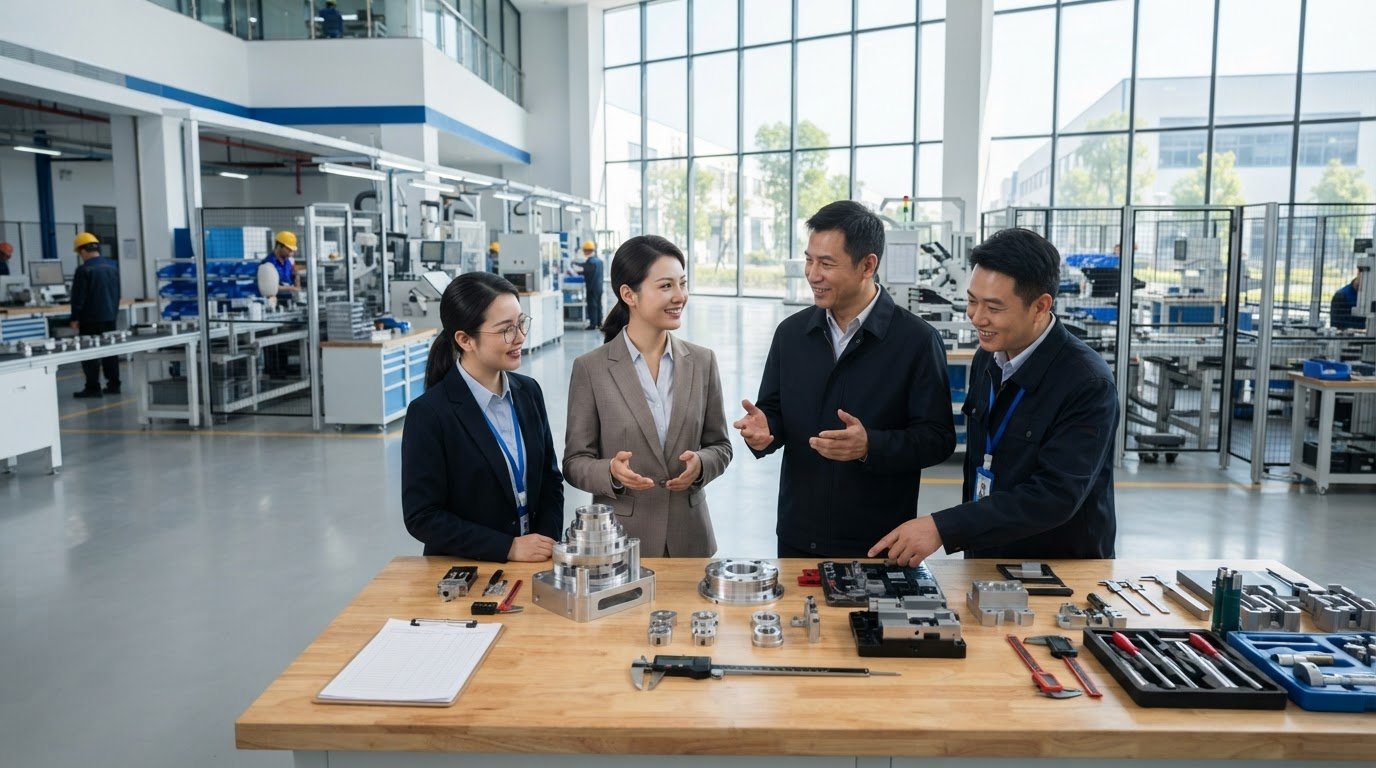
What if your signed OEM agreement protects the product on paper but leaves the factory unclear about what to make, when to deliver it, or how quality will be judged? That gap is where an oem manufacturing agreement china project can lose control: responsibilities blur between buyer, sourcing interme...

What if the safest payment deal isn’t the one that delays the most cash, but the one that releases it only when progress is verifiable? Payment terms negotiation with Asian suppliers is about balancing your working capital with the supplier’s need for confidence, not simply pushing for a smaller dep...