


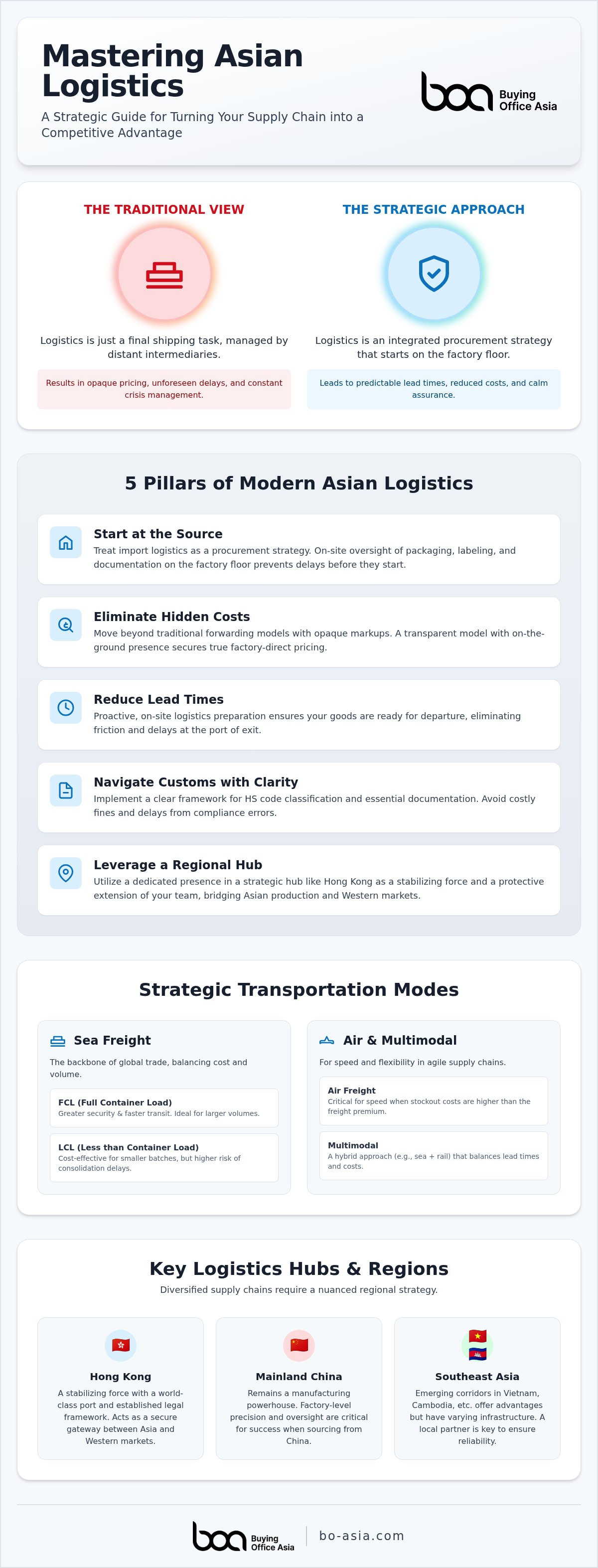
Most businesses treat import logistics from Asia as a final shipping task, yet the most successful enterprises understand it's actually a procurement strategy won or lost on the factory floor. If you're managing a global supply chain, you've likely realized that standard freight forwarding often leaves you blind to the critical moments before a container even reaches the port. Relying on distant intermediaries frequently results in opaque pricing and "unforeseen" delays that turn your 2026 projections into expensive guesswork.
You deserve a logistics model that offers calm assurance rather than constant crisis management. We'll show you how to move beyond the traditional, fragmented approach to secure predictable lead times and significantly reduced landed costs. This guide provides a strategic framework to master Asian logistics by integrating oversight directly at the source. You'll learn how on-the-ground presence and factory-level preparation eliminate hidden fees and ensure seamless customs clearance, turning your supply chain into a stable foundation for growth. We'll explore the Hong Kong hub advantage and the specific mechanics of on-site coordination that keep your goods moving while others remain stuck at the port.
• Shift your mindset to treat import logistics from asia as an integrated procurement strategy that starts on the factory floor to protect your 2026 margins.
• Identify hidden costs and opaque markups common in traditional forwarding so you're able to secure true factory-direct pricing through a transparent model.
• Reduce lead times and eliminate transit delays by implementing on-site logistics preparation before your goods ever reach the port.
• Navigate global trade compliance with a clear framework for HS code classification and essential documentation to avoid costly customs fines.
• Leverage a dedicated regional presence in Hong Kong to act as a stabilizing force and a protective extension of your own team.
The landscape of import logistics from Asia has shifted from a simple transportation exercise into a vital component of strategic global supply chain management. In 2026, the journey from the factory floor to your final warehouse involves more than booking a container. It requires an integrated view of how goods move through complex regulatory and physical networks. When your supply chain stretches across oceans, every day of transit represents capital locked in inventory. This lengthy cycle is often the single greatest risk to your cash flow.
Many businesses are moving away from the "Just-in-Time" models of the past decade. The 2026 reality demands a "Just-in-Case" philosophy that prioritizes resilience and buffer capacity over extreme leanness. You can mitigate these global trade disruptions by maintaining a physical, on-the-ground presence in Asia. This proximity allows you to anticipate bottlenecks before they manifest as delayed shipments.
Logistics planning shouldn't be an afterthought. It must begin during the initial sourcing and procurement phase to ensure total landed cost viability. If a factory isn't ready at the gate, your entire shipping schedule collapses. We find that mass production oversight is the most effective way to prevent delays. By verifying that packaging, labeling, and documentation are completed correctly at the source, you eliminate the friction that usually occurs at the port of exit. Efficient import logistics from Asia depend on this factory-level precision.
Simultaneously, new logistics corridors are maturing in Southeast Asia. Countries like Vietnam and Cambodia offer competitive advantages, yet their infrastructure readiness varies significantly. You must evaluate these regions not just on labor costs, but on their ability to move goods to the coast efficiently. A regional partner with local networks can help you navigate these emerging markets without sacrificing the reliability your customers expect. We act as your eyes and ears, ensuring that "new" doesn't mean "unreliable" for your 2026 projections.
Selecting the right transportation mode is a balancing act between operational speed and long-term financial viability. For import logistics from Asia, the decision often centers on the trade-off between sea and air freight. While sea freight remains the backbone of global trade, the choice between Full Container Load (FCL) and Less than Container Load (LCL) depends on your specific volume and risk tolerance. FCL offers greater security and faster transit because your goods aren't handled alongside other shippers' cargo. Conversely, LCL allows you to manage smaller batches, though it introduces a higher risk of delays during the consolidation and deconsolidation phases.
Air freight serves as a critical tool when the cost of a stockout exceeds the freight premium. Many savvy operators are currently rethinking sourcing strategies by incorporating multimodal solutions. By combining sea transit with rail or road legs, you can often find a middle way that offers better lead times than pure ocean freight without the exorbitant costs of air. This hybrid approach is becoming a staple for 2026 supply chains looking to maintain agility.
Port selection is a high-stakes decision that impacts your time-to-market. In the US, West Coast ports like Los Angeles offer the fastest trans-Pacific times, but East Coast ports like Savannah provide closer proximity to major consumer markets, potentially reducing inland trucking costs. In Europe, the rise of Mediterranean hubs like Piraeus offers a faster entry point for goods coming through the Suez Canal compared to the traditional Northern range ports of Rotterdam or Hamburg. You must calculate the hidden cost of added inventory during longer transits. Every extra week at sea is capital that isn't working for your business. If you're struggling to balance these variables, our team can help you optimize your specific route.
High-volume, multi-supplier orders benefit immensely from consolidation services. By utilizing strategic warehousing in hubs like Hong Kong, you can group shipments from various factories into a single Load-and-Go container. This reduces individual handling fees and streamlines the customs process at the destination. It's a protective measure that ensures you aren't paying for empty container space or redundant documentation fees.
Transloading is the process of transferring goods from international ocean containers into domestic trailers or railcars near the port of entry to accelerate inland distribution and reduce container detention fees.
Traditional freight forwarding often operates in a shadow economy of undisclosed markups. Many businesses fall into the trap of opaque pricing where the final invoice includes hidden kickbacks from local handlers or unmanaged surcharges that provide zero value. Securing 100% transparency is the only way to achieve true factory-direct pricing for your 2026 supply chain. This isn't merely about finding the lowest rate; it's about professional logistics and shipping coordination that optimizes your entire financial cycle. You should audit your current provider by demanding a granular breakdown of every line item. If a provider cannot verify the origin of a fee, it's likely a markup designed to pad their own margins at your expense.
Transparency is a primary risk mitigation tool. It creates a direct link between your documentation and customs compliance, ensuring that every dollar spent is accounted for and legitimate. "Factory Direct" sourcing loses its value if you don't also control the logistics negotiation. Factories often select carriers that offer them the best incentives rather than the one that offers you the best service. By taking control of this process, you eliminate these conflicts of interest. Our documented savings examples demonstrate how removing these layers of obscured costs directly enhances your landed cost viability and secures your capital.
You must distinguish between a transactional "Sourcing Agent" and a dedicated procurement team that functions as an extension of your company. Intermediaries often obscure critical communication during logistics crises to hide their lack of regional influence. This interference creates a dangerous vacuum where information is filtered and delayed, leaving you unable to make informed decisions. Protecting your margins requires the elimination of unearned commissions that brokers frequently embed into freight quotes. When you manage import logistics from Asia through an integrated partner, you gain the calm assurance that comes from direct oversight. Reliability is built through physical proximity and local networks, not through a chain of disconnected brokers who prioritize their own transactional fees over your long-term success. Every layer you remove from the communication chain is a layer of risk you've successfully mitigated.
Customs clearance is the final hurdle where even the most efficient logistics plan can stall. For successful import logistics from asia, you must understand the critical roles of the Importer of Record (IOR) and Exporter of Record (EOR). These entities hold legal responsibility for ensuring all goods comply with local laws and that duties are paid accurately. Errors here don't just cause delays; they invite audits and heavy financial penalties. HS Code classification remains the primary cause of customs friction. A single digit error in your product code can result in incorrect duty assessments or the seizure of your entire shipment.
Managing ESG and regulatory adherence is no longer optional in 2026. You need absolute certainty that your documentation, including the Bill of Lading, Commercial Invoice, and Packing Lists, reflects the physical reality of your cargo and its ethical origins. These documents serve as the legal evidence of your trade. Any discrepancy between them can trigger intensive inspections that disrupt your delivery schedule and damage your brand's reputation with regulatory bodies.
Reliability is built through a methodical approach to data verification. Before any cargo leaves the factory, you must verify the supplier's business licenses and export permits. This pre-shipment phase is where most compliance issues are solved. Once goods are in-transit, real-time tracking and document pre-filing with your customs broker ensure that clearance begins before the vessel even docks. Upon arrival, your brokerage team navigates the final duty payments. This ensures your goods move swiftly from the port to your warehouse without incurring unnecessary storage fees or demurrage charges.
Protecting your brand requires a defense against ethical and compliance breaches at the source. It's vital to conduct on-site factory audits to verify logistics readiness and labor standards. These audits confirm that your supplier has the physical infrastructure to handle your volume and the integrity to meet international standards. You also need to master the application of Incoterms in 2026 to clearly define insurance and liability boundaries. Knowing exactly when the risk transfers from the seller to the buyer prevents costly disputes during transit. If you're concerned about your current compliance posture, you can request a strategic compliance review with our regional experts.
Effective import logistics from asia require more than a digital dashboard; they require a partner who understands that the final mile is won at the first mile. A dedicated Asia procurement team functions as your most valuable logistics asset by bridging the gap between factory production and global transport. We don't just book cargo. We prepare it. This integrated approach ensures that mass production oversight and logistics prep happen in parallel, eliminating the friction that usually occurs when these tasks are siloed. It's a method designed to protect your capital from the very beginning of the manufacturing cycle.
Our model, the "Helsinki-Hong Kong Bridge," combines the professional rigor of European management with the tactical execution of our Hong Kong headquarters. This dual presence ensures that your supply chain adheres to international standards while benefiting from deep regional networks. We provide end-to-end security by overseeing every step of the journey, allowing you to scale high-volume operations with the same level of oversight typically reserved for major enterprises. Reliability isn't a promise here; it's a structural outcome of our regional proximity. By positioning ourselves as an extension of your team, we remove the transactional barriers that often hinder long-term growth.
Digital-only freight platforms offer convenience but often fail when a crisis hits. Physical proximity to factories allows us to solve problems in real-time, whether it's navigating port strikes or managing carrier shortages. Our insider expertise gives you access to regional networks that digital algorithms simply can't replicate. This protective nature ensures your cargo isn't just a number on a screen, but a priority that we defend through direct, on-site intervention. For growing enterprises, this level of hands-on management provides the stability needed to navigate a complex and often volatile global market.
Transitioning from unmanaged sourcing to an integrated model is a calculated move toward financial health. During the first 90 days, we focus on auditing your existing Asian import flow to identify obscured costs and operational bottlenecks. We then implement a structured optimization plan that aligns your production schedules with the most efficient shipping windows. This shift moves your business away from reactive crisis management toward the steady confidence of an established expert. The BOA 100% transparency promise for 2026 guarantees you a granular, un-marked-up breakdown of all logistics coordination fees, ensuring every dollar spent contributes directly to your supply chain's financial viability.
Mastering import logistics from asia requires a fundamental shift from viewing transportation as a final task to treating it as a core procurement strategy. You've learned that the most resilient supply chains are built on-the-ground, where factory-level preparation and 100% transparency eliminate the hidden markups that traditional middlemen often obscure. By integrating logistics coordination directly into your sourcing phase, you secure predictable lead times and robust customs compliance. This proactive approach transforms your supply chain from a source of anxiety into a stable engine for growth.
Buying Office Asia serves as your seasoned insider, providing European-managed oversight with a strategic headquarters in Hong Kong. We specialize in high-volume sourcing and logistics coordination, offering a transparent model that prioritizes your financial health over transactional commissions. Our team acts as a protective extension of your own, ensuring your operations remain scalable and secure in an increasingly complex global market. Optimize your Asian supply chain with Buying Office Asia to replace uncertainty with the calm assurance of expert oversight. Your path to a more profitable and reliable 2026 starts with a partnership built on accountability.
Sea freight via Full Container Load (FCL) remains the most cost-effective method for high-volume shipments. To maximize savings, you should focus on eliminating middleman markups and optimizing container utilization through consolidation. Buying directly from the factory gate and managing the logistics coordination independently prevents the hidden surcharges often embedded in "free shipping" or all-in quotes provided by unmanaged suppliers who prioritize their own margins over your landed costs.
Transit times vary based on the specific port of entry and the carrier's route. Generally, shipments from Hong Kong to US West Coast ports take approximately 15 to 20 days, while routes to the US East Coast can exceed 30 days. If your route includes the Panama Canal, you can check out Panama Ship Service for specialized technical and operational assistance. These estimates exclude the critical time needed for factory-level prep and customs clearance at both ends of the journey.
A freight forwarder acts as a transactional broker that books space on vessels and handles basic documentation. In contrast, a logistics management partner functions as an integrated extension of your team. They provide on-the-ground oversight, verify factory-gate readiness, and ensure 100% pricing transparency. This protective approach mitigates the operational risks and hidden costs that traditional forwarders often overlook or fail to disclose during the complex shipping process.
Accurate HS Code classification and pre-shipment documentation verification are the most effective ways to prevent delays. You should ensure that your Commercial Invoice, Packing List, and Bill of Lading are perfectly aligned before the cargo leaves the factory. Implementing on-site inspections in China allows you to catch labeling errors early, ensuring a seamless transition through customs brokerage and reducing the likelihood of expensive audits that can stall your 2026 supply chain.
Hidden costs often manifest as opaque documentation fees, unmanaged port congestion surcharges, and kickbacks embedded in factory-arranged shipping. Intermediaries may also hide commissions within the freight rate. Achieving 100% transparency requires a granular audit of every line item on your invoice. By managing import logistics from asia through a partner with regional proximity, you can eliminate these unearned markups and secure true factory-direct pricing for your business.
Port congestion necessitates a shift from "Just-in-Time" to "Just-in-Case" inventory models. You must build extra lead time into your projections to account for potential bottlenecks at major global hubs. Diversifying your port selection and utilizing transloading services can help bypass the most congested areas. A strategic inventory strategy in 2026 prioritizes resilience and buffer stock to protect your brand from stockouts during periods of high maritime and infrastructure volatility.
The essential document set includes the Bill of Lading, Commercial Invoice, and Packing List. Depending on the product category and destination, you may also require a Certificate of Origin, export licenses, and specific compliance certifications. Ensuring these documents are prepared accurately at the source is vital for import logistics from asia. Any errors in these filings can lead to customs seizures, fines, and prolonged delays that disrupt your entire financial cycle.

As of July 2026, the average effective tariff rate on Chinese imports has climbed to 22.8%, but is the cost on the invoice really your biggest financial risk? You likely feel the mounting pressure of managing a supply chain where the rules of engagement change every quarter. The challenges of sourci...

Is your current China manufacturing management strategy robust enough to survive the regulatory shifts of 2026? With the recent implementation of Decree 834 and the new "Made in China" procurement standards, the distance between a successful product launch and a costly supply chain failure has never...

What if your final quality check isn't just a formality, but the only thing standing between a successful product launch and a container full of unsellable defects? For many businesses, the fear of receiving substandard goods from overseas is a constant anxiety, often compounded by communication bar...