

In 2026, the success of your supply chain isn't determined by simply finding a factory; it's defined by how effectively you can manage that relationship from the inside. You've likely dealt with the anxiety of quality drift during mass production or the frustration of opaque pricing models that hide true manufacturing costs. These challenges, along with communication barriers and intellectual property risks, often make production outsourcing in China feel like a gamble rather than a strategic advantage.
This guide provides a professional framework to reclaim control over your operations. You'll learn how to vet suppliers with clinical precision, mitigate risks using the latest trade secret protections enacted in June 2026, and achieve factory-direct pricing without the burden of intermediaries. We will outline a strategy for establishing a reliable, on-the-ground partnership that functions as an integrated extension of your own team. By the end of this briefing, you'll have the tools to transform your supply chain into a stable, high-performance asset that prioritizes both quality and financial transparency.
• Transition from transactional purchasing to a strategic manufacturing partnership to leverage China’s 2026 advancements in automation and precision engineering.
• Navigate the financial pitfalls of DIY platforms and broker models by implementing a framework for transparent, factory-direct price negotiations.
• Protect your brand from the hazards of "quality drift" and intellectual property theft with on-site oversight and updated regulatory compliance strategies.
• Execute a rigorous vetting process for production outsourcing in China that utilizes professional networks and deep-dive audits rather than unreliable public directories.
• Integrate a dedicated on-the-ground procurement team to act as your eyes and ears, ensuring seamless management from initial sampling to final logistics.
In 2026, successful manufacturing requires a fundamental shift in perspective. You can no longer view production outsourcing in China as a simple series of purchase orders. It has evolved into a high-stakes strategic partnership where your brand's viability depends on technical integration. As China moves deeper into the goals of its 15th Five-Year Plan, the focus has shifted toward advanced manufacturing, robotics, and precision engineering. This isn't the low-cost labor market of a decade ago. It's a sophisticated ecosystem where 5G infrastructure and AI-driven automation define the production floor.
While regional competitors have emerged under "China +1" strategies, the mainland remains the world's factory because of its unmatched component availability. Every screw, sensor, and specialized material is accessible within a tight geographic radius. To manage this complexity, the role of a professional trade hub like Hong Kong remains critical. It serves as the legal and financial gateway, providing a stable bridge between Western corporate standards and mainland operational realities. By leveraging a dedicated Asia procurement team, you ensure that your interests are protected by experts who understand both the regional nuances and your bottom-line requirements.
Understanding the landscape of production outsourcing in China involves recognizing that the legal environment is also maturing. New trade secret protection regulations that took effect on June 1, 2026, provide clearer guidance for enforcing your intellectual property rights. This regulatory shift, combined with massive investments in smart manufacturing, means your brand can achieve levels of quality and consistency that were previously reserved for only the largest global enterprises.
The primary driver for choosing China in 2026 is scalability. Whether you're moving from a prototype to a pilot run or scaling to high-volume mass production, the infrastructure is built to absorb growth without the bottlenecks found in less developed markets. Many brands also utilize the "Made in PRC" branding evolution. This labeling shift reflects a more neutral, professional image that aligns with the high-tech reality of modern Chinese factories. It's about matching the label to the quality of the engineering inside the box.
Labor costs in China are rising, with Shanghai's monthly minimum wage reaching RMB 2,740 as of April 2026. However, this is being offset by aggressive automation. To maintain your margins, you must focus on factory-direct pricing and the Total Cost of Ownership (TCO). TCO accounts for more than just the unit price; it includes the costs of quality failures, communication delays, and logistics. By eliminating unnecessary middlemen and negotiating directly with the source, you secure the financial viability of your product line while benefiting from the increased efficiency of automated production lines.
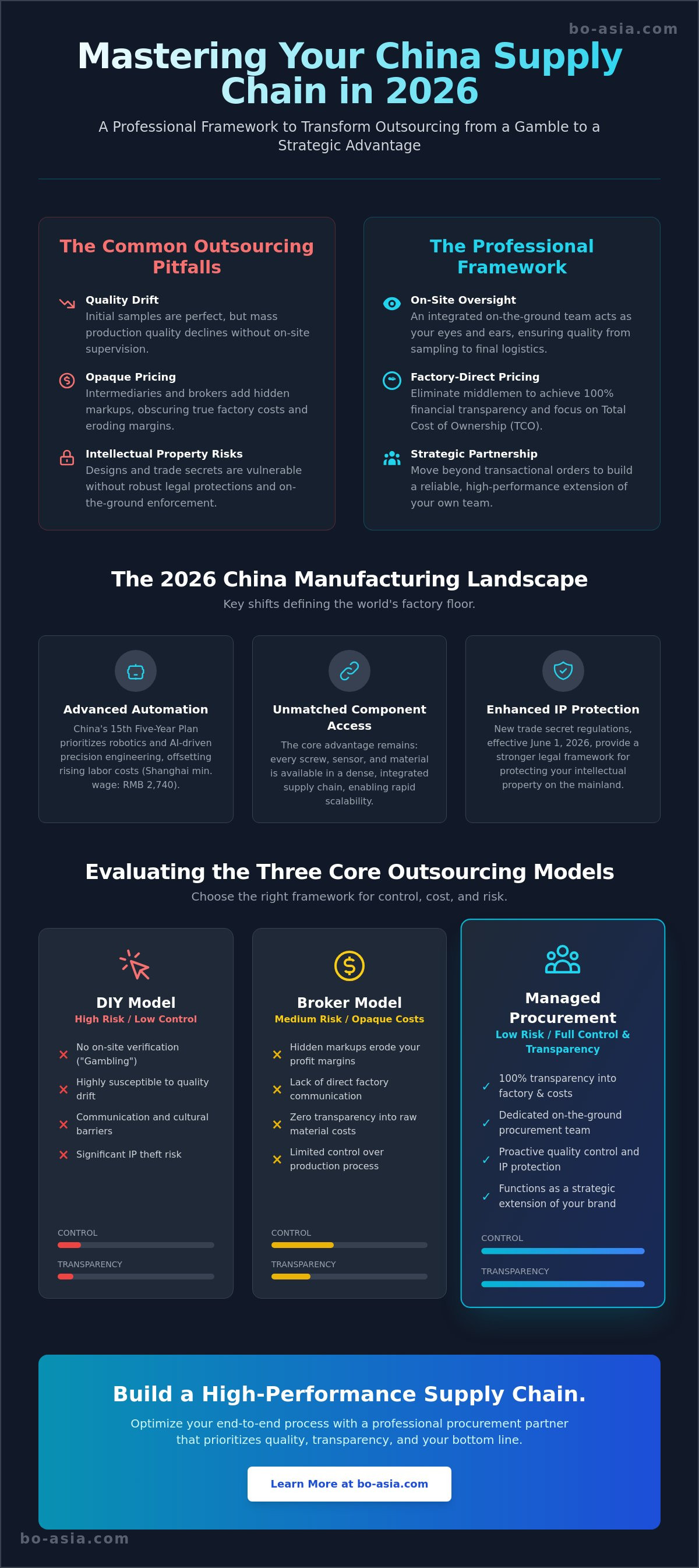
Choosing the right operational framework determines whether your venture succeeds or fails. When evaluating outsourcing models, you'll encounter three primary paths. Each offers a different balance of control, cost, and risk. The DIY model relies on public platforms like Alibaba. It's accessible but often feels like gambling. Without a physical presence, you're forced to trust digital profiles that don't always reflect factory reality. The Broker model uses trading companies to handle the heavy lifting. While this reduces your immediate workload, it introduces significant opacity and hidden markups that erode your margins over time.
The Managed Procurement model stands as the professional alternative. This involves establishing a dedicated Asia procurement team that functions as an integrated extension of your brand. Unlike brokers, this model provides 100% transparency. You know exactly which factory is producing your goods. You see the raw material costs. This approach is designed for businesses that view production outsourcing in China as a long-term strategic asset rather than a series of disconnected transactions. It prioritizes financial viability and operational security by placing your interests at the center of the negotiation table.
High risk, low control, potential for low unit cost but high hidden failure costs.
Moderate risk, zero transparency, high long-term cost due to commissions.
Low risk, total control, factory-direct pricing with professional oversight.
Intermediaries often deliberately obscure the factory's identity to protect their own commissions. This prevents you from building a direct relationship with the manufacturer. We call this the "Middleman Tax." It's a recurring expense that stifles your ability to scale. When you lack a direct line to the production floor, resolving quality issues becomes a game of telephone. You can see the impact of eliminating these layers in our BOA Pricing and Savings analysis, which highlights the financial advantage of direct factory access.
A professional buying office acts as your eyes and ears on the ground. This "integrated extension" philosophy ensures that every decision made in the factory aligns with your brand's standards. You gain the leverage of a local office without the overhead of managing international payroll yourself. This model provides the steady confidence of a seasoned insider. If you're ready to move beyond transactional sourcing, you can learn more about our dedicated sourcing team and how we stabilize complex supply chains. For a detailed assessment of your current production needs, connect with our procurement specialists today.
The primary threat to your brand's reputation isn't the first shipment; it's the third. Many businesses entering production outsourcing in China experience "Quality Drift," a phenomenon where a manufacturer gradually substitutes cheaper raw materials or relaxes tolerances once they feel the relationship is secure. This isn't always malicious, but it's often a factory's way of reclaiming margins against rising costs. To prevent this, you need a physical presence that monitors the production floor in real time. We act as your eyes and ears, ensuring that batch fifty meets the exact same standards as the initial prototype.
Protecting your intellectual property requires more than just a signed NDA. With China's "Provisions on the Protection of Trade Secrets" taking effect on June 1, 2026, the legal framework for enforcing your rights is more robust than ever. However, these laws are only useful if you have the ground-level oversight to detect breaches before they escalate. A professional procurement team ensures that your custom designs and proprietary processes remain within the walls of the vetted factory. We prioritize your operational security by maintaining a constant, protective presence throughout the production cycle.
Ethical standards and ESG compliance are also non-negotiable in the modern market. As China works toward its 2060 carbon neutrality goal, factories are increasingly scrutinized for their environmental impact. We verify that your partners adhere to these evolving regulations and maintain fair labor practices. This level of oversight protects you from the brand risks associated with unmanaged or unethical supply chains.
Reliability is built through a systematic three-stage inspection process. Pre-production checks verify that raw materials match your specifications before the assembly line begins. During Production (DUPRO) inspections catch defects while they're still correctable, preventing a total loss of the run. Finally, a Final Random Inspection (FRI) provides a comprehensive data set on the finished lot before it leaves the port. These detailed reports ensure that defective goods never reach your customers. For a deeper analysis of how to qualify your manufacturing partners, see our guide on Supplier Vetting in Asia.
When you invest in OEM/ODM contract manufacturing, you're often paying significant sums for custom tooling and molds. It's vital to ensure you retain legal and physical ownership of these assets. We secure your tooling by documenting its location and usage on-site, preventing it from being used for unauthorized production runs. Our regional presence allows us to manage these assets as an integrated extension of your team, providing the elite level of oversight usually reserved for major enterprises.
Vetting manufacturers for production outsourcing in China is a rigorous process that begins long before you sign a contract. You shouldn't rely on public directories or digital reviews that can be easily manipulated. Instead, your search must start within established, private networks where supplier performance is documented over years. This roadmap ensures your production run is built on a foundation of operational transparency and technical competence. It moves you away from the gambling mindset of DIY sourcing and toward a disciplined corporate procurement strategy. Precision is the only defense against operational failure.
Identify manufacturers through vetted industry networks rather than public search engines.
Conduct on-site audits focusing on technical machinery, social compliance, and financial health.
Validate capability through multiple rounds of sampling and prototyping to ensure the factory can meet your tolerances.
Secure factory-direct pricing by analyzing raw material costs and local labor rates.
Formalize the relationship with a Source-to-Contract (S2C) framework that defines every operational milestone and quality benchmark.
Supplier Vetting is a multi-stage forensic audit of operational capacity. You need to look past the official business license to evaluate the actual machinery on the floor and the stability of the workforce. High turnover in a factory is a red flag for quality drift. It's also essential to verify "Factory-Direct" status. Many entities present themselves as manufacturers but are actually disguised trading companies. These middlemen add costs without adding value. We ensure you're dealing directly with the source to protect your margins and your intellectual property.
Achieving true factory-direct pricing requires an "Open Book" approach. You should understand the factory's margins and the specific costs of raw materials and labor. For example, as of April 2026, monthly minimum wages in regions like Shanghai have reached RMB 2,740. Knowing these local benchmarks gives you leverage during the negotiation phase. High-volume sourcing further strengthens your position by making your brand a priority for the factory management. When you negotiate from a place of data, you eliminate the "Middleman Tax" and secure the long-term profitability of your product line. This transparency allows you to adjust to market shifts without compromising your margins. For a deeper look at selecting the right partner, read The Definitive Guide to Choosing a China Sourcing Company.
If you need a professional audit of your current or prospective manufacturers, contact our on-site procurement experts to secure your supply chain.
Successful production outsourcing in China doesn't end when the last unit comes off the assembly line. It ends when that product arrives at your warehouse, fully compliant and ready for your customers. Our operational structure provides a unique advantage by combining the strategic oversight of European leadership in Helsinki with the tactical, on-site expertise of our Hong Kong headquarters. This dual presence ensures that your corporate standards are maintained throughout the entire process. We act as a stabilizing force, managing the critical transition from factory floor oversight to global logistics coordination with the steady confidence of a seasoned insider.
Managing this transition requires more than just scheduling a pickup. It involves verifying that every regulatory detail is addressed before the goods leave the port. For example, as of March 1, 2026, high-risk products like power banks must feature the updated China Compulsory Certification (CCC) mark with a traceability QR code. We ensure these technical requirements are met on-site, preventing your shipments from being delayed or rejected at customs. This level of integrated management moves you away from transactional interactions and toward a long-term partnership built on financial viability and operational security.
Lead times are often won or lost during the documentation phase. We optimize shipping routes and handle all customs documentation to ensure a frictionless flow from the factory to the destination. For clients involved in high-volume sourcing, we implement consolidation strategies that maximize container efficiency and reduce overall shipping expenses. This comprehensive oversight is a core pillar of our Sourcing & Procurement Services. We don't just find suppliers; we manage the entire movement of your assets.
You must weigh the cost of a managed procurement retainer against the potential losses from a single failed production run. A single batch of defective goods or a missed delivery window can cost your business more than an entire year of professional oversight. Beyond risk mitigation, we focus on supplier development and relationship management to drive long-term value. This proactive approach builds a resilient supply chain that can adapt to market shifts without sacrificing quality. You can see the documented evidence of these results in our briefing on the ROI of a dedicated Asia procurement team.
Real profitability is found in the details. By utilizing a dedicated on-the-ground partner, you eliminate the hidden costs of unmanaged sourcing and secure a defense against the operational setbacks that affect your competitors. We provide the elite level of oversight usually reserved for major enterprises, ensuring your brand remains competitive in a complex global market. It's time to transform your supply chain into a transparent, high-performance asset.
Success in production outsourcing in China today depends on moving away from the uncertainties of unmanaged sourcing. You've learned that a professional framework, built on factory-direct pricing and rigorous on-site oversight, is the only way to ensure long-term financial viability. By replacing hidden markups with a transparent, managed procurement model, you regain control over your margins and your brand's reputation.
Buying Office Asia acts as your seasoned insider, offering the security of European leadership combined with over 15 years of on-the-ground experience in Helsinki and Hong Kong. We provide a defense against operational setbacks through end-to-end management and a commitment to 100% transparency. Book a consultation with our Helsinki and Hong Kong teams to secure your supply chain.
Building a resilient, high-quality supply chain is an achievable goal when you have the right ally. We look forward to helping you stabilize your operations and achieve your production targets with the steady confidence of an established expert.
Production outsourcing in China remains highly cost-effective in 2026 because the country's manufacturing sector has successfully transitioned to high-tech automation. While monthly minimum wages in cities like Shanghai reached RMB 2,740 as of April 2026, the increased efficiency of AI-driven production lines offsets these labor costs. You benefit from a mature supply chain that delivers scalability and precision engineering that newer regional manufacturing hubs cannot yet replicate at scale.
A sourcing agent usually operates as a transactional intermediary, often hiding factory identities to protect their commissions. In contrast, a managed procurement office acts as an integrated extension of your own team. This model prioritizes 100% transparency, giving you direct access to factory names and raw material costs. You gain the security of a local presence without the hidden markups or lack of control associated with traditional brokers.
Protecting your intellectual property requires leveraging China's "Provisions on the Protection of Trade Secrets" that took effect on June 1, 2026. Beyond legal contracts, you must maintain a physical, protective presence on the factory floor to monitor tooling and proprietary processes. We secure your custom molds and designs by conducting frequent on-site audits, ensuring your assets aren't used for unauthorized production runs or leaked to competitors.
Verifying a manufacturer's status requires a forensic audit of their operational capacity on-site. You should look for specific machinery, a stable workforce, and internal quality control processes that a trading company simply doesn't possess. A professional procurement team identifies these disguised intermediaries by cross-referencing business licenses with the physical reality of the production floor, ensuring you negotiate directly with the actual source rather than paying a middleman tax.
The most prevalent issue is quality drift, where a factory gradually substitutes cheaper materials or relaxes tolerances after the first successful batch. This often happens as manufacturers try to reclaim margins against rising operational costs. Other common problems include finish inconsistencies and packaging failures. You mitigate these risks by implementing a three-stage inspection process: Pre-production, During Production (DUPRO), and Final Random Inspection (FRI) before the goods leave the port.
Managing production outsourcing in China remotely is a high-risk strategy that often leads to quality failures and unforeseen expenses. Without a local team to act as your eyes and ears, you lack the leverage to resolve communication barriers or detect production errors in real time. A professional on-the-ground partner provides the steady confidence needed to stabilize your supply chain, ensuring that your standards are upheld without you needing to be physically present.
Factory-direct pricing is a model where you pay the manufacturer's actual cost plus a transparent margin, rather than a price inflated by hidden intermediary markups. Achieving this alone is difficult because most independent businesses lack the regional networks and high-volume leverage required to bypass trading companies. We use an open-book negotiation strategy, analyzing raw material costs and local labor rates to secure the financial viability of your product line.
We conduct deep-dive factory audits that evaluate technical machinery, social compliance, and financial stability. Our on-site inspections are systematic, covering the entire production cycle from raw material verification to final random sampling. By providing detailed inspection reports, we prevent defective goods from ever leaving the factory. This end-to-end oversight ensures your production runs are stable and that every shipment meets your brand's exact specifications without delay.

What if the first clear sign of a production problem arrives after the goods are packed? Manufacturing risk management in Asia works best when controls are connected from the start, not left to a final inspection or occasional supplier update. You need visibility into factory activity, early warning...

What if the lowest unit quote isn’t the lowest-cost way to make your board game? Board game manufacturing costs depend on more than the number of boxes ordered. Component materials, custom tooling, assembly, packaging and delivery scope can all change what a quote covers, making headline prices diff...

What if the factory’s lowest quote isn’t the lowest-cost option? A lower unit price can hide differences in materials, tooling, packaging, quality checks or production terms. Understanding how sourcing agents negotiate factory prices starts with making those differences visible, not simply asking a...