


A six-digit classification can affect how customs identifies and assesses an imported product. If you’re asking what an HS code is, it’s the internationally standardized code used to classify traded goods. Its first six digits identify a product category, while the importing country may add digits for its own tariff classification.
This shared foundation is useful, but it doesn’t make classification automatic. Products with different materials, functions, components, or packaging can fall into different categories, and a supplier’s suggested code may not match the importing country’s requirements.
This guide explains how the code is organized, what its digits represent, and how tariff classification is determined. You’ll see why product composition and intended function matter, how national extensions affect the final code, and what information importers sourcing from Asia should prepare to support accurate classification. Understanding these distinctions can help you plan customs documentation and landed costs with fewer avoidable surprises.
• Use the internationally shared code structure as a starting point, then account for the importing country’s additional digits.
• Classify the product by its materials, function, components and presentation, not just its everyday name.
• Understand how tariff classification can affect duty assessment and the customs information required for an import.
• Keep product specifications and supplier details aligned with the classification used in import documentation.
• For complex products or ongoing production in Asia, coordinate sourcing and procurement with classification needs in view.
An HS code is the internationally standardized six-digit classification used to identify traded goods. Customs administrations use it as the shared foundation for country-specific tariff schedules and commodity codes.
A first-time importer may ask, “What is an HS code?” The practical answer is a shared product classification, not a complete tariff decision for every country. The importing country may add digits to classify goods in greater detail, so the right code depends on the market and whether the shipment is imported or exported.
The World Customs Organization reviews the HS on a five-year cycle. For a current U.S. import code, consult the U.S. Harmonized Tariff Schedule, commonly called HTSUS, and match the product to its full national classification.
A commodity code identifies a product category, while a tariff code applies that classification within a country’s customs tariff system. The terms can overlap, but the full code and its purpose depend on the country and whether the shipment is imported or exported.
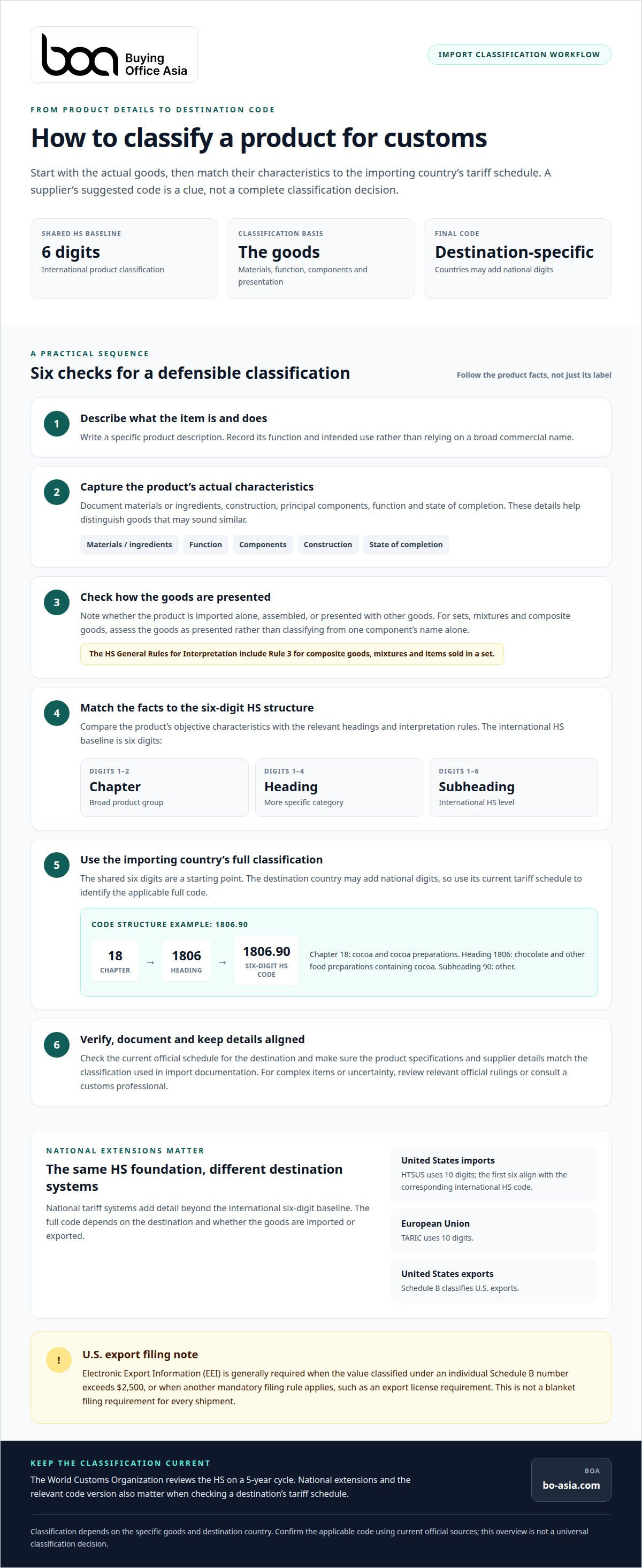
For U.S. imports, HTSUS extends the HS code to 10 digits; its first six digits match the corresponding international code. The remaining digits provide U.S.-specific classification detail, so an overseas supplier’s six-digit code alone may not identify the applicable U.S. tariff line.
National extensions make the final code destination-specific. The European Union’s TARIC uses 10 digits, while the United States uses HTSUS for imports and Schedule B for exports. Although the shared first six digits help connect these systems, importers should use the code version for the destination country when assessing duties.
For U.S. exports, Electronic Export Information is generally required when the value classified under an individual Schedule B number exceeds $2,500, or when another mandatory filing rule applies, such as an export license requirement, according to the U.S. Census Bureau. Schedule B codes classify U.S. exports, and the U.S. Census Bureau provides an online search engine to help find them.
Commodity-code tools are searchable government databases that help narrow down a product’s classification. For U.S. imports, use the current HTSUS and search by product description or relevant terms. For exports, use the U.S. Census Bureau’s Schedule B search engine.
Search results are a starting point, not a substitute for matching the product’s actual materials, function, and construction to the tariff descriptions. A broad label such as “plastic product” may cover goods with different uses and classifications. Compare the product details with the relevant code descriptions before using a result in customs documentation.
Product specifications matter, especially when a product combines materials or functions. A detailed description helps distinguish similar categories and supports consistent classification across purchase documents and shipment records. The practical question, “What is an HS code for this shipment?” should be answered using the product’s actual details and the destination country’s system. For products developed with suppliers in Asia, clear specifications and coordinated sourcing can help keep product information aligned; the on-the-ground sourcing approach is relevant when production details span multiple suppliers.
Tariff classification matches a product’s objective characteristics to the descriptions and rules in the importing country’s tariff schedule. A reliable decision starts with the product itself, not just the supplier’s label or a familiar commercial name.
The Harmonized System is an international index that groups traded goods into consistent categories. It gives customs authorities and businesses a common starting point for describing products across borders.
That shared index supports tariff classification, but product details still matter. Record the materials, function, construction, and components, then compare those facts with the relevant headings and interpretation rules. A generic description such as “food preparation” may be too broad to distinguish a specific cocoa product.
A practical classification review considers the product’s actual use and form:
• Describe what the item is and what it does.
• Identify its materials, ingredients, and principal components.
• Check whether it is imported alone, assembled, or presented with other goods.
• Compare the description against the importing country’s tariff schedule and interpretation rules.
For example, 1806.90 is the six-digit HS subheading for other chocolate and food preparations containing cocoa. Chapter 18 covers cocoa and cocoa preparations, heading 1806 covers chocolate and other food preparations containing cocoa, and the final two digits identify the six-digit subheading. The code’s description and the product’s actual composition must align.
A composite good combines materials or functions, while a set presents different articles together for a shared purpose. Classification matters because a product may appear to fit more than one heading.
The HS has six General Rules for Interpretation. Rule 3 addresses composite goods, mixtures, and items sold in a set. Its application depends on the goods’ characteristics and the relevant tariff descriptions, so a product bundle should be assessed as presented rather than classified from one component’s name alone.
The importer coordinates classification for the destination country, using accurate product information and the applicable national schedule. A supplier can provide specifications or a suggested code, but that suggestion may not settle the importing country’s tariff treatment.
For U.S. imports, CROSS contains official, legally binding rulings on HTS numbers; it does not issue legally binding rulings on Schedule B export numbers. A binding tariff ruling applies to the specific product and applicant involved, so compare the ruling’s product facts with the goods being imported.
A misclassification can produce an inaccurate tariff assessment or customs declaration. For a complex product, assemble its materials, functions, components, and packaging details before reviewing candidate headings. If product development requires coordinated specifications for classification, contact Buying Office Asia to discuss your sourcing project.
For procurement teams, an HS code is useful beyond identifying a category. It provides a common reference that can be recorded alongside each product’s specifications and version history.
“HS” means “Harmonized System.” In product records, its code is a classification reference, not a company SKU or model number. A SKU distinguishes a seller’s own stock item, while a model number identifies a product design. The HS reference serves a different purpose, so one product can have an internal SKU and an HS classification at the same time.
Keeping these identifiers separate prevents confusion in procurement files. For example, an importer might use one SKU for a product and another for a differently packaged version, while both records point to the classification appropriate to the goods described. The product name, internal identifier, and classification each provide different information.
The World Customs Organization maintains the Harmonized System as a shared nomenclature. For a business, this standardized reference can help teams organize product information across purchasing, finance, and trade documentation without replacing the detailed specification that describes the item.
One useful purpose of classification is to connect a product master record with the relevant trade data used by a business. When the code is stored alongside specifications, invoices, and supplier records, staff can trace which product version it refers to instead of relying on a name that may change between departments.
That connection becomes especially useful when products change. If a design switches materials or a kit gains a component, the product record can capture the change and prompt a review of the existing classification. Keep the code associated with the version and description it was assessed against.
For an organization sourcing through several suppliers, consistent naming also supports clearer handovers. A procurement team can distinguish a finished product from a replacement component, while finance and trade staff work from the same product record. Classification does not replace technical specifications, invoices, or supplier documentation. It helps connect them.
retain the SKU or model number for internal identification.
record materials, function, and version information in the specification.
associate the code with the product description it applies to.
This recordkeeping approach makes classification part of product information management, rather than an isolated entry copied between documents. When product data changes, teams can identify which records need review and keep the classification connected to the correct goods.
Product categories distinguish goods by their characteristics, not by the marketing language on a catalogue page. A product name such as “collectible” may describe how an item is sold, but its physical form, materials, and function provide more useful classification details.
Consider a hypothetical desk accessory sold as a decorative object. A description that says only “gift” gives little information about what the item is. A stronger product record describes its material, design, and intended use, allowing the category to be assessed against the actual goods rather than the sales label.
Category boundaries can matter even when two products look similar. A reusable household item and a decorative object may share a material, yet have different functions. Likewise, an unfinished component and a completed article may need different descriptions. These distinctions are why product categorization should reflect the goods’ identity and state, not appearance alone.
For a product range, organize specifications around meaningful differences. A variation in material, function, or construction may affect which description fits. A change only in colour or branding may not alter the product’s underlying identity, but complete product details still belong in its records. Don’t assume every variant automatically shares one classification.
describe what the product is made from, including important material differences between versions.
state the practical purpose, not only the retail category or promotional name.
distinguish a component or unfinished item from the finished product.
document meaningful differences in construction or included parts.
A useful way to review a product category is to write a plain-language description without brand names or marketing claims. Then compare it with the wording used for candidate categories. If the description could fit several unrelated goods, it likely needs more detail about the product’s physical characteristics or use.
This approach is especially useful during product development. When a prototype changes, record the revised materials and construction alongside the approved specification. That gives the classification review a precise product version to assess, rather than relying on an earlier sample or outdated catalogue description.
Keep category descriptions consistent across product specifications, purchase records, and supplier documents. Clear descriptions help teams identify when two items are genuinely alike and when their differences warrant separate review. The goal is a category that accurately describes the goods, not simply one that is convenient for an internal product list.
For an import, the importer needs a defensible classification for the destination country. The manufacturer supplies product facts, while customs professionals can help interpret them against the relevant tariff schedule.
A supplier’s code is useful evidence, not a complete classification decision. It may reflect the export country’s schedule, a broad product description, or a product version made with different materials. The importer needs to ensure the code used for the planned import matches the actual goods and destination.
Start with a product file that describes the item clearly. Include its materials, function, construction, components, and presentation. For a Bluetooth speaker, record whether it includes a radio-broadcast receiver. That detail can affect whether classification is considered under heading 85.27 rather than loudspeaker heading 85.18.
Share the same file with the manufacturer, customs broker, and internal trade or procurement teams. Consistent information helps each party assess the same product instead of relying on different invoice names or incomplete specifications.
provide accurate product composition, function, and production specifications.
identify the destination country and maintain the classification rationale alongside product records.
advise on applying the destination tariff schedule to the supplied product facts.
administer the importing country’s tariff system and assess declarations.
Separate product versions when their characteristics differ. A plastic model and a metal model have different material descriptions, while a speaker with an added receiver may differ from a standalone loudspeaker. Tie each classification to the exact version rather than applying one code across a product family without examining its variations.
Record the reasoning as well as the selected code. A useful file includes the product description, supplier specifications, relevant tariff wording, and the date of review. If materials, function, or packaging change, revisit the code against the revised product facts and destination schedule.
For an unresolved U.S. import classification, an importer can review official tariff information and relevant customs rulings. A ruling’s product description matters: similarities in a commercial name alone do not establish that another product receives the same classification. Keep the reviewed product details with the decision.
Clear product specifications during development make this review more reliable, especially when suppliers or components change. To coordinate product requirements with manufacturing in Asia, discuss your sourcing project.
Buying Office Asia helps importers connect product information with the realities of sourcing and production in Asia. Through End-to-End Sourcing & Procurement, your team can coordinate supplier communication and product details throughout purchasing, giving classification work a clearer foundation.
This is especially useful for custom products, changing specifications, or orders involving multiple suppliers. A Dedicated Asia Procurement Team can help keep product descriptions and manufacturing information aligned as sourcing progresses. Customs classification still needs to reflect the destination country’s tariff rules, but organized product information makes it easier to assess the goods accurately.
Contact Buying Office Asia to discuss your sourcing requirements and procurement needs.
Knowing what an HS code is gives you a starting point, but product decisions begin well before a shipment is ready. Build classification considerations into supplier discussions while materials, functions, components, and packaging are still being defined. Clear product records can help keep procurement assumptions aligned with the goods ultimately produced.
For businesses sourcing from Asia, Buying Office Asia supports this broader process through End-to-End Sourcing & Procurement, High-volume sourcing & procurement, and a Dedicated Asia Procurement Team. Coordinating sourcing details with the product specification can give your team better visibility across suppliers and production requirements.
Bring your product scope and sourcing priorities into the conversation, especially if specifications are still evolving or several suppliers are involved. Contact Buying Office Asia to discuss sourcing support and take the next step with a clearer procurement plan.
Classification assigns goods to categories based on their characteristics and the wording used for those categories. For a shipment containing different products, assess each distinct item rather than assuming one code covers the entire consignment. Clear line-item descriptions help connect each product to its own classification and reduce ambiguity when the commercial invoice lists several goods.
The HS provides a shared international reference; national or regional systems apply their own extensions and tariff measures. A customs form may ask for a code specific to the transaction’s market, while a supplier’s invoice may show only an international-level reference. Keep the importing market in view when preparing records, and don’t treat different database fields as interchangeable.
Prepare a product record that can be reviewed consistently: a plain-language description, material details, function, component list, and product images or drawings. For a bundled product, describe what it includes and how the items are presented together. You can record a supplier’s suggested classification as a reference, but retain the supporting product facts so the selected code can be reviewed against the goods actually shipped.
A wrong code can create a mismatch between the declared goods and their supporting documents. If a customs review raises questions, the importer may need to explain the product description and amend records as appropriate. A practical safeguard is to preserve the classification rationale with the relevant product version, then update the product file and future shipment documentation if the assessment changes.
A commodity code is the classification identifier used for a particular product in a trade or customs system. In a multi-item shipment, each distinct product line may need its own identifier rather than inheriting the code used for another item in the same carton. Accurate line-item descriptions make it easier to connect each code with the goods represented on invoices and packing documents.
Forms and trade software may use labels such as “tariff number,” “customs code,” or “commodity code.” Their meaning can depend on the system and document, so read each field label in context. For example, an internal product database may use “commodity code” as a general field name, while a customs declaration may require a destination-specific tariff identifier.
HS stands for Harmonized System. The code identifies product categories in international trade records, but it isn’t a shipment tracking number or a seller’s product identifier. Keep these references separate in business documents: a tracking number follows the consignment, while the HS classification describes the goods for trade purposes.
The international HS classification uses six digits, grouped into pairs that progressively narrow the product category. Read the digits with the accompanying description, rather than treating them as a complete product specification. When a code appears in a document, retain the product name and supporting details beside it. That context helps distinguish similar goods and keeps the classification tied to the item being declared.

Supplier coordination works best when everyone knows when decisions will be made, what can happen asynchronously, and which local time zone applies to each deadline. Managing different time zones with suppliers means setting a practical window for live discussions, documenting updates for people who...

A shipment can be ready to move and still be held at the border. The customs clearance process for imports determines whether goods can enter their destination market, which documents are reviewed, and what duties or fees may be due. The exact requirements depend on the goods and the country they’re...

Distance can turn a small production issue into a coordination problem. The benefits of having a team on the ground in Asia include closer alignment between regional operations and your wider business. Local presence can connect strategy with supplier activity, product decisions, and day-to-day coll...