


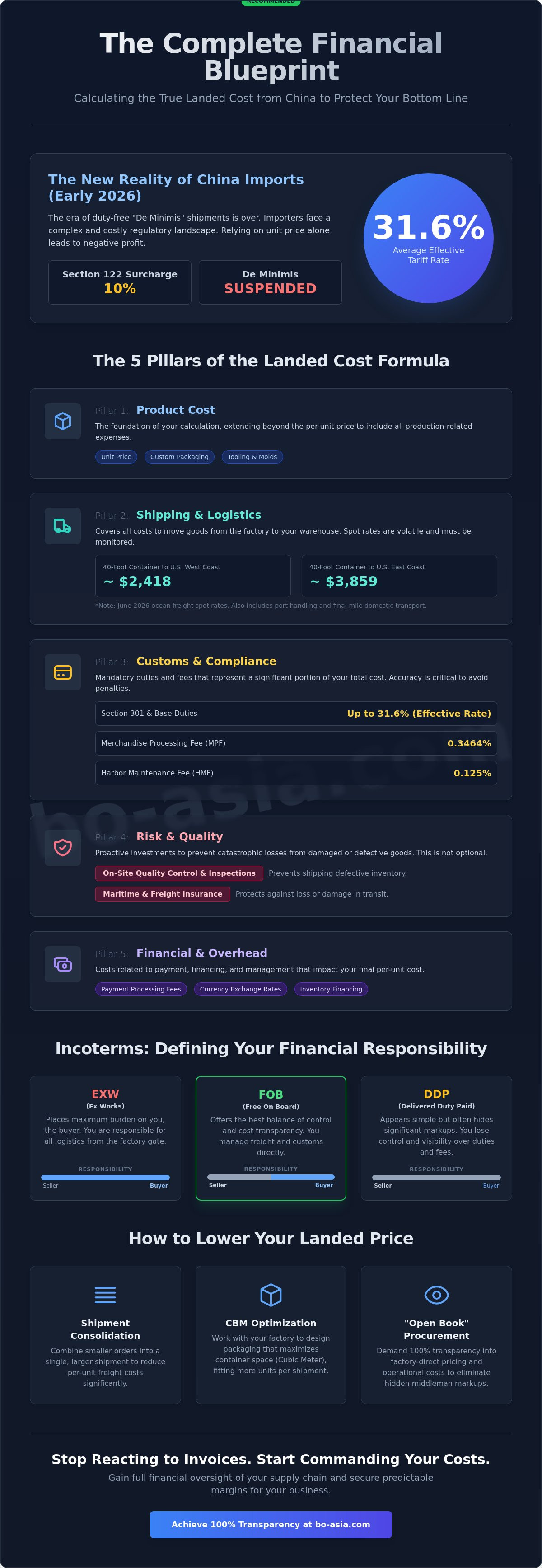
Did you know that as of early 2026, the average effective tariff rate on Chinese imports has climbed to approximately 31.6%? For many importers, the era of duty-free "De Minimis" shipments is a distant memory, replaced by a complex web of Section 301 duties and the mandatory 10% Section 122 global surcharge. It's a high-stakes environment where calculating landed cost from China with absolute precision is the only way to protect your bottom line. You've likely experienced the frustration of unexpected customs bills or realized too late that middleman markups were inflating your unit prices. We understand that these hidden variables make it feel like you're losing control over your own supply chain.
This guide provides the complete financial blueprint you need to move from guesswork to professional-grade oversight. We'll walk you through the specific mechanics of the 0.3464% Merchandise Processing Fee, current ocean freight spot rates, and the often-ignored costs of quality issues. By the end of this briefing, you'll have a repeatable formula to secure predictable margins and ensure every new product line is a viable, profitable asset for your business. It's time to stop reacting to invoices and start commanding your costs.
• Move beyond the "unit price" trap to understand the true financial impact of your supply chain on your net margins.
• Master the five essential pillars of calculating landed cost from China, ensuring every duty, fee, and logistics charge is accounted for before you place an order.
• Identify and eliminate "hidden" expenses, such as obscured middleman markups and the catastrophic costs associated with unmanaged quality failures.
• Implement strategic mitigation tactics like shipment consolidation and CBM optimization to significantly reduce your total logistics spend.
• Shift to an "Open Book" procurement model that provides 100% transparency into factory-direct pricing and operational expenses.
Landed cost represents the total sum of all expenses incurred to bring a product from the factory floor to your warehouse. While many importers focus solely on the "unit price" provided by a supplier, this figure is often a deceptive fraction of the actual or landed cost. Successfully calculating landed cost from China requires accounting for every variable, from the raw material surcharges to the final mile of domestic transport. If you don't track these numbers with surgical precision, you aren't running a business; you're managing a series of expensive surprises.
The "Alibaba Trap" is a psychological hurdle where low factory quotes create a false sense of security. These numbers rarely include the 2026 regulatory realities, such as the suspension of the de minimis exemption or the Section 122 global surcharge. In 2026, the landscape is defined by an effective tariff rate that can reach 31.6% for many Chinese goods. Relying on a static calculator or outdated spreadsheets makes your projections obsolete before the first container is even loaded. Professional sourcing and procurement demands a dynamic view of the supply chain where volatility is the only constant.
Your choice of Incoterms determines exactly where your liability begins and the supplier's ends. FOB (Free on Board) generally offers the best balance of control, allowing you to manage the freight and customs directly to ensure transparency in the rates you pay; to explore how this control translates into cost savings, you can learn more about Customs and Trade Logistics and their brokerage expertise. Conversely, EXW (Ex Works) puts the entire burden on you from the factory gate, which often requires a dedicated regional team to manage the logistics chain effectively. DDP (Delivered Duty Paid) creates an illusion of simplicity but often serves as a veil for hidden markups. Suppliers frequently overcharge for the "convenience" of handling duties, obscuring the true cost of the goods and preventing you from optimizing your tax liabilities. Incoterms function as the legal and financial boundary that dictates the precise moment risk and cost transfer from the seller to the buyer.
Mastering the financial blueprint of your supply chain requires a structured approach. Calculating landed cost from China isn't a single math problem; it's a synthesis of five distinct financial pillars. If you ignore even one of these components, your profitability projections will fail when the actual invoices arrive. You must treat these pillars as the non-negotiable foundation of your procurement strategy.
First, consider Product Cost. This includes the raw unit price negotiated with the factory, but it must also encompass specialized packaging and any custom tooling development required for mass production. Second is Shipping and Logistics. As of June 2026, ocean freight spot rates to the U.S. West Coast are approximately $2,418 per 40-foot container; East Coast routes average $3,859. These figures are only the beginning. You must also factor in port handling fees and the final mile of domestic transport to your facility.
Third, Customs and Compliance represents your most significant regulatory hurdle. Beyond the base duty rate, you're responsible for the 0.3464% Merchandise Processing Fee (MPF) and the 0.125% Harbor Maintenance Fee (HMF) for ocean shipments. According to the Customs Valuation Agreement, duties are typically assessed on the transaction value of the goods, making accurate reporting essential to avoid penalties. Fourth is Risk and Quality. This pillar covers maritime insurance and the critical cost of on-site quality control and inspections. Paying for a dedicated team to vet goods in China is a defensive investment that prevents the catastrophic expense of shipping defective inventory. Finally, don't overlook Operational Overhead. Bank transfer fees, currency exchange fluctuations, and procurement service fees all influence your final margin.
Your HS Code is the DNA of your shipment. A single digit error can misclassify your product, potentially triggering a 25% penalty or unexpected anti-dumping duties. Ensuring your factory provides the correct technical documentation is a core part of supplier vetting. In the 2026 trade environment, regulatory scrutiny has never been higher, and misclassification is a risk you can't afford to take.
New for 2026 are costs associated with ESG compliance and digital supply chain visibility. Many jurisdictions now require Carbon Border Adjustment Mechanisms (CBAM) reporting, which adds administrative and financial weight to your total spend. Digital tracking fees are no longer optional for high-volume importers who require real-time visibility to manage inventory risk. If you find these variables difficult to track, you can consult with our procurement experts to audit your current cost structure and identify hidden inefficiencies.
Most importers stop their analysis at duties and freight. That's a dangerous mistake. Beyond the visible pillars of logistics, several "phantom" expenses can quietly dismantle your profitability. If you aren't looking for these hidden variables, calculating landed cost from China becomes an exercise in subsidized inefficiency rather than strategic planning. You must account for the costs that don't appear on a standard pro-forma invoice.
The most pervasive hidden expense is the middleman tax. Many entities on global B2B platforms present themselves as manufacturers while operating as trading companies. These intermediaries typically embed a 15-30% markup directly into the unit price. Because this isn't listed as a separate line item, you're paying a premium for "convenience" that you didn't explicitly authorize. This markup compounds across every unit, duty payment, and insurance premium, inflating your total spend without adding any tangible value to the product itself.
Currency volatility also demands your attention. In 2026, the USD/CNY exchange rate remains a moving target. A quote accepted during the sampling phase might be 3-5% more expensive by the time the final production balance is due. We recommend building a "currency buffer" into your initial projections to absorb these shifts. Similarly, you must plan for demurrage and detention fees. These daily penalties for container usage at the port can quickly exceed your original freight budget if your paperwork isn't perfect or your warehouse isn't ready for delivery.
The "Cost of Poor Quality" (COPQ) is far higher than the price of a defective item. It includes the freight you paid to ship air and water across the ocean, the duties paid to the government, and the labor required to sort through the mess. If you discover a 5% defect rate after the container arrives, your actual landed cost increases by significantly more than that 5% margin. Implementing on-site quality control and inspections is a defensive investment that ensures you only pay to ship sellable inventory. Catching an error at the factory gate is an expense; catching it at your warehouse is a financial disaster.
Unmanaged sourcing creates a transparency gap that always favors the intermediary. By prioritizing factory direct price negotiations, you strip away the obscured commissions that inflate your base cost. Our experience shows that moving to a direct model often reduces unit prices by 10-20% almost immediately. This "open book" approach ensures that every cent of your capital is working toward product excellence rather than padding a trading company's bottom line. When you see the actual factory invoice, your cost calculations finally reflect reality.
While calculating landed cost from China is the first step toward financial clarity, the most successful importers treat this data as a baseline for active cost mitigation. You shouldn't simply accept the total figure as an unchangeable reality. By applying strategic pressure to specific variables in the supply chain, you can reclaim lost margins and reduce the financial friction that often plagues international trade. Mitigation is about moving from a reactive state to a position of operational control.
One of the most immediate ways to reduce costs is through shipment consolidation. LCL (Less than Container Load) shipments carry a disproportionate premium due to complex port handling and warehouse stripping fees. By consolidating multiple factory orders into a single FCL (Full Container Load), you eliminate these per-unit surcharges. Furthermore, optimizing your packaging to reduce the total cubic meters (CBM) of a shipment can slash your freight component by double-digit percentages. In an era where 30% of global TEU-miles are attributed to empty container repositioning, ensuring your containers are packed to maximum capacity is a direct defense against logistics waste.
True cost reduction also happens at the source through "should-cost" pricing. Rather than accepting a quoted unit price, you should analyze the raw material costs, labor hours, and factory overhead required for production. This level of transparency is only possible when you bypass the traditional intermediary and leverage a dedicated Asia procurement team. This on-the-ground presence allows you to negotiate from a position of data-driven authority, stripping away the "safety margins" that factories often add when dealing with unmanaged foreign accounts.
Strategic logistics management involves more than just picking a carrier. For multi-factory orders, using Hong Kong as a strategic hub for consolidation can simplify your customs entry process and reduce administrative brokerage fees. Additionally, investing in custom tooling can lead to long-term savings by reducing material waste and assembly time during mass production. For a deeper analysis of how these upfront investments impact your bottom line, refer to our guide on OEM manufacturing.
Many businesses view sourcing fees as an additional expense, yet they often fail to account for the massive savings generated by 100% transparency. When you see the actual factory invoice, you eliminate the hidden markups that typically inflate unmanaged supply chains. A permanent local presence eliminates the need for expensive third-party audits because accountability is already built into the daily workflow. This proactive management reduces the "Risk Premium" factories build into their quotes, ensuring your landed cost reflects the actual value of the goods. If you're ready to audit your current supply chain for these hidden efficiencies, connect with our team for a professional consultation.
Achieving financial predictability in international trade isn't about finding a cheaper supplier; it's about establishing a transparent window into your own operations. The traditional intermediary model thrives on information asymmetry, where "hidden" markups and obscured factory identities create a barrier between you and your capital. Buying Office Asia rejects this transactional approach in favor of an "Open Book" philosophy. We believe that calculating landed cost from China should be a process of discovery, not a series of defensive guesses. When you have access to the same data we do, you gain the power to make informed strategic decisions.
Our operational structure is designed to bridge the gap between Western expectations and Eastern manufacturing realities. Our European management provides the rigorous standards and ethical framework you require, while our Hong Kong-based operations offer the physical proximity needed for daily accountability. This synergy ensures that every invoice you pay is verified at the source. We don't just act as a connection; we function as a defense against the operational setbacks and brand risks that affect unmanaged supply chains. This shift from a transaction-based model to a strategic partnership is what separates elite importers from those who are constantly surprised by their own balance sheets.
We don't view ourselves as a third-party service provider. Instead, we function as an integrated extension of your own team. This relationship is built on 100% transparency in pricing and savings. By eliminating the middleman markups discussed in previous sections, we ensure that your capital is invested directly into product quality and supply chain efficiency. This model allows you to secure the most competitive landed cost possible without sacrificing the oversight typically reserved for major multinational enterprises. You aren't just buying a service; you're acquiring a regional infrastructure that works exclusively in your interest.
Moving from a prototype to mass production is the most vulnerable phase for cost creep. Without strict oversight, initial quotes can slowly inflate as "unforeseen" complexities arise. You can mitigate this risk by requesting a savings example tailored to your specific product category. This documented history of success demonstrates how our on-the-ground presence stabilizes costs and protects margins throughout the production lifecycle. If you're ready to move beyond the Alibaba trap and establish a repeatable formula for your new product lines, contact Buying Office Asia for a transparent procurement audit. Let's build a supply chain that serves your financial health as much as your customers.
Mastering the five pillars of procurement and identifying hidden middleman markups are the first steps toward predictable margins. Active mitigation through shipment consolidation and on-the-ground negotiation ensures your business remains resilient against 2026's regulatory shifts. When you prioritize data over guesswork, calculating landed cost from China becomes a strategic advantage rather than a source of anxiety. You've now seen the blueprint for a transparent, efficient supply chain.
Buying Office Asia serves as your protective partner in this complex market. As a European-managed firm with our headquarters in Hong Kong, we provide the regional proximity required for 100% transparency. We eliminate the obscured costs of traditional intermediaries by negotiating directly with factories on your behalf; this ensures there are no hidden markups in your unit price. Our on-site presence allows us to defend your interests where it matters most: at the factory gate.
It's time to reclaim control over your bottom line. Download our Transparent Pricing Guide to see how an open-book approach transforms your procurement efficiency. Your path to a more secure and profitable supply chain starts today.
The standard formula for calculating landed cost from China is the sum of your product unit price, shipping fees, customs duties, insurance, and operational overhead. In 2026, this must include specific line items like the 10% Section 122 global surcharge and the Merchandise Processing Fee (MPF) of 0.3464%. You must account for every expense from the factory floor to your warehouse to ensure your margin projections are accurate and sustainable.
Yes, your landed cost must include all import duties, fees, and applicable VAT to reflect the true capital required for your inventory. Since the suspension of the de minimis exemption in 2025, every shipment from China is subject to these costs regardless of its value. Failing to account for the Section 301 tariffs and the Harbor Maintenance Fee (HMF) for ocean freight will lead to significant margin erosion and cash flow bottlenecks.
To calculate landed cost for Amazon FBA, you must extend the standard formula to include referral fees, storage costs, and fulfillment expenses. It's critical to factor in the "last-mile" transport from the port to an Amazon fulfillment center. These secondary logistics costs can fluctuate based on seasonal demand; ignoring them prevents you from setting a competitive retail price that covers your total operational spend.
A buffer is a percentage added to your cost projections to account for unforeseen expenses like port delays or quality issues. We recommend building a 5% to 10% contingency into your initial calculation to absorb currency fluctuations and demurrage fees. This protective measure ensures that your business remains financially viable even when global supply chain disruptions occur, preventing a single delay from turning a profitable shipment into a loss.
A professional procurement partner reduces your landed cost by eliminating middleman markups and negotiating factory-direct pricing. By providing on-site quality control, they prevent the catastrophic expense of shipping defective goods across the ocean. While an integrated procurement team charges a service fee, the savings generated through 100% transparency and optimized logistics usually far outweigh the cost of the service. It's an investment in supply chain security.
The most common hidden fees include obscured trading company markups, currency conversion surcharges, and port-side detention penalties. You might also encounter unexpected laboratory testing requirements or "handling fees" from freight forwarders that aren't listed in the initial quote. Maintaining an open-book relationship with your suppliers and having a regional presence is the only way to expose and eliminate these parasitic costs before they impact your bottom line.
Currency exchange impacts your final price by changing the USD value of your CNY-based factory quotes between the sampling and production phases. A 3% shift in the USD/CNY rate can wipe out a significant portion of your net margin on high-volume orders. Using calculating landed cost from China with real-time exchange data helps you decide when to hedge your currency or negotiate fixed-rate contracts to stabilize your long-term procurement costs.
FOB (Free On Board) is generally superior to CIF (Cost, Insurance, and Freight) because it gives you total control over the logistics and customs clearance process. Under CIF, the supplier manages the freight, which often results in hidden markups and inflated destination charges at the port. Choosing FOB allows you to use your own vetted freight forwarder, ensuring you pay the actual market rate for shipping and receive transparent billing for all services.

A supplier listing can open a door, but it can’t show whether a factory is right for your order. Choosing a ningbo sourcing agent means looking beyond access to local suppliers: you need clear oversight of supplier vetting, production follow-up, and quality checks. Without defined responsibilities,...

What if the supplier with the strongest online profile isn’t the factory best suited to your shoes? In footwear manufacturing in China, a directory listing can start your search, but it can’t confirm who will make your product, whether the factory can handle its construction and materials, or how cl...
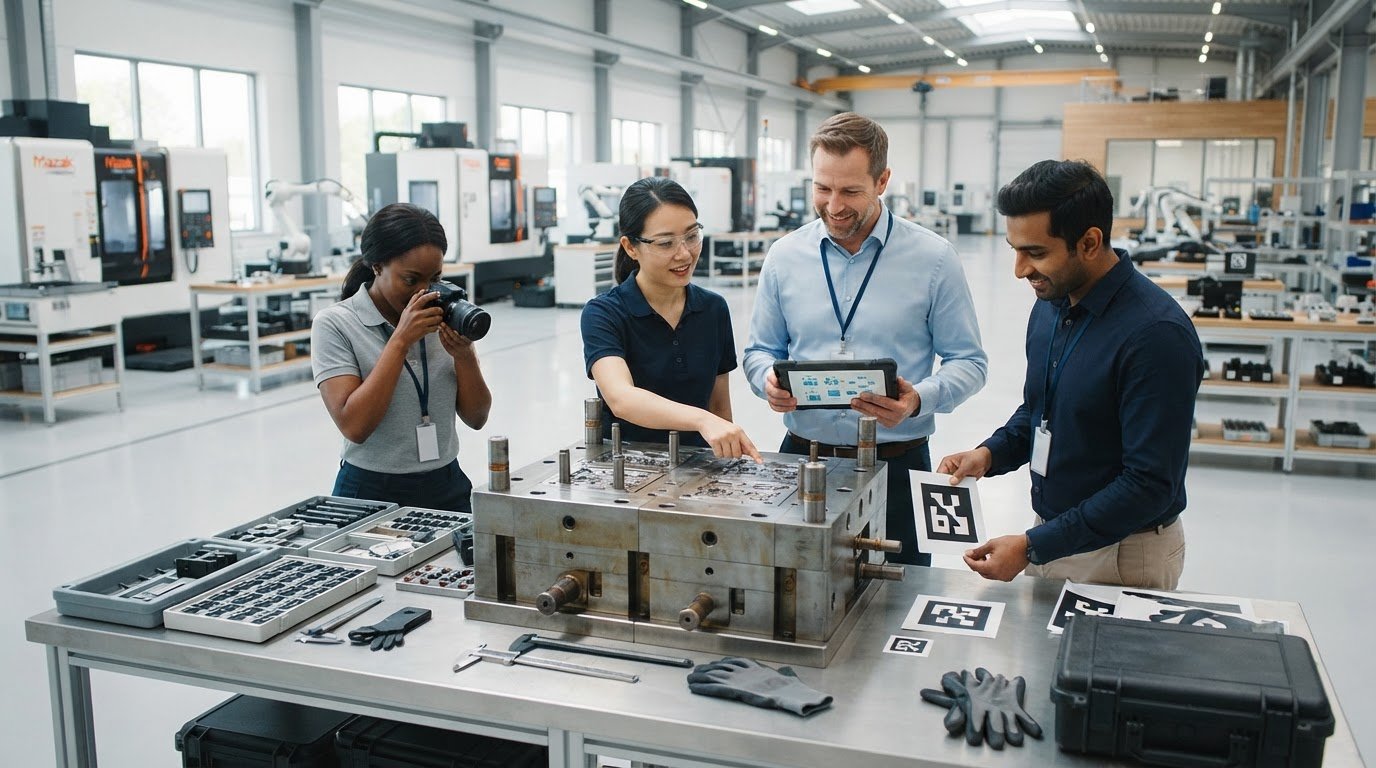
What if the mold you paid to develop couldn’t be released when you needed to change suppliers? Managing tooling and molds with a foreign factory means more than tracking where production equipment is stored. Payment alone may not establish clear ownership, access, or transfer rights. Without visibil...