


When U.S. imports from China dropped 35% in early 2026, it didn't signal the end of the relationship; it signaled the end of the unmanaged supply chain. You've likely seen your margins squeezed by the 25% Section 301 tariffs or the elimination of the $800 de minimis exemption in May 2025. It's a complex environment where moving goods from a China factory to USA warehouse involves rising sea freight rates, now reaching up to $3,025 for a 20-foot container. We understand that the lack of transparency from traditional middlemen only adds to the anxiety of global procurement.
This guide provides the strategic clarity you need to master your sourcing and logistics pipeline. You'll learn how to achieve financial optimization and secure a verified supplier network that survives current trade barriers. We'll examine the shift toward on-shored Chinese factories, the impact of the May 2026 Section 301 review, and the specific steps required to move goods with total regulatory adherence from the factory floor to your destination.
• Identify the strategic advantages of Chinese-owned US manufacturing plants as a viable alternative to traditional transpacific shipping.
• Master the calculation of total landed costs from a China factory to USA destination, incorporating the latest 2026 Section 301 tariff updates.
• Establish a defense against production failures by adopting a rigorous five-step manufacturer vetting process and on-site quality oversight.
• Replace high-risk intermediary models with an integrated procurement team to secure factory-direct pricing and full supply chain transparency.
The landscape of the China factory to USA pipeline has undergone a fundamental transformation. In 2026, importing is no longer a simple transactional process of shipping finished goods across the Pacific. It's a strategic choice between traditional offshore production and a new model of stateside manufacturing. Chinese firms are increasingly investing in U.S. manufacturing hubs, creating a "Made in USA by China" reality that allows businesses to bypass the most aggressive trade barriers while maintaining technical expertise. This dual nature of the market requires you to evaluate whether your product benefits more from the physical proximity of a US-based plant or the massive industrial scale of the mainland.
The primary driver for this shift is the heavy burden of Section 301 tariffs, which have reached up to 100% for specific sectors like electric vehicles as of late 2024. By establishing facilities in the US Midwest, Chinese manufacturers can eliminate these duties entirely. This movement is part of the broader History of US-China Trade Relations, where economic pragmatism often dictates operational shifts. Beyond tariff avoidance, these firms are attracted by competitive energy costs and local land incentives that are often more favorable than those in highly industrialized Chinese provinces. We also see a narrowing labor cost gap. While US labor remains more expensive, the high level of automation in modern Chinese-owned plants in America offsets much of the difference. This makes domestic production a viable financial strategy for businesses looking to stabilize their landed costs.
Despite the rise of domestic plants, traditional offshoring remains the dominant force for high-volume consumer goods. China offers an unmatched supply chain depth that US-based facilities cannot yet replicate. If your product requires complex sub-components or specialized raw materials, the raw availability in the PRC ensures a level of agility that domestic hubs lack. Scalability is another critical factor. When you need to ramp up mass production quickly, China-based factories possess the infrastructure and workforce density to meet aggressive timelines. For many enterprises, the most effective path involves professional sourcing and procurement directly from the source. This is particularly true for OEM manufacturing, where the integration of design and production at scale is most efficient within China’s established industrial clusters. Navigating the China factory to USA route requires a balance between these two worlds, ensuring your supply chain is resilient against both geopolitical shifts and operational bottlenecks.
Understanding the financial viability of a China factory to USA shipment requires looking far beyond the initial quote on the factory floor. The factory gate price is often a deceptive figure. To protect your margins, you must account for the total landed cost, which includes ocean freight, insurance, and the complex web of U.S. Customs fees. As of May 2026, the Merchandise Processing Fee (MPF) stands at 0.3464%, while ocean shipments incur a Harbor Maintenance Fee (HMF) of 0.125%. When you layer these on top of volatile container rates, which for a 20-foot container now range between $2,475 and $3,025, the financial landscape changes rapidly. Unmanaged supply chains often fall victim to obscured fees from intermediaries who lack the regional presence to secure true factory-direct pricing.
Compliance is your strongest defense against margin erosion. The current U.S. Trade Representative on China guidelines outline a layered tariff structure that demands precise HTS code classification. While 178 product exclusions have been extended through November 10, 2026, List 1, 2, and 3 products still carry a 25% additional duty. Specific items like battery parts saw increases to 25% as of September 2024, making the stakes incredibly high. We focus on factory direct price negotiations to mitigate these costs at the source. It isn't just about the rate; it's about ensuring the "Country of Origin" rules are strictly followed to prevent costly seizures or retrospective audits by CBP.
Choosing the right entry point is a strategic decision. West Coast ports often offer faster transit times from Asia, but the rising costs of inland trucking to the Midwest or East Coast can negate those savings. In May 2026, air freight rates have climbed to $7.99/kg, making sea freight consolidation even more essential for high-volume importers. Professional logistics coordination ensures your cargo doesn't languish in port, racking up demurrage fees that could have been avoided with better oversight. By moving away from "agent" models and toward an integrated team, you gain the transparency needed to optimize every mile of the China factory to USA journey. If you need to verify your current landed cost projections, you can request a professional cost analysis to identify potential savings.
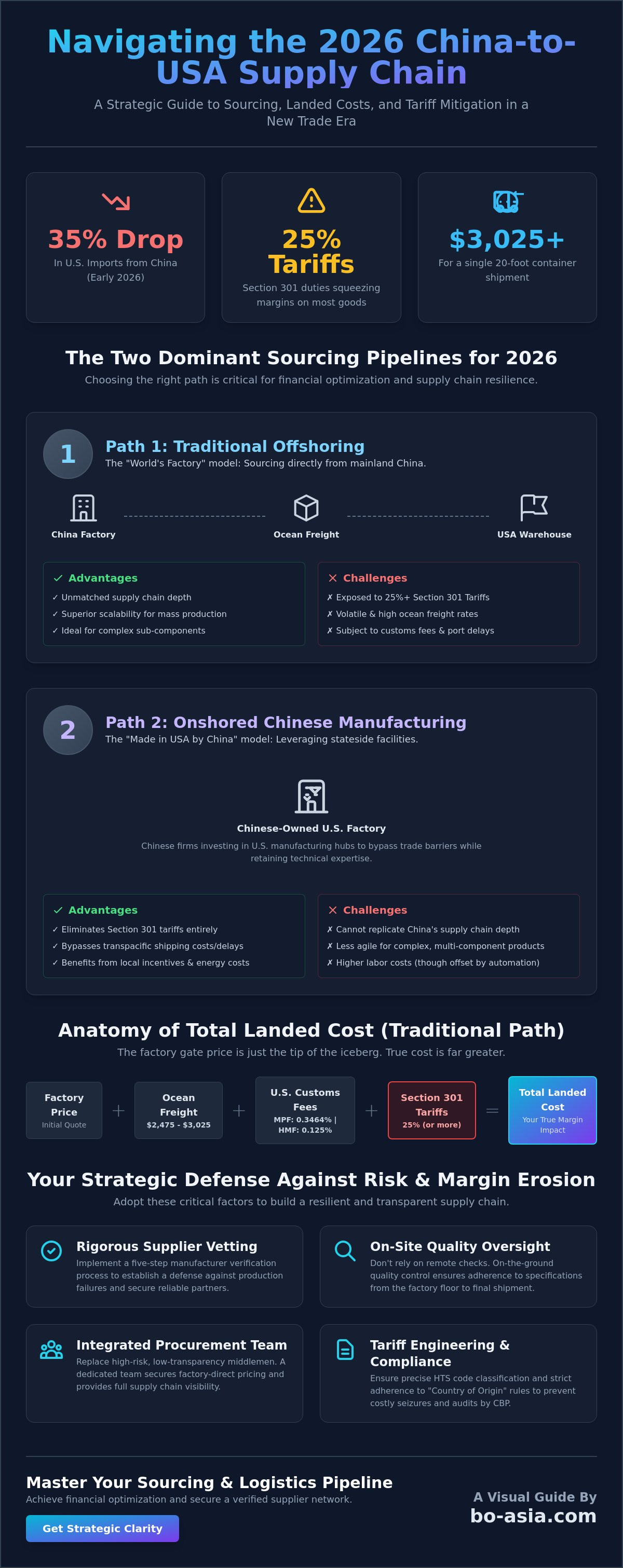
Selecting the optimal production model for a China factory to USA supply chain requires a sober analysis of your specific product requirements. The choice is no longer a simple binary between domestic and offshore. Instead, it involves weighing the industrial expertise of Asian hubs against the logistical security of stateside operations. While US-based Chinese plants offer a defense against the 80% increase in sea freight rates seen in early 2026, they often lack the specialized component ecosystems found in the PRC. You must determine if your priority is the lowest possible unit cost or the maximum protection against trans-Pacific shipping volatility.
China remains the global benchmark for OEM manufacturing because of its dense network of raw material and component suppliers. When your project requires complex custom product and tooling development, the specialized infrastructure in the PRC is often irreplaceable. Chinese factories typically offer lower minimum order quantities (MOQs) for customized items, whereas US-based automated plants require massive volume to remain profitable. To manage this effectively, leveraging a dedicated Asia procurement team ensures you maintain on-site oversight and factory-direct negotiations without the overhead of an internal department. For those formalizing these relationships, the Basic Importing and Exporting guidance provides a necessary framework for managing your legal and financial responsibilities as an importer of record.
Conversely, sourcing from Chinese-owned factories located within the United States offers a strategic advantage for Just-in-Time (JIT) delivery. This model completely eliminates the risk of port congestion and the unpredictability of international logistics. With 40-foot container rates reaching up to $3,685 in May 2026, domestic production provides a predictable cost structure that stabilizes your balance sheet. The "Assembled in USA" tag also carries significant marketing weight, allowing you to position your brand as a domestic supporter while still utilizing Chinese manufacturing efficiencies. Many successful firms now use a hybrid model: they source high-precision components from a China factory to USA final assembly line, balancing technical excellence with a reduced carbon footprint and shorter lead times.
While industry headlines often focus on large-scale reshoring, the reality for the vast majority of importers remains the direct route from a China factory to USA warehouse. Success in this lane isn't found in a digital directory or a remote negotiation. It's built through rigorous, physical verification on the factory floor. You need a defense against the operational setbacks and hidden risks that plague unmanaged supply chains. Transitioning from an "agent" model to a dedicated procurement team ensures that your interests are protected by a partner who understands the local industrial landscape as well as your financial goals.
Vetting in 2026 requires a focus on financial health and regulatory adherence that goes beyond basic certifications. You must look past the glossy digital storefront to confirm business licenses and actual production capacity. A deep-dive factory audit is the only way to identify "ghost" factories that act as fronts for unauthorized subcontracting. Our five-step process verifies that the entity signing your contract is the one actually operating the machinery. We look for red flags like shifting production schedules or unverified material sources, ensuring your supplier network is both stable and transparent.
Digital inspections are a liability in modern manufacturing. They provide a curated view that often hides batch defects or material substitutions until the goods arrive at your US facility. To maintain 100% transparency, your oversight must include on-site inspections at the pre-production, during-production, and final stages. This multi-stage approach allows you to catch errors before they become expensive, trans-Pacific mistakes. If a production halt occurs, having an on-the-ground presence allows for immediate resolution, preventing the port delays and logistics bottlenecks we analyzed in previous sections. This level of mass production oversight protects your brand from the reputational risk of faulty goods.
Modern US brands also face intense scrutiny regarding ESG and ethical standards. Compliance with labor laws and environmental regulations is now a requirement for long-term viability in the American market. We integrate these ethical checks into every supplier development plan to ensure your China factory to USA pipeline remains both resilient and compliant with global expectations. To secure your supply chain with professional on-site oversight, book a consultation with our Asia procurement team today.
The complexity of the 2026 trade environment proves that traditional sourcing agents are no longer sufficient. To maintain a competitive edge, you must move beyond the transactional "middleman" model and integrate a dedicated office into your supply chain. This shift from a third-party agent to an integrated procurement team provides the same level of oversight usually reserved for major enterprises. By establishing a physical presence at the source, you eliminate the obscured costs and lack of control that often derail a China factory to USA pipeline. Transparency is not a luxury; it is a fundamental requirement for financial viability in an era of heightened regulatory adherence.
European-managed oversight in Asian manufacturing hubs serves as a critical bridge between Western quality expectations and local production realities. This model was particularly effective in 2025. While overall U.S. imports from China fell by 29% that year, our clients utilized strategic sourcing to improve profitability by identifying efficiency gaps that unmanaged competitors missed. Reliability is built on regional expertise and the ability to intervene on the factory floor before a minor production error becomes a catastrophic brand risk.
Relying on digital directories like Alibaba often results in paying a premium for a lack of transparency. On-the-ground negotiators secure better terms because they engage directly with factory ownership rather than sales intermediaries. We utilize an "Open Book" model, ensuring you understand exactly where every cent of your budget is allocated. This approach is essential for high-volume sourcing, where even a small percentage reduction in unit cost significantly impacts your bottom line. Leveraging regional networks allows us to bypass the markups associated with conventional sourcing models, passing those direct savings to your balance sheet.
Preparing for 2027 requires predictive supply chain management. The trade relationship between the U.S. and China remains in flux, and the second four-year review of Section 301 tariffs initiated in May 2026 suggests that compliance burdens will only increase. Our Hong Kong headquarters provides a strategic advantage for global trade logistics, offering a stable base to manage the flow of goods from a China factory to USA warehouse. This regional proximity functions as a signature promise of accountability. We don't just describe a connection; we provide a defense against the operational setbacks that affect unmanaged supply chains. To secure your 2026 operations and beyond, you can protect your production with Buying Office Asia.
The 2026 trade landscape demands more than just a shipping connection; it requires a strategic defense against rising tariffs and operational opacity. Mastering the route from a China factory to USA warehouse means balancing the industrial scale of the PRC with the logistical agility of domestic assembly. We've established that success depends on rigorous, on-site vetting and an "Open Book" financial model that eliminates the hidden costs of traditional agents. Buying Office Asia provides the stabilizing force your business needs. Our European-managed on-the-ground expertise ensures that your high-volume OEM/ODM production is protected by 100% transparency and zero hidden commissions. We don't just facilitate a transaction; we act as an integrated extension of your team to secure your financial health in a volatile market. Don't leave your margins to chance in an unmanaged supply chain. You deserve the same level of oversight reserved for major enterprises. Take control of your procurement strategy today and build a resilient pipeline that survives the complexities of global trade.
Get a Free Sourcing Consultation for Your China-to-USA Supply Chain
Chinese manufacturers are establishing U.S. facilities primarily to bypass the heavy financial burden of Section 301 tariffs and the elimination of the de minimis exemption. By producing stateside, these firms can offer "Assembled in USA" products that are immune to trans-Pacific shipping volatility and port congestion. This strategy also allows them to utilize local land incentives and competitive energy costs in manufacturing hubs across the Midwest.
Finding a reliable China factory to USA partner requires a shift from digital directories to physical, on-site verification. You should prioritize suppliers with a proven track record in high-volume OEM production and documented compliance with U.S. Customs and Border Protection (CBP) standards. Utilizing an integrated procurement team ensures that every potential manufacturer undergoes a rigorous five-step vetting process before you commit your capital.
As of the second four-year review in May 2026, most goods on Lists 1, 2, and 3 still carry a 25% additional duty. While 178 product exclusions have been extended through November 10, 2026, specific categories like electric vehicles and battery parts face significantly higher rates. You must classify your products accurately under the Harmonized Tariff Schedule (HTS) to determine your exact financial liability at the port of entry.
China remains the more cost-effective option for labor-intensive, high-volume consumer goods due to its unmatched component availability and supply chain depth. Conversely, the U.S. is increasingly viable for high-value products where 25% tariffs and rising sea freight rates would otherwise erase your margins. A professional landed cost analysis is essential to identify the point where domestic production costs converge with international logistics expenses.
You can achieve total transparency by utilizing a regional procurement team that maintains a physical presence in Asian manufacturing hubs. Professional factory audits and on-site quality control inspections provide a level of oversight that digital tools cannot replicate. This approach allows you to verify business licenses, production capacity, and ethical standards directly on the factory floor while you manage your business from the United States.
A professional sourcing team acts as an integrated extension of your own company rather than a traditional third-party agent. They manage the entire China factory to USA pipeline, from factory-direct price negotiations to mass production oversight and logistics coordination. This model eliminates hidden commissions and provides the regional expertise needed to defend your supply chain against operational setbacks and regulatory risks.
Port delays often result in escalating demurrage and detention fees that can severely impact your balance sheet. These bottlenecks are typically caused by documentation errors or heightened CBP scrutiny of Chinese imports. Professional logistics management minimizes this risk by ensuring all regulatory filings are accurate and by selecting the most efficient entry points based on real-time port performance data.
Section 301 tariffs are an additional percentage tax applied to the declared value of your goods, which can double or triple your standard duty expenses. These costs must be factored into your margins at the product development stage to ensure financial viability. Precise HTS classification and the utilization of available tariff exclusions are your best strategies for mitigating these expenses and protecting your bottom line.

The lowest freight quote can carry the highest operational risk if supplier readiness, documentation, and exception handling are left outside the plan. If you’re asking how to choose a freight forwarder for Asia, look beyond the headline rate. A smooth shipment depends on who coordinates each handof...
What if your signed OEM agreement protects the product on paper but leaves the factory unclear about what to make, when to deliver it, or how quality will be judged? That gap is where an oem manufacturing agreement china project can lose control: responsibilities blur between buyer, sourcing interme...

What if the safest payment deal isn’t the one that delays the most cash, but the one that releases it only when progress is verifiable? Payment terms negotiation with Asian suppliers is about balancing your working capital with the supplier’s need for confidence, not simply pushing for a smaller dep...