

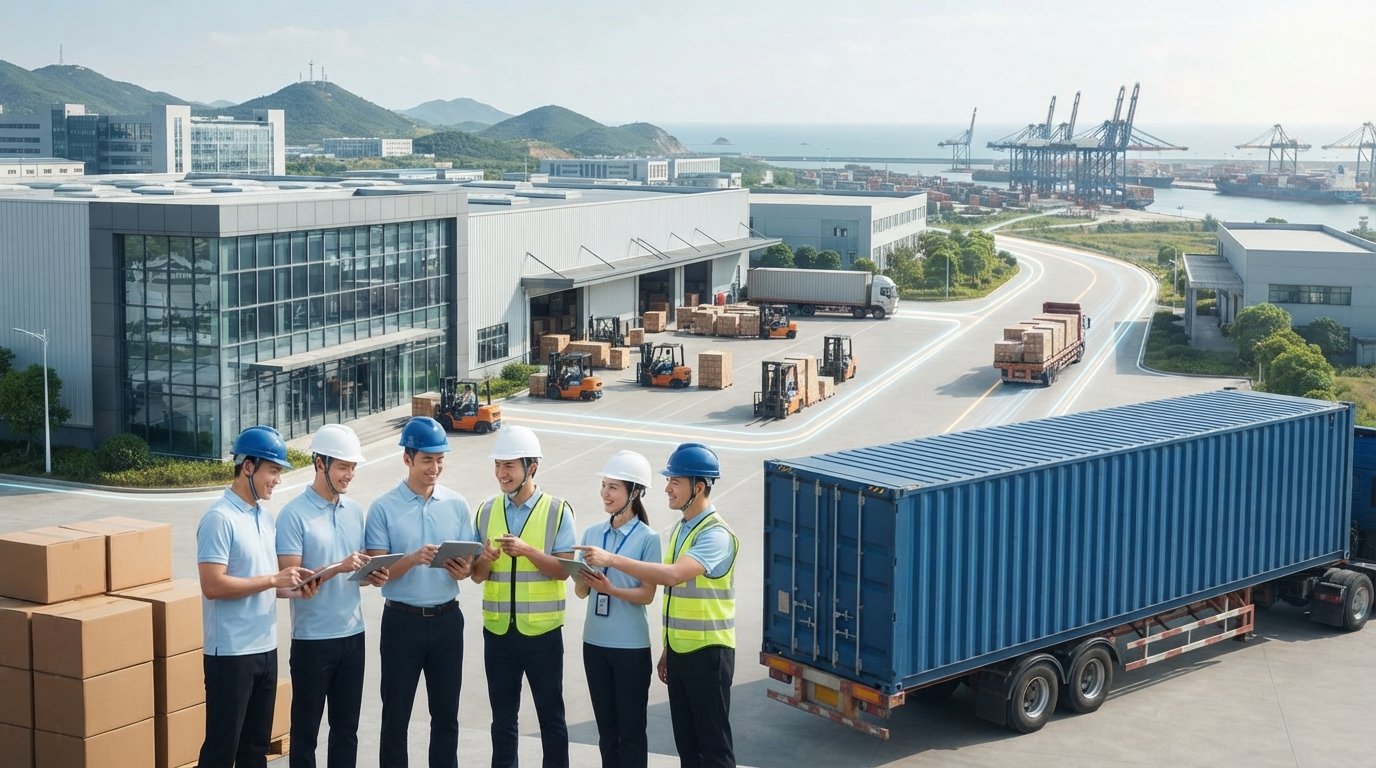
Your ocean carrier booking is rarely where your international cargo timeline breaks down. The actual point of failure occurs right at the factory gate, where unmonitored handovers turn minor workshop delays into catastrophic shipping disruptions. For cross-border procurement leaders, mastering end-to-end China manufacturing logistics coordination isn't merely an administrative task; it's the primary defense mechanism protecting your landed margins.
You already understand the compounding headaches of supply chain blind spots once finished goods leave the assembly line. Misaligned production milestones routinely collide with rigid carrier cancellation deadlines, while uncoordinated shipments from sub-tier vendors force you to absorb inflated LCL freight expenses and avoidable customs clearance holdups caused by inaccurate export paperwork.
This 2026 strategic playbook demonstrates how to synchronize factory-gate handovers with vessel schedules, consolidate multi-vendor purchase orders into secure full container loads (FCL), and verify compliance before cargo leaves the factory floor. Here is how you eliminate operational blind spots between final assembly and ocean departure.
• Mastering China manufacturing logistics coordination requires shifting oversight upstream to the factory gate, synchronizing shop-floor milestones directly with strict carrier cutoffs.
• Consolidating multi-vendor purchase orders into single full container loads (FCL) eliminates inflated LCL expenses and simplifies origin freight handling.
• Selecting between FOB, EXW, and FCA determines your operational liability and reveals hidden inland markups that factories often bundle into export quotes.
• Enforcing systematic loading supervision and pre-export documentation reviews prevents costly customs holds before containers arrive at port terminals.
• Deploying an independent, on-the-ground procurement team bridges critical time-zone gaps and eliminates blind spots between final packing and vessel departure.
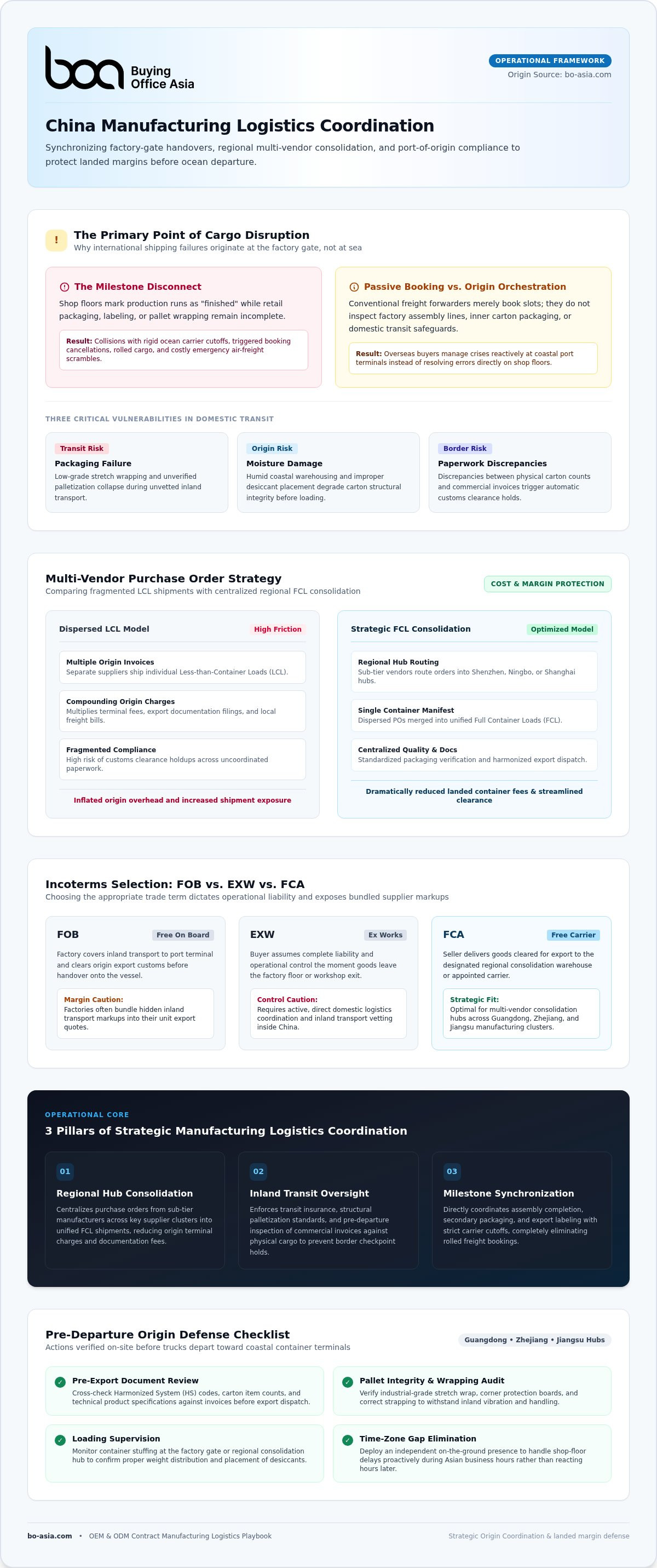
China manufacturing logistics coordination is the active operational synchronization connecting factory production schedules, origin warehousing, inland freight, and export customs dispatch. It represents the critical operational bridge in global supply chain management, converting finished goods into export-ready ocean freight. Most organizations confuse passive cargo booking with proactive origin orchestration, leaving a dangerous managerial vacuum right where their cargo is most vulnerable.
Managing this stage from a Western head office thousands of miles away creates structural blind spots. Conventional freight forwarders simply book container slots; they don't audit assembly lines, confirm inner-carton packaging specs, or inspect pallets before domestic transport departs. Without hands-on oversight during high-stakes OEM and ODM contract manufacturing runs, overseas buyers end up reacting to crises at the port terminal rather than preventing them on the production floor.
Unannounced shop-floor delays cause expensive freight cancellation penalties and missed shipping cutoffs. Factory supervisors often mark a production run as "finished" while secondary retail packaging, barcode labeling, or export pallet wrapping remain days away from completion. Western teams discover these mismatches only after the shipping line's cargo cutoff window closes, triggering rolled bookings and painful air-freight scrambles.
The moment products move past the factory gate is fraught with operational risk. Domestic carriers hired on informal terms often cut corners on basic transit safeguards. Without strict origin management, you face several compounding risks:
Low-grade stretch wrapping and unverified palletization collapse during rough domestic inland transit.
Humid coastal warehousing and improper container desiccant placement ruin packaging integrity before ocean loading.
Discrepancies between physical carton counts and commercial invoices trigger automatic customs holds at Chinese border checkpoints.
Closing these gaps demands rigorous, boots-on-the-ground management directly across local supplier hubs before trucks ever roll toward the port terminal.
Protecting your product margins requires moving beyond fragmented factory handovers. Strategic China manufacturing logistics coordination rests on three operational pillars that convert chaotic regional shipments into structured, predictable export pipelines. Managing these handovers directly across manufacturing powerhouses in Guangdong, Zhejiang, and Jiangsu shortens cash-to-order cycles while safeguarding your working capital.
Shipping multiple Less-than-Container Loads (LCL) from separate suppliers multiplies origin terminal charges, documentation fees, and inland freight bills. Directing goods from various sub-tier vendors into regional consolidation hubs in Shenzhen, Ningbo, or Shanghai lets you merge dispersed purchase orders into single Full Container Loads (FCL). This consolidation model centralizes packaging checks, streamlines export clearance under a unified manifest, and dramatically reduces landed container expenses.
Moving cargo from inland factories to coastal departure terminals introduces severe regulatory and transit risks. Unvetted domestic carriers frequently lack adequate transit insurance or cargo securement equipment. At the same time, misdeclared Harmonized System (HS) codes and documentation discrepancies trigger port customs audits. Considering the persistent regulatory uncertainty surrounding cross-border commercial compliance, having local specialists review commercial invoices and technical product specifications before container gating prevents costly terminal demurrage.
Your logistics schedule must remain tethered to technical quality metrics. Authorizing domestic freight dispatch before final on-site inspection completes is an expensive mistake. A disciplined operational protocol requires a verified Quality Assurance pass report before issuing the domestic warehouse release note. During final loading, on-the-ground supervisors ensure proper weight distribution, install industrial desiccants to prevent container rain, and apply high-security bolt seals. If you are balancing sourcing models across regions, explore our strategic logistics guide to evaluate landed cost structures.
Coordinating these interlocking milestones requires local presence rather than passive emails. You can connect with our regional procurement specialists to establish systematic origin oversight for your upcoming production runs.
Contractual trade terms dictate where legal liability transfers and determine who controls local routing. In multi-vendor manufacturing, choosing the wrong Incoterm undermines your entire China manufacturing logistics coordination strategy before cargo leaves the shop floor. Chinese manufacturing infrastructure continues to shape global supply chains, making clear contractual boundaries essential to prevent cost inflation and logistical deadlock.
Defaulting to Ex Works (EXW) or Cost, Insurance, and Freight (CIF) hands operational leverage to the wrong party. Under EXW, your business assumes total liability from the factory floor, requiring foreign entities to manage domestic Chinese road transport, local warehouse permits, and export customs clearance. Without direct regional presence, clearing customs under EXW is an administrative minefield.
Conversely, CIF appears hands-off because the supplier arranges transit to your destination port. In practice, factories use low-cost ocean carriers that work with aggressive destination handling agents. These agents hold arrival bills of lading hostage until you pay exorbitant local terminal fees, documentation surcharges, and deconsolidation markups. Both terms strip control from your procurement team and hide the real costs of transit.
Managing multi-supplier production runs successfully demands operational clarity at origin. Free On Board (FOB) remains the baseline standard for standalone sea shipments from single vendors. The supplier pays domestic trucking, absorbs origin terminal handling charges (THC), and clears Chinese customs. Risk and cost pass to you once the container clears the ship's rail.
Free Carrier (FCA) offers superior flexibility when coordinating complex component consolidation across multiple sub-tier suppliers. Under FCA terms:
Each factory remains legally and financially responsible for domestic transit and Chinese export clearance up to your nominated hub.
Risk transfers to you once goods are delivered to your regional warehouse, allowing your team to merge multiple shipments into full containers without supplier interference.
You strip hidden domestic shipping margins out of unit prices, paying only true operational costs.
Aligning these commercial terms requires rigorous supplier negotiations backed by experienced on-site oversight. Explore our structured sourcing and procurement services to optimize your purchase contracts across Chinese vendor networks.
Preventing cargo disruptions demands an active operational roadmap rather than passive tracking links. Strategic China manufacturing logistics coordination replaces unverified supplier emails with concrete physical checkpoints. Executing these five sequential steps anchors production output directly to vessel departure schedules.
Precision begins weeks before cargo moves. In Step 1, synchronize shop-floor assembly schedules directly with your ocean carrier's cargo cutoff deadlines. Audit raw material inputs and verify secondary packaging completion fourteen days prior to estimated dispatch to catch delays early. In Step 2, conduct a pre-export document audit. Review commercial invoices, packing lists, Harmonized System (HS) classifications, and any required dual-use declarations before trucks arrive, eliminating customs holds at the terminal gate.
Never permit cargo dispatch without formal technical authorization. Step 3 mandates an on-site pre-shipment quality inspection to confirm finished goods meet exact manufacturing specifications before final vendor disbursements are released. Learn more about protecting production integrity through our OEM manufacturing guide.
Step 4 requires comprehensive container loading supervision at the factory or consolidation warehouse:
Match carton counts, shipping marks, and barcodes directly against the packing manifest.
Inspect container flooring for cleanliness, verify industrial desiccant placement, and enforce proper weight distribution to prevent load shifts.
Confirm container door closure and record tamper-evident bolt seal numbers on origin paperwork.
The final phase bridges inland transit and port dispatch. In Step 5, track the container's domestic trucking leg to verify timely port terminal gate-in before the carrier's cutoff. Secure the verified gross mass (VGM) certification, monitor electronic customs release through Chinese border authorities, and verify prompt ocean bill of lading issuance. Partnering with a dedicated Asia procurement team guarantees these five checkpoints operate like clockwork.
Ready to bring operational predictability to your Chinese supply chain? Schedule a consultation with our team to implement this 5-step framework on your next production run.
Managing overseas production through distant email threads creates an expensive illusion of control. When freight deadlines loom, forwarders blame manufacturing delays, while factories blame carrier availability. Effective China manufacturing logistics coordination requires an independent partner standing directly between factory workshops and international forwarders. This physical presence cuts through finger-pointing, aligns incentives, and enforces compliance before cargo ever leaves the assembly facility.
Buying Office Asia bridges the operational divide through a dual operational model: regional headquarters in Hong Kong paired with European executive leadership in Helsinki. This structure delivers Western corporate governance alongside immediate, same-timezone intervention across major Chinese manufacturing hubs. Our teams visit factory floors in person, eliminating the miscommunication and delayed notifications that derail unmanaged supply chains.
Unlike conventional trading intermediaries that inflate shipping margins and hide supplier markups, we operate with complete financial transparency. We don't act as a freight forwarder or carrier; we serve as your fiduciary procurement partner. You get unvarnished visibility into actual transport costs, factory progress, and origin documentation. Explore our tailored procurement and shipping coordination solutions on our services page.
Treating quality control and logistics management as isolated functions creates operational friction. When your inspection team operates independently of your shipping coordinators, scheduling conflicts and delayed sign-offs inevitably stall container bookings. We unify supplier management, on-site quality inspections, and export dispatch under a single dedicated team:
The same team verifying assembly tolerances signs off on container loading and domestic transit handovers.
Container loading supervision occurs immediately upon quality approval, eliminating intermediate staging delays.
Origin export paperwork matches physical carton counts and verified product specs before carrier dispatch.
See the commercial impact of integrated on-the-ground governance in our strategic case study. To secure your supply chain with disciplined origin oversight, Partner with Buying Office Asia today.
Reliable global freight isn't won on the water. It's won at the factory gate, where rigorous milestone tracking, multi-vendor container consolidation, and verified pre-shipment inspections eliminate bottlenecks before cargo ever moves. Taking active control of your China manufacturing logistics coordination replaces reactive fire-fighting with predictable shipping schedules, protecting both your delivery promises and landed margins.
Buying Office Asia serves as your protective, on-the-ground partner across mainland China. By pairing Helsinki-based European executive governance with operational headquarters in Hong Kong, we deliver comprehensive supply chain integration that links supplier vetting, quality sign-offs, and export management. Our 100% transparent fee structure eliminates hidden agent commissions and inflated handling fees, giving you total financial clarity.
Ready to eliminate origin blind spots and streamline your Asian operations? Secure your China manufacturing logistics with Buying Office Asia and safeguard your global supply chain today.
Freight forwarders book vessel space, issue ocean bills of lading, and handle port-to-port carriage. They don't manage shop-floor readiness or inspect packaging. A dedicated partner providing China manufacturing logistics coordination stands inside origin operations. They audit manufacturing schedules, inspect goods, supervise container packing, and resolve customs documentation before cargo ever moves toward the port. Buying Office Asia acts as a management partner, not a freight carrier.
Yes. Consolidating multi-supplier purchase orders into a single full container load (FCL) requires setting up a regional hub warehouse in major industrial centers like Shenzhen, Ningbo, or Shanghai. Sub-tier vendors deliver goods under Free Carrier (FCA) terms. On-site logistics teams verify carton counts, perform loading supervision, and generate a unified customs declaration, eliminating costly Less-than-Container Load (LCL) freight surcharges.
It stops schedule slippage upstream before shipping line cancellation windows close. When proactive China manufacturing logistics coordination occurs at the factory gate, on-site teams physically verify packing completion, barcoding, and export paperwork fourteen days prior to dispatch. Catching workshop delays or documentation discrepancies early prevents rolled carrier bookings, costly air-freight scrambles, and extended terminal demurrage penalties at the departure port.
The cargo dispatch must be held immediately, and the freight forwarder should be notified to roll the booking to a subsequent vessel. Releasing uninspected or defective goods to protect a booking cutoff risks expensive overseas returns and unsellable inventory. An on-site partner supervises factory rework, updates the ocean carrier before cancellation penalties apply, and re-inspects goods before container loading.
Neither is ideal for multi-supplier programs; Free Carrier (FCA) is typically best. EXW places the complex burden of domestic trucking and Chinese export clearance onto overseas buyers. FOB works well for single factories, but forces multiple vendors to handle fragmented port bookings. FCA allows each supplier to clear customs locally and deliver to your nominated consolidation warehouse, giving you total control over the container build.
Standard export customs clearance requires a commercial invoice, packing list, export customs declaration, customs power of attorney, and the ocean bill of lading or sea waybill. Depending on commodity classifications, shipments may also require a certificate of origin, chemical testing reports, or specific dual-use export permits. Inaccurate Harmonized System (HS) codes or packaging discrepancies routinely trigger customs inspection holds.
Factories routinely prioritize raw assembly speed over secondary requirements like retail packaging, drop-testing, palletization, or export labeling. In addition, sub-tier component delays or shop-floor bottlenecks often go uncommunicated to overseas buyers until the cargo cutoff has already passed. Without independent on-site tracking monitoring milestones two weeks in advance, buyers discover production delays only after missing carrier deadlines.

The lowest freight quote can carry the highest operational risk if supplier readiness, documentation, and exception handling are left outside the plan. If you’re asking how to choose a freight forwarder for Asia, look beyond the headline rate. A smooth shipment depends on who coordinates each handof...
What if your signed OEM agreement protects the product on paper but leaves the factory unclear about what to make, when to deliver it, or how quality will be judged? That gap is where an oem manufacturing agreement china project can lose control: responsibilities blur between buyer, sourcing interme...

What if the safest payment deal isn’t the one that delays the most cash, but the one that releases it only when progress is verifiable? Payment terms negotiation with Asian suppliers is about balancing your working capital with the supplier’s need for confidence, not simply pushing for a smaller dep...