


In 2026, the traditional intermediary model isn't just inefficient; it's a liability that can inflate your landed costs by up to 40% through a single operational misstep. You've likely felt the frustration of opaque pricing from middlemen or the anxiety of losing control over factory production as trade regulations shift. It's a common struggle for businesses trying to maintain margins while refining their China to USA supply chain management in a volatile market. We understand that your financial health depends on stability and precision, not guesswork from a third party thousands of miles away.
This article provides a strategic blueprint to eliminate unnecessary layers, mitigate geopolitical risks, and optimize your procurement for maximum profitability. You'll learn how to secure factory-direct pricing transparency and implement on-site quality controls that protect your brand. We'll also examine the impact of the May 2025 de minimis exemption removal and the July 2026 CPSC eFiling mandates. By the end of this briefing, you'll have the insights needed to transform your supply chain into a lean, high-performance asset that thrives under pressure.
• Understand the critical shift from 'just-in-time' to 'just-in-case' resilience needed to navigate the 2026 trade landscape.
• Dismantle the 'hidden middleman tax' by transitioning to a 100% transparent model that secures factory-direct pricing.
• Learn why physical proximity and on-site oversight are the only ways to secure your China to USA supply chain management against production delays and quality failures.
• Implement a rigorous five-step framework for supplier vetting and engineering-led product development to protect your margins.
• Recognize the strategic advantage of treating your procurement team as an integrated extension of your own company rather than a third-party vendor.
Managing the flow of goods from Chinese manufacturing hubs to US distribution centers in 2026 is no longer a simple logistical exercise. It has evolved into a high-stakes strategic discipline. Effective Supply chain management (SCM) now requires a fundamental shift from the "just-in-time" efficiency of the past decade toward a "just-in-case" resilience model. This change is driven by a need to buffer against sudden port closures and the extreme volatility of Transpacific spot rates. In July 2026, US ports handled a record 2.47 million containers as importers rushed to beat tariff deadlines, proving that capacity is a resource you must secure in advance.
The regulatory environment has tightened significantly. With the May 2025 elimination of the $800 de minimis threshold and new CPSC eFiling mandates effective July 2026, the era of unmanaged, low-oversight importing is over. For high-volume enterprise needs, relying on digital platforms like Alibaba is no longer sufficient. These platforms lack the granular oversight required to handle complex Section 301 tariffs, which remain between 7.5% and 25% for most goods. Professional China to USA supply chain management demands an on-the-ground presence that digital dashboards cannot replicate.
Experts from institutions like MIT have observed the "weaponization" of global supply chains, where trade becomes a tool of geopolitical leverage. You can mitigate these risks by partnering with a team that maintains a physical presence in Hong Kong and Helsinki. This regional footprint provides a buffer against sudden policy shifts. European management ensures your operations adhere to strict ethical and regulatory standards, providing a layer of security that traditional local agents often bypass. It's about building a defense against operational setbacks before they reach the water.
Many importers mistakenly focus solely on shipping, yet logistics typically represents only 20% of the total cost equation. The real drain on profitability occurs through opaque factory pricing and production errors. Moving to an End-to-End Sourcing & Procurement model allows you to capture the remaining 80% of value. Rigorous supplier vetting is essential in 2026 to ensure factory capacity matches your scaling needs. By transitioning to a dedicated procurement team, you treat your supply chain as an integrated extension of your business rather than a series of disconnected transactions.
Traditional sourcing agents often operate in the shadows, creating a "Hidden Middleman Tax" that erodes your profitability. These intermediaries frequently claim to offer free services while securing kickbacks or adding undisclosed markups to factory quotes. In the context of China to USA supply chain management, this lack of clarity is more than an annoyance; it's a strategic risk. When you don't know the true cost of production, you can't accurately forecast margins or compete effectively in the US market. Modern China sourcing requires a foundation of 100% transparency where every dollar spent is accounted for and justified.
While many headlines discuss the complexities of decoupling from China, the reality for most high-volume US brands is that China remains an essential manufacturing partner. The goal shouldn't be to leave, but to gain absolute control over the relationship. An integrated procurement partner acts as an extension of your own team. Unlike transactional agents who profit from your lack of knowledge, a dedicated team focuses on long-term stability and financial optimization through a transparent service-fee model.
Opaque models do more than just inflate costs. They often hide the fact that your "factory" is actually a second-tier trader with no manufacturing capability. This creates a dangerous gap in mass production oversight. You risk losing control over your intellectual property and custom tooling because the intermediary owns the relationship, not you. For high-volume production, direct factory access is non-negotiable. It ensures that your quality standards are communicated directly to the shop floor without being filtered through an agent's agenda.
Achieving true factory direct price negotiations requires on-the-ground expertise. Auditors must verify raw material costs and labor rates to ensure the factory isn't padding the bill. This level of scrutiny allows for significant savings achieved through direct oversight rather than relying on an agent's "best price." By stripping away the middleman's margin, you reinvest that capital into product quality or marketing. If you are ready to audit your current procurement costs, you can connect with our team for a transparent assessment of your existing supplier relationships.
Digital dashboards offer a sense of control that is often illusory. Managing high-volume China to USA supply chain management from a remote office leaves your brand exposed to "quality fade" and unauthorized sub-contracting. When a factory floor dispute arises, a digital message rarely resolves it with the necessary urgency. Physical proximity allows for immediate intervention, preventing small technical errors from becoming catastrophic financial losses. The cost of a single rejected 40HQ container, which currently averages between $3,500 and $7,902 in shipping costs alone, far outweighs the investment in professional on-site oversight.
Pre-shipment inspections are a reactive measure; they tell you what went wrong after the damage is done. During-production oversight is proactive. It allows your team to catch defects while the goods are still on the line, ensuring corrective actions are taken before the final assembly. You must ensure that explicit verification clauses are written into every manufacturing contract to guarantee unrestricted access for your auditors. This on-site presence is the only reliable method to reduce batch defect rates and maintain the rigorous standards your US customers expect.
The "Yes-Man" culture in many manufacturing hubs often leads to over-promising and under-delivering. Factories may agree to aggressive timelines or complex specifications they can't actually meet just to secure the order. Navigating this requires seasoned negotiators who understand both local manufacturing culture and Western business requirements. Our Finnish leadership team provides the professional rigor you expect, while our Hong Kong presence ensures real-time accountability. We've replaced opaque weekly emails with instant production data and transparent reporting. By utilizing a dedicated Asia procurement team, you gain a protective force that operates as an integrated extension of your own company.
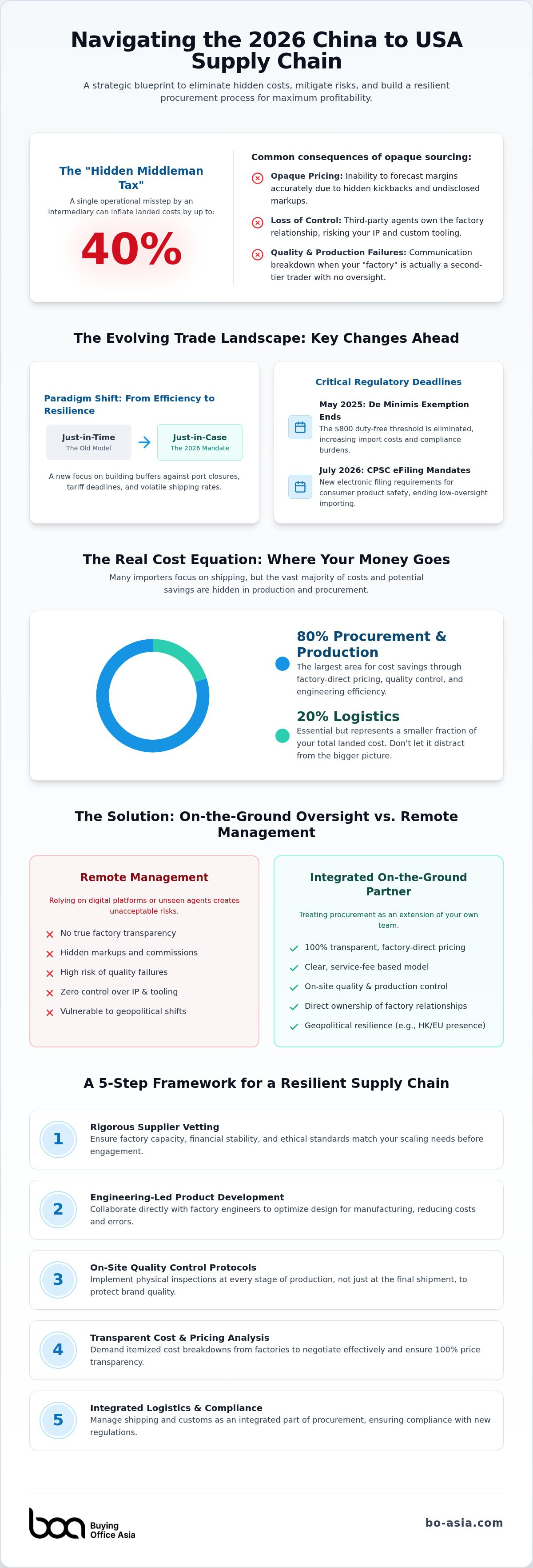
Optimizing China to USA supply chain management requires moving from passive observation to active control. This transition is achieved through a disciplined, five-step implementation roadmap that secures every link of the chain. You don't just need a vendor; you need a process that eliminates the variables that lead to unforeseen expenses and delays. By following this framework, you transform a complex international operation into a predictable business asset.
Conduct on-site audits that verify manufacturing capacity and financial stability rather than relying on digital certificates.
Ensure technical specifications are finalized and understood by the factory engineers before the first deposit is paid.
Finalize contracts that include penalty clauses for quality deviations and clear timelines for production milestones.
Deploy full-time monitors during mass production to catch defects on the line before they ever reach the shipping container.
Coordinate the hand-off from factory gate to port to minimize demurrage and storage fees while ensuring all customs documentation is pre-cleared.
Managing custom product and tooling development is the most vulnerable phase for intellectual property theft and technical failure. You must ensure that all proprietary molds and designs are legally owned by your entity and physically secured at the factory. The golden sample serves as the immutable benchmark for the 2026 standards, bridging the gap between engineering intent and factory floor execution. This physical prototype remains your only defense against "specification drift" during high-volume runs. Without it, you have no objective basis for rejecting sub-standard batches or negotiating repairs.
In 2026, shipping a 40HQ container from Shanghai to Los Angeles fluctuates between $3,000 and $4,200, while New York rates can exceed $6,000. Consolidating shipments at the origin is a primary strategy to reduce these trans-Pacific freight costs. You must also navigate US customs with pre-verified documentation to avoid the $5,000 fine for late Importer Security Filing (ISF). By coordinating production schedules with vessel departures, you can often compress total lead times by up to 20%. This level of coordination requires a team that understands both the factory floor and the shipping manifest. If you're ready to implement these steps and secure your margins, schedule a strategic consultation with our team.
Scaling isn't just about increasing order volume; it's about hardening your infrastructure against the variables of a complex global market. For many independent US business owners, Buying Office Asia functions as a stabilization force. We provide the protective oversight and regional expertise that smaller teams often lack. By moving from transactional sourcing to integrated China to USA supply chain management, you capture value that agents typically obscure. This shift isn't merely an operational change. It's a strategic defense that secures your margins against the volatility seen in 2026.
A robust, transparent supply chain is a key asset during business valuation; for those exploring such opportunities, SellAnyBiz.com | AI-Powered Business Marketplace & M&A Platform facilitates the acquisition and sale of mid-market brick-and-mortar companies.
The ROI of an integrated model is clear when you consider that a single misstep in planning can increase landed costs by up to 40%. Our documented outcomes show that high-volume brands achieve greater stability by securing production lines well before peak seasons. In July 2026, when US ports handled a record 2.47 million containers, our clients were already positioned with pre-verified documentation and secured capacity. Local presence isn't a luxury in this environment; it's the only true defense against the delays and demurrage fees that erode profitability.
Bridging the cultural and professional gap between a US headquarters and an Asian factory floor requires more than just a translator. It requires a shared philosophy of professional rigor and ethical standards. Our Helsinki-based leadership ensures that your ESG requirements and regulatory compliance are met at every tier of the chain. The Helsinki-Hong Kong management axis provides the legal security of European oversight combined with the tactical advantage of physical proximity to your manufacturers.
Transitioning from an opaque agent model to a dedicated procurement team is a methodical process. We begin by auditing your current supplier relationships and identifying hidden markups or quality risks. Proactive procurement is essential for the 2026 peak season, where shipping rates often increase by 15% to 25%. By finalizing your strategy now, you protect your brand from the rush to beat tariffs that disrupts unmanaged chains. You can contact Buying Office Asia to audit your current supply chain and begin the transition to a more secure, transparent model.
The 2026 trade environment rewards precision and punishes ambiguity. You've seen that successful China to USA supply chain management now requires a shift from "just-in-time" convenience to "just-in-case" resilience. By eliminating the hidden middleman tax and implementing on-site mass production oversight, you reclaim control over both your product quality and your financial health. Professionalism in this market isn't just about finding a supplier; it's about building an integrated defense against regulatory shifts and opaque pricing models.
Buying Office Asia stands as your seasoned insider in this complex landscape. As a European-managed firm with over 15 years of experience, we provide the regional expertise and on-the-ground presence in Hong Kong and China that your brand deserves. We operate with 100% transparency and zero hidden commissions, ensuring every dollar you invest strengthens your market position. Transitioning to a model of physical accountability ensures your brand remains competitive regardless of market volatility.
Secure your 2026 production with a dedicated Asia procurement team today and stabilize your path to growth.
Transit times for ocean freight typically range from 18 to 22 days for West Coast ports and up to 35 days for the East Coast. However, total lead times in 2026 must account for record port volumes and tighter customs scrutiny. You should factor in an additional 14 to 21 days for production, documentation, and inland distribution to ensure your inventory remains resilient against seasonal spikes.
Managing your operations from a remote office leaves you vulnerable to quality fade, where a factory slowly substitutes cheaper materials to increase their own margins. Without physical presence, you cannot verify if a supplier has outsourced your order to a lower-tier facility with no quality standards. This lack of oversight often leads to batch failures that are only discovered once the goods arrive at your US warehouse.
You can detect hidden commissions by requesting a detailed cost breakdown that separates raw materials, labor, and overhead from the final unit price. If your agent refuses to provide direct factory contact or original invoices, they are likely obscuring markups. A professional audit of the factory's standard price list against your quoted price usually reveals the middleman tax that inflates your total procurement costs.
A sourcing agent typically operates on a transactional basis, focusing only on finding a supplier and collecting a commission. In contrast, an end-to-end procurement partner acts as an integrated extension of your team, managing everything from engineering-led development to on-site mass production oversight. This model prioritizes long-term financial optimization and 100% transparency, whereas agents often prioritize their own undisclosed kickbacks over your brand's security.
Protecting your intellectual property requires securing legal ownership of all custom molds and tooling through explicit contract clauses. You should implement NNN agreements that are enforceable in Chinese courts rather than relying on generic US contracts. For high-sensitivity products, consider splitting production between different factories so no single entity possesses the complete technical blueprint for your entire product line, effectively mitigating the risk of unauthorized replication.
Yes, on-the-ground management significantly reduces your landed cost by eliminating production errors that lead to expensive air-freight corrections. Professional China to USA supply chain management identifies inefficiencies on the factory floor that remote managers miss. By securing factory-direct pricing and avoiding the $5,000 ISF late-filing fines through better coordination, the savings generated often exceed the cost of the management service itself.
Common pitfalls include failing to file the Importer Security Filing (ISF) at least 24 hours before loading, which triggers an automatic $5,000 fine from CBP. Many importers also misclassify goods under incorrect HS codes, leading to unexpected Section 301 tariff charges. Additionally, neglecting to consolidate LCL shipments into FCL once volumes exceed 15 cubic meters results in significantly higher per-unit shipping costs that erode your profit margins.
Manufacturing in China remains highly profitable in 2026 for businesses that prioritize strategic China to USA supply chain management over unmanaged sourcing. While tariffs and shipping costs have risen, China's unrivaled manufacturing infrastructure still offers the best scale for high-volume production. Success depends on your ability to strip away middleman markups and maintain rigorous on-site oversight to ensure every unit meets your target margin.

As of July 2026, the average effective tariff rate on Chinese imports has climbed to 22.8%, but is the cost on the invoice really your biggest financial risk? You likely feel the mounting pressure of managing a supply chain where the rules of engagement change every quarter. The challenges of sourci...

Is your current China manufacturing management strategy robust enough to survive the regulatory shifts of 2026? With the recent implementation of Decree 834 and the new "Made in China" procurement standards, the distance between a successful product launch and a costly supply chain failure has never...

What if your final quality check isn't just a formality, but the only thing standing between a successful product launch and a container full of unsellable defects? For many businesses, the fear of receiving substandard goods from overseas is a constant anxiety, often compounded by communication bar...