


The "zero-percent" service fee model is often the most expensive line item on a balance sheet. While a 3% to 10% commission might look like a low-risk entry point, it frequently masks a conflict of interest where agents prioritize higher-priced suppliers to pad their own payouts. Deciding between a commission vs flat fee sourcing agent isn't just about the service invoice you see; it's about the hidden factory markups you don't. You need a procurement strategy that treats your capital with the same rigor you apply to every other part of your business.
We recognize the anxiety that comes with a lack of control over international manufacturing costs. This guide provides a strategic breakdown of sourcing fee structures to help you identify the model that ensures transparency and maximizes your manufacturing profitability in 2026. You'll learn how to eliminate the middleman tax, secure true factory-direct pricing, and establish a reliable, on-the-ground procurement team in Asia. By the end of this briefing, you'll have the framework necessary to transform your supply chain from a source of risk into a measurable competitive advantage.
• Understand the transition from transactional commission models to sophisticated procurement retainers that prioritize your long-term manufacturing profitability.
• Evaluate the commission vs flat fee sourcing agent debate to identify how percentage-based fees can inadvertently lead to hidden factory markups and misaligned incentives.
• Learn why enterprise-level procurement teams prefer flat-fee structures to ensure the focus remains on operational efficiency and strict quality control.
• Utilize a strategic decision matrix to select the most viable fee model based on your specific production volume, technical complexity, and risk profile.
• Discover why physical proximity and a dedicated regional presence in Asia are the ultimate safeguards for securing true factory-direct pricing and supply chain transparency.
The global procurement process has undergone a fundamental shift. By 2026, the industry has moved away from opaque, handshake-based deals toward a standard of 100% transparency. This evolution is most visible in the debate of commission vs flat fee sourcing agent models. In the past, businesses accepted a lack of clarity as a necessary evil of doing business in Asia. Today, that lack of control is recognized as a direct threat to your bottom line and your brand's financial health.
The evolution of sourcing fees reflects a broader demand for accountability. A decade ago, a simple commission was the standard. Today, sophisticated service retainers are the hallmark of enterprise-level procurement. This shift isn't just about how you pay; it's about what you're buying. You aren't just paying for a contact list. You're paying for a defense against operational setbacks, quality failures, and unmanaged supply chain risks. A professional supply chain management firm differs from a traditional agent by offering a comprehensive suite of services, including factory-direct price negotiations and on-site quality control.
Many agents still promote a "free" or "zero-percent fee" model, but this is a dangerous myth. If an agent isn't charging you a visible fee, they're likely collecting a hidden markup from the factory. These kickbacks can range from 10% to 30% of the unit price according to industry reports. This effectively turns your agent into a salesperson for the factory rather than a protector of your interests. When you choose between a commission vs flat fee sourcing agent, you're essentially choosing between a transactional middleman and a professional ally who is financially incentivized to drive your costs down.
Transactional agents focus primarily on one-off supplier identification and basic vetting. They're often the first choice for small businesses or those importing simple, low-complexity products where the risk of failure is manageable. These agents typically operate on a per-project or commission basis. While this seems cost-effective for a single order, it lacks the depth required for mass production oversight. Without a long-term commitment, these agents have little incentive to monitor ongoing quality or negotiate better terms as your volume grows.
A strategic partner provides end-to-end sourcing and procurement by acting as a seamless extension of your own team. Unlike a transactional agent, a management firm focuses on long-term supplier development and total cost of ownership (TCO). This model prioritizes risk mitigation, ensuring that every factory audit and quality inspection serves your brand's reputation. By 2026, the most successful importers have moved toward this integrated approach to secure their ROI. They don't just want a supplier; they want a resilient, on-the-ground presence that manages the entire lifecycle of the product from sampling to shipping.
The traditional commission model operates on a deceptively simple premise. For orders under $10,000, you likely pay a 10% commission; for larger volumes over $100,000, this often drops to a range between 3% and 5%. While this sliding scale appears to reward growth, it creates a structural flaw in the commission vs flat fee sourcing agent comparison. When your agent's income is tied directly to the total purchase price, their financial interests align with the factory rather than your balance sheet. This is a fundamental divergence from the professional standards expected of Purchasing Managers, Buyers, and Purchasing Agents who are traditionally tasked with aggressive cost optimization and value engineering.
This "Conflict of Interest" trap is the primary driver of unmanaged manufacturing expenses. A commission-based agent doesn't have any incentive to fight for a lower unit price because doing so reduces their own payout. In many cases, this leads to the "kickback" phenomenon. The agent may claim to work for you, but they simultaneously collect a secret 10% to 30% markup from the supplier. You end up paying twice: once in the visible commission and once in the inflated product price. This dual-payment structure effectively subsidizes the agent's operations at the expense of your ROI. It turns your procurement process into a profit center for the middleman rather than a lean operation for your brand.
The failure point occurs during price negotiations. A strategic partner should aggressively pursue factory-direct savings, but a commission agent often accepts the first quote provided by the supplier. This lack of transparency means you won't see the true manufacturing cost. Over time, these misaligned incentives prevent the year-over-year cost reductions vital for a competitive edge. Commission models can inadvertently inflate your landed cost by 15% to 20% compared to transparent procurement methods. If you want to secure your margins, aligning with a transparent partner is essential.
Agents who offer low commissions often recoup margins through back-end charges. You might see inflated domestic shipping costs, excessive sampling fees, or undisclosed exchange rate markups. Auditing these supply chains is difficult because the financial trail is obscured. To protect your investment, you need a dedicated Asia procurement team that prioritizes your bottom line. Making the right choice between a commission vs flat fee sourcing agent is a matter of long-term financial security.
Enterprise-level procurement requires a shift from transactional interactions to strategic partnerships. While smaller importers often default to percentage-based models, sophisticated operations recognize that the debate of commission vs flat fee sourcing agent is really about incentive alignment. A flat-fee structure ensures that your agent’s primary objective is to drive down your total cost of ownership. Because their compensation is fixed, they are free to negotiate the most aggressive factory-direct prices without sacrificing their own margins. This model removes the bias toward higher-priced suppliers, placing the focus squarely on your financial health.
Integrating service fees into your financial planning allows for a dedicated on-the-ground presence that functions as your own "Dedicated Asia Procurement Team." This model transforms the agent from an external vendor into an integrated extension of your corporate structure. You aren't just buying a service; you're securing a regional defense against supply chain volatility. Fixed costs incentivize the agent to focus on long-term quality and operational efficiency, which is the only way to protect your ROI in a complex manufacturing environment. It creates a partnership where success is measured by the stability and profitability of your production lines.
Transparency is the cornerstone of the retainer model. Unlike commission agents who may obscure factory invoices to hide markups, professional firms provide open-book access to every cent of the manufacturing and logistics spend. This 100% transparency eliminates middlemen and ensures you're paying the true factory-direct price. You gain the ability to verify every transaction, from raw material costs to final shipping duties. This level of oversight is a prerequisite for any business serious about financial optimization and regulatory adherence in 2026. It replaces the anxiety of the unknown with the steady confidence of documented data.
High-volume sourcing demands more than just occasional check-ins. It requires continuous mass production oversight and rigorous quality control. A retainer model provides the financial predictability needed to maintain ongoing supplier management and performance auditing. Instead of worrying about fluctuating commission costs as your orders scale, you benefit from a stable, manageable expense. This approach allows you to focus on market expansion while your regional team handles the technical complexities of supplier development and risk mitigation. It is a sophisticated, elite level of oversight designed specifically for the growth of independent business owners.
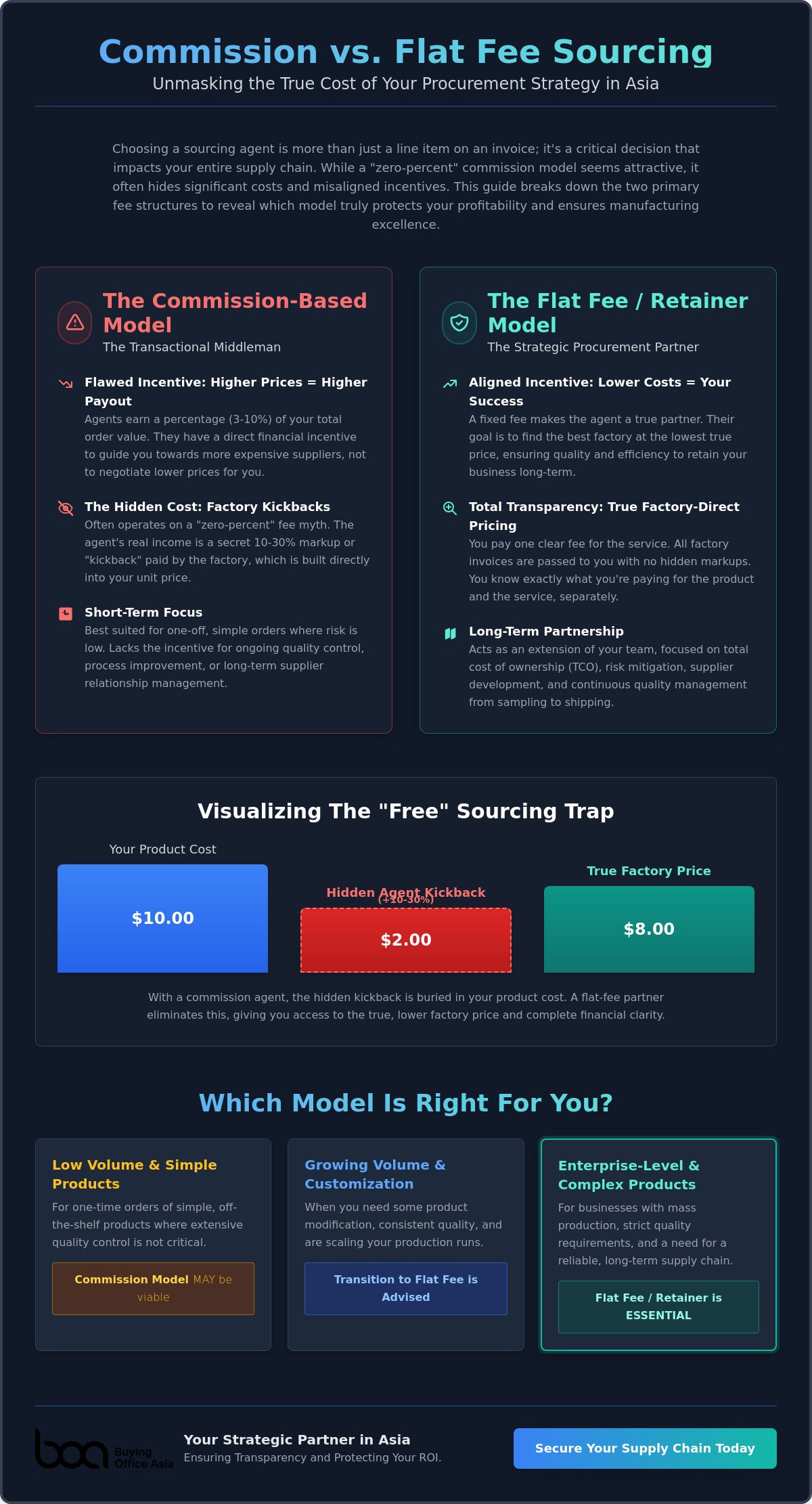
Selecting the optimal model in the commission vs flat fee sourcing agent debate depends entirely on your operational scale and technical requirements. For a startup testing the waters with a single product, a commission might feel like a variable cost that scales with success. However, for established brands, that same percentage becomes a significant financial drain. You need to identify the exact point where your procurement costs stop being an investment and start being an unmanaged expense. This transition often occurs when your annual spend exceeds the threshold where a fixed retainer provides more hours of dedicated oversight than a percentage-based fee ever could.
High-value sourcing requires a clean break from percentage-based models. When your order volume reaches significant levels, a 5% commission can easily surpass the cost of a full-time, on-the-ground team. By switching to a flat fee, you effectively cap your procurement overhead while increasing your level of service. This shift allows you to reinvest those savings into product development or market expansion. It's about moving from a transactional middleman to a professional structure that mirrors the efficiency of a China sourcing company integrated into your own operations.
A 10% commission on a $10,000 trial order is a manageable $1,000. It covers basic vetting and order processing. But apply a 5% commission to $1,000,000 in annual procurement, and you're paying $50,000 for the same transactional service. In this scenario, the ROI loss is staggering. A fixed retainer would likely provide a dedicated team for a fraction of that cost, offering deep-dive inspections and strategic supplier management that a commission agent simply won't perform. Consider these volume benchmarks:
Commission ($1,000) is often viable for simple, low-risk sourcing.
Commission ($12,500) starts to outpace the cost of professional management.
Commission ($50k+) creates a massive profit gap compared to a fixed retainer model.
Before committing to a fee structure, you must evaluate the depth of service provided. Does the agent’s fee include the ability to conduct rigorous factory audits on-site? Professional firms maintain a clear separation between the actual product cost and their service fees. This ensures that every dollar you spend is accounted for. You should also verify how the agent handles logistics and shipping coordination. A transparent partner will pass through the actual shipping costs without adding hidden markups, whereas a commission agent may use logistics as a secondary profit center.
If you're ready to move beyond transactional sourcing and secure your manufacturing margins, reach out to our team today for a professional briefing on your procurement options.
In the global market of 2026, focusing solely on the service invoice is a tactical error. A low fee is irrelevant if your agent fails to secure factory-direct pricing or misses a critical quality defect during mass production. The real value lies in a structure that protects your brand from the systemic risks of unmanaged production. This is where the distinction between a commission vs flat fee sourcing agent becomes a matter of operational survival. Transparency isn't just a business goal; it's the financial barrier that prevents your margins from being eroded by hidden interests and misaligned incentives.
The most effective procurement strategy combines European accountability with regional execution. Our Helsinki office provides the high-level corporate consultancy and legal security you expect, while our Hong Kong operations ensure we're on the factory floor when it matters most. This hybrid model offers a level of oversight that generic agents simply can't match. By positioning Buying Office Asia as an integrated extension of your own team, we function as a protective shield against the volatility and lack of control often found in international trade.
We eliminate hidden markups by utilizing a 100% transparent fee structure. This approach turns saved commissions into tangible product quality and improved lead times. Our team prioritizes a physical, on-the-ground presence to conduct on-site quality control throughout the manufacturing cycle. You don't have to guess about the status of your order because our regional experts are there to verify it in person. You can see the impact of this professional oversight in our documented success stories and performance history, where we've consistently secured better terms than traditional intermediaries who operate without local accountability.
The cheapest agent is often the most expensive in the long run. When you choose a partner based on the lowest visible fee, you're often inviting obscured costs and brand risks into your supply chain. A professional, European-managed procurement partner provides the calm assurance you need to scale with confidence. Deciding between a commission vs flat fee sourcing agent is ultimately about choosing between a transactional cost and a strategic investment in your company's future. If you're ready to optimize your margins and gain total control over your manufacturing, schedule a consultation to optimize your Asia procurement strategy today.
Navigating the complexities of international trade requires more than just a contact list; it requires a structural commitment to transparency. We've analyzed how the commission vs flat fee sourcing agent choice dictates the integrity of your supply chain. While percentage-based models often hide a conflict of interest, a professional retainer aligns your agent’s goals with your own financial health. High-volume manufacturing demands this level of rigor to eliminate hidden markups and secure true factory-direct pricing.
By partnering with a European-managed firm with offices in Helsinki and Hong Kong, you gain a dedicated Asia procurement team that operates as an extension of your business. We specialize in end-to-end supply chain management with 100% transparency and zero hidden fees. This approach doesn't just protect your ROI; it builds a resilient foundation for sustainable growth. It's time to move away from unmanaged risk and toward the steady confidence of professional oversight. Get a Transparent Quote for Your Asia Procurement Team today and take control of your production destiny. Your brand's profitability deserves a partner that prioritizes your bottom line.
Not necessarily. While the visible percentage may seem low on a trial order, commission-based agents often lack the incentive to negotiate the lowest factory-direct price. You might pay a 10% commission but end up with a unit price that is 20% higher than market value due to hidden markups. For small batches, the total landed cost is often higher than if you had used a transparent fee structure.
The most reliable sign is a lack of transparency regarding original factory invoices. If your agent refuses to let you communicate directly with the manufacturer or won't show the breakdown of product costs, they're likely receiving a hidden markup. Professional firms provide open-book access to all financial transactions to ensure your interests are protected and every cent is accounted for.
Industry data indicates that per-project flat fees for multi-supplier sourcing typically range from $300 to $2,000. For businesses managing specific SKUs, a flat fee between $150 and $500 per unit is common. These figures represent industry averages for general sourcing services and vary based on the technical complexity and the depth of vetting required for your specific product line.
You can propose a shift, but many traditional agents are structured specifically to profit from transactional markups. A flat-fee model requires 100% transparency, which many commission-based intermediaries aren't equipped or willing to provide. When evaluating a commission vs flat fee sourcing agent, it's often more effective to transition to a dedicated procurement team that is built on a foundation of accountability.
A procurement retainer provides continuous, on-the-ground oversight and acts as a seamless extension of your team. A one-time fee is strictly transactional, covering only the initial identification of a supplier. Retainers are the standard for high-volume operations because they include ongoing supplier development, mass production oversight, and recurring quality inspections that a one-time fee cannot sustain.
Commission models create an inherent conflict of interest. If an agent’s income increases when the factory price goes up, they have no financial reason to negotiate for your benefit. Professional firms avoid this trap to ensure their incentives are perfectly aligned with yours. This focus on performance over percentage allows the team to prioritize cost optimization and rigorous quality control above all else.
A comprehensive retainer should include factory-direct price negotiations, on-site quality control, and rigorous supplier vetting. It also covers mass production oversight and logistics coordination to ensure your supply chain remains resilient. The goal of a retainer is to provide end-to-end management, allowing you to focus on growth while your regional team handles the operational complexities in Asia.
Eliminating middleman markups and kickbacks can frequently reduce unit costs by 10% to 30%. By choosing a flat-fee partner, you secure the true manufacturing cost and gain a team that is incentivized to find further efficiencies. These savings often exceed the service fee itself, turning your procurement process into a measurable contributor to your company's overall profitability and ROI.

If your current sourcing agent claims their services are free, you're likely paying a hidden tax of 10% to 30% through inflated unit prices and factory kickbacks. This lack of transparency doesn't just erode your margins; it creates a dangerous barrier between you and the factory floor. Finding a re...

A perfect golden sample is often the most dangerous document in your supply chain. If a prototype is handcrafted by a master technician rather than built using scalable factory processes, your sample development phase isn't a success; it's a liability. This gap between a one-off masterpiece and a hi...

Scaling production to millions of units isn't a purchasing task; it's a high-stakes risk management discipline where a single percent of quality fade can liquidate your annual margin. You likely understand that the leap from mid-scale orders to massive procurement runs often exposes cracks in even t...