

The biggest risk in contract manufacturing in India is not simply finding a factory. It is starting production before product specifications, responsibilities and intellectual property terms are clearly documented.
Finding and contacting suitable manufacturers is an important first step, but the right partner also depends on your product, production model and quality requirements. Clarify who supplies the design, who controls tooling, and how approvals, production and delivery will be managed.
This article explains the differences between OEM, ODM, private-label and other manufacturing models, and how to assess a potential partner’s capabilities and fit. It also covers practical ways to find company contacts, what to define in an agreement, and how to address intellectual property protections for designs, artwork and other confidential materials. With these points in place, you can set clearer expectations and manage supplier and brand risks more effectively.
• Choose an OEM, ODM, private-label or other model based on who controls the design, materials and production decisions.
• Assess manufacturers against your product requirements, process capabilities, quality controls and communication needs, not price alone.
• Match your sourcing approach to the product category, since manufacturing and compliance considerations differ across industries.
• Define ownership and permitted use of designs, tooling, artwork and confidential information clearly in the manufacturing agreement.
• Build a realistic cost and order plan around specifications, tooling, production quantities, packaging and quality checkpoints.
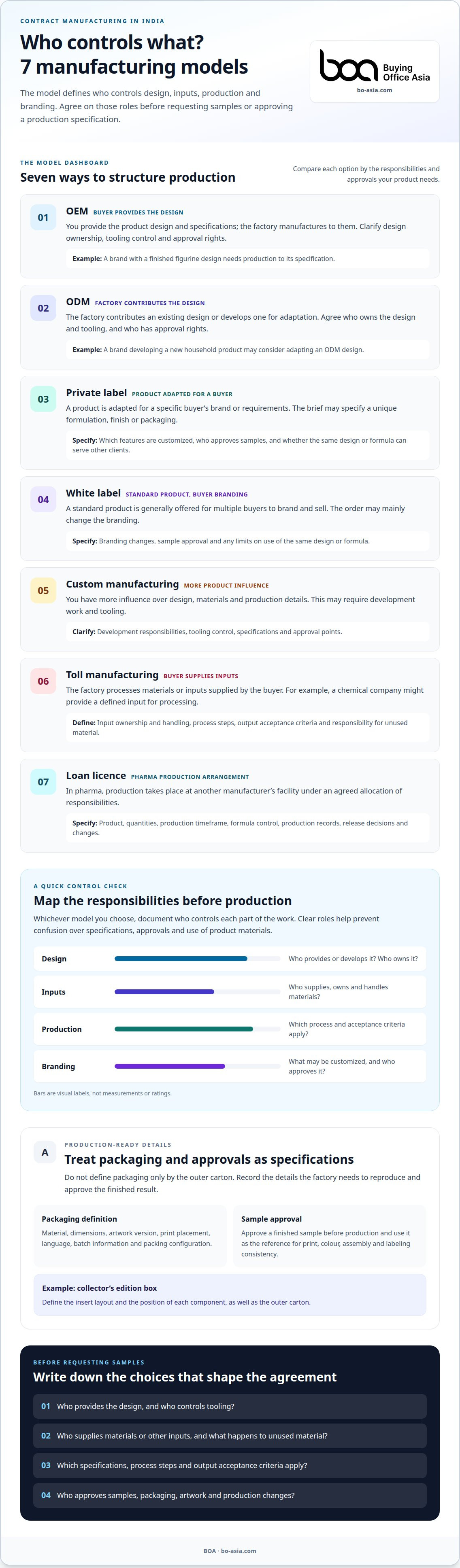
For contract manufacturing in India, the model determines who controls design, inputs, production and branding. Define those roles before requesting samples or approving a production specification.
In an original equipment manufacturer (OEM) arrangement, you provide the product design and specifications; the factory manufactures to them. In an original design manufacturer (ODM) arrangement, the factory contributes an existing design or develops one for adaptation. For example, a brand with a finished figurine design may need OEM production, while a brand developing a new household product may consider ODM. Clarify design ownership, tooling control and approval rights. OEM and ODM manufacturing support can include product development and tooling coordination.
Private-label manufacturing usually adapts a product for a specific buyer’s brand or requirements. White-label manufacturing generally uses a standard product that multiple buyers can brand and sell. The distinction matters: a private-label brief may define a unique formulation, finish or packaging, while a white-label order may mainly change branding. In both models, document which specifications are customized, who approves samples and whether the same design or formula can serve other clients.
Custom manufacturing gives you more influence over product design, materials and production details, but may require development work and tooling. Toll manufacturing focuses on processing materials or inputs supplied by the buyer. For example, a chemical company might provide a defined input for a factory to process. Specify who owns the inputs, how they are handled, the process steps, output acceptance criteria and responsibility for unused material. These details help both parties coordinate supply and production.
In pharma, a loan-licence arrangement involves production at another manufacturer’s facility under an agreed allocation of responsibilities. Specify the product, quantities, production timeframe and each party’s role in the agreement. Also clarify who controls the formula, production records, release decisions and changes. This distinction helps prevent confusion between the commercial manufacturing arrangement and the separate responsibilities associated with regulated products.
Packaging and labeling need their own approved specifications. Identify the packaging material, dimensions, artwork version, print placement, language, batch information and packing configuration. For a collector’s edition box, for example, define the insert layout and position of each component, not just the outer carton. Approve a finished sample before production and use it as the reference for print, colour, assembly and labeling consistency.
Build cost assumptions from current supplier quotations and the specific production brief. Materials, tooling, packaging, process requirements, order quantities, quality controls and delivery terms all affect the commercial offer. Compare suppliers on the same scope and date so a lower headline price does not hide excluded work or different specifications.
Compare Indian, Chinese and other manufacturers by product fit, capabilities, infrastructure, quality controls and total landed cost, not country alone. A sourcing partner can translate your brief into factory requirements, identify potential suppliers and assess production readiness. This gives you a consistent basis for evaluating candidates and managing the move from supplier selection to production.
Location matters, but the comparison should start with your product and process. A sourcing partner assesses relevant manufacturing experience, equipment, production capacity and communication needs. For pharma, that means examining experience with the relevant formulations and tablets. For a custom product, it means reviewing tooling, materials, assembly and finishing capabilities.
India, China and other countries each have manufacturers with different specialities. A country-level comparison cannot tell you which factory fits your order. Compare candidates against the same product requirements, quality criteria, order assumptions and delivery terms. This helps distinguish a suitable supplier from one whose offer looks attractive only because important requirements were left out.
Manufacturing costs and minimum order quantities vary by product, supplier and production setup. Rather than relying on broad country or industry averages, ask for comparable quotations based on your agreed specification. Separate recurring production charges from development, tooling and other setup costs, and clarify what each manufacturer includes in its offer.
MOQ discussions should also account for the supplier’s production plan and separate purchasing requirements for components or packaging. Ask how the proposed quantity relates to the factory’s process and where the order could be structured differently. This makes the commercial trade-offs clearer before you approve a purchase order.
Start with a brief covering product requirements, target volumes, intended use and destination market. A sourcing partner can turn these details into supplier criteria, find suitable manufacturers and review their capabilities. Sourcing and procurement support can link supplier selection with commercial discussions and production planning.
Next, coordinate samples and track decisions on design, materials and specifications. Before production, align the approved sample, quality checkpoints, production schedule and responsibilities for changes. During manufacturing, follow-up can flag deviations or delays and help coordinate corrective action. This keeps decisions tied to the production brief instead of leaving each supplier to interpret requirements independently.
Assess suppliers for relevant experience, technical expertise, quality controls, regulatory compliance where applicable, cost structure and production technology. For party manufacturing, clarify who supplies inputs and maintains production records. A manufacturer’s documented process and clear communication about changes help establish whether its operating practices suit the project.
For products involving several processes, the partner maps each stage to a responsible supplier and defines the handoffs. That can reveal coordination gaps before they affect production. If you need support assessing manufacturers and managing the sourcing process, discuss your requirements.
The capabilities you need depend on the product, process and production stage you outsource. You can contract for a complete finished product or divide the work between specialist factories. That choice affects supplier coordination, production records, inspection points and responsibility for the final result.
India’s contract manufacturing spans pharmaceuticals, electronics, cosmetics and chemical products. Each category requires different equipment, process knowledge, materials and packaging controls. Start by defining the output and manufacturing steps involved. A sourcing assessment can then establish whether one factory can handle the full brief or whether several suppliers need coordination.
Pharmaceutical manufacturing may cover tablets, capsules, syrups, ointments and injectables. A contract development and manufacturing organization, or CDMO, combines contract research and manufacturing services. This model may suit a company that needs development support alongside production. A focused manufacturing arrangement may fit better when the formulation and product requirements are already established. Production planning should specify the product, quantity, timeframe, records and approval responsibilities.
Electronics manufacturing can involve component sourcing, assembly and production testing. For a device or electronic assembly, map each component and process to a responsible factory. Confirm how parts, assembly stages, inspection findings and revisions will be recorded, and assess the actual supplier’s equipment, process controls and relevant experience rather than relying on a country-level supplier count.
Cosmetics and chemical manufacturing require attention to formulation, processing steps, filling and packaging. A cosmetic product’s finished consistency, for example, depends on the agreed formulation and production method, while its packaging must match the product and approved artwork. Chemical products may need process controls suited to their inputs and intended use. Define acceptance criteria and document approved samples before production starts.
Other products bring different coordination needs. A collector’s edition box may combine printed packaging, inserts and assembled components; a toy or figurine may involve moulding, decoration and final assembly. The sourcing plan should identify component ownership, artwork approvals, sample sign-off and inspection points at each stage. This helps distinguish a late packaging or assembly issue from a broader factory quality problem.
Contract manufacturing can also be split across several parties. One factory may make components while another handles final assembly or packaging. This can provide access to specialist processes, but it makes version control and handoffs more important. A coordinated plan connects specifications, production records and quality checkpoints across suppliers. On-site quality control and inspection can assess production at the factory against agreed criteria. An inspection provides a snapshot of production, while ongoing follow-up supports issue tracking and corrective-action coordination.
A manufacturing agreement turns commercial expectations into documented responsibilities. For contract manufacturing in India, define product specifications, quantities, delivery timing, quality requirements and intellectual property (IP) terms before production begins. India’s Contract Act dates to 1872; the agreement should address how both parties will perform, approve changes and handle disputes.
Product and destination determine which regulations, licences and quality requirements apply. India’s Drugs and Cosmetics Rules include manufacturing requirements for pharmaceuticals, while revised Schedule M sets good manufacturing practice requirements for covered pharmaceutical manufacturers. Under the BIS Act, 2016, the Indian government can make compliance with specified standards compulsory through product-specific Quality Control Orders. These frameworks are not interchangeable, and the current official requirements must be checked for the exact product, factory and market.
Indian manufacturing hubs vary by sector, process and supplier capability. City directories can help frame an initial search, but listing counts do not establish whether a factory fits your product, quality needs or production plan. Compare locations using the required process, component ecosystem, supplier evidence, logistics and applicable regulation.
Separate your pre-existing IP from work created during product development. The agreement can identify ownership of drawings, formulas, tooling, artwork, packaging files and production specifications. India’s Patents Act dates to 1970, Trademarks Act to 1999, Designs Act to 2000, and Copyright Act to 1957. These laws concern different forms of IP; contract terms should still specify who owns each asset and how the manufacturer may use it.
For licensed character artwork, identify the approved files and permitted production purpose. Restrict reproduction, disclosure, retention and use for other orders. Record who may access the files, how revised artwork is approved, and what happens to production materials when work ends. For a custom figurine, for example, define ownership of the sculpt, mould or tooling separately from the licensed character design.
Attach a controlled product specification and approved sample to the agreement. Describe materials, dimensions, tolerances, decoration, packaging, inspection criteria, quantity and delivery schedule. Set a written approval process for changes, substitutions or revised production methods. For pharma or healthcare products, document the medicine or formulation, production timeframe and responsibilities for records, testing and release decisions.
Finally, define how to handle rejected goods, corrective actions, confidentiality breaches and termination. Keep the signed agreement, specification versions and sample approvals together as the production record. This gives global teams a clear reference when different parties manage development, sourcing and manufacturing.
Manufacturing costs in India depend on product specifications, processes, materials, order volume and packaging. A useful quote separates one-time development or tooling charges from recurring production costs. It should also show which materials, components, quality checks and packing operations are included. Compare offers using the same specification, approved sample and delivery terms, or a lower unit quote may reflect different assumptions.
Build the cost comparison around specific production inputs. For a custom plastic product, an estimate may separate mould tooling, resin, decoration, assembly and retail packaging. For a medicine, formulation, production process, batch size and packaging affect the calculation differently. Freight and logistics coordination also influence delivered cost. Request an itemized quotation to see which elements change with quantity and which remain fixed.
In cost-plus manufacturing, a supplier adds an agreed conversion margin to the defined production-cost base. Clarify what the margin applies to, which costs are included, how supporting costs can be reviewed, and how changes in materials or production volume affect the calculation. A like-for-like comparison should distinguish conversion charges from supplied inputs, tooling and packaging.
Minimum order quantities (MOQs) often reflect production setup, batch economics and supplier purchasing requirements. Cosmetics and pharmaceutical products have category-specific MOQ ranges, but the actual offer depends on the formulation, packaging format and factory process. A low initial quantity may still require buying materials or printed packaging in larger lots. Ask for the production MOQ and any separate component or packaging MOQ, then compare the resulting exposure to unused stock.
Quantity breaks show the trade-off between unit cost and working inventory. Request quotes at your planned order volume and nearby production tiers, using identical specifications. For a collector’s box, for example, the printed carton and custom insert may each have separate setup or quantity assumptions. Confirm whether a larger run reduces recurring costs enough to justify additional stock, storage and cash tied up in finished goods.
Prototypes and tooling also affect project economics. Sampling can reveal fit, finish or assembly issues before a full order, while a production-ready golden sample gives both parties a shared quality reference. Clarify which development work is charged separately and whether tooling is reusable or dedicated to your design. For a clearer project cost breakdown, review manufacturing project pricing factors.
Before approving production, align the quote, specifications, sample approvals, order quantity and payment milestones in writing. If you want help assessing supplier quotations and production costs, discuss your manufacturing requirements.
Buying Office Asia helps international brands coordinate sourcing and manufacturing decisions across Asia, from supplier selection through production planning. If you’re assessing Indian manufacturers, this support can help align product requirements, supplier capabilities, commercial terms and production expectations before you commit.
For complex or high-volume projects, a Dedicated Asia Procurement Team can manage supplier communication and factory-direct price negotiations as part of an end-to-end sourcing approach. This is useful when production involves several suppliers, tooling decisions or ongoing coordination. A focused manufacturing plan gives your team clearer visibility into responsibilities, specifications and next steps.
Contact Buying Office Asia to discuss your manufacturing requirements.
Before committing to contract manufacturing in India, bring your product brief, target volumes and key commercial decisions into one working plan. This gives your manufacturing partner a clear basis for defining responsibilities, approvals and production milestones.
Buying Office Asia can connect supplier selection and price discussions with your team’s production requirements, keeping decisions and responsibilities visible as the project advances. This coordination is particularly useful when your internal team needs practical support managing multiple production decisions.
Whether you’re developing a new product or preparing an established design for production, the next step is a focused conversation about your requirements and sourcing priorities. Discuss your project with Buying Office Asia, and move forward with a clearer plan for production.
Contract manufacturing means hiring a manufacturer to make products to agreed commercial and technical requirements. The buyer typically retains responsibility for its brand and market strategy, while the factory carries out defined production work. For example, a brand may provide approved packaging artwork and product specifications, then review a pre-production sample before authorizing production. The agreement defines responsibilities and acceptance terms.
Indian contract manufacturers serve pharmaceuticals, electronics, cosmetics, chemicals and consumer products, as well as toys, collectibles and industrial components. The right factory depends on the processes and controls the product requires. A company commissioning a multi-part game product, for example, may need coordinated printing, component production and assembly. Healthcare products involve different technical and regulatory considerations, so assess the product and destination market rather than relying on an industry label alone.
A sourcing partner can turn your product brief into a shortlist based on processes, equipment and relevant experience. Evaluation may include reviewing factory documents, discussing capacity and controls, examining samples and assessing whether the site can manage the required work. For products with multiple components, the partner can also map supplier responsibilities and handoffs. Match evidence of capability to the project, not just a directory listing.
An agreement should make the commercial and technical relationship workable in day-to-day production. Include the product specification, order quantities, delivery schedule, payment terms, acceptance process, change approvals and responsibility for materials and tooling. Add confidentiality and IP provisions that distinguish buyer-owned designs from factory-owned processes. For version control, identify the governing specification and approved sample, and state how revised documents replace earlier versions. Set out procedures for nonconforming goods, corrective actions and ending the arrangement.
Key risks include inconsistent output, undocumented substitutions, production delays, unclear subcontracting and unauthorized use of designs or artwork. Reduce exposure by limiting file access to those who need it, documenting approved suppliers and materials, and recording changes in writing. Define inspection criteria before production and link findings to corrective actions. Inspection provides evidence about a production sample or stage, not proof that every unit is identical or that IP is protected by itself.
Ahmedabad and Bangalore are among the Indian cities where contract manufacturers may operate. Identify suitable hubs by matching the required processes, supplier capabilities and logistics needs to the product.

Knowing how to manage overseas manufacturing projects starts with comparing total landed cost, not just the factory quote. Include tooling, freight, tariffs and duties, insurance, management time, and the cost of correcting problems. Weigh those expenses against product quality, delivery risks, and...
A manufacturer’s quotation can look right while the factory behind it lacks the capacity or quality controls your product needs. Knowing how to vet manufacturing suppliers in Asia means assessing production fit, business credentials, quality practices, and sample results before committing to an orde...

A Certificate of Origin can affect how customs assesses a shipment at its destination, so accurate origin information matters. If you’re asking what a certificate of origin is, it’s a document declaring the country where goods were manufactured, produced or last substantially transformed. It may sup...