


A Certificate of Origin can affect how customs assesses a shipment at its destination, so accurate origin information matters. If you’re asking what a certificate of origin is, it’s a document declaring the country where goods were manufactured, produced or last substantially transformed. It may support customs procedures, trade agreement claims or a buyer’s documentation requirements.
It’s easy to assume that a product’s shipping country is also its country of origin. That isn’t always true, especially when production spans more than one country. The document doesn’t automatically secure preferential duty treatment: the goods must also meet the applicable agreement’s rules of origin.
This article explains when a certificate may be required, who can issue or certify it, and how free trade agreements affect the process. It also covers the information the document typically contains and why confirming origin during sourcing and production helps keep trade records aligned with the goods being shipped.
• Determine origin from where goods were produced or last substantially transformed, not simply the country they ship from.
• Find out whether the destination’s rules, a buyer, a bank, or an applicable trade agreement requires origin documentation.
• Distinguish ordinary origin certificates from FTA origin claims, which depend on the agreement’s product-specific rules.
• Identify who can issue or certify the document under the destination and agreement requirements; Chambers of Commerce commonly issue non-preferential certificates.
• Align origin records with production and shipment details so customs documentation supports the claim being made.
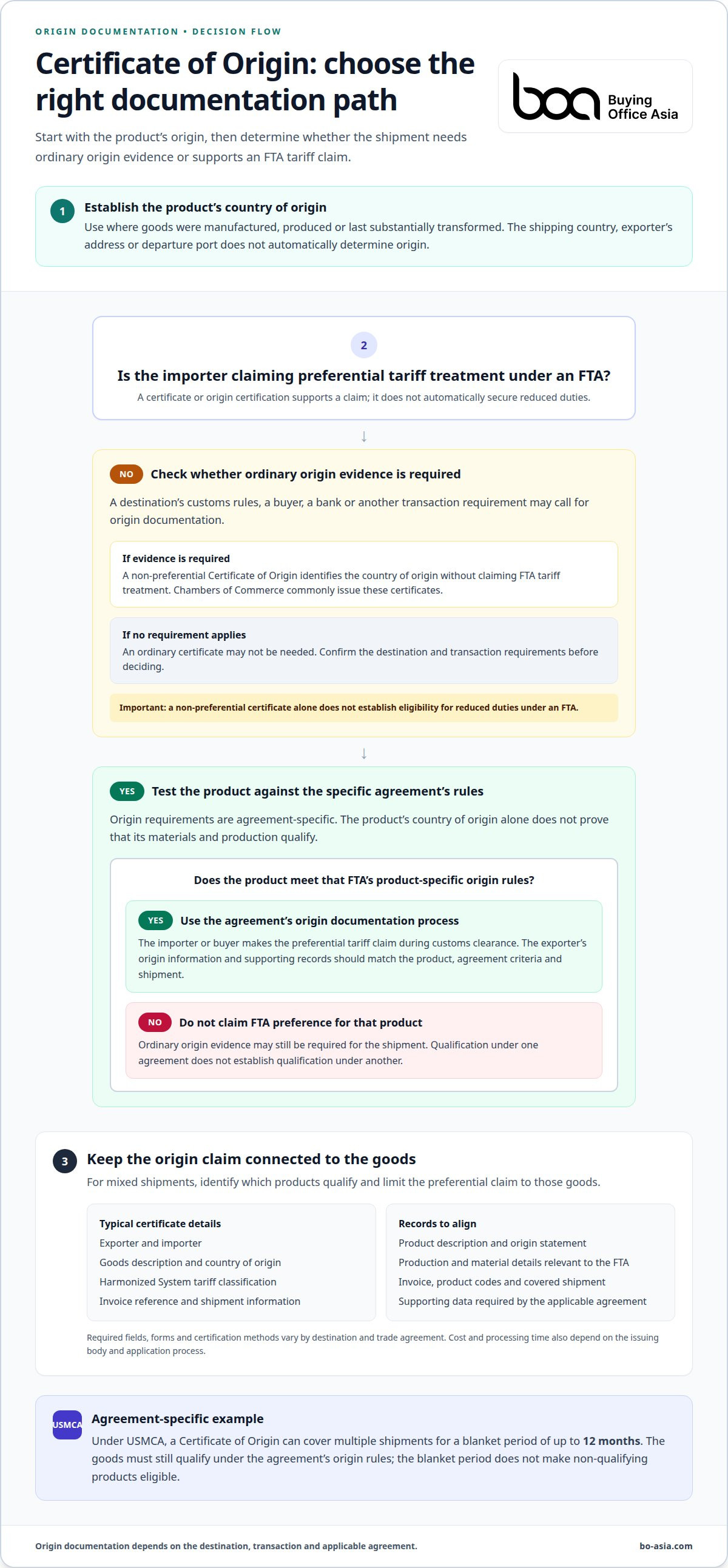
Free trade agreements can change which origin document supports a tariff claim, but they don’t make a certificate necessary for every shipment. The key distinction is whether the importer is seeking preferential treatment or needs ordinary evidence of origin.
A non-preferential Certificate of Origin identifies a product’s country of origin without claiming reduced duties under a trade agreement. A preferential certificate supports a claim that goods qualify for a specific agreement’s tariff treatment. The distinction matters because an ordinary certificate alone doesn’t establish that goods meet an agreement’s product-specific origin rules.
For example, a buyer may request a non-preferential certificate for its records while an importer separately seeks an FTA tariff preference. A chamber of commerce commonly issues non-preferential certificates. Preferential origin documentation follows the applicable agreement’s rules and may use a different certification process.
Free trade agreements can reduce or remove tariffs for goods that satisfy their rules of origin. A product’s country of origin alone doesn’t establish eligibility; the agreement’s requirements determine whether its materials and production qualify. The same product may qualify under one agreement but fail another agreement’s criteria.
Under USMCA, a certificate of origin can cover multiple shipments for a blanket period of up to 12 months, according to U.S. Customs and Border Protection. That blanket period can suit repeat shipments of qualifying goods, but it doesn’t make non-qualifying products eligible. Keep each product’s origin support aligned with the agreement and shipments covered.
The importer or buyer claims preferential tariff treatment when clearing imported goods through customs, using origin information supplied by the exporter. The exporter’s records therefore need to support the product description, origin statement and relevant agreement criteria. A certificate is evidence for the claim, not an automatic tariff reduction.
For a mixed shipment, separate qualifying goods from products that don’t meet the agreement’s rules. The claim should cover only eligible products. If customs requests supporting data, the importer needs to provide the information required by the applicable agreement, including relevant origin details.
Cost and processing time depend on the issuing body, destination, document format and application process. A chamber-issued certificate and an exporter’s FTA certification may involve different steps, so there is no single cost or turnaround time for every certificate.
An inaccurate origin statement can put a preferential tariff claim at risk and lead to customs review or loss of the claimed treatment. Any additional duty or penalty depends on the applicable country’s rules and the shipment’s circumstances; there is no universal penalty amount.
To understand what a certificate of origin is, start with the product’s origin, not its shipping route. The document identifies where goods were made or last substantially transformed and supports trade and customs procedures.
A Certificate of Origin is a commercial document declaring the country where goods were manufactured, produced or last substantially transformed. Customs authorities, importers and banks may use it to assess origin, apply trade rules or meet transaction requirements. Its value depends on whether the declared country matches the product’s production history, not the exporter’s address or departure port.
For goods made in multiple countries, origin depends on the rules applied by the destination or relevant agreement. Many systems use a substantial-transformation test, but the exact legal criteria differ by jurisdiction. A product shipped from one country can therefore have another country of origin. The certificate records that origin for a specific transaction; it doesn’t change the product’s manufacturing history or establish eligibility for every tariff treatment.
Ordinary certificates commonly identify the exporter and importer, describe the goods, state the country of origin and include the Harmonized System tariff classification. A producer’s name and contact details may also appear. The document may reference an invoice, shipment information and product codes, helping customs officials connect the origin statement with the goods declared for import.
An FTA certificate or origin certification supports a claim that goods meet a free trade agreement’s rules of origin. Those rules determine whether a product qualifies for preferential tariff treatment. The document matters because the claim depends on the agreement’s criteria, not simply on a label naming the country where the goods were produced.
For example, a product assembled from materials sourced across several countries may need its production and material details assessed under the relevant agreement. Qualification under one trade agreement doesn’t establish qualification under another. The exporter’s origin information gives the importer a basis for claiming preference, while supporting records connect that information to the product and shipment.
Certificates don’t follow one standardized format worldwide. Required fields and certification methods depend on the destination and applicable trade rules. Some processes use electronic documents, while others require a specified form or supporting records. The importer and exporter need consistent product descriptions, origin details and invoice references so customs can connect the claim to the shipment.
For products whose origin depends on multiple production stages, reliable manufacturing records help keep declarations aligned with what was made and where. Discuss your product development and origin documentation needs when production plans involve several suppliers or countries.
In the United States, exporters can obtain non-preferential Certificates of Origin through a Chamber of Commerce. U.S. Customs and Border Protection does not directly issue these certificates. The issuing authority and application format depend on national practice, so the destination country and document purpose shape the route.
For a U.S. shipment, an exporter can submit an application through a Chamber platform, such as essCert or SWIFTcert. The exporter identifies the relevant chamber, follows its application process and provides origin and shipment documentation for certification. These platforms support submission; they don’t make the chamber’s certification a preferential tariff claim.
Chambers of commerce commonly act as issuing authorities for non-preferential certificates in the United States and many other countries. Their role supports international trade by providing an established channel for certifying commercial documents. Governments have delegated certificate issuance to chambers since 1923, while the specific process continues to follow national practice.
A chamber may also act as a trusted issuing agent. The Revised Kyoto Convention treats Certificates of Origin as commercial documents issued according to national practice, rather than documents issued by customs authorities. That distinction matters: chamber certification doesn’t mean the chamber determines customs treatment or guarantees acceptance of every origin claim.
Chamber certification generally concerns the certificate’s attestation and supporting documentation. Because the format isn’t standardized worldwide, exporters must use the format accepted for the shipment and destination. Ordinary certificates commonly identify the exporter and importer, describe the goods, state the country of origin and include the Harmonized System classification.
For U.S. exporters, the practical first step is to determine whether the shipment needs a non-preferential certificate or an FTA origin certification. Then use the relevant chamber process for a non-preferential document, or follow the agreement’s certification rules for an FTA claim. These routes serve different purposes and aren’t interchangeable.
Issuing arrangements also vary by country. Chambers of commerce commonly issue non-preferential certificates in many markets. In China, exporters may apply through Customs or the China Council for the Promotion of International Trade and its local branches, depending on the certificate and route. The Revised Kyoto Convention’s approach reflects this variation: a chamber’s role and accepted documentation depend on the national system involved.
For non-preferential certificates, ICC Publication 809 sets out internationally recognized principles and practices for Chambers issuing certificates. It provides a reference for chamber procedures, not a single mandatory global format. For exporters, the operational priority is matching the chamber’s application requirements with accurate product, exporter, importer, and origin details.
FTA origin certification connects a product’s production evidence to the rules of a specific agreement. The exporter’s records must support the origin statement and identify the products covered by the claim.
Certification methods differ across international trade agreements. Some arrangements use a prescribed certificate, while others permit an origin declaration by a knowledgeable party, generally the exporter. The exporter should identify the agreement, determine which products qualify and use the documentation method recognized by that agreement. A certificate prepared for one agreement doesn’t automatically support another agreement’s tariff claim.
China’s Form E is used to certify the origin of goods shipped to ASEAN countries under a preferential agreement. It connects the goods to the relevant agreement’s origin requirements. The exporter needs to ensure the certificate describes only eligible products. Non-qualifying goods shouldn’t be added simply because they travel in the same shipment.
Some agreements allow certification to cover repeat shipments. A blanket FTA certification may cover a period of no more than 365 days. Under the Thailand-India preferential trade rules, a certificate of origin is valid for 12 months from its date of issuance. These periods are agreement-specific, so an exporter should apply the duration stated for the relevant route.
Before issuing a declaration, the exporter should gather production and sourcing records to support the origin claim. If the exporter isn’t the manufacturer, a manufacturer’s declaration can support the stated country of origin. The importer then uses the exporter’s information to claim preferential treatment during customs clearance. Keeping product descriptions and supporting records aligned helps connect the claim to the goods.
Trade facilitation resources can help clarify documentation and origin procedures. The World Trade Organization’s Trade Facilitation Agreement addresses acceptance of paper or electronic copies of supporting documents in Article 10.2. Its relevance is practical: exporters and importers need to know which document format customs procedures accept for a particular transaction.
Other tools serve different purposes. Advance rulings from a country’s national customs authority can address how customs treatment applies to a proposed transaction. An online certificate verification tool allows customs authorities to check a certificate’s authenticity. Neither replaces the exporter’s underlying origin evidence or the agreement’s qualification rules.
For a U.S. importer, the key distinction is between holding an origin document and making a valid preference claim. The exporter supplies the supporting information; the importer claims preferential tariff treatment. If customs requests the agreement’s required data elements, the importer must be able to provide them. Accurate product-level records help both parties maintain a traceable basis for the claim.
A Certificate of Origin isn’t required for every export shipment. The importing country’s rules, an applicable free trade agreement, a buyer’s instructions or a bank’s terms can make it necessary. Requirements can also vary by product and destination, so one shipment’s document set may not apply to another.
Start with the transaction requirements. Import regulations may require origin documentation for particular goods, while a buyer may need it for internal records or a contract. A bank can also make a certificate a condition of payment when a letter of credit explicitly requires one. In that case, missing or inconsistent paperwork can disrupt payment.
Distinguish ordinary origin documentation from an FTA declaration. A buyer or importing authority may request a non-preferential certificate without any tariff claim. If the importer seeks preferential treatment, the product must meet the relevant agreement’s rules, and the supporting declaration must follow that agreement’s requirements. The certificate alone doesn’t establish eligibility.
For a USMCA preference claim, the origin document must include nine required data elements to determine whether goods qualify for preferential duty rates. The parties need consistent product descriptions and origin information across the declaration and shipment records. A blanket certification covering multiple shipments still applies only to goods and shipments within its stated scope.
Prepare the document based on the actual goods and transaction. Common certificate details include the exporter and importer, goods description, country of origin and product classification. Shipment references can connect the declaration with the invoice and transport records. For products made across several countries, supporting production information helps explain how the declared origin was determined.
Before dispatch, align the origin document with the buyer’s contract, bank instructions and destination requirements. For example, a letter of credit that names a Certificate of Origin as a payment condition creates a different documentation obligation from a buyer’s informal request. Check the required format and submission method against the transaction’s terms.
For a product with several manufacturing stages, discuss product development and sampling support to keep production details organized alongside shipment documentation.
Buying Office Asia helps businesses manufacturing in Asia coordinate sourcing and procurement across suppliers and production stages. This coordination can support clearer product and production records for the importer or exporter preparing origin documentation. It doesn’t replace the responsible party’s origin determination or the importing country’s requirements.
For programs involving multiple suppliers, coordinated procurement can help keep sourcing information and supplier communication organized. This is useful when manufacturing changes or several production partners make it harder to keep origin records aligned with the goods shipped.
If your sourcing program involves complex suppliers or production in Asia, contact Buying Office Asia to discuss your requirements.
Understanding what a certificate of origin is helps you treat origin documentation as part of supply-chain planning, not a last-minute shipping form. Bring production locations, supplier records and product details into the conversation early. That gives the parties responsible for certification and customs declarations a clearer record to use as sourcing arrangements evolve.
For production in Asia, Buying Office Asia can coordinate sourcing and procurement. This can help keep supplier and production information organized alongside procurement decisions, while the exporter and importer remain responsible for accurate origin claims and applicable trade requirements.
Whether you’re planning a new manufacturing program or refining an established supply chain, a clear sourcing process can support stronger documentation practices. Contact Buying Office Asia to discuss your sourcing needs, and take the next step with greater clarity.
The document set depends on whether the request concerns shipment paperwork or evidence supporting an origin claim. A commercial invoice and shipment reference help connect the certificate to the transaction; production records support how origin was determined. Keep these document types distinct in the file. For example, an invoice identifies the sale, while manufacturing records explain the product’s production history.
Prepare the information needed to identify the applicant, transaction and goods, then organize it by product line. A mixed invoice may list products with different origins, so item-level detail can prevent one description from obscuring another. Align the application’s goods descriptions with the commercial invoice and keep supporting origin evidence together. The issuing process determines the application format.
It is a trade document that communicates a product’s declared origin to parties handling an international transaction. For example, an importer may rely on it when assembling customs entry records, while a bank may review it against payment-document terms. The certificate is one part of the transaction file; it doesn’t replace the invoice, transport records or evidence supporting the origin declaration.
Alongside party names and a goods description, a certificate may record shipment identifiers that distinguish one consignment from another. Depending on the accepted format, details can include quantity, package information, weight, transport route, a bill of lading or waybill number, and invoice date. These references help connect the certificate to relevant commercial records, especially when a shipment includes several documents or product lines.
For a non-preferential certificate, U.S. exporters commonly apply through a Chamber of Commerce; U.S. Customs and Border Protection does not issue these certificates directly. Application platforms include essCert and SWIFTcert. FTA origin certification follows the relevant agreement’s process instead. Choose the route based on the document’s purpose, since a Chamber-issued ordinary certificate and an exporter’s FTA certification aren’t interchangeable.
For an application, gather the invoice and product-level facts that support the origin entry. If the exporter didn’t manufacture the goods, a manufacturer’s declaration can help substantiate the stated origin. Keep supporting production details associated with the relevant product lines rather than filing them only under a general order number. The Chamber’s application process determines which records accompany the submission.
Use the transaction terms to identify what triggers the requirement: an import rule, buyer instruction, bank condition or request for preferential treatment under an agreement. A practical review starts with the destination and product, then checks the buyer’s contract and payment documents. For instance, a certificate named in a letter of credit is a payment-document condition, even when the shipment isn’t claiming an FTA preference.
The distinction lies in the purpose of the origin statement. A non-preferential certificate documents origin without supporting an FTA tariff claim. Preferential certification relates to a particular agreement and requires evidence that the goods satisfy its origin rules. If a shipment includes several products, assess each under the agreement rather than assuming the whole invoice qualifies because some items meet the criteria.

Procurement outsourcing isn’t an all-or-nothing handover. It can transfer selected sourcing and supplier-management activities to an external team while your business retains strategic decisions and oversight. The right procurement outsourcing services can help you add expertise and capacity without...

The main types of quality inspections in manufacturing are pre-production, during-production, final and pre-shipment inspections. Each addresses a different point in the production cycle: pre-production checks materials and components before work begins, while later inspections assess products as th...

The biggest risk in complex board game manufacturing isn’t any single component, but the handoffs between them. A game with cards, boards, miniatures, inserts and custom packaging needs coordinated sourcing, assembly and quality checks to ensure the finished set matches the approved design.It’s natu...