

A manufacturer’s quotation can look right while the factory behind it lacks the capacity or quality controls your product needs. Knowing how to vet manufacturing suppliers in Asia means assessing production fit, business credentials, quality practices, and sample results before committing to an order. A thorough supplier vetting timeline depends on the review scope, document availability, factory access, sample readiness, and any required testing or audit work.
It’s reasonable to want clear evidence before placing production in another country. This guide explains how to vet manufacturing suppliers in Asia, including what to examine in their manufacturing capability and capacity, registration documents, relevant certifications, factory procedures, and product samples. You’ll also learn how audit findings and quality checkpoints can reveal risks early, and what affects the time needed to complete a review. The aim is to give you a sound basis for choosing a supplier and managing quality and production risk.
• Assess production fit against your product specifications, order volume, required processes, capacity, and minimum order quantity.
• Treat an ISO 9001 certificate as one piece of evidence; assess how quality procedures work in the factory day to day.
• Check that business documents and product certifications relate to the actual supplier, product, and intended market.
• Use agreed defect categories and AQL sampling criteria to guide inspections, while remembering that sampling cannot guarantee every unit is defect-free.
• Plan the vetting timeline around document review, factory access, sample readiness, testing needs, and audit scope rather than relying on a fixed duration.
A sourcing professional compares a factory’s actual processes, available capacity, and order terms with your product specification. The review also checks whether the factory’s schedule, tooling arrangements, and quality checkpoints can support your order.
•
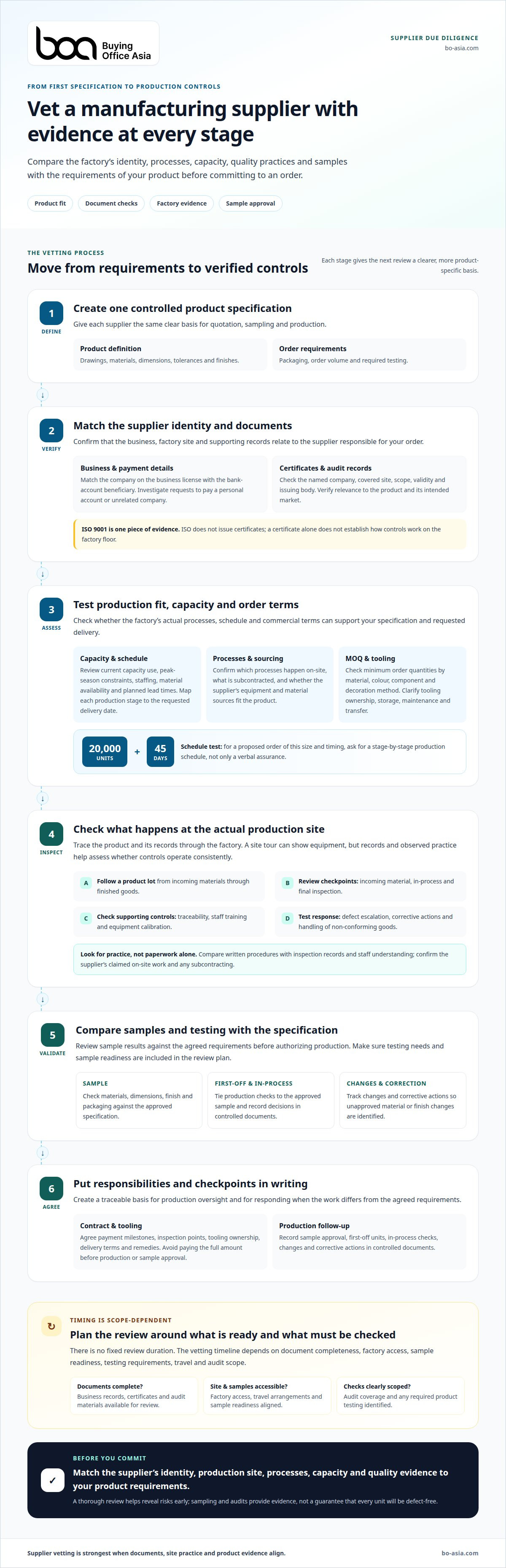
Ask the factory to map each production stage against the requested delivery date. A professional reviews current capacity use, peak-season constraints, staffing, material availability, and planned lead times. For example, a proposed order of 20,000 units in 45 days needs a production schedule that shows how each stage fits, not just a verbal assurance. Confirm which processes happen on-site and whether any work will be subcontracted.
•
Put tooling ownership, storage, maintenance, and transfer arrangements in the written agreement before production begins. For moulded products, the tool affects both the unit cost and the factory’s ability to reproduce approved details. A professional also checks the minimum order quantity for each material, colour, component, and decoration method. If a supplier sets a high minimum, clarify whether it reflects a tooling limit, material batch, or production setup.
• Define the product requirements before comparing factories. A sourcing professional translates drawings, materials, dimensions, tolerances, finishes, packaging, and required testing into a controlled specification. This gives suppliers the same basis for quotations and sampling. For a custom product, OEM and ODM contract manufacturing may involve development samples and tooling coordination before mass production.
• Assess country and supplier risks in relation to the product, rather than relying on a blanket country ranking. China has a deeper component supply chain. Vietnam may suit some products for tariff-risk management, though some Vietnamese factories use inputs made in China. In India, Thailand, and elsewhere in Asia, assess the specific factory’s processes, material sources, schedule, and quality controls.
• Review the supplier’s business identity and payment instructions before transferring funds. Match the company named on its business license with the bank-account beneficiary, and investigate requests to pay a personal account or unrelated company. Agree payment milestones, inspection points, tooling ownership, delivery terms, and remedies in the contract. A 30% deposit and 70% before shipment are described as typical terms, not a universal safest arrangement. Avoid paying the full amount before production or sample approval.
• Tie production oversight to agreed specifications. Track sample approval, first-off units, in-process checks, changes, and corrective actions, and record decisions in controlled documents. This creates a traceable basis for inspections and helps prevent unapproved material or finish changes from reaching the full order.
An ISO 9001 certificate is useful evidence of a quality management system, but it cannot establish factory performance by itself. A professional audit checks whether documented controls operate consistently at the actual production site. A practical answer to how to vet manufacturing suppliers in Asia is to pair certificate review with an assessment of factory operations.
•
Check each certificate’s scope, named company, covered site, and validity against the supplier and production location. ISO itself does not issue certificates, so examine the issuing body and supporting records. Compare audit documents with the processes used for your product, rather than relying on general supplier claims. Strong evidence links a current certificate to the factory and operations responsible for your order.
•
Visit the stated production address and trace the product through the actual factory. An effective factory audit checks incoming material controls, in-process and final inspections, traceability, staff training, equipment calibration, and the handling of non-conforming goods. These checks help establish whether the supplier performs the claimed work on-site or relies on undisclosed subcontracting.
The most useful audit is scoped to your product and its risks. It combines a site review with checks of relevant processes and records. Third-party audits can provide independent evidence, while a facility tour alone may show equipment without proving consistent controls. When deciding how to vet manufacturing suppliers in Asia, make sure the audit reflects the product’s processes and the consequences of failure.
•
Trace a product lot from incoming materials to finished goods, then compare each stage with written procedures. Check inspection records, defect escalation, corrective actions, calibration records, and staff understanding. For example, a procedure has little value if workers cannot explain how they isolate a failed component. An audit should test actual practice, not just documents prepared for a visit.
• Assess labour, environmental, and social compliance against your company’s commitments and retailer requirements. A site review can examine working conditions and hours, fire safety, environmental handling, and subcontracting where relevant. Consider responsible sourcing practices alongside quality controls, not as a substitute for them.
• Third-party audit fees vary with location, travel, scope, and the processes reviewed; the price depends on the case and is given after a quote request. To scope an audit or inspection around your production risks, contact Buying Office Asia.
Document checks link a supplier’s legal identity to its factory, products, and export activity. For teams deciding how to vet manufacturing suppliers in Asia, they also clarify which records relate to the contracting entity and planned shipment.
•
Match the registered business name, address, and business scope across registration documents, the quotation, contract, and factory address. Where an official registry is available, check the entity’s current registration details. If a trading company arranges production, establish which factory makes the goods and who controls quality. Clarifying these roles helps define responsibility before placing an order.
•
Check each certificate against the relevant product, factory, model, materials, and destination. A test report should identify its laboratory, product, standard, report date, and applicant. Professionals assess the issuing organization and whether changes to components or product configuration affect the report’s relevance. For custom products, the review also identifies testing needed for the final design.
• Confirm that each certificate supports the claim being made. According to the European Commission, CE marking indicates that a product complies with applicable European Union legislation. Professionals review supporting documentation for the specific product configuration, rather than treating a mark alone as sufficient evidence. They also clarify supplier and importer responsibilities for compliance activities before ordering.
• Assess China Compulsory Certification (CCC) only where the product and market make it relevant. CCC, also called 3C, is compulsory for products sold in the Chinese market and imported foreign products. It is not a universal requirement for every product made in China. A professional checks the product category and destination, then matches any applicable certification evidence to the actual product.
• Evaluate export experience using records relevant to the product and destination. Review redacted shipping documents or references for comparable orders, and check whether the supplier understands packaging and documentation requirements. Manufacturing capacity alone does not demonstrate experience preparing international shipments. This distinction helps you assess operational fit, not just production claims.
• Consider tariffs, product regulations, and shipping terms together when selecting a supplier. Tariffs and transport arrangements affect landed-cost planning, while product requirements depend on category, materials, intended use, and destination. Align product evidence, supplier responsibilities, delivery terms, and shipment documents. This helps you assess the quotation alongside relevant import costs and compliance responsibilities.
• Record unresolved document questions as conditions for proceeding, such as identifying the company responsible for export documents or obtaining a report for the final product configuration. This keeps responsibilities traceable across supplier, factory, and shipment. A structured supplier qualification process connects documentation review with the production partner under consideration.
Set defect definitions and acceptance criteria before production inspection begins. ISO 2859-1 specifies sampling procedures for inspection by attributes, indexed by acceptance quality limit (AQL). The selected plan and defect criteria still need to match the product, order, and consequences of failure.
• Classify defects by their effect on product safety, function, appearance, and use. A critical defect creates an unacceptable risk; a major defect affects function or usability; a minor defect falls short of appearance or finish expectations. Define examples for your product, such as a sharp edge, a component that will not assemble, or inconsistent paint. Clear categories give inspectors and factories a shared basis for decisions.
• Agree the AQL criteria, sample plan, and inspection stage in writing. The supplied benchmark identifies an AQL of 0 for critical defects, 2.5 for major defects, and 4.0 for minor defects. These values are not universal choices for every product. The appropriate plan depends on the order, defect consequences, product type, and agreed acceptance requirements.
• Use sampling as a decision tool, not as proof that every unit is defect-free. An inspector checks a selected sample against agreed criteria, records observed defects, and makes a lot decision. A result within the acceptance limit does not establish that every item conforms. For products with multiple components, define whether the inspection counts defects per unit or evaluates each component separately.
• Connect inspection findings to the factory’s quality system and corrective actions. An ISO 9001 certificate can indicate a documented quality management system, but the supplier’s daily controls still matter. A quality assurance team should record defect evidence, identify the production step involved, contain affected goods, and document corrective action. For example, repeated loose assembly may require process changes, not only additional sorting.
• Base acceptance decisions on the approved specification and destination country. Compare inspected products with the approved sample, drawings, tolerances, materials, and packaging requirements. For a set with several components, check completeness and assembly as well as individual appearance. Link inspection records to the production lot, date, and corrective-action status so shipment decisions rely on traceable evidence.
• Choose inspection frequency according to the consequences of failure and the production process. A thorough plan may include checks before production, during manufacturing, and before shipment, with particular attention to identified risks. Align the inspection method with the order’s agreed sampling criteria, and communicate any failed result before release. This keeps quality decisions consistent across factories, components, and production lots.
There is no reliable universal duration for thorough supplier vetting. The timeline depends on the product and review scope, including document completeness, factory access, sample readiness, testing needs, travel, and whether an on-site audit is required. A professional assesses production capacity, equipment, and quality-control processes by reviewing the factory’s schedule, production records, machinery, inspection procedures, and sample results.
• Start with document collection and a defined review scope. Initial communication and document collection can be quick when records are complete, but missing or inconsistent information can extend this stage. The full timeline depends on factory access, document completeness, sample availability, and whether production processes need an on-site review. Agreeing these inputs early helps avoid delays caused by missing records or unclear inspection requirements.
• Compare a representative sample with controlled drawings and specifications. Record dimensions, tolerances, materials, finish, function, assembly, and packaging against the approved requirements. For a multi-component product, check both individual parts and how they fit together. Document deviations by location and type, then resolve them before the sample becomes the approved production reference.
• Use a first-article or initial-production check when the product, process, tooling, or risk justifies it. Define the sample quantity and acceptance criteria for the specific order rather than assuming one universal number. Checking early production output against the approved specification can surface process or specification gaps before the full run proceeds.
• Map quality-control checks to the production sequence. Review incoming material checks, in-process inspection, final inspection, traceability, staff training, and equipment calibration. Confirm that the factory records rejected units and corrective actions, rather than relying on verbal assurances. Independent inspection provides a snapshot of production; ongoing oversight can also track corrective actions and changes between checkpoints.
• Write protections into the manufacturing contract. Specify the approved product version, inspection and acceptance process, responsibility for corrective action, claims handling, warranty obligations, and liability for late delivery. Define payment milestones and delivery terms clearly, including the agreed Incoterms. Make required evidence and decision points traceable, rather than leaving acceptance to informal messages after production.
For support coordinating factory vetting, sample checks, and production inspections, contact the team.
Buying Office Asia helps turn supplier checks into a coordinated sourcing decision. Its end-to-end sourcing and procurement support connects supplier assessment, production requirements, and purchasing decisions, so you can consider a factory’s quoted price alongside its capabilities and fit for your order.
Turn to the team when you need support evaluating suppliers, managing a high-volume sourcing project, or negotiating factory-direct pricing. A dedicated Asia procurement team can help keep requirements and supplier discussions aligned as your project moves from selection toward production.
Share your product requirements, target order volume, and current supplier questions to start the conversation. Contact Buying Office Asia to discuss your manufacturing needs.
Knowing how to vet manufacturing suppliers in Asia is a starting point, not a one-time qualification exercise. Treat supplier approval as an ongoing decision: record who owns each production responsibility, how changes are approved, and what evidence is needed before an order advances. As product designs, materials, volumes, or destination markets change, revisit whether the factory’s capabilities and controls still fit.
A clear decision record also helps your team respond calmly when production deviates from plan. Keep the approved specification, sample status, audit findings, and corrective-action decisions linked to the supplier and order. This creates continuity across procurement, product, and quality teams, even as requirements evolve.
If you want support turning your requirements into a practical supplier and production plan, contact Buying Office Asia.
With a disciplined process and the right operational support, you can move forward with greater clarity and control.
A professional sourcing partner can turn your product brief into a shortlist of qualified China suppliers. The partner clarifies required materials, processes, target volume, and destination, then assesses factories against those needs. Buying Office Asia supports sourcing and procurement, coordinating supplier selection and commercial discussions. A custom multi-part product, for example, may require separate suppliers for moulding, printing, and assembly, so coordination matters alongside each factory’s capabilities.
Yes. Online supplier directories help identify candidate businesses by product category, location, and stated capabilities, but listings are leads for discovery, not proof of factory status or production performance. Use directory details to begin qualification, then compare the listed business with its registration documents, production site, equipment, and actual process ownership. This keeps a polished profile from substituting for evidence relevant to your order.
A professional vetting process links each supplier claim to evidence and a decision. The partner aligns specifications and quotation requirements across candidates, then assesses process fit, production control, documentation, and communication using consistent criteria. Gaps are recorded as resolved, open, or disqualifying, with an owner and deadline for each outstanding item. This creates an auditable basis for approval and helps your team explain why a factory fits the project.
An Alibaba profile alone cannot establish whether the listed supplier owns or operates a factory. Match its platform identity to company registration documents, then check the production address, equipment, and relevant process in operation. If another company manufactures the goods, identify that factory in the sourcing record and clarify who manages quality, contracts, and corrective actions. The key distinction is operational responsibility, not the seller’s label.
Relevant records include business registration, applicable operating licenses, quality certificates, product-specific test reports, and export documents tied to the contracting entity and product. A professional checks names, site, product configuration, scope, issuing body, and report date for consistency. A report covering a different material or version may not support the proposed item. The required product evidence depends on intended use and destination market.
Check the supplier’s registered legal name and registration status against authoritative business records, then reconcile that entity with the quotation, contract, and applicable licences. Ownership can be assessed through official corporate records or ownership documents where available. The factory operator may be separate from the contracting company, so map both parties and clarify who holds production responsibilities and contractual obligations.
Use an approved sample as the reference, then have an inspector compare production units with drawings, tolerances, materials, finish, function, and assembly requirements. Laboratory testing can assess properties that visual inspection cannot establish, such as material composition or performance. Choose tests relevant to the product and destination, and link reports to the exact configuration tested. A sample or test result does not automatically represent every later production unit.
Costs vary by location, travel, scope, and processes reviewed.

Knowing how to manage overseas manufacturing projects starts with comparing total landed cost, not just the factory quote. Include tooling, freight, tariffs and duties, insurance, management time, and the cost of correcting problems. Weigh those expenses against product quality, delivery risks, and...

The biggest risk in contract manufacturing in India is not simply finding a factory. It is starting production before product specifications, responsibilities and intellectual property terms are clearly documented.Finding and contacting suitable manufacturers is an important first step, but the righ...

A Certificate of Origin can affect how customs assesses a shipment at its destination, so accurate origin information matters. If you’re asking what a certificate of origin is, it’s a document declaring the country where goods were manufactured, produced or last substantially transformed. It may sup...