


Using more suppliers can reduce dependence on a single factory, but it also makes coordination more complex. Multi-sourcing means buying the same product or material from two or more suppliers. Effective multi product sourcing and logistics coordination links supplier choices to a clear plan for production, packing and delivery across a multi-product order.
It makes sense to use specialist suppliers for different products while retaining control of specifications, timing and decisions. The challenge is ensuring each supplier’s work fits the overall order, rather than treating every purchase as a separate transaction. Build a plan around product requirements, business priorities and the level of oversight your team can sustain.
This article explains how integrated supply chain processes support coordination, compares single, dual and multiple sourcing, and shows how to assess suppliers for different products. It also covers preparing for disruptions and considering inventory redistribution or alternative transport arrangements. Use these steps to decide where supplier choice can support continuity, clarify coordination responsibilities and prepare your next order with better-informed procurement decisions.
• Compare single, dual and multiple sourcing against product criticality, supplier capacity and the complexity your team can manage.
• Standardize purchase orders, production updates and performance reporting so issues across suppliers are easier to spot and address.
• Set product-specific specifications and quality checkpoints before production, including clear acceptance criteria for components, assembly and packing.
• Build contingency plans around practical alternatives for production, inventory placement and transport when delays disrupt the original plan.
• Vet suppliers for capability, reliability and fit with each product, then coordinate sourcing and logistics through one consistent operating plan.
Integrated supply chain processes link procurement, supplier communication, production updates, quality checks and shipping plans. For multi-product orders, shared processes help teams coordinate work across suppliers and respond to disruptions with clearer information.
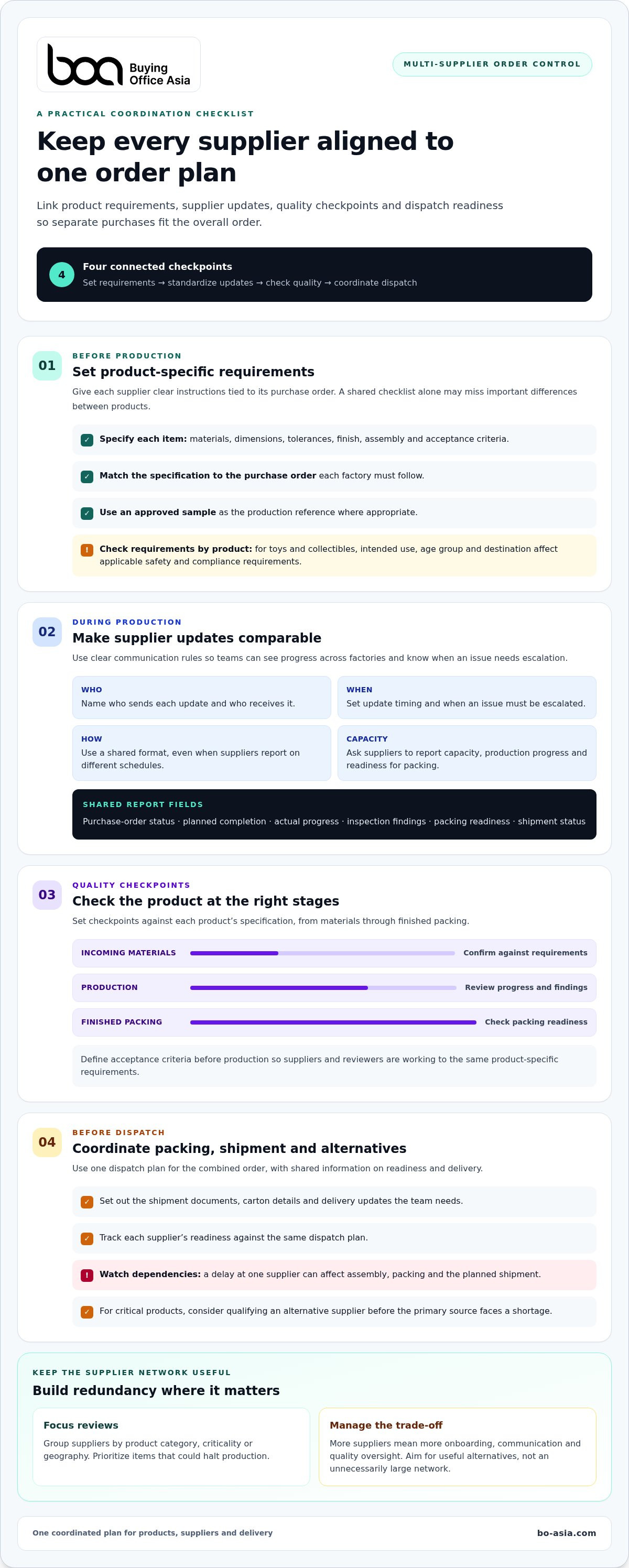
Supplier coordination aligns purchase orders, production schedules, packing instructions and shipment updates across factories. Standardized logistics processes matter because a delay at one supplier can affect the dispatch date for a combined order. A shared operating plan can specify:
• Which purchase order and product specification each factory must follow.
• How suppliers report capacity, production progress and readiness for packing.
• What shipment documents, carton details and delivery updates the team needs.
For example, a furniture supplier and a packaging supplier can report readiness against the same dispatch plan. A documented on-the-ground sourcing model can help align factory updates with procurement and logistics decisions.
Communication protocols clarify who sends each update, in what format and when an issue needs escalation. This is especially useful when suppliers use different schedules or reporting styles. A shared report can track purchase-order status, planned completion, actual progress, inspection findings, packing readiness and shipment status.
Performance reporting turns updates into comparable measures, such as on-time delivery, defect rates and lead-time reliability. Procurement teams can review supplier performance and adjust allocations when delivery or quality issues arise. What software helps coordinate multi-supplier procurement and logistics? ERP, inventory-management and supply-chain platforms can bring supplier, order and stock data into a shared view. Choose a setup that connects existing workflows and gives order managers access to timely updates.
Supplier diversification spreads sourcing across qualified vendors instead of relying on one source for every critical input. It can reduce exposure to factory disruptions and provide alternative capacity when demand rises. For example, a business can qualify a second supplier for a key component before the primary source faces a shortage.
More suppliers also require more onboarding, quality oversight and communication. Procurement teams can group suppliers by product category, criticality or geography, then focus reviews on items that could halt production. The goal is useful redundancy, not an unnecessarily large supplier network.
In a traditional process, purchasing, production, quality checks and freight arrangements may be managed separately. An integrated process links these activities through shared order information and coordinated updates. This matters when several products must be packed or dispatched together: a late component can delay assembly, packing and the planned shipment.
How do Incoterms affect responsibility, cost and risk in international sourcing? Use the agreed Incoterms rule and named place in the contract to clarify transport responsibilities and planned handovers. Align purchase orders, freight bookings and supplier instructions with the agreement so everyone follows the same delivery plan.
Multi-sourcing means buying the same product or material from two or more suppliers. For multi-product orders, apply the strategy selectively: sort products by specification, production capability and business criticality before choosing suppliers.
Product-specific requirements define each item’s materials, dimensions, tolerances, finish, assembly and acceptance criteria. A shared checklist may overlook the differences between a printed box, a moulded component and an assembled product. Record each specification against its purchase order and, where appropriate, use an approved sample as the production reference.
Set inspection points for incoming materials, production and finished packing. For toys and collectibles, intended use, age group and destination affect applicable safety and compliance requirements. Match product testing and compliance verification to those factors instead of assuming one standard applies to every item.
Supplier vetting assesses whether a factory’s equipment, process knowledge and available capacity suit a particular product. Match each product’s materials and manufacturing process to the supplier’s demonstrated capabilities. Then review production samples, quality controls, relevant records and the factory’s ability to meet the required specification.
For example, a supplier experienced in printed packaging may not be equipped to make detailed injection-moulded components. Factory audits and documented capability reviews can identify this mismatch before production commitments are made. Qualify alternatives for critical products where continuity matters, while keeping the supplier network manageable.
Multiple suppliers add onboarding, communication and quality-control work, so diversification can raise initial procurement complexity. Quality coordination adds cost and work, but the appropriate level should be weighed against product risk, production continuity and the consequences of inconsistent output.
Plan quality oversight around each product’s likely failure points. A printed item may need checks for colour and finish, while an assembled product needs component-count and fit checks. Inspections and testing help reduce risk, but they do not replace clear specifications or follow-up on corrective actions.
For a multi-product shipment bound for the U.S., customs treatment and entry requirements depend on factors such as product classification, origin, declared value and shipment configuration. Determine the requirements for the specific goods and destination using current official U.S. customs guidance.
Typical sourcing, freight, customs and warehousing costs depend on product specifications, order volumes, transport mode, handling and storage needs. Build a landed-cost view that includes these factors alongside coordination and inventory costs; actual prices depend on the case and are provided after a quote request.
A contingency plan sets out what to do when a supplier, facility or transport route cannot meet the order plan. For multi-product orders, connect each disruption to an action, a decision-maker and the affected inventory. For example, a delayed component may hold up a packed set even when the other products are ready.
Start by ranking products according to customer demand and production criticality. Identify which items can ship separately, which must arrive together, and where substitute suppliers or transport routes are available. This helps teams allocate inventory effectively without moving stock that cannot fulfil an order on its own.
assess qualified alternatives and their available production capacity.
compare another carrier or route against the shipment’s timing and handling needs.
consider moving stock from a location with excess inventory to one facing a demand shortfall.
Multiple suppliers provide options, but a backup is useful only if its product specification and production readiness match the order. Keep the approved specification, sample reference and latest production status accessible. If the primary supplier reports a capacity shortage, procurement can assess whether an alternative can produce the same item without changing the customer-facing product.
Inventory redistribution can help protect fulfilment when a delay threatens orders at one location. A logistics partner can review stock across facilities, identify where demand is strongest, and adjust planned routes. For example, if one warehouse lacks a product while another holds available stock, transferring units may be more efficient than waiting for the next supplier shipment.
Cross-docking may also help reroute goods: delayed shipments can go through another facility for processing and onward delivery. The decision depends on shipment readiness, receiving capacity, handling requirements and demand at the destination. Recalculate the full route and update receiving teams before changing the plan, so the revised movement does not create another bottleneck.
Alternative carriers are another contingency, not an automatic substitute. Compare available routes, collection timing, handling capability and compatibility with the goods. If a port closure delays container movements, an inland route or rail-served option may keep inventory moving, depending on the shipment’s origin and destination.
Record each response in a concise disruption playbook: trigger, owner, affected purchase orders, available stock, decision deadline and people to update. A complex network is easier to manage when teams record the same details for each event. Review the plan as supplier capacity, facility stock or customer demand changes, and maintain practical alternatives rather than relying on a single recovery route.
Single sourcing assigns a product or material to one supplier. Dual sourcing divides that requirement between two suppliers, while multiple sourcing uses two or more. Each model affects purchasing workload, supplier leverage and exposure to production disruption. Choose based on product criticality, supplier capabilities, order volume and the effort your team can manage.
With single sourcing, one factory handles the full requirement. Fewer supplier relationships can simplify purchase orders, quality alignment and production follow-up. The trade-off is dependency: if the factory faces a capacity constraint, the buyer has fewer immediate alternatives. This model may suit a stable product with reliable capacity and manageable disruption impact.
Dual sourcing divides demand between two qualified suppliers. This can preserve an alternative production route and give procurement options in price and delivery discussions. It also requires comparable specifications and quality criteria. If suppliers use different processes or materials, assess whether their products remain interchangeable before shifting orders.
Multiple sourcing distributes the same product or material across several suppliers. It can support high-volume demand when one factory cannot meet the full requirement, and may suit time-sensitive sectors such as electronics, automotive and fast-moving consumer goods. More suppliers can increase administrative and quality-control work and reduce access to volume-based discounts.
Compare sourcing strategies against each item’s operational needs, not a company-wide preference. For example, a business might single-source a low-risk standard component, dual-source a production-critical part and use separate specialist factories for unrelated products. The last arrangement is product diversification, not necessarily multiple sourcing of the same item. Keep the distinction clear in procurement records and supplier performance analytics.
when one supplier meets demand reliably and simplicity matters.
when continuity or negotiation options justify managing a second source.
when capacity, resilience or geographic coverage outweighs added coordination.
How do sourcing agents compare with procurement platforms and in-house teams? A sourcing agent can coordinate supplier communication and production activity, while a procurement platform organizes data, workflows and reporting. An in-house team retains direct control but needs the regional coverage and time for supplier follow-up. These approaches can work together: platform visibility supports decisions, while people resolve factory-level issues.
Before allocating orders, compare each supplier’s demonstrated capabilities, available capacity, quality history and delivery performance. Define each source’s share of demand, what evidence triggers a change and who approves it. This makes sourcing decisions traceable and helps teams adjust allocations without disrupting specifications or customer commitments.
Start with a product map, not a factory list. Group each item by material, manufacturing process, complexity and intended use. A moulded enclosure, printed carton and assembled kit require different equipment and production knowledge. This map helps procurement find factories suited to each product instead of assuming one supplier can make everything.
Prepare a sourcing brief for each product before comparing candidates. Include drawings or artwork, materials, tolerances, finish, assembly steps, packaging requirements and expected demand. Clarify which requirements are essential and where alternatives are acceptable. Suppliers can then describe their capabilities, capacity, processes and quotation assumptions on a consistent basis.
Use a structured evaluation across each candidate:
compare the factory’s equipment and process experience with the product brief.
review its inspection stages, defect handling and records relevant to the product.
discuss current workload, production planning and how demand changes affect output.
clarify tooling, minimum order quantities, materials and what each quotation includes.
assess how the supplier reports progress, raises issues and documents changes.
Evidence matters more than a polished presentation. Request product samples or a prototype that demonstrates critical details, then compare it with the approved specification. For a painted figurine, check surface finish and colour consistency; for a multi-component kit, confirm component count, fit and assembly. Record accepted changes so sampling decisions carry through to production.
Factory visits can help validate the information in documents and samples. Buyers and purchasing agents may visit supplier plants and distribution centres to assess capabilities, according to the U.S. Bureau of Labor Statistics. During a visit, compare the equipment and workflow with the proposed product, and observe how materials, work-in-progress and finished goods are handled.
Match qualification to the level of risk. A critical component may justify a factory audit, closer production follow-up and a qualified alternative. A simpler product may need a focused sample review and clear acceptance criteria. For products with licensed artwork, control file access and document approval revisions. For toys and other regulated categories, assess applicable requirements based on intended use, age group and destination.
Use the results to maintain a concise supplier record: product scope, approved sample, specification version, audit findings, capacity notes and open corrective actions. Buying Office Asia’s supplier network information can support the early research stage; qualification still needs to match each product’s actual requirements.
For support mapping products to suitable factories and managing supplier qualification, discuss your sourcing requirements.
Buying Office Asia coordinates end-to-end sourcing and procurement for businesses managing multiple products and suppliers in Asia. Turn to the team when separate factory schedules, specifications and order updates are stretching your internal procurement capacity.
A dedicated Asia procurement team can coordinate suppliers, negotiate factory-direct prices and plan production within one sourcing process. This connects product requirements with supplier selection and purchasing decisions instead of treating each order as an isolated task. For high-volume programs, coordinated procurement can also organize supplier responsibilities and order allocations.
Share your product range, target specifications, expected volumes and sourcing priorities to discuss a suitable approach. Contact Buying Office Asia to discuss your sourcing requirements.
Before the next production cycle, turn your sourcing plan into a working brief. Define who approves specification changes, who owns supplier decisions and how a delay or quality issue moves from detection to action. Clear decision rights help your team respond without losing control of product requirements or order priorities.
Use the brief to identify where your internal team needs additional support. A coordinated approach to multi-product sourcing and logistics coordination links procurement decisions with production oversight and shipment planning, while keeping responsibilities visible across the supply chain.
Buying Office Asia can support businesses that need an integrated sourcing and procurement partner for manufacturing in Asia. Share your product scope and priorities to discuss a practical next step: contact Buying Office Asia about your sourcing needs. A clear plan is a strong starting point for your next order.
Multiple suppliers can share demand when one factory lacks the capacity to meet the required schedule. For example, a qualified second source may produce a compatible component while the primary factory focuses on other orders. Before shifting volume, confirm that both factories can use the approved materials, tooling and specification. If tooling or process capability differs, validate a sample first to avoid introducing variation while relieving a bottleneck.
It links the product and order information needed to move different goods from supplier commitments through to receiving. A practical control document can map each product to its specification version, supplier, purchase order, packing configuration and destination. For a mixed merchandise order, this distinguishes standalone items from components that must be packed together. Teams can then see which changes affect one product and which affect the combined delivery.
Start with a master order schedule linking each purchase order to its product specification and required delivery window. Set a quality checkpoint before each item is approved for packing, then record approval or corrective action against the order. Next, reconcile supplier packing details with the shipment plan. If a specification changes, update the controlled document and notify every affected supplier before production continues.
Consolidation combines compatible goods at a shared collection or handling point before onward transport. Coordinate supplier completion dates, carton measurements, packing lists and shipment documentation so goods can be received and grouped efficiently. Compare the consolidated route with separate dispatches, including extra handling, storage and the cost of waiting for later goods. Consolidation may not suit urgent products or items that require separate handling.
These risks can occur at different stages: a supplier may miss a milestone, a batch may differ from its approved sample, payment details may be misrepresented, or product documentation may not meet the destination’s requirements. Reduce exposure by verifying supplier identity and bank-detail changes through established controls, documenting sample approvals, and promptly escalating schedule or quality deviations. Assess compliance for each product’s intended use and destination before shipment.

A container can be ready to move and still incur port charges. The practical question is what demurrage is and how to avoid it: demurrage is a charge for cargo left at a port or terminal beyond its agreed free time. The amount depends on the applicable rate and how long the cargo remains there.That...

Knowing how to manage overseas manufacturing projects starts with comparing total landed cost, not just the factory quote. Include tooling, freight, tariffs and duties, insurance, management time, and the cost of correcting problems. Weigh those expenses against product quality, delivery risks, and...

The biggest risk in contract manufacturing in India is not simply finding a factory. It is starting production before product specifications, responsibilities and intellectual property terms are clearly documented.Finding and contacting suitable manufacturers is an important first step, but the righ...