


Did you know that implementing a rigorous pre-shipment inspection can reduce production defects by as much as 99%? You've likely experienced the anxiety of approving a perfect "Golden Sample" only to receive a mass production shipment riddled with flaws. It's a common frustration where communication barriers and hidden rework costs quickly erode your margins. You need a more reliable strategy for creating a quality control plan for overseas production that transforms your supply chain from a source of risk into a stable, financial asset.
We understand that managing Asian manufacturing requires more than remote oversight; it demands a physical presence that bridges the gap between paper quality and production reality. You'll learn how to build a rigorous, on-the-ground quality framework that eliminates defects and protects your brand. This article provides a repeatable QC template, explains the implications of the September 2026 ISO 9001 revision, and details the specific steps needed to gain full transparency into the factory floor. By the end, you'll have the tools to reduce lead times and ensure every shipment meets your exact standards.
• Identify why traditional contracts often fail to prevent defects and how to move beyond "paper quality" to secure actual production consistency.
• Master the four technical pillars required for creating a quality control plan for overseas production that defines tolerances with mathematical precision.
• Discover why factory self-inspections are an inherent liability and how on-site oversight by a dedicated team protects your financial viability.
• Learn the step-by-step process for conducting Pre-Production Meetings (PPM) that align factory engineers with your specific quality standards before mass production begins.
• Transition from a transactional vendor relationship to a strategic partnership that utilizes regional expertise to enforce transparency on the factory floor.
A signed manufacturing agreement provides a legal safety net, but it doesn't guarantee a defect-free product. Many businesses fall into the "Paper vs. Reality" trap. They assume that a detailed contract automatically translates to factory floor execution. In Asian manufacturing, a document is often viewed as a starting point for negotiation rather than a rigid set of rules. When you are creating a quality control plan for overseas production, you must account for the fact that distance erodes accountability. Without a physical presence, your specifications are subject to the factory manager's interpretation of "good enough."
Cultural nuances play a significant role in these failures. A factory engineer might prioritize production speed over minute aesthetic tolerances to meet a deadline. This isn't necessarily malicious; it's a different approach to risk. However, for a brand owner, a 20% defect rate can lead to over $10,000 in lost revenue and damaged customer trust. Relying on an unmanaged supply chain means you're gambling with your margins. You need a dedicated Asia procurement team that understands these regional dynamics and enforces your standards in real-time.
Traditional sourcing agents often create a barrier to transparency. These intermediaries may obscure factory issues to protect their own fees or maintain a comfortable relationship with the supplier. There's a glaring conflict of interest when inspectors are paid by the factory instead of the buyer. To protect your investment, you must insist on 100% transparency. Genuine quality control principles require an unbiased auditor who reports directly to you. We reject the conventional intermediary model because it thrives on obscured costs and operational inefficiency. Your QC partner should be an integrated extension of your own team.
Digital-only verification is a dangerous shortcut. "Photo-only" inspections are easily manipulated; they rarely show the structural integrity or material quality of the entire batch. Language barriers also lead to the misinterpretation of technical specs. What you define as "high-grade" might be lost in translation on the factory floor. Perhaps the most common pitfall is the "Golden Sample" illusion. These samples are often hand-crafted under perfect conditions. They don't represent the reality of mass production. Without on-site oversight, you won't know if the factory substituted cheaper materials until the shipment arrives at your warehouse and the rework costs begin to mount.
Creating a quality control plan for overseas production requires moving beyond vague descriptions to mathematical certainty. A robust document acts as your defense against margin erosion and brand damage. It aligns your expectations with the factory's technical capabilities, ensuring every stakeholder understands the definition of a "passed" shipment. Without these pillars, your quality standards are merely suggestions that a factory may choose to ignore under production pressure.
Precision is the foundation of quality. You must define defects categorized as critical, major, and minor with clear visual references. Establish exact measurement tolerances, such as +/- 0.5mm, for every critical component. By incorporating your oem-manufacturing requirements into the core QC document, you eliminate guesswork. Factories often default to the easiest path; your job is to define the only path. Aligning your internal requirements with International quality standards ensures your specifications are globally recognized and enforceable.
You can't inspect every single unit in a high-volume run without destroying your lead times. Instead, use ISO 2859-1 (AQL) to determine statistically significant sample sizes. Setting your "Accept" and "Reject" numbers based on defect categories provides a clear binary outcome for each inspection. If you're involved in high-volume sourcing, stricter AQL levels are non-negotiable. This statistical rigor protects your reputation by catching systemic issues before they leave the factory floor. It moves the conversation from subjective "feel" to objective data.
The third pillar involves identifying critical inspection milestones. Quality isn't just checked at the end; it must be verified at every stage, from raw material arrival to final container loading. Each milestone acts as a gate. If the materials don't meet the specification, production doesn't start. This proactive approach prevents the high cost of discovering errors only after mass production is complete.
Finally, your plan must include a predetermined Corrective Action Plan (CAP). When a batch fails inspection, there should be no room for debate. The CAP outlines exactly how the factory must handle rework, material replacement, or disposal. Having these steps documented in advance prevents the factory from pushing back or causing delays during a crisis. If you're unsure how to benchmark your current supplier against these pillars, you can consult with our team to identify existing gaps in your supply chain.
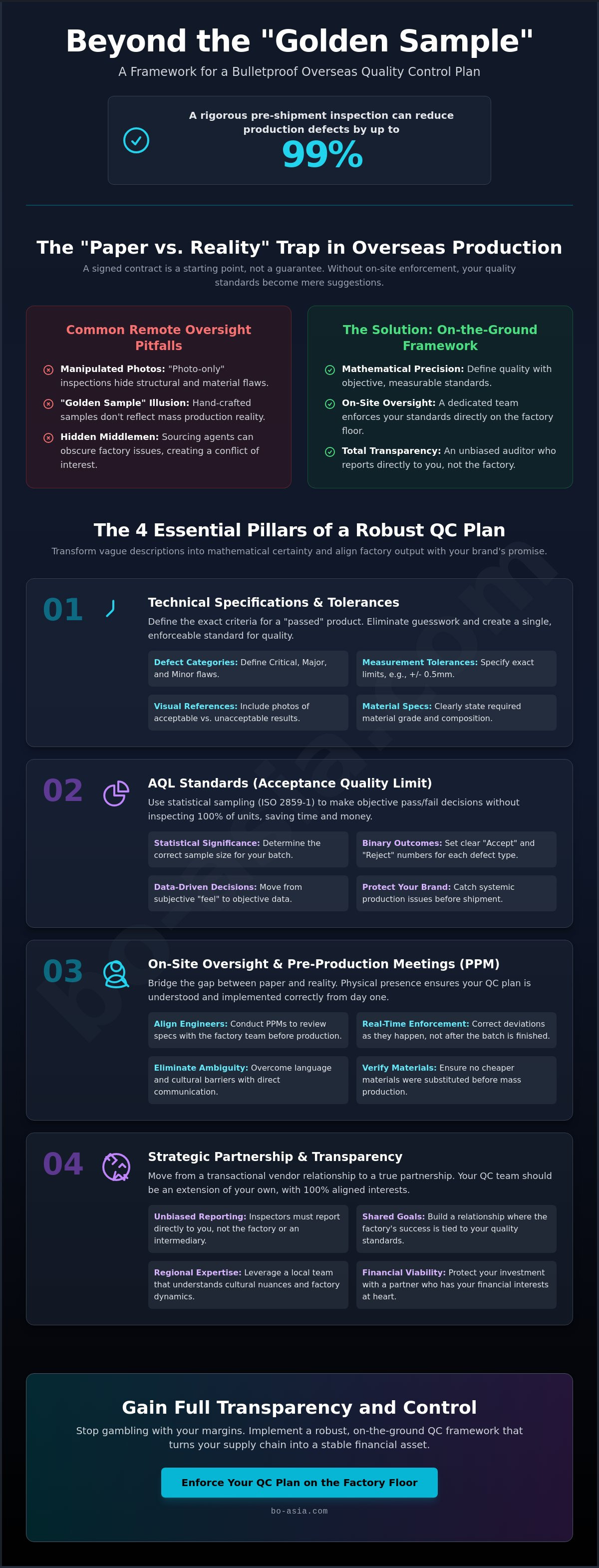
Relying on factory-provided self-inspections is one of the most common mistakes in international procurement. It is a fundamental conflict of interest. A factory's primary goal is to maintain production velocity and clear inventory. They naturally overlook minor defects that could trigger a rejection. When you are creating a quality control plan for overseas production, you must decide between a transactional third-party inspection or a dedicated on-the-ground team. While third-party firms provide a basic checklist, they often lack the deep product context required to catch nuanced failures. A dedicated team acts as an extension of your business, ensuring that your financial interests are protected at every stage of the manufacturing process.
The advantage of physical proximity cannot be overstated. Being based in Hong Kong or mainland China fundamentally changes the power dynamic with your suppliers. It moves the relationship from a distant, digital interaction to one of active accountability. Experts often highlight the importance of a quality control program that includes real-time problem solving. Catching a calibration error on day two of a production run is significantly cheaper than discovering it after 10,000 units are packed and sealed. On-site oversight allows for immediate corrective actions, preventing the hidden costs of rework and returns that destroy your margins.
On-the-ground presence is the only way to perform genuine supplier vetting. It allows for "surprise" audits that reveal the true state of factory management discipline. When a factory knows an inspector could arrive at any moment, they maintain higher standards of organization and safety. This physical oversight also helps reduce lead times. By verifying raw material stock levels before production starts, your team can identify potential shortages that would otherwise cause unannounced delays. It's about proactive defense rather than reactive damage control.
Transparency is maintained through rigorous digital reporting. A professional inspection report isn't just a "pass" or "fail" notification. It must include high-resolution photos, video evidence of stress tests, and raw data points. Our model combines European leadership in Helsinki with hands-on Asian operations in Hong Kong. This structure ensures that technical data is interpreted through a Western business lens, removing the ambiguity of language barriers. You can then integrate this QC data into your broader supply chain management strategy to benchmark supplier performance over time. This data-driven approach transforms quality from an anxiety-inducing variable into a predictable, manageable metric.
Drafting the actual criteria for your quality control plan requires a shift from strategic oversight to tactical execution. You need a document that leaves no room for factory improvisation. This process begins long before the first machine starts. By establishing a comprehensive Bill of Materials (BOM) that specifies material grades and chemical compositions, you prevent the common "material substitution" trap where factories use cheaper inputs to pad their own margins. Your plan must be a living enforcement mechanism that bridges the gap between your expectations and the factory's output.
Phase 1 focuses on rigorous vetting. Verifying raw material certificates is a mandatory step in 2026 to ensure compliance with evolving global standards like the EU Ecodesign for Sustainable Products Regulation. Your "Golden Sample" serves as the legally binding quality benchmark; it's the physical proof of what you expect. The Pre-Production Meeting is the most critical hour in the manufacturing cycle. During this meeting, your on-site team aligns factory engineers with the QC plan, resolving technical ambiguities before they become expensive errors on the assembly line. This alignment ensures that the factory's internal quality team understands your tolerances with mathematical precision.
Phase 2 moves into the live production environment. Implementing a During Production (DUPRO) inspection is essential for high-volume sourcing to prevent massive waste. If an error is detected when only 10% of the goods are finished, it's a minor correction. If it's found at the end, it's a catastrophe. Catching these early-stage errors protects your lead times and financial health. It's a proactive defense that ensures the factory maintains the agreed-upon standards throughout the entire production run.
When a batch fails, the response must be clinical. You handle a "Fail" result by following a predetermined Corrective Action Plan (CAP), ensuring the factory understands that quality is non-negotiable. This isn't about damaging the relationship; it's about maintaining professional standards and financial viability. Every factory visit also serves as an opportunity to ensure ESG compliance and ethical standards are met, reflecting the transparency required in modern supply chains. This hands-on approach eliminates the anxieties of unmanaged sourcing.
The final defense consists of the Final Random Inspection (FRI) and Container Loading Supervision (CLS). The FRI ensures the total batch matches the approved sample, while CLS guarantees that your goods aren't damaged by poor packing or moisture during transit. This end-to-end rigor ensures that what you paid for is exactly what arrives at your warehouse. If you need assistance drafting these technical specifications, reach out to our procurement experts for a professional review of your current criteria.
Enforcing a quality control framework requires more than just a checklist; it demands a physical presence that factories respect. The BOA advantage lies in our unique structure, where European management standards meet deep Asian manufacturing expertise. When you are creating a quality control plan for overseas production, you aren't just drafting a document. You're establishing an on-the-ground enforcement mechanism that operates as a direct extension of your business. By utilizing a dedicated Asia procurement team, you move beyond the limitations of transactional vendors and into a strategic partnership defined by 100% transparency.
Traditional sourcing agents often obscure factory failures to protect their commissions or maintain supplier relationships. We reject this model entirely. Our team operates with full transparency, providing you with unfiltered data from the factory floor. This allows us to negotiate factory-direct pricing while maintaining the most rigorous quality standards. We eliminate the hidden costs of rework and returns by catching issues at the source. This ensures your financial viability remains protected throughout the product lifecycle, removing the anxieties typically associated with international manufacturing.
We believe that quality is a continuous process rather than a single event. Our role extends beyond simple inspections into continuous supplier development. We work closely with factory management to improve their internal QC processes and technical capabilities. The financial impact of this work is measurable. For instance, reducing a defect rate from 5% to 0.5% can save thousands in logistics and replacement costs. Our documented case studies demonstrate how we've successfully turned around quality for international brands by implementing better tooling and stricter material vetting protocols.
Our Helsinki-Hong Kong bridge is designed to eliminate the risks that plague unmanaged supply chains. You get the elite oversight usually reserved for major enterprises, but tailored for your specific growth needs. As you scale, our team scales with you, providing the same level of hands-on mass production oversight for every new product line. This integrated approach ensures that creating a quality control plan for overseas production becomes a repeatable, scalable success rather than a one-off struggle. Protect your production with Buying Office Asia's on-site QC services and secure your margins in the complex global market.
Success in international manufacturing no longer depends on the strength of your contract alone; it relies on the rigor of your physical oversight. By creating a quality control plan for overseas production that integrates mathematical precision with on-site enforcement, you eliminate the "Golden Sample" trap and protect your margins from the hidden costs of rework. You've seen how defining clear AQL standards and conducting proactive inspections like DUPRO can transform your supply chain into a stable, financial asset.
Buying Office Asia acts as a protective, hands-on partner to ensure your standards are met without exception. As a European-managed firm with over 15 years on the ground, we provide 100% transparency with no hidden middleman fees. Our team performs on-site inspections across all major Asian manufacturing hubs, giving you the elite level of oversight usually reserved for global enterprises. Don't leave your product quality to chance or unvetted intermediaries. Secure Your Supply Chain with a Dedicated Asia Procurement Team and gain the calm assurance that comes with total operational control. Your business deserves a partner that prioritizes your financial health as much as you do.
Acceptance Quality Limit, or AQL, is a statistical standard used to define the maximum number of defective units allowed in a sample size before a batch is rejected. It's based on the ISO 2859-1 standard and is essential because 100% inspection is often cost-prohibitive in high-volume runs. By setting clear AQL thresholds for critical, major, and minor defects, you establish an objective, mathematical benchmark that removes interpretation from the quality assessment process.
You shouldn't rely on internal factory reports because they represent an inherent conflict of interest. A factory's primary goal is to maintain production velocity and clear inventory to secure final payment. Internal staff may overlook minor flaws or material inconsistencies that could lead to high return rates for your brand. Genuine transparency requires an independent, on-site presence that reports directly to your team rather than the factory management.
A DUPRO (During Production) inspection occurs when about 10% to 20% of the goods are finished, which allows you to catch systemic errors early. In contrast, a Pre-Shipment Inspection (PSI) takes place when at least 80% of the order is completed and packed. While the PSI is your final line of defense, the DUPRO is a proactive measure that prevents massive waste and rework by identifying issues before the entire batch is manufactured.
You must immediately trigger the Corrective Action Plan (CAP) established when creating a quality control plan for overseas production. This involves the factory identifying the root cause of the failure and performing rework at their own expense. You should never release final payment or approve the shipment until a re-inspection confirms that all defects have been rectified and the batch meets your specified AQL standards.
Common issues include material substitution, where factories use cheaper components to increase their margins, and aesthetic inconsistencies like color variance or poor finishing. Functional failures and structural defects are also risks if technical specifications aren't strictly enforced on the floor. These problems often arise during the transition from a hand-crafted prototype to high-volume mass production, where consistency can suffer without rigorous oversight.
Third-party inspection firms provide a transactional checklist, but a dedicated sourcing office acts as an integrated extension of your own team. A dedicated office offers deeper product context and regional expertise that one-off inspectors lack. This partnership model ensures higher accountability and more effective communication, moving beyond simple "pass or fail" reports to provide comprehensive supplier development and long-term risk mitigation.
A manufacturing contract is a legal framework defining commercial terms and liabilities, while a QC plan is a tactical document used for creating a quality control plan for overseas production that governs daily execution. The QC plan contains the actual technical specifications, tolerances, and testing protocols. While the contract provides a safety net for legal disputes, the QC plan serves as the roadmap that prevents those disputes by ensuring production matches your expectations.
A Golden Sample is the final, approved prototype that serves as the legally binding quality benchmark for your entire production run. It's the physical proof of your specifications. During inspections, on-site teams compare mass-produced units directly against this sample to identify any deviations. Without a Golden Sample, quality becomes a subjective matter of interpretation, which is a dangerous risk when managing factories across different languages and technical standards.
What if your signed OEM agreement protects the product on paper but leaves the factory unclear about what to make, when to deliver it, or how quality will be judged? That gap is where an oem manufacturing agreement china project can lose control: responsibilities blur between buyer, sourcing interme...

What if the safest payment deal isn’t the one that delays the most cash, but the one that releases it only when progress is verifiable? Payment terms negotiation with Asian suppliers is about balancing your working capital with the supplier’s need for confidence, not simply pushing for a smaller dep...

What if your biggest supply chain risk isn’t the supplier you chose, but what you can’t see after the order is placed? Asia procurement services can connect supplier selection with factory follow-through, giving you clearer visibility into production, product quality, and responsibilities along the...