
A character render is not a manufacturing specification. In custom gaming merchandise manufacturing, artwork must be translated into decisions about materials, tooling, decoration, dimensions and assembly before a factory can reproduce it consistently. Even a small gap between an approved design and a production brief can affect the finished collectible, box or tabletop game.
The practical way to manage that risk is to turn creative approvals into clear production specifications, then review representative samples and define quality checks. This gives your creative, procurement and factory teams a shared reference throughout development and production.
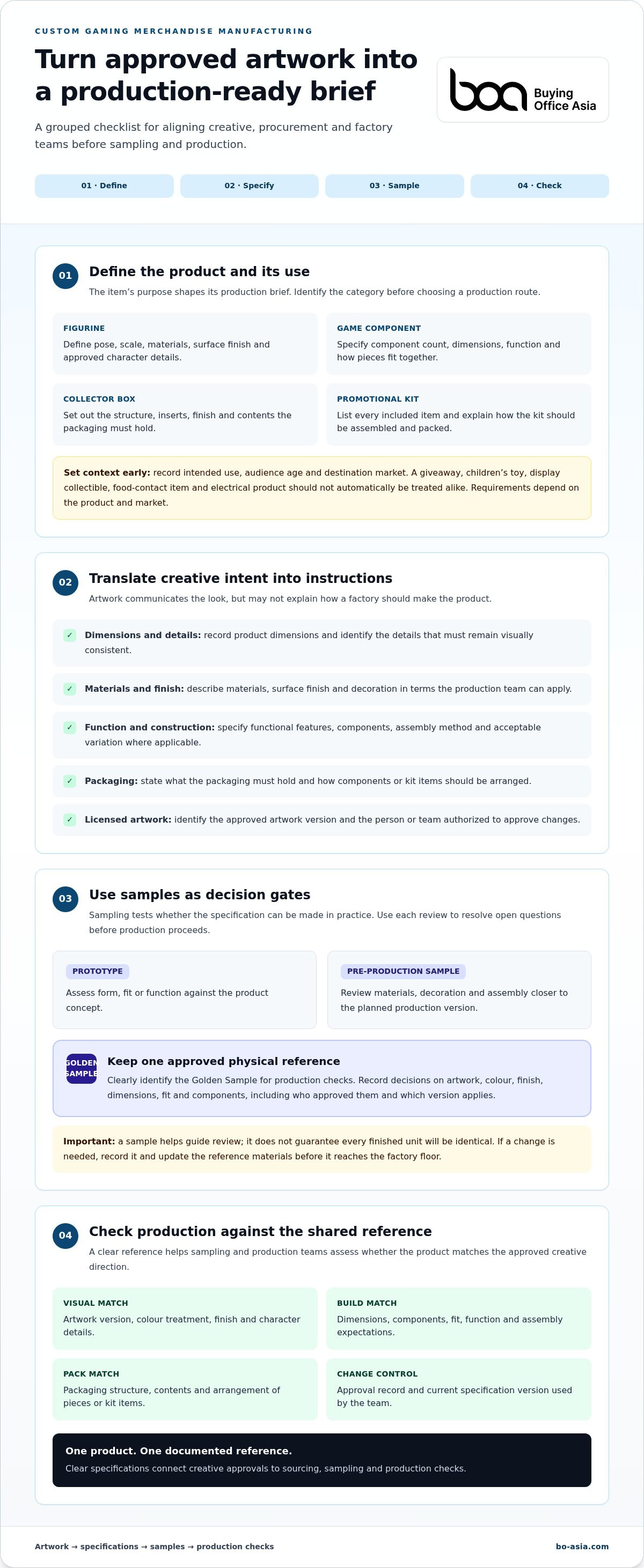
This article explains how to move from artwork to production, including how to select materials and processes, weigh tooling against unit cost, approve a Golden Sample, and specify decoration, components, assembly and packaging. Whether you’re developing a detailed figurine, an injection-moulded product, a collector’s edition box or a multi-component board game, clear decisions at each stage help prevent avoidable surprises.
• Custom gaming merchandise manufacturing covers factory-made products such as collectibles, game components, boxes and kits, not only apparel.
• Translate licensed artwork into a production brief with clear dimensions, materials, decoration, components and packaging requirements.
• Compare materials and processes against design complexity, finish, tooling needs and planned production volume.
• Use representative samples and staged quality checks to assess whether production matches the approved specifications.
• Coordinated sourcing, supplier communication and production oversight help keep quality decisions and delivery planning aligned.
Custom gaming merchandise manufacturing turns a game-world concept into goods that are specified, sampled and produced for a defined use. It goes beyond esports jerseys and print-on-demand items. Factory-made products can include detailed figurines, injection-moulded pieces, game components, collector’s edition boxes and influencer kits. Each product type brings different decisions about materials, construction, finish, assembly and packaging.
BOA supports product development and contract manufacturing across these formats, connecting creative requirements with production planning. OEM and ODM contract manufacturing translates product requirements into a coordinated development and production process.
The item’s purpose shapes its production brief. A display figurine prioritizes sculpted detail and finish; a game component must work as part of play; a collector box needs to protect and present its contents; and a promotional kit may combine several separately produced items. Promotional merchandise serves different brand and campaign needs, so define the intended use before choosing a production route.
Define the pose, scale, materials, surface finish and approved character details.
Specify the component count, dimensions, function and how the pieces fit together.
Set out the structure, inserts, finish and contents the packaging must hold.
List every included item and explain how the kit should be assembled and packed.
Intended use, audience age and destination market can affect product requirements. A giveaway, a toy intended for children, a display collectible and an item that contacts food or uses electricity should not automatically be treated alike. Requirements depend on the product and market. Establish these details early so the brief can account for relevant safety, testing, labelling and documentation needs without assuming a universal exemption or approval.
Artwork shows what a product should communicate, but may not explain how a factory should make it. Convert visual references into usable instructions: dimensions, materials, surface finish, decoration, functional features and acceptable variations. For a hypothetical character figurine, a reference image alone may leave the scale, colour treatment and position of separate parts open to interpretation.
• Record the approved artwork version and the person or team authorized to approve changes.
• Specify dimensions and identify the details that must remain visually consistent.
• Describe materials, finishes and decoration in terms the production team can apply.
• List components, assembly expectations and packaging requirements.
Treat licensed artwork and approvals as controlled production inputs. Share the files needed for development, keep versions identifiable, and route proposed changes through the designated approval process. A visually approved concept still needs manufacturable specifications because artwork may not resolve construction, tolerances, component fit or packaging. Clear instructions give sampling and production teams a common reference, making it easier to assess samples against the approved creative direction.
A controlled development process gives creative, procurement and factory teams the same reference at each decision point. In custom gaming merchandise manufacturing, the goal is to resolve open questions before they become costly changes during production. A clear sequence also connects product development with the wider manufacturing supply chain, from sourcing inputs through production and delivery.
Start with the product’s intended use, audience age, destination market and planned quantity. Add the component list, licensed artwork, packaging needs and relevant requirements for use or presentation. Separate essential features from optional details so production options can be compared against clear priorities.
Turn references into instructions a production team can apply. Record materials, dimensions, finish, decoration, assembly method and acceptable variation where applicable. For a hypothetical multi-piece tabletop game, a component schedule can identify each piece and its quantity, while packaging instructions explain how the set should be arranged. This reduces ambiguity during sourcing and makes sample reviews more focused.
Sampling tests whether a specification can be made in practice. A prototype can help assess form, fit or function; a pre-production sample can bring materials, decoration and assembly closer to the planned production version. Neither sample guarantees that every finished unit will be identical, so use each review to record observations and resolve changes before production proceeds.
Once the production version is approved, retain a clearly identified Golden Sample as the physical reference for production checks. Document decisions on artwork, colour, finish, dimensions, fit and components, including who approved them and which version applies. If a change is needed later, record it and update the reference materials before it reaches the factory floor.
Custom tooling may suit a design that needs a purpose-made mould or another production tool. The decision depends on design complexity, intended material and production plan. Tooling can involve an upfront development commitment, while a tooling-based production method may affect unit costs. Compare the full production plan against the intended order quantity and future needs rather than choosing solely on the lowest initial unit estimate.
After approval, coordinate production instructions, component sourcing, factory communication, inspection points and delivery planning. BOA supports development and sampling through production oversight, keeping decisions and records connected. Its OEM and contract manufacturing process brings these stages into a coordinated workflow. If you’re preparing a product brief, discuss your manufacturing requirements with BOA.
The right production route depends on what an item must do, how it should look and how its parts come together. In custom gaming merchandise manufacturing, a process that suits a simple printed component may not suit a sculpted collectible or multi-item kit. Compare options against design complexity, intended use, finish, assembly and packaging before weighing factory proposals.
| Product type | Key decisions | Risks to manage |
|---|---|---|
| Detailed figurine | Material, sculpt detail, paint or other finish | Inconsistent surface detail, colour or part fit |
| Printed game component | Stock or material, dimensions, print and finish | Variation between pieces or mismatch with play requirements |
| Injection-moulded product | Plastic material, mould design, geometry and volume | Tooling changes, moulded detail or fit issues |
| Assembled kit or boxed game | Component count, assembly sequence and pack layout | Missing, mismatched or incorrectly packed parts |
Injection moulding is relevant to suitable plastic products, but it is not the default for every design. It can produce repeatable formed parts, provided the design, material and mould work together. Detailed figurines require decisions about how sculpted features and surface decoration will be made. Printed game components need specifications for dimensions and print treatment. Kits require coordination across items made through different processes.
Define the intended use, too. A promotional giveaway, a toy and a display collectible are not interchangeable categories. Intended audience and destination can affect applicable product requirements, so establish them before fixing materials or approving a production route.
Custom tooling can support distinctive shapes or repeatable formed details, but it adds a development decision beyond the unit price. Consider the design, material, expected order and potential future production together. A less complex approach may avoid dedicated tooling but limit how closely the result follows the concept. Minimum order quantities depend on the product, process and factory proposal, so compare proposals using the same specification.
More components also mean more coordination. Each part may need its own sourcing, identification and inspection criteria, while assembly adds another point where parts can be missed or mismatched. A component schedule helps identify these requirements before production planning is settled.
Paint, print and other decoration methods suit different artwork and surfaces. Specify which details matter most, such as colour placement, fine lines or coverage, and assess the chosen finish on the actual material. A complex graphic may need a different treatment from a small painted detail. Define acceptable variation in terms production and inspection teams can apply.
Map the assembly sequence and how each component should be matched and packed. Packaging affects presentation and protection, and its size and structure feed into shipping planning. Treat it as part of the product specification, not an afterthought. This gives production teams a clearer basis for planning the work and lets you review the finished configuration as a complete merchandise item.
Quality control works best when the factory has clear acceptance criteria before production begins. For custom gaming merchandise manufacturing, use the approved specification and Golden Sample as working references, then check the product at suitable stages rather than relying only on a final inspection. This gives your team a chance to identify mismatches and agree on corrective action while production is still underway.
Translate subjective approval into observable comparisons. A quality checklist can cover:
Compare colour, paint coverage, print placement and finish with the approved reference.
Measure specified features and check whether components fit or function as intended.
Confirm the specified materials and component count, including agreed variations.
Check assembly steps, component matching, pack contents and presentation against the specification.
Record relevant approvals, product requirements and inspection findings.
Where dimensions or visual variation matter, set tolerances and acceptance criteria in the agreed specification. “Match the artwork” is not enough if teams interpret colour, detail or finish differently. For licensed merchandise, control access to approved character artwork and production files, and identify the versions authorized for use. This helps prevent outdated or unapproved material from reaching production.
An on-site inspection is a snapshot of sampled goods at a defined point in production. Checks can be scheduled around the product and its risks, such as reviewing components during production, assembled goods before packing, or finished packaging before dispatch. Findings support decisions, but an inspection cannot guarantee that every unit is defect-free. AQL sampling also examines a sample, not every item, so it does not guarantee every unit’s quality.
Inspection reports make issues visible; supplier communication and follow-up help determine what corrective action is needed and whether it has been addressed. BOA provides multi-stage, on-site inspections that assess production against the approved Golden Sample. A standalone inspection can address a specific checkpoint and can start from one inspector-day, with same-day reporting. Broader production oversight adds supplier management, prevention and follow-up between checkpoints. To plan an inspection, define the product scope, factory access, location, sampling or tests, and timing.
Product requirements depend on intended use, audience age, product type and destination. A promotional item, a collectible and a toy intended for children may have different considerations. Small parts or testing may be relevant for some products, but should not be assumed for every item. Verify applicable requirements with official regulators or standards bodies for the destination market, and include relevant documentation in the production plan.
BOA can coordinate product requirements, supplier communication and quality checks. Contact BOA about your merchandise production.
Complex merchandise can involve several suppliers, production methods and approval points. BOA works as an on-the-ground sourcing and procurement partner, coordinating product development, sampling, production oversight, quality control and logistics. This connected approach keeps specifications, factory communication and client decisions aligned as a project moves from requirements toward finished goods.
Local factory communication helps translate approved requirements into production instructions, raise questions early and relay inspection findings to the teams responsible for addressing them. A collector’s box with several components, for example, may require coordination across the box, inserts and included items. Shared project information helps prevent suppliers from working from different instructions or artwork versions.
BOA provides transparent reporting of factory prices, documents and communications, and negotiates factory-direct prices. That gives you visibility into supplier discussions and production decisions. A dedicated sourcing team connects procurement activity with project communication, keeping decisions accessible to your team.
BOA also coordinates international logistics, including consolidation, documentation and transport planning. This connects production readiness with the arrangements needed to move goods onward.
End-to-end coordination links development, supplier management, production follow-up and quality oversight. This approach is useful for projects involving tooling, multiple components or several production stages, because decisions and corrective actions can be managed across the workflow. BOA’s sourcing and procurement support can form part of that broader process.
A standalone inspection suits a defined need at a particular production point. It provides a focused view of sampled goods, while broader oversight also addresses supplier communication and follow-up between checkpoints. The product scope, factory access, location, sampling or tests, and timing help define the inspection plan.
You don’t need every technical decision finalized to begin a discussion. Sharing what’s known helps clarify the next steps for custom gaming merchandise manufacturing. Gather the following information:
Category, concept files and known materials or dimensions.
Intended use, target audience and destination market.
Component counts, assembly expectations and packaging needs.
Artwork status, authorized versions and approval restrictions.
Planned quantity, desired launch window and project priorities.
Share your starting brief with BOA to discuss a suitable development and production path. Discuss your gaming merchandise project.
Turn the creative direction into a project that can be evaluated and developed. Start with the decisions that shape manufacturing: what the item needs to do, which visual details are essential, and what must be resolved before production can proceed. Clear priorities help your team make informed trade-offs as the concept moves from design intent toward a manufacturable product.
Custom gaming merchandise manufacturing benefits from practical coordination between creative stakeholders and production teams. BOA’s on-the-ground Asian team works with European leadership to coordinate manufacturing projects. The team connects project requirements with factory communication and production follow-up.
Bring your concept, even if some specifications are still being developed. A focused discussion can help identify the next decisions and the right level of sourcing, sampling and production support for your project. Discuss your custom gaming merchandise project with BOA and take the next step toward turning your licensed artwork into a production-ready product.
It’s the process of producing physical goods designed around a game, publisher or related brand. For procurement teams, distinguish between customizing an existing item and developing a product with its own specifications, components or tooling. That distinction affects what needs to be agreed with suppliers and who must approve design changes, production changes and final product details.
Prepare a controlled artwork pack before sharing files for production. Include clearly named versions, identify the approved file for each product element, and record who can authorize creative or technical changes. For layered artwork, label the intended use of each relevant layer or asset. This helps prevent suppliers from selecting an outdated image or interpreting a visual reference as permission to alter licensed character details.
Yes, but describe the intended use accurately in the project brief and product information. Calling an item promotional does not explain whether it is designed for play, display or another use. If a product is intended for children, has small parts, contacts food or uses electricity, identify that function early. This gives the project team a sound basis for identifying relevant product and destination-market requirements.
Ask how a proposed material or process handles the product’s most demanding feature, such as fine sculpted detail, repeated handling or a particular surface finish. Compare alternatives against the approved appearance and intended use, not just the quoted unit cost. Record whether substitutions require your written approval. This helps prevent a sourcing change from quietly altering the item’s look or performance.
Make sample approvals traceable. Record the sample version, review date, approved components and any accepted deviations, then keep the approval record with the specification. If a later revision changes a part or finish, document which previous approval it replaces. This gives creative, procurement and production teams a clear reference and helps prevent an approval for one configuration from being applied to another.
Make inspection findings actionable by recording the affected component, the observed issue, supporting images where appropriate and the agreed next step. Assign a decision owner for questions such as whether affected goods need rework or another review. For a multi-component product, link findings to the relevant part rather than describing only the set as a whole. A clear record supports supplier communication and follow-up.
Yes. BOA offers standalone inspections, starting from one inspector-day, with same-day reporting. Prepare the approved product references, the specific concerns to examine and the acceptance criteria your team will use. Identify who should receive the findings and who can authorize follow-up actions. This helps align the inspection report with the decisions your procurement or quality team needs to make.
Knowing how to manage overseas manufacturing projects starts with comparing total landed cost, not just the factory quote. Include tooling, freight, tariffs and duties, insurance, management time, and the cost of correcting problems. Weigh those expenses against product quality, delivery risks, and...

The biggest risk in contract manufacturing in India is not simply finding a factory. It is starting production before product specifications, responsibilities and intellectual property terms are clearly documented.Finding and contacting suitable manufacturers is an important first step, but the righ...
A manufacturer’s quotation can look right while the factory behind it lacks the capacity or quality controls your product needs. Knowing how to vet manufacturing suppliers in Asia means assessing production fit, business credentials, quality practices, and sample results before committing to an orde...