

Most businesses believe that finding the "right" factory is the final hurdle in global trade, but the reality is that success depends almost entirely on the technical oversight you maintain during the tooling and sampling phases. Your strategy for custom product manufacturing in China must move beyond simple sourcing and toward a model of rigorous, hands-on management. It's the only way to ensure your intellectual property remains secure and your margins stay intact.
You've likely experienced the frustration of a prototype that looks perfect, only to watch the quality slip during mass production. It's a common anxiety caused by communication barriers, hidden markups from intermediaries, and the very real threat of design theft. We understand that you need a supply chain built on transparency and physical accountability, not just digital promises. This guide provides a professional framework to help you master these complexities and secure factory-direct pricing without the usual risks.
We'll examine how to navigate the 2026 VAT law updates, implement strict on-site quality control protocols, and utilize the latest IP protection strategies. You'll learn how to transform your manufacturing process into a reliable, high-performance asset that delivers exactly what you designed.
• Understand why China's manufacturing ecosystem remains the global leader for ground-up engineering and complex product development in 2026.
• Identify how Design for Manufacturing (DFM) analysis and production-grade testing prevent costly technical errors during the transition from prototype to mass production.
• Choose the right path for your brand by evaluating the distinct advantages of OEM, ODM, and fully custom product manufacturing in China.
• Establish operational safeguards and physical oversight to protect your intellectual property and prevent unauthorized 'backdoor' sales of your designs.
• Secure a more profitable supply chain by adopting a transparency-first model that removes hidden intermediary fees and ensures factory-direct pricing.
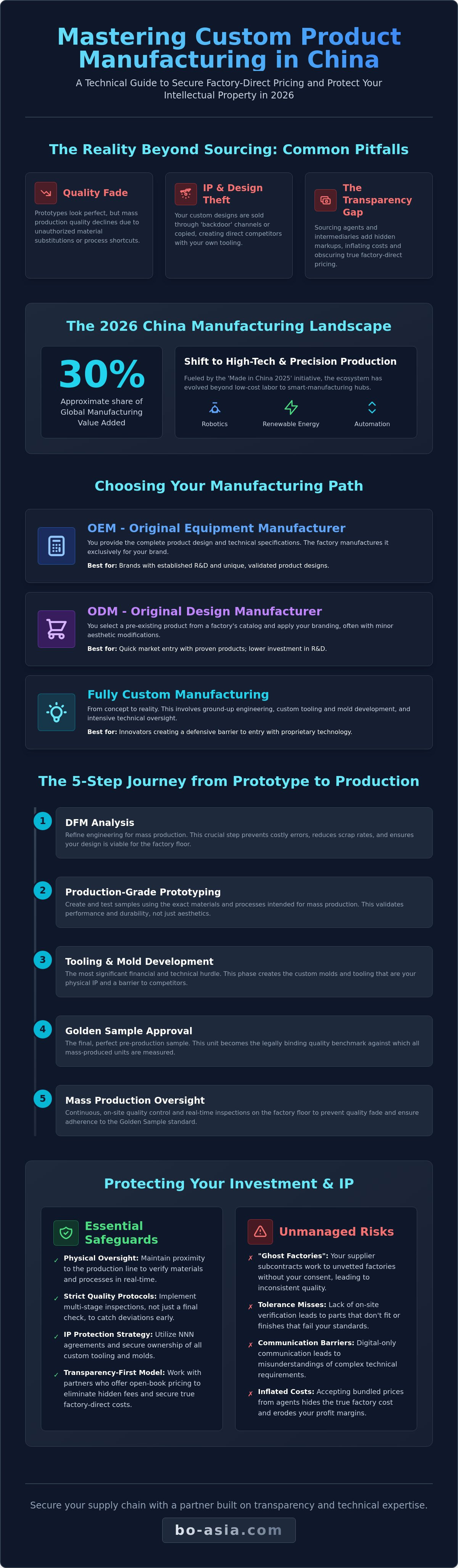
Custom product manufacturing in China has evolved into a high-stakes technical discipline. In 2026, it's no longer about finding the lowest labor cost. It's about accessing an unparalleled industrial ecosystem that accounts for approximately 30% of global manufacturing value added. This landscape spans a broad spectrum. It ranges from minor aesthetic modifications to complex, ground-up engineering and custom tooling development. Success in this environment requires you to recognize the shift toward high-tech, precision-driven production. This movement is largely fueled by the Made in China 2025 initiative, which has transformed local factories into automated, smart-manufacturing hubs focused on robotics and renewable energy components.
Many businesses fall into the "Transparency Gap." Traditional sourcing agents often operate on hidden margins, obscuring the true factory-direct price. This lack of financial clarity creates a conflict of interest. Your agent's profit should never be tied to inflated costs. You need a partner that functions as an extension of your own team to eliminate these obscured expenses. The implementation of the new national VAT law on January 1, 2026, has provided more legal certainty for businesses, yet navigating these tax frameworks still requires professional rigor to ensure financial optimization and regulatory adherence.
Market saturation has made generic products a liability. To build long-term brand equity, you must offer unique functional improvements that competitors can't easily replicate. Custom manufacturing allows you to control the user experience through proprietary designs and specialized materials. It's the difference between being a reseller and an innovator. By investing in custom tooling, you create a defensive barrier to entry. This strategic move secures your market position and ensures your product stands out in a crowded digital marketplace.
Without a dedicated procurement team on the ground, your project faces significant hazards. Quality fade is a common outcome where the first 100 units match your prototype, but subsequent batches suffer from unauthorized material substitutions. You might also encounter "ghost factories," which are subcontractors used by your primary supplier without your knowledge or consent. These breakdowns in technical specifications lead to tolerances that miss the mark and finishes that fail to meet your standards. Risk management is not an option; it's a requirement for financial viability. You must maintain physical proximity to the production line to defend against these operational setbacks.
Moving from a digital design to a physical product requires a disciplined technical framework. Custom product manufacturing in China is often misunderstood as a simple linear process, but it actually requires iterative oversight at every stage. According to McKinsey's 2026 outlook on China, supply chain resilience now depends on how well executives manage these technical transition points. The journey begins with Design for Manufacturing (DFM) analysis. This stage ensures your design is mass-producible without excessive scrap rates or assembly failures. Once the design is validated, prototyping begins using production-grade materials. This is not the time for 3D prints. You need samples that mimic the final product's performance and durability.
The technical journey follows five critical steps:
DFM analysis to refine the engineering for mass production.
Prototyping and iterative testing with production-grade materials.
Tooling and mold development, which is the most significant financial hurdle.
Golden Sample approval to serve as the legally binding quality benchmark.
Mass production oversight and real-time inspections on the factory floor.
The most significant technical and financial hurdle is tooling and mold development. This phase involves Non-Recurring Engineering (NRE) costs that represent a long-term investment in your brand's proprietary assets. You must ensure that you maintain full ownership of these physical molds. Without a clear contract and physical verification, factories may use your custom tooling for other clients. High-volume production demands high-grade steel molds with a documented maintenance schedule to prevent quality degradation over time. This level of oversight is a core part of custom product manufacturing in China when managed through a professional framework.
NRE costs are often viewed as a barrier, but they're actually a strategic defense. Ownership of the mold is the only way to protect your supply chain from being held hostage by a single supplier. We ensure that every mold is cataloged, marked, and physically verified at the factory. This prevents the "backdoor" sales of your designs and ensures that your investment remains your property. Proper maintenance extends the lifespan of these molds, ensuring consistent quality across hundreds of thousands of units.
Your final defense against quality disputes is the Golden Sample. This is the unit that has been approved by all stakeholders and serves as the benchmark for mass production. We recommend sealing these samples and keeping them on-site for our quality control teams to reference during inspections. Linking your final payment milestones to the Golden Sample's standards ensures the factory remains accountable for every unit that leaves the line. If you're ready to secure your technical roadmap, you can reach out to our engineering team for a consultation.
Selecting the right production model is a pivotal decision that impacts your speed to market, capital allocation, and long-term intellectual property security. In the context of custom product manufacturing in China, businesses usually operate within three distinct frameworks. Each path offers a different balance of control and investment. Your choice should align with your internal engineering capabilities and your competitive strategy for the global market. It's not just about what you make; it's about how you protect your right to sell it.
You provide the technical specifications and designs. The factory acts as your production arm, leveraging their specialized equipment to bring your vision to life.
The factory owns the design. You select a pre-engineered product and apply your branding, color schemes, or packaging. This is often called white-labeling.
This involves ground-up development. You aren't just modifying a product; you're creating a new one that requires unique tooling and proprietary technology.
Deciding which model fits your brand depends on your budget, how quickly you need to launch, and how much you need to protect your specific design features. Learn more about our OEM/ODM contract manufacturing services to see how we manage these distinctions for our clients.
OEM is the ideal choice for brands with internal engineering teams or specific functional patents. It allows you to maintain absolute control over the product's DNA. While it requires a higher upfront investment in custom tooling development, it typically results in lower unit costs at high volumes. This model secures your competitive advantage by ensuring your product cannot be legally replicated by the factory for other customers. It's a strategic move for those prioritizing brand equity and unique functionality over immediate market entry.
If speed to market is your primary metric for success, ODM manufacturing offers a significant head start. You leverage the factory's existing R&D and tested blueprints to launch a product in weeks rather than months. Minor modifications like logo placement or custom packaging help differentiate your brand without the heavy expense of new molds. However, you must accept the risks associated with ODM. Since the factory owns the design, the barrier to entry for your competitors is much lower. They can theoretically launch the same product under a different name, making your marketing and distribution the only real points of differentiation. For many, this is a calculated trade-off to capture market share quickly.
Regardless of the path you choose, custom product manufacturing in China requires a protective, hands-on partner. We ensure that whether you're using an existing design or building a new one from scratch, your financial interests and brand integrity remain the priority. Our role is to provide the regional expertise you need to navigate these choices with calm assurance.
Intellectual property theft remains the single greatest risk in custom product manufacturing in China. Many businesses rely on standard NDAs, but these are often insufficient in local courts. You need a robust NNN agreement. This contract covers Non-Use, Non-Disclosure, and Non-Circumvention. It prevents a factory from using your designs for their own benefit or selling them to your competitors. This "backdoor" sale of your proprietary design is a common operational setback that can destroy your brand equity before you even scale. While China is actively strengthening its legal framework through the 2026 Plan for Building a Strong Intellectual Property Nation, judicial protection still requires documented evidence gathered from on-site oversight.
Legal frameworks are only half the battle. Contracts aren't enough without a physical presence to enforce them. We recommend "splitting" production for highly sensitive projects. By manufacturing critical components at different facilities and handling final assembly separately, you ensure no single factory has the full blueprint for your innovation. This compartmentalization is a standard defense used by elite enterprises to maintain control. It transforms a vulnerable supply chain into a secure, fragmented network that protects your most valuable technical assets.
Having a partner with a regional presence is vital for maintaining IP security. Why physical presence is our signature promise is rooted in the need for immediate, local accountability. Being based in Hong Kong provides a legal bridge between international standards and local factory operations. This proximity allows for unannounced factory audits. These surprise visits are the only reliable way to verify that your custom tooling isn't being used for unauthorized "third-shift" production runs. It's about moving from a position of hope to a position of documented certainty.
Custom molds are high-value assets that require professional management throughout their lifecycle. We track mold wear and tear meticulously to prevent batch-to-batch defects that lead to quality fade. High-volume production demands strict storage protocols and insurance for these assets. If your business needs to move tooling between factories, the logistical and legal challenges can be significant. You need clearly documented ownership and a pre-negotiated exit strategy in your initial supplier agreement. This prevents factories from holding your molds hostage during a dispute. If you're concerned about the security of your designs, you can contact our procurement experts today to discuss a customized protection strategy.
Success in custom product manufacturing in China requires a bridge between Western expectations and Eastern industrial realities. Most businesses struggle because they rely on intermediaries who thrive on information asymmetry. We've dismantled this traditional agent model. By combining European leadership from our Helsinki headquarters with deep regional expertise in Hong Kong and mainland China, we provide the steady confidence you need to scale. Our approach isn't about being a third-party vendor; it's about functioning as a protective, integrated extension of your own procurement department.
We manage the entire lifecycle of your project. This includes everything from the first CAD drawing and custom tooling development to final logistics coordination. Our team has successfully scaled production for international brands by maintaining physical proximity to the factory floor. This on-site presence allows us to enforce the rigorous standards we've discussed, ensuring that your mass production matches your initial prototype without the common risks of quality fade or design theft.
The most significant barrier to financial viability is the hidden markup. Traditional sourcing agents often obscure the true factory-direct price to pad their own margins. Our 100% Transparency Model eliminates this conflict of interest. We conduct factory-direct price negotiations on your behalf, providing you with the raw data and original invoices. Our fee-based structure ensures that our interests are perfectly aligned with your profitability. When we negotiate a lower price or identify a more efficient production method, those savings stay with you. You can see real-world savings examples from our clients to understand the impact of this transparent approach on your bottom line.
Complex manufacturing chains fail when communication is fragmented. We solve this by providing a single point of contact who manages every technical detail of your supply chain. You don't have to navigate the nuances of the 2026 VAT law or verify industrial electricity rates in different provinces. Your dedicated sourcing team handles the supplier vetting, factory audits, and mass production oversight. This level of management is usually reserved for major enterprises, but we make it accessible to independent business owners looking to secure their market position. If you're ready to move from unmanaged sourcing to a professional manufacturing framework, contact our team today to start your project.
Mastering custom product manufacturing in China requires moving beyond the role of a passive buyer and becoming a proactive architect of your supply chain. Success depends on rigorous technical oversight, from the initial DFM analysis to the final on-site quality inspection. Protecting your intellectual property isn't just a legal exercise; it's a physical one that demands a constant presence on the factory floor. By choosing a partner that rejects the opaque intermediary model, you secure the factory-direct pricing and operational control necessary for high-volume growth.
Buying Office Asia operates as a European-managed firm with Helsinki leadership, providing a bridge between Western quality standards and Eastern industrial capacity. Our 100% transparency model ensures there are zero hidden markups, while our on-the-ground presence in Hong Kong and Mainland China provides the accountability a digital world lacks. We don't just connect you to a factory; we function as your dedicated defense against the risks of international trade. Secure your custom production with Buying Office Asia's expert team and transform your manufacturing from a source of anxiety into a stable, profitable asset. Your vision deserves a supply chain that is as resilient as your brand.
OEM (Original Equipment Manufacturing) involves the factory producing a product based entirely on your unique designs and technical specifications. In contrast, ODM (Original Design Manufacturing) allows you to select a product already engineered by the factory and apply your own branding or minor cosmetic changes. OEM provides greater intellectual property security and product differentiation, while ODM offers a faster route to market with lower initial engineering costs.
Non-Recurring Engineering (NRE) costs vary significantly based on the complexity of your design, the type of material used, and the required lifespan of the mold. Factors such as the grade of steel for injection molds or the precision of CNC fixtures will dictate the final price. While labor costs are rising, China's ecosystem density keeps tooling competitive. You should always ensure your quote includes a detailed breakdown of material specifications and mold maintenance protocols.
Effective IP protection requires a combination of legal contracts and physical oversight. You should utilize an NNN (Non-Use, Non-Disclosure, Non-Circumvention) agreement drafted specifically for the Chinese jurisdiction. Beyond paperwork, maintaining a physical presence on the factory floor is the only way to prevent unauthorized "backdoor" production. Splitting production between multiple suppliers for sensitive components is another professional strategy to keep your full blueprint secure.
A Golden Sample is the final, approved version of your product that serves as the definitive quality benchmark for mass production. It's the most critical tool for quality control because it provides a physical reference that cannot be misinterpreted through translation. This sample should be signed, dated, and sealed. It serves as the legally binding standard that the factory must meet for every unit in your order.
You only own the tooling if your contract explicitly states that ownership transfers to you upon payment. Without clear legal language and physical verification, factories may attempt to retain the molds or use them for other clients. Professional custom product manufacturing in China involves cataloging every mold and ensuring you have the right to move that tooling to another facility if a dispute arises.
Verification requires a comprehensive on-site factory audit that goes beyond reviewing digital certificates. You must evaluate their technical engineering team, their internal quality management systems, and their experience with similar custom projects. Reviewing their machinery and maintenance logs provides proof of their precision capabilities. A factory that refuses a physical audit or hides its production lines is a significant red flag for any custom project.
The most frequent pitfalls include quality fade and hidden markups from unvetted sourcing agents. Communication breakdowns regarding technical tolerances or material finishes often lead to expensive production errors. Many businesses also fail to account for the tooling lifecycle, leading to defects as molds wear out over time. These risks are best managed through a transparent, fee-based model that aligns the interests of your procurement team with your own profitability.
We implement a protective, hands-on quality control process that involves real-time mass production oversight. Our team conducts on-site inspections at critical stages of the manufacturing cycle, not just at the final packaging phase. We reference your Golden Sample for every check to ensure consistency. This physical proximity allows us to identify and correct defects before they become a financial liability, ensuring the final product matches your initial prototype exactly.
What if the first clear sign of a production problem arrives after the goods are packed? Manufacturing risk management in Asia works best when controls are connected from the start, not left to a final inspection or occasional supplier update. You need visibility into factory activity, early warning...

What if the lowest unit quote isn’t the lowest-cost way to make your board game? Board game manufacturing costs depend on more than the number of boxes ordered. Component materials, custom tooling, assembly, packaging and delivery scope can all change what a quote covers, making headline prices diff...

What if the factory’s lowest quote isn’t the lowest-cost option? A lower unit price can hide differences in materials, tooling, packaging, quality checks or production terms. Understanding how sourcing agents negotiate factory prices starts with making those differences visible, not simply asking a...