


What if the factory’s lowest quote isn’t the lowest-cost option? A lower unit price can hide differences in materials, tooling, packaging, quality checks or production terms. Understanding how sourcing agents negotiate factory prices starts with making those differences visible, not simply asking a supplier for a discount.
It’s difficult to judge whether an offer is fair when factories quote against different specifications. Distance can also make it harder to assess production costs and flexibility. A sourcing agent with local factory access can clarify the details behind an offer and negotiate against a consistent brief, while keeping the agreed product and production expectations in view. The goal isn’t a lower number at any cost. It’s a commercially sound offer you can compare and manage.
This article explains the practical levers behind factory-price negotiations, how to compare quotes on equivalent specifications and terms, and which costs can affect the final landed cost. You’ll also learn what information to prepare, how to evaluate trade-offs such as tooling and order volume, and what transparent agent support should look like, so potential savings don’t come at the expense of quality or production reliability.
• Strong negotiations begin with clear product requirements and comparable factory quotes, not a discount request alone.
• Learn how sourcing agents negotiate factory prices by using local factory access and credible supplier alternatives to clarify assumptions and strengthen leverage.
• Compare offers against the same quantity, tooling, packaging and delivery assumptions, separating one-time development costs from recurring production costs.
• Set non-negotiable specifications apart from flexible commercial preferences before approaching factories.
• Transparent access to factory prices, documents and communications helps you understand what changed in an offer and how BOA coordinates negotiations.
Sourcing agents negotiate by improving information, comparability and commercial terms before discussing a lower price. A factory can only price the requirements it receives. An incomplete brief may produce an attractive quote that excludes essential features or leaves key assumptions unresolved. Start by defining what you’re buying and asking each factory to price the same scope.
A lower unit price isn’t automatically a better purchasing outcome. If it relies on a different material, omits packaging, assumes less assembly or excludes production checks, the apparent saving may shift cost or risk elsewhere. Effective negotiation focuses on the agreed product and the full order scope, not the headline number alone. This section concerns factory pricing, rather than how an agent’s service fee is calculated.
Quotes can look similar while covering different work. Material grade, dimensions, surface finish, decoration, packaging and assembly all affect scope. Tooling and setup should also be identified separately from recurring production costs. A mould or other custom tool may involve a one-time development charge, while the production quote covers units made using that tool. Combining these costs can make one offer seem cheaper simply because its assumptions are less visible.
Hypothetical example: Two factories quote for the same branded desk accessory. One includes a specified material, printed decoration, individual packaging and assembly. The other quotes a simpler finish and bulk packing, with setup charges listed separately. Comparing only the unit prices would be misleading. First align the specifications and inclusions, then compare one-time and recurring charges on their own terms.
Give suppliers a shared brief and ask them to identify assumptions or exclusions before requesting revised offers. Clarify the order quantity, number and type of components, production process, and completeness of drawings or reference samples. State required dimensions, materials, finish, decoration and assembly expectations. If a detail is flexible, label it as a preference rather than leaving the factory to guess.
Packaging and delivery terms matter too. Specify the packaging format and whether the quote includes packing or only the product. State the delivery point and commercial terms required for comparison. For a more complete cost picture, list freight, customs-related charges and other destination costs separately from the factory quote. These details help distinguish a genuine pricing difference from an omitted service or a different quotation basis.
List materials, dimensions, tolerances, finish, components and assembly requirements.
Provide the target quantity and identify any quantity options you want quoted.
Request tooling, setup or development items apart from recurring unit costs.
Use the same packaging and delivery assumptions for every supplier.
This preparation creates a transparent basis for negotiation, including the alternatives and trade-offs each party can consider. A broader overview of negotiation strategies and processes can help frame those discussions. For practical context on coordinating these steps across suppliers in Asia, see BOA’s Asia sourcing and procurement support.
Price leverage comes from being able to discuss real options, not from making an unsupported demand. A sourcing agent with local factory access can clarify production arrangements, assess relevant capabilities and ask what assumptions sit behind an offer. That context helps distinguish a genuine supplier constraint from a misunderstanding or an unpriced requirement, giving the buyer a stronger basis for a practical negotiation.
This is how sourcing agents negotiate factory prices without relying on pressure tactics: they connect the buyer’s approved brief to supplier information and comparable alternatives. A second supplier is useful only when its capabilities, scope and commercial terms are understood. An unverified alternative may weaken trust rather than improve the discussion.
Direct factory communication can clarify who will produce the order, which operations are performed on-site, and what the quote includes or excludes. Supplier vetting adds context by assessing whether the stated capabilities and production arrangements support the proposed offer. BOA’s supplier identification and vetting work helps build that picture. This makes negotiation more specific: the buyer can ask about a stated assumption instead of requesting a general discount.
Local access can also surface practical constraints, such as whether a proposed process suits the product or whether an order configuration affects production planning. These findings don’t prove that one factory is always cheaper or better. They help the buyer compare credible options against the same requirements. For additional frameworks to structure a prepared discussion, see procurement negotiation strategies and tools.
The unit price is only one part of the commercial offer. Depending on the project, an agent may discuss minimum order quantity (MOQ), order configuration, payment terms, packaging, production terms and delivery responsibilities. Record each change alongside its effect on the buyer’s obligations, cash flow, handling requirements or delivery scope. A revised offer isn’t comparable until the inclusions and assumptions are clear.
Explore whether quantities can be structured differently, while checking the effect on unit pricing and production planning.
Compare proposed milestones and conditions, not just the quoted amount.
Clarify what the factory packs, where its responsibility ends, and which delivery assumptions apply.
Request alternatives only when their specification differences are explicit.
A different material or process may change the quote, but it may also affect finish, durability, tolerances or consistency. Treat it as an option for evaluation, not an approved substitution. The buyer’s approved specifications and quality requirements remain the baseline. Any proposed change needs explicit approval before it becomes part of the order. Don’t call an option a saving until its scope and trade-offs have been compared fairly.
For factory-direct negotiation grounded in local supplier coordination, contact BOA’s sourcing team.
A lower factory price isn’t, by itself, evidence of reduced quality. It may reflect a genuine production efficiency, different commercial terms or an omitted cost. The buyer-side test is whether each offer covers the same approved product and production scope. That’s the practical point behind how sourcing agents negotiate factory prices: compare the offer, its assumptions and the controls needed to deliver the agreed standard.
Use a comparison sheet that makes gaps visible. Don’t treat a blank field as included. Ask the supplier to state what the quote covers, identify exclusions and explain any difference from the brief.
Use one column for the comparison basis and one for each supplier. Enter the same required specification in every row, then record each factory’s response. “Different” or “not stated” is useful information. It shows where a price comparison needs clarification before you choose an offer.
| Scope item | Comparison basis | Factory offer A | Factory offer B |
|---|---|---|---|
| Product | Material, dimensions, finish, tolerances | Record response or gap | Record response or gap |
| Configuration | Component count, assembly and order quantity | Record response or gap | Record response or gap |
| Development | Tooling and sampling, listed separately | One-time or recurring | One-time or recurring |
| Packaging | Agreed format and quantity per pack | Included or excluded | Included or excluded |
| Delivery | Delivery point, responsibilities and commercial terms | State assumptions | State assumptions |
Keep tooling, setup and sample-development charges separate from recurring unit pricing. Also record production assumptions, such as the approved sample being the reference and the agreed inspection or reporting checkpoints. For delivery, align responsibilities and terms without assuming that different quotes include the same logistics scope.
Approve a Golden Sample, the signed-off physical sample used as the agreed production reference. Record its version and the approved materials, dimensions, finish and decoration. For painted or printed items, define consistency and acceptable variation in the specification rather than relying on a general description such as “good finish.”
Set quality checkpoints at relevant stages, such as sample approval and production follow-up, and agree how deviations will be documented and addressed. An inspection is a snapshot of the units and conditions assessed; it doesn’t guarantee every unit will meet requirements. Follow-up matters because findings need an owner, corrective action and confirmation before production proceeds or the issue is closed.
For games and merchandise, tailor the comparison to the item. A multi-component tabletop product needs clear component counts and assembly expectations. Licensed artwork may require approval against authorized files. If an item is intended as a toy or collectible, age grading, small parts and applicable testing may be relevant depending on intended use and destination. Don’t apply these considerations automatically to every promotional product, or assume a product is exempt without assessing its use and market.
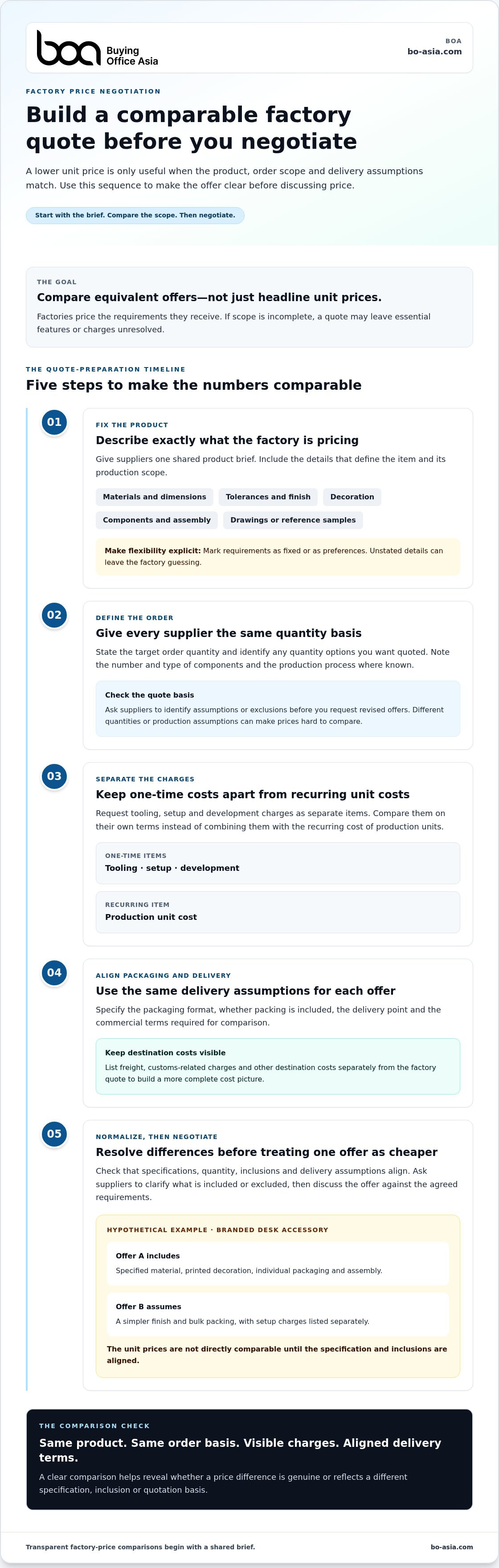
A focused negotiation begins with a brief that makes the buyer’s requirements clear and separates essential product standards from commercial preferences. This gives the factory room to propose options without unintentionally changing the product. It also creates a written basis for evaluating how sourcing agents negotiate factory prices: each counteroffer can be traced to a specific change in scope or terms.
Gather the current drawings, material requirements, dimensions, finishes, component list, packaging instructions and expected order configuration. Identify the approved sample or define how samples will be reviewed and approved before production. Mark specifications as non-negotiable or open to discussion, and state who must approve any change.
Check that drawings and written specifications describe the same product, including finish, tolerances, decoration and assembly.
Identify the approved sample, or document the sample-approval process and production checkpoints.
Keep required materials and performance standards fixed; list negotiable options such as order configuration or packaging separately.
Ask for MOQ, unit pricing, tooling and sampling charges, packaging, payment terms and delivery responsibilities to be stated distinctly.
Save each quote version, clarification, approved change and the person authorizing it.
This sequence helps prevent a verbal concession from quietly becoming a specification change. If an alternative material or process is proposed, ask how it affects finish, consistency, tolerances and production checks. Treat it as an option for review, not an approved substitute.
Ask the factory to identify exactly what changed from the original offer. Was the price revised because of quantity, packaging, tooling, payment terms or a product change? Record the explanation beside the revised quote. Then compare it with other offers using the same specification, order configuration and delivery responsibilities.
• Does the revised offer meet every non-negotiable requirement?
• Are one-time tooling or sampling charges separated from recurring production pricing?
• Have packaging, assembly, quality checkpoints or reporting responsibilities changed?
• Is the sample approval process still clear, and does it govern the production standard?
• Does any proposed saving depend on a change that still needs buyer approval?
If an answer is unclear, mark the offer as pending clarification rather than treating the gap as included. This simple decision record protects you from comparing a complete offer with one that leaves important work or responsibility unstated.
BOA’s sourcing and procurement support can coordinate local supplier communication and keep quote changes visible. Discuss your factory negotiation requirements with BOA.
Factory-price negotiation is most useful when the buyer can see how quoted terms connect to the product and production plan. BOA’s on-the-ground Asian team works with European leadership to coordinate supplier communication, clarify factory assumptions and keep decisions visible across locations. Clients receive factory prices, supporting documents and communications transparently, with a clearly defined service fee and no hidden commissions or mark-ups.
Negotiation is one part of a connected process. BOA’s support can extend from product requirements and supplier selection through sampling and approval, production oversight, quality checks and logistics coordination. If a sample reveals a gap between the brief and the factory’s interpretation, the requirement can be clarified before mass production.
After terms are agreed, production follow-up helps identify deviations and coordinate corrective action. An inspection is a snapshot of the units and conditions assessed, not a guarantee of every unit’s quality. BOA reports client savings of 9% to 23% across projects. These are company-reported results, not a forecast or guarantee; outcomes depend on the project. The factory-price savings examples provide further context.
Share product specifications or drawings, the target order configuration, current factory quotes and their stated inclusions, plus the quality requirements that must remain unchanged. Details about samples, tooling, packaging and delivery responsibilities can also help clarify where offers differ. BOA’s sourcing and procurement support is tailored to the product and production project.
For a standalone inspection, share the product scope, factory access, inspection location, required sampling or tests, and timing. Inspections can start from one inspector-day, with same-day reporting. Discuss sourcing requirements or standalone inspection support with BOA.
Before the next negotiation, decide who will review the factory’s response, who can approve a revised offer, and what decision will move the project forward. A clear approval path helps your team respond consistently and prevents a promising discussion from stalling while responsibilities remain unclear.
Knowing how sourcing agents negotiate factory prices helps put those decisions in context, but the value lies in applying them to your own procurement process. Treat each negotiation as an opportunity to strengthen how your team evaluates supplier proposals and makes purchasing decisions.
When you’re ready to discuss your project, Discuss your factory sourcing requirements with BOA. Share your specifications and current quotes to identify a practical next step.
Yes. You can appoint an agent to support negotiations with an existing supplier. Define the agent’s authority first: can they request revised offers, discuss future orders, or agree to any changes? Share relevant purchase records and unresolved issues, and specify that existing orders or approved terms can’t be changed without your consent. Clear boundaries help the agent support the relationship without creating conflicting instructions.
No. “Factory-direct” describes the purchasing route, not a guaranteed price advantage. Consider what work your own team must take on under each arrangement, such as supplier communication, order administration or production follow-up. A lower quote may require more internal coordination. Decide which responsibilities your team can manage, then assess the overall arrangement against your operational needs rather than treating the channel alone as proof of value.
BOA’s success-based partnership uses a pre-agreed percentage of production value without a fixed monthly fee. Its dedicated sourcing team model combines monthly per-person fees with a success-based fee. The applicable terms depend on the agreed service model, project complexity and scope. Before appointing an agent, get the compensation terms in writing and clarify how they’re calculated, when payment is due, and what happens if an order changes or doesn’t proceed. Keep the service fee separate from the factory quote so your team can track agent compensation and manufacturing charges distinctly.
Yes. Ask how the factory applies its MOQ: per product, variation, colour or production run. A written breakdown can reveal whether your planned assortment fits the supplier’s ordering rules or creates excess stock in a particular variant. Before accepting a revised arrangement, check that the quantities align with your sales plan and purchasing authority. The practical goal is an order structure your business can use, not simply a smaller stated minimum.
A target price is a decision benchmark, not a commitment to place an order. If the factory won’t accept it, record the current offer and decide internally whether to proceed, pause or revisit the project scope. Don’t authorize production based on an informal promise that the price will be adjusted later. Confirm any agreed commercial terms in writing before treating the negotiation as settled or issuing an order.
There’s no dependable fixed duration. The process can move faster when the brief, quote and approval authority are ready, and take longer if a factory needs technical input or your team must review changes. Agree on a response schedule with clear milestones, such as quote revision, sample review if needed, and final commercial approval. This helps you manage internal decisions without assuming that a price discussion alone sets the production timetable.
Yes. For tooling, clarify who owns or may use the tool, and record responsibilities for its care and future use in the relevant agreement. For packaging, identify the approved artwork version and who signs off on the final proof. These details help prevent disagreements over access to custom tooling or which packaging design should be used, even after the price and product specification have been agreed.

A factory audit can look reassuring while leaving a critical question unanswered: will the same materials, processes and controls be used for your production run? Responsible toy manufacturing in China requires more than reviewing a certificate. You need to understand factory conditions, subcontract...

A final inspection can show you what came off the production line, but it can’t change the decisions that shaped it. That’s the key distinction in standalone quality inspections vs procurement services: one checks product output at a defined point, while the other can coordinate work across supplier...

A factory quote is not a shipment plan. Sourcing products from China to USA involves more than finding a manufacturer and agreeing on a unit price. Unclear specifications, samples that differ from production, or overlooked packaging and freight details can put quality and commercial viability at ris...