


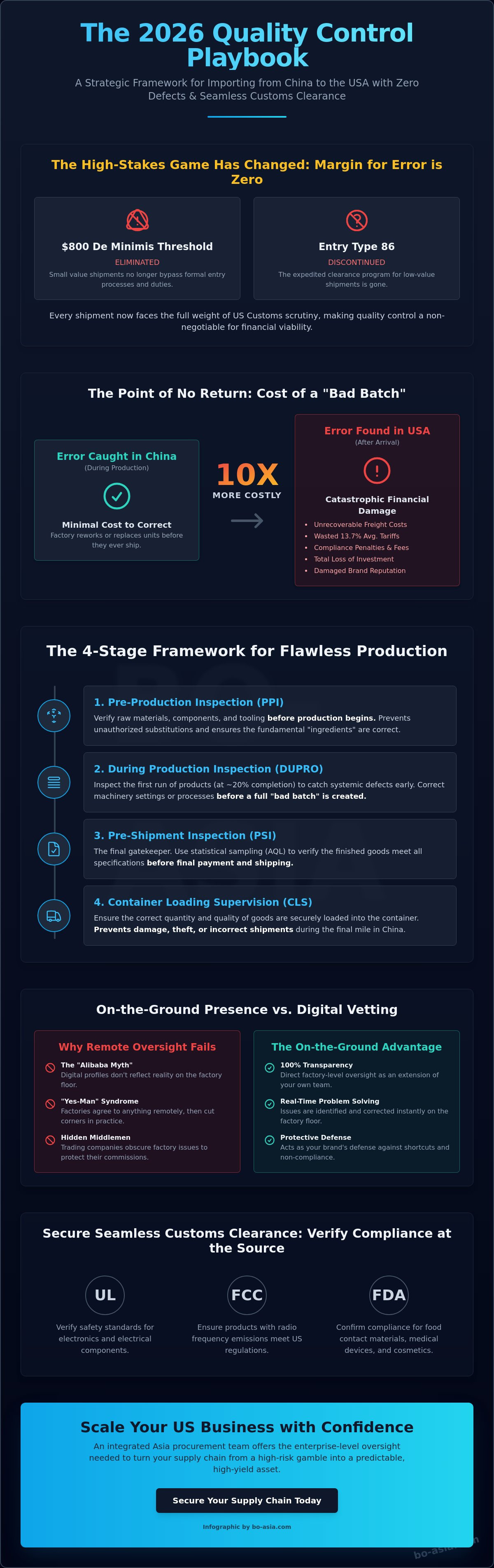
Since May 2025, the margin for error in transpacific trade has effectively vanished. With the elimination of the $800 de minimis threshold and the discontinuation of Entry Type 86, every shipment now faces the full weight of US Customs scrutiny. Mastering importing from China to USA quality control isn't just about avoiding bad products anymore; it's a fundamental requirement for your financial viability.
You've likely felt the anxiety of a container arriving with unsellable defects or the frustration of hidden middleman fees that erode your margins. It's difficult to maintain confidence when you lack real-time visibility into the factory floor. This masterclass provides the strategic framework you need to secure zero-defect shipments and ensure seamless US customs clearance through verified compliance. We'll examine how on-the-ground oversight and direct factory management transform your procurement from a high-risk gamble into a predictable, high-yield business asset.
• Understand the financial imperative of catching defects early, as resolving errors in China is significantly more cost-effective than managing US-based returns.
• Master a strategic 4-stage framework for importing from China to USA quality control to ensure every shipment meets your exact specifications before it leaves the factory floor.
• Move beyond the "Alibaba Myth" by establishing an on-the-ground presence that bypasses the communication barriers and "Yes-Man" syndrome typical of remote oversight.
• Secure your supply chain by verifying mandatory US regulatory standards, such as UL, FCC, and FDA compliance, directly at the source to ensure seamless customs clearance.
• Learn how an integrated Asia procurement team functions as a protective defense for your brand, offering the level of oversight usually reserved for major enterprises.
In the high-velocity environment of 2026, quality control is no longer a luxury reserved for large enterprises; it's the primary survival mechanism for any business importing from China. We define quality control as the systematic process of ensuring production matches technical specifications, regulatory requirements, and safety standards. In trans-Pacific trade, this process serves as your eyes and ears on a factory floor thousands of miles away, providing a level of security that digital vetting simply cannot replicate.
The "Point of No Return" occurs the moment your goods are loaded onto a vessel. Once the ship leaves port, you've committed to the freight costs, the harbor maintenance fees, and the applicable Section 301 duties. If you discover a systemic defect after the container arrives in Los Angeles or Savannah, the financial damage is often terminal. Catching an error during production in Shenzhen or Ningbo is roughly ten times cheaper than managing a recall or disposal in the United States.
Current 2026 market trends have added new layers of risk. With the average US tariff rate reaching 13.7% and raw material costs remaining volatile, some manufacturers are tempted to use unauthorized material substitutions to preserve their shrinking margins. Implementing a rigorous strategy for importing from China to USA quality control acts as your defense against these shortcuts, preventing brand erosion and potential litigation from non-compliant products.
Calculating the true cost of defective inventory requires looking far beyond the unit price. You must account for the 0.3464% Merchandise Processing Fee, the 0.125% Harbor Maintenance Fee, and the massive opportunity cost of lost sales. US Customs and Border Protection (CBP) has increased scrutiny on supply chains linked to specific materials like copper and steel in 2026. If your goods don't meet strict origin verification or safety standards, they can be seized at the border. This results in a total loss on your investment, including:
• Wasted freight and logistics expenses.
• Unrecoverable 13.7% average tariff duties.
• Compliance penalties and storage fees at the port.
• Irreparable damage to your retail partnerships.
Many importers fall into the trap of using trading companies that promise ease but deliver obscurity. These intermediaries often hide factory-level issues or swap suppliers without notice to protect their own commissions. This lack of visibility is a major vulnerability. To achieve zero-defect shipments, you must demand 100% transparency through a factory-direct model. By working as an integrated extension of your team, a dedicated procurement office ensures you have direct oversight of the production line. This eliminates the hidden costs and risks associated with unmanaged sourcing, allowing you to scale with the steady confidence of an established expert.
Effective importing from China to USA quality control requires a shift in perspective. You shouldn't view inspection as a final exam that a factory passes or fails at the last minute. Instead, it's a continuous strategic framework designed to remove risk at every milestone of the manufacturing cycle. By implementing a multi-stage oversight plan, you catch deviations before they become expensive, systemic failures.
This stage focuses on the "ingredients." We verify raw materials, components, and tooling before the assembly line starts. In 2026, with material costs fluctuating, this prevents unauthorized substitutions that could lead to product failure.
Once 20% of the order is complete, we identify systemic defects. If a machine setting is wrong or a manual process is inconsistent, we correct it immediately. This prevents a "bad batch" from reaching 100% completion.
This is the final gatekeeper. Using statistical sampling, we ensure the finished goods meet your specifications. The Acceptable Quality Level (AQL) serves as the industry benchmark for batch acceptance, defining the maximum number of defects allowed before a shipment is rejected.
The final mile in China is often the most hazardous. We ensure your goods are packed correctly, the container is structurally sound, and the seals are applied properly to prevent transit damage or tampering.
Before the first unit is produced, you must verify the factory's actual technical capability. A business license doesn't guarantee quality or ethical standards. Professional supplier vetting in Asia involves physical on-site audits to assess machinery maintenance, labor practices, and internal QC protocols. This process is essential for Navigating US Regulatory Compliance, as it ensures the manufacturer can consistently produce goods that meet FDA or UL standards.
Quality fade is a common risk in long-term manufacturing partnerships where standards slowly slip over time. To combat this, you must utilize "golden samples" approved during the product development phase as the absolute reference point for every subsequent run. Integrating OEM manufacturing standards into your inspection checklists ensures that mass production remains identical to your initial prototype. If you're unsure which stage of inspection your current project requires, you can consult with our regional experts to design a custom oversight plan that protects your investment.
Relying on digital vetting for your supply chain is a high-stakes gamble that often ends in operational failure. Many importers fall for the "Alibaba Myth," assuming that a gold-star rating or five-star review on a B2B platform equates to US-market readiness. These ratings often reflect transaction volume or payment status rather than a factory's ability to meet rigorous technical specifications. When you're importing from China to USA quality control demands a physical presence that a web browser simply cannot provide. Digital platforms can't smell a chemical residue, feel a structural weakness, or verify if a factory is outsourcing your order to a low-quality sub-contractor in the middle of the night.
Cultural nuances play a decisive role in manufacturing success. In many Asian production hubs, the concept of "Mianzi" or "Face" dictates communication. Factories may suffer from "The Yes-Man" syndrome, where managers agree to impossible deadlines or technical requirements just to avoid the perceived conflict of saying "no." Without a local representative to read between the lines, you'll only discover the truth when your shipment is three weeks late or full of defects. A European-managed presence acts as a stabilizing force, bridging the gap between your high US expectations and the complex realities of the factory floor. This on-site proximity allows for real-time problem solving; a production error that would take two weeks to resolve via email is often fixed in two hours when our team is standing on the production line.
Unmanaged sourcing frequently leads to a "good enough" mentality that fails US safety standards. We've seen cases where products designed for local markets lacked the necessary flame retardants or lead-free coatings required by US law. A dedicated sourcing team acts as your defensive shield, ensuring that "Face" never comes before "Fact." Physical presence also commands priority. When a factory manager knows an inspector is arriving tomorrow, your order stays at the top of the schedule. You can find more detailed strategies for Sourcing Goods And Suppliers In China to understand how physical vetting separates elite importers from the rest.
Traditional third-party inspection agencies often operate with hidden commissions and obscured costs. They function as transactional intermediaries rather than long-term partners. By moving to a factory-direct model with integrated oversight, you eliminate these "middleman markups" and regain control over your financial health. The ROI of direct price negotiations, combined with built-in QC, is measurable and immediate. Review our pricing and savings examples to see how this transparent approach secures your margins while elevating your product quality.
Compliance is the legal bridge between a factory in Ningbo and a warehouse in New Jersey. When you're importing from China to USA quality control must extend beyond physical aesthetics to encompass rigorous regulatory adherence. In 2026, US Customs and Border Protection (CBP) has intensified its focus on product safety and origin verification. If your goods arrive without the mandatory UL, FCC, FDA, or ASTM certifications, they won't just be delayed; they'll likely be seized and destroyed at your expense. You must treat these standards as non-negotiable production requirements rather than afterthoughts.
The "Certificate of Conformity" (CoC) serves as your primary defense during a customs audit, yet it's one of the most frequently forged documents in international trade. You cannot take a PDF at face value. Our on-site teams verify these certificates at the source, cross-referencing them with accredited laboratory databases before the cargo is booked. For electronics or medical devices, visual inspection is insufficient. We implement laboratory testing protocols that move into chemical analysis and stress testing to ensure your products don't just look the part but actually meet US safety thresholds. This is particularly vital for Amazon FBA sellers, where incorrect packaging or missing labels can lead to immediate account suspension and inventory disposal.
Your quality control reports should directly inform your shipping documentation. A precise Bill of Lading and Commercial Invoice must be supported by verified QC data to expedite the customs bond process. With the average effective US tariff rate reaching 13.7% in 2026, HTS code accuracy is a financial imperative. Misclassification doesn't just invite penalties; it can trigger exhaustive audits that freeze your supply chain for weeks. By integrating QC results into your formal entry procedures, you provide CBP with the transparency they require to flag your shipments as low-risk.
Modern procurement requires a commitment to ethical standards that go beyond the factory floor. Enforcement of the Uyghur Forced Labor Prevention Act (UFLPA) is at an all-time high in 2026, specifically targeting supply chains linked to copper, steel, and lithium-related products. You must verify labor standards at every tier of production to protect your brand from terminal litigation. Our Buying Office Asia ESG Policy outlines the rigorous vetting process we use to ensure your manufacturing partners meet global ethical benchmarks. As US consumers increasingly prioritize eco-friendly packaging, we also help you transition to sustainable materials that reduce your environmental footprint without compromising structural integrity.
Securing your supply chain against regulatory risk requires a partner who understands the nuances of US law and Asian manufacturing. If you need to verify the compliance status of a new product line, get in touch with our compliance specialists today to conduct a comprehensive regulatory audit.
Scaling a business requires a shift from reactive problem-solving to proactive supply chain management. When you're importing from China to USA quality control shouldn't be a series of disconnected events. Transactional inspections often lead to fragmented data and inconsistent results. By transitioning to an integrated procurement office, you gain a permanent, professional extension of your own team. Buying Office Asia (BOA) manages this entire ecosystem from our strategic hubs in Hong Kong and Helsinki, providing a seamless bridge between Western business standards and Asian manufacturing capability.
Reducing operational overhead is a primary driver for this transition. Establishing an in-house quality team in China involves complex legalities, recruitment risks, and high management costs. Outsourcing these functions to a seasoned partner provides immediate access to regional expertise and established networks without the fixed costs of a foreign subsidiary. This model allows you to move from prototype to mass production with the confidence that your financial interests are protected at every stage of the production cycle. It's about moving away from the volatility of unmanaged sourcing toward the steady confidence of an established expert.
A dedicated team does more than just inspect; they drive the entire product development and sampling process. We ensure that your initial prototypes are not only aesthetically correct but also engineered for scalable manufacturing. Our European leadership team understands the nuances of US market expectations, ensuring that nothing is lost in translation. This high-level oversight has been the cornerstone of our clients' high-volume success, where we've managed complex supply chains for independent business owners and major enterprises alike.
The first three months of a partnership focus on stabilization and baseline setting. We begin with a comprehensive factory audit to verify technical capability and ethical compliance. From there, we establish a custom Standard Operating Procedure (SOP) for your specific product line, ensuring that every QC check is tailored to your brand's unique requirements. This methodical approach dismantles common industry objections and builds a foundation for long-term growth. If you're ready to secure your supply chain and eliminate the anxieties of international manufacturing, you can request a consultation with Buying Office Asia to begin your transition to a managed procurement model.
The landscape of trans-pacific trade has shifted permanently. Success no longer depends on finding the lowest unit price but on maintaining absolute command over your production line. By implementing a multi-stage framework and rejecting the risks of remote oversight, you eliminate the systemic failures that threaten unmanaged supply chains. Integrating regulatory compliance directly into your importing from China to USA quality control strategy ensures your cargo passes CBP scrutiny without the threat of seizure or unrecoverable tariff waste.
Operational security requires a partner who functions as an integrated extension of your team. Our European-managed oversight, anchored by a Hong Kong operational base, provides the 100% transparency needed to scale without hidden middleman fees. We apply a proven track record in high-volume US import management to every project, protecting your financial health in an increasingly complex market. It's time to replace the anxiety of the unknown with the steady confidence of a managed procurement office.
Secure Your Supply Chain with Buying Office Asia and begin your transition toward zero-defect manufacturing today. Your business is ready for the elite oversight that transforms global sourcing into a predictable, high-yield asset.
A factory audit evaluates the manufacturer's physical facility, machinery maintenance, and internal management systems before production begins. In contrast, a product inspection focuses on the physical units themselves at various stages of the assembly line. While the audit ensures the factory is a reliable partner with the technical capability to fulfill your order, the inspection ensures the specific batch matches your approved samples.
The cost of importing from China to USA quality control is typically structured as a per-man-day rate for on-site visits. You should view this expense as essential insurance for your landed cost rather than an optional fee. While rates vary based on factory location and technical complexity, the investment is negligible compared to the 13.7% average tariff and freight costs you risk losing on a defective shipment.
Relying on a factory's internal report is a strategic error that compromises your brand's financial security. Manufacturers have an inherent conflict of interest and may overlook minor defects to meet shipping deadlines or avoid re-work costs. An independent, third-party presence provides the objective transparency required to identify systemic flaws before the goods leave the factory floor and hit the water.
Acceptable Quality Level (AQL) is a statistical sampling standard that defines the maximum number of defects allowed in a batch before it is rejected. Most US importers utilize AQL Level II, which provides a reliable balance between inspection depth and operational speed. You should choose your specific limits based on the product's safety risk and your retail partner's tolerance for minor cosmetic imperfections.
Ensuring compliance requires verifying the "Certificate of Conformity" directly with the issuing laboratory or accredited database. You cannot rely on digital copies provided by the supplier, as these are frequently altered. On-site teams must confirm that the production materials match those used in the certified samples, as unauthorized substitutions are a common cause of US Customs seizures in 2026.
If an inspection fails, the factory is typically required to perform a "re-work" to correct the identified defects at their own expense. You should never authorize final payment or container loading until a follow-up inspection confirms the issues are resolved. This leverage is your primary defense against receiving a container full of unsellable inventory and facing unrecoverable customs duties.
Yes, maintaining oversight for every order is the only way to prevent "quality fade" over long manufacturing cycles. Even established partners may experience machine wear or staff turnover that impacts output consistency. Consistent importing from China to USA quality control signals to the factory that your standards are permanent, ensuring your production always receives priority and precision on the factory floor.
The 2026 regulatory environment has made quality errors significantly more expensive for US businesses. With the elimination of the $800 duty-free threshold and increased scrutiny on materials like copper and steel, every defect results in wasted duties and potential customs delays. High-precision oversight is now a prerequisite for navigating these complex US import requirements and maintaining your company's financial health.
What if your signed OEM agreement protects the product on paper but leaves the factory unclear about what to make, when to deliver it, or how quality will be judged? That gap is where an oem manufacturing agreement china project can lose control: responsibilities blur between buyer, sourcing interme...

What if the safest payment deal isn’t the one that delays the most cash, but the one that releases it only when progress is verifiable? Payment terms negotiation with Asian suppliers is about balancing your working capital with the supplier’s need for confidence, not simply pushing for a smaller dep...

What if your biggest supply chain risk isn’t the supplier you chose, but what you can’t see after the order is placed? Asia procurement services can connect supplier selection with factory follow-through, giving you clearer visibility into production, product quality, and responsibilities along the...