

The biggest risk in complex board game manufacturing isn’t any single component, but the handoffs between them. A game with cards, boards, miniatures, inserts and custom packaging needs coordinated sourcing, assembly and quality checks to ensure the finished set matches the approved design.
It’s natural to start by looking for a factory in China and requesting a production quote. But a sound manufacturing plan also accounts for prototypes, materials, tooling, component specifications, minimum order quantities and inspection points. These decisions shape production costs and the risk of delays, mismatched parts or assembly errors.
This article explains what custom board game production involves, how to assess a manufacturer’s capabilities and what to prepare before production begins. You’ll learn how prototypes and approved samples guide manufacturing, why component complexity affects sourcing and assembly, and how inspections can catch issues before shipment. The goal is to help you make practical decisions and stay in control from design handoff through final inspection.
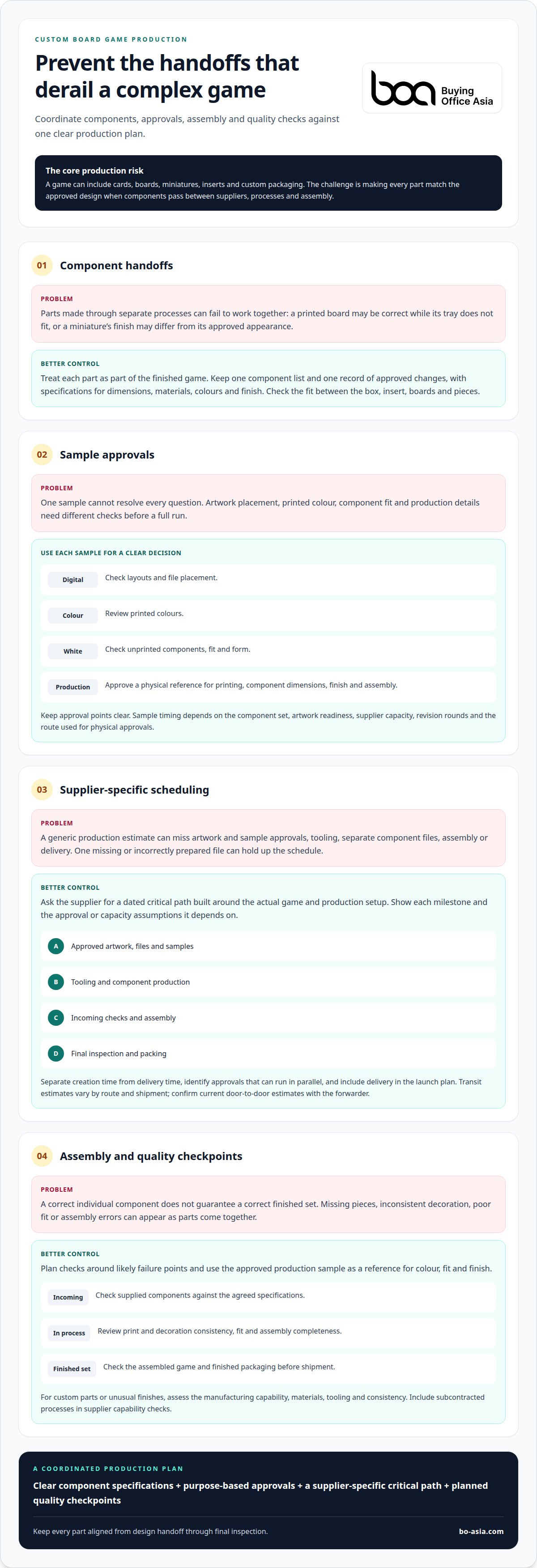
• Plan digital, colour, white and production samples as distinct checkpoints for resolving artwork, materials and assembly details before full production.
• Assess a manufacturer’s ability to coordinate custom components, such as trays and miniatures, alongside printing, assembly and packaging.
• Use prototyping to expose design and fit issues early, before they become harder to correct on the production line.
• Build a realistic cost and quantity plan around component choices, tooling, order size and the assembly work your game requires.
• For production in China, account for supplier coordination, quality checkpoints and factory scheduling as part of the manufacturing plan.
Custom production moves from artwork and sample approvals through printing, component manufacturing, assembly and shipment. The schedule depends on the game’s complexity, print-ready files, tooling requirements, approval stages and current supplier and carrier schedules. Confirm a dated schedule for each project.
A four-stage sample process can use digital, colour, white and production samples to resolve different decisions before a full run. A digital sample checks layouts and file placement; a colour sample shows printed colours; a white sample checks unprinted components, fit and form; and a production sample represents the approved manufacturing specification. Each stage can catch a different mismatch before it affects the complete game.
Sample timing depends on the component set, artwork readiness, supplier capacity, revision rounds and the route used for physical approvals. Ask the supplier to separate creation time from delivery time and identify which approvals can run in parallel. Approving the production sample gives the factory a physical reference for printing, component dimensions, finish and assembly.
Mass-production timelines vary with component count, assembly demands, tooling and current factory capacity. Ask the supplier for a dated critical path covering component production, incoming checks, assembly, final inspection and packing. Confirm which milestones depend on approved files, samples or tooling before treating the schedule as committed.
A factory production schedule does not automatically include earlier artwork and sample approvals or later delivery. Build those stages into the launch calendar, especially when multiple components need separate review.
Offset printing requires setup before the press run. Using the manufacturer’s current component templates can reduce avoidable layout revisions, but the effect on timing depends on file readiness and the supplier’s schedule. Complex games may have separate files for cards, boards, rulebooks and packaging, so a missing or incorrectly prepared file can hold up the full production schedule.
A rush schedule may remove an approval stage, but that trades review time for greater production risk. Instead of accepting a generic fast or economy option, ask which approval, process or capacity assumption changes and record the effect on quality checks and dated milestones. A shorter process may leave less time to catch issues.
Local production can simplify physical review and reduce the distance between the factory and the approval team, while overseas production adds shipping time. Sea and air transit times vary by origin, destination, service, capacity, routing and customs handling. Confirm current door-to-door estimates with the forwarder for the actual route and shipment. For manufacturing in Asia, OEM and ODM contract manufacturing connects production planning with the work needed to bring custom products into production.
Choose a manufacturer that can coordinate printed pieces, custom components, assembly and packaging against one clear specification. The main risks include mismatched parts, inconsistent finishes, missing components and assembly errors. Reduce them with supplier capability checks, documented requirements and defined inspection points.
Custom components are game pieces made for a specific design, from formed trays to detailed miniatures. Their dimensions and materials affect fit, appearance, protection and assembly, so assess each part as part of the finished game, not in isolation. For example, a tray must hold its components securely while fitting inside the selected box.
Packaging is part of the product specification. Define board grade or thickness, wrap material, construction, finish and dimensional tolerances for the box and boards rather than relying on a generic material label. The manufacturer should align the box, insert, boards and pieces with your approved design and intended use.
Unusual components may require a different production process or specialist supplier, adding coordination points. Before including a detailed miniature, custom-shaped token or unusual finish in the production plan, assess manufacturing capability, materials, tooling and consistency. Supplier vetting and factory audits help establish whether the production setup meets the project’s requirements.
Capability checks should cover the entire production route, including any subcontracted processes. The production team needs a clear component list, approved artwork and specifications for dimensions, materials, colours and finish. For licensed character artwork, controlled files and formal approval points help protect intellectual property and prevent unapproved changes from reaching production.
Risks increase when different pieces come from separate processes or suppliers. A printed board may be correct while the tray does not fit, or a miniature’s finish may differ from its approved appearance. Component-level specifications and one record of approved changes reduce ambiguity between purchasing, production and assembly teams.
Plan inspections around the product’s likely failure points. Checks can cover incoming components, print and decoration consistency, assembly completeness and finished packaging. A defined reference sample helps align decisions on colour, fit and finish. For a six-panel board, for example, check folding and panel alignment as well as the printed surface.
Review insert design for practical fit, too. Player boards, cards, tokens and miniatures need designated spaces, and the assembled insert must sit correctly in the box. Unusual components can affect the layout or packing sequence, so account for their handling before assembly begins. These details matter to the finished set, not just to individual pieces.
Compare manufacturers by their documented process, not by a general claim of capability. Review how they manage component sourcing, tooling, artwork control, assembly and corrective actions. Supplier vetting and factory audits can support a more informed assessment of production readiness. If you need help coordinating these checks, contact Buying Office Asia to discuss your manufacturing requirements.
Design consultation turns a game concept into production-ready artwork, component specifications and a prototype. It matters because unclear rules, dimensions or file preparation can lead to costly corrections after manufacturing begins.
Start with a complete component list naming every card, board, token, miniature, tray and packaging element. For each piece, record its intended dimensions, material, finish, artwork file and relationship to other components. A player board, for example, needs enough space for its tokens and readable information. These decisions align the game’s design with practical production requirements.
Artwork preparation involves more than completing illustrations. Each printed component needs correctly arranged artwork, with text, symbols and visual elements positioned for its final format. The production team can review files for consistency across cards, boards, rulebooks and packaging. Manufacturer templates can guide file setup and reduce avoidable layout revisions, while a controlled approval record helps keep outdated artwork out of production.
Consultation should also cover how the game is played and packed. If a set includes player boards, cards and shaped pieces, the component list and packing plan should account for how they interact. This helps identify whether the insert, box or assembly process needs changes before sampling.
A prototype gives the team a physical or digital version to evaluate before committing to a full run. Its schedule depends on the component set, production method, artwork readiness and the decisions it must support, such as testing component fit, card readability or the handling of a miniature. Agree the prototype scope and dated review cycle before tying it to a campaign milestone.
Use the prototype to assess the game as a complete set, not as a collection of unrelated pieces. For example, place cards, tokens and player boards in the proposed insert, then check whether the arrangement supports the intended packing sequence. Record corrections against specific components, artwork files or assembly instructions. This creates a clear revision trail for the next sample.
Separate design feedback from manufacturing feedback. Design review covers playability, information hierarchy and each piece’s function. Manufacturing review considers whether the materials, decoration and component shapes can be produced consistently. Keeping these decisions distinct helps prevent a creative change from being mistaken for a factory correction.
Before approving the final design, consolidate revisions into one current specification. Include approved artwork, component details, packaging layouts and assembly instructions. This gives production teams a shared reference for making and checking the finished game.
There’s no fixed cost ranking between the US, China and Europe without comparing the same game specification. Production route, materials, tooling, order quantity and delivery arrangements all affect the total. Compare like-for-like quotes, not factory unit prices alone.
A useful cost model separates one-time development costs from repeat production. Development can include artwork preparation, prototypes, custom tooling and packaging setup. Repeat production includes printing, materials, component manufacturing, assembly and packing. Freight and destination-related costs also affect the delivered total. Keeping these categories visible helps explain why quotes for the same game can differ.
Component choices can significantly change costs. A game with standard cards, a printed board and a paper insert has a different production profile from one with plastic miniatures, a custom tray and decorated tokens. Each additional material or process creates a sourcing and quality-control step. A custom miniature, for example, may need a mould, while printed pieces require artwork and print setup.
Tooling adds upfront development cost, while its use across production can affect unit economics. Lead time depends on the part geometry, mould type, material, cavity count, supplier capacity, trials and correction rounds. Request a tooling plan with design approval, fabrication, trial samples and correction milestones. A game with new moulds should account for tooling separately from printing, assembly and packaging.
Minimum order quantities depend on the factory’s processes, material sourcing and production setup. A supplier may need to buy materials in set quantities or run equipment efficiently at a particular batch size. Ask how the quantity in each quote is calculated, including whether packaging or custom components have separate minimums. A lower unit price at a higher volume can still mean a larger total commitment and more inventory to manage.
For a fair regional comparison, use one specification and request the same quantity, materials, finishes, packaging and quality checks from each production location. Then compare the complete cost structure, including tooling, local transport and international delivery where applicable. A US quote, a China quote and a European quote aren’t comparable if they include different production steps.
Identify development, tooling and setup separately from per-game production.
Record minimums for the game and any custom component or packaging.
Match materials, finishes, assembly, inspection and delivery terms.
Check whether every plastic piece, custom shape or finish supports the game’s function.
This breakdown makes trade-offs clearer before production begins. It can also show whether a simpler insert, fewer custom finishes or a different component material would meet the design brief with less tooling or sourcing complexity.
China can support a wide range of board game components, but a manufacturer’s suitability depends on the production work your game requires. Evaluate the full process, from printed cards and boards to custom pieces, assembly and packed sets. A factory quote alone doesn’t prove that the supplier can handle every step.
A card game with printed cards and a tuck box has a different production profile from one combining a folding board, plastic miniatures, a custom tray and several decks. Some components may involve distinct materials or production methods. Map each part to its process, then identify which factory or supplier is responsible for making it and how the pieces come together.
For complex board game manufacturing, coordination across component suppliers is a key selection criterion. The production plan should identify who owns artwork files, specifications, sample approvals, assembly instructions and change management. If a custom miniature is made separately from the printed components, the parties still need shared requirements for fit, colour references, quantities and delivery to assembly. Clear ownership helps prevent gaps between production stages.
Assess a factory’s relevant experience against the actual components and operations in your project. A manufacturer experienced with a simple card game may not be equipped for custom moulds or multi-part assembly. Look for evidence of comparable production processes, such as printed boards, inserts, miniatures or finished-box packing. Review how incoming parts are checked, how deviations are recorded and who coordinates corrections when a component misses its specification.
Planning around the factory calendar is essential. Chinese New Year shutdown dates and the time needed to return to normal capacity vary by factory and upstream supplier. Ask each responsible supplier for its confirmed closure, restart and capacity-recovery dates because the interruption can affect sampling, component sourcing, production and dispatch. Work backwards from your required delivery date and include approval and shutdown buffers in the plan.
A useful manufacturer review follows the product through its actual workflow:
Match every card, board, token, miniature, insert and package element to a named process and responsible supplier.
Align materials, dimensions, artwork, finish and packaging instructions across production partners.
Define how components are counted, arranged and packed into each finished game.
Set checkpoints for incoming parts, print consistency, assembly and final packing, with a process for corrective actions.
Choose a production partner based on demonstrated process fit, transparent responsibility and its ability to coordinate the complete component set. Coordinated sourcing and procurement can help connect component requirements with supplier and production planning. Discuss your China manufacturing requirements when you need support aligning suppliers, approvals and production oversight.
Buying Office Asia helps publishers coordinate the sourcing and procurement decisions involved in complex board game manufacturing. When a project combines printed components, custom pieces, packaging and assembly, fragmented supplier communication can complicate specifications, approvals and production changes. End-to-end sourcing and procurement support can help coordinate these activities, along with supplier communication and production follow-up.
Factory-direct price negotiations can clarify how component choices, tooling and order quantities shape a supplier’s quotation. This support is useful when you’re moving from prototype to production, developing custom components or coordinating multiple manufacturing requirements across Asia. The right level of involvement depends on your sourcing and production needs. Standalone inspections are also available and can start from one inspector-day, with same-day reporting. Contact BOA to confirm the scope, factory access, inspection location, checks and timing.
Contact Buying Office Asia to discuss your board game manufacturing project or standalone inspection needs.
For complex board game manufacturing, production readiness means connecting the factory plan to your commercial launch. Decide how finished goods will fit into your distribution plan, who owns launch-critical decisions and how changes affecting the release date will be communicated. A clear handoff between manufacturing and your internal launch team keeps operational decisions tied to the business milestone.
Buying Office Asia supports international businesses coordinating manufacturing in Asia. Share your project priorities and launch requirements to discuss the right support for your production plan.
Discuss your board game project with Buying Office Asia and take the next step toward a well-coordinated launch.
Games can be assembled and packed as finished products, but launch readiness also depends on your commercial requirements. Plan separately for market-specific packaging information, barcode placement, approved licensed artwork and any testing relevant to the product’s intended use and destination. For example, retail packaging may require different files from a game prepared for a publisher’s direct campaign distribution.
Yes, Buying Office Asia can support a project from early product development through production coordination. To make that support effective, define who on your team approves artwork, specifications, samples and changes, and how those decisions are recorded. This keeps manufacturing aligned with your project’s goals while leaving product decisions and release priorities in your hands.
Materials vary by component and by the experience the game is designed to deliver. Cards and rulebooks commonly use paper-based materials, while boxes and boards use structural board; custom pieces may use plastic. Consider how each part will be handled, stored and presented. A material specification should also define the expected surface finish and appearance, giving production teams a clear reference.
Buying Office Asia supports board-game publishers with projects ranging from simple card games to innovative tabletop games with many components. The project can be scoped around its format and manufacturing needs rather than a fixed game category. For example, a card-focused product and a tabletop game with custom pieces need different component plans and production coordination.
Complexity can come from version control as well as component variety. If a game has alternate language editions, artwork variants or different box contents, each version needs a clear product specification and packing instruction. Otherwise, correct individual pieces may still end up in the wrong finished edition. A controlled master record keeps approved contents and artwork aligned throughout production.
At a high level, production moves from defining the product and its versions to preparing files, developing samples, approving specifications, producing components, assembling sets and checking packed goods. Decide on editions early: language, variant and packaging choices can affect artwork and packing instructions. A final review should compare the assembled product with the approved contents list and packaging files.
Components with detailed shapes or visible decoration often need closer control than standard printed pieces. For a miniature, review whether sculpted details and finish match the approved reference. For a fitted insert, check whether it accommodates the actual contents without making them difficult to remove. Design and acceptance criteria should reflect each component’s specific quality risks.
Minimum order quantities depend on the production setup, materials and custom elements, so they vary by project. Splitting editions also affects planning: multiple language or artwork versions require quantities to be allocated across separate finished configurations. Request a quote that shows the assumptions for each version and distinguishes shared components from edition-specific parts. This makes the production commitment easier to assess before you confirm an order.

Procurement outsourcing isn’t an all-or-nothing handover. It can transfer selected sourcing and supplier-management activities to an external team while your business retains strategic decisions and oversight. The right procurement outsourcing services can help you add expertise and capacity without...
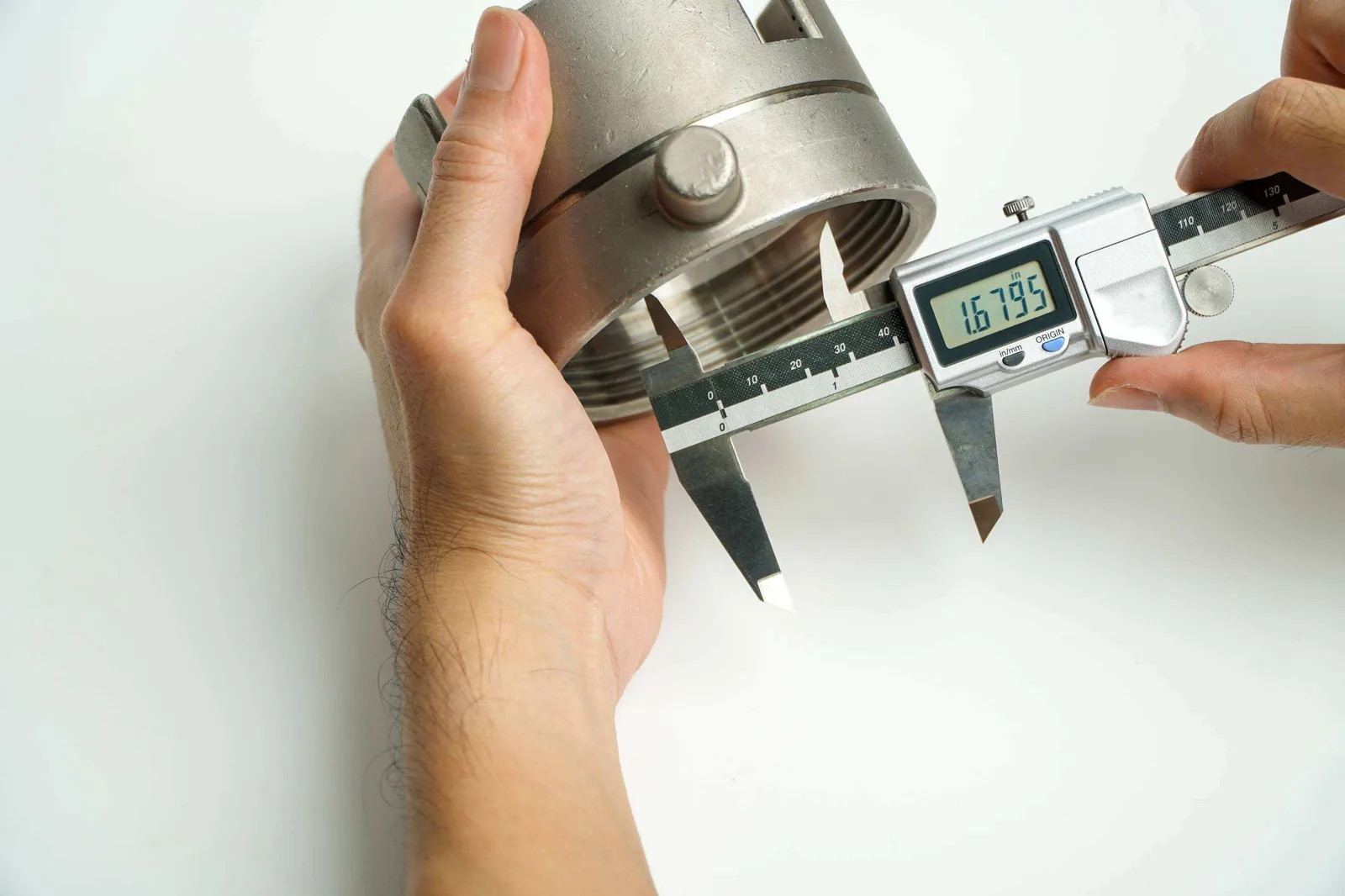
The main types of quality inspections in manufacturing are pre-production, during-production, final and pre-shipment inspections. Each addresses a different point in the production cycle: pre-production checks materials and components before work begins, while later inspections assess products as th...

Alibaba can work well when your team can manage supplier checks, samples, production follow-up, and quality control. Moving from Alibaba to a sourcing agent makes more sense when you need coordinated oversight, have complex specifications, or cannot manage every factory detail in-house. The better o...