

Procurement outsourcing isn’t an all-or-nothing handover. It can transfer selected sourcing and supplier-management activities to an external team while your business retains strategic decisions and oversight. The right procurement outsourcing services can help you add expertise and capacity without building every capability in-house.
That flexibility matters when international sourcing calls for local supplier knowledge, consistent production follow-up, and clear accountability. You may already have procurement staff but still need support in particular categories or markets. Define what the outsourced team owns, what stays in-house, and how performance will be managed.
This article explains what procurement outsourcing covers, how it can affect costs and capacity, and what to assess when building a business case. It also considers when an on-the-ground procurement partner can provide practical local reach and oversight, and how to preserve visibility and control across supplier relationships.
• Define which sourcing and supplier-management activities to outsource, and which decisions your internal team will retain.
• Build the cost case around total spend, internal capacity, operational risks and the expertise needed, rather than savings alone.
• Set clear performance measures, reporting routines and decision rights to maintain visibility and control over supplier relationships.
• Assess whether an international procurement office can provide the local supplier access and production oversight your sourcing plan requires.
• Consider coordinated sourcing and procurement support when you need an external team to manage supplier and production activities across Asia.
Procurement outsourcing transfers defined purchasing activities to an external team while your organization retains agreed decision rights. Scope can range from purchase-order processing to strategic sourcing and supplier management.
Procurement sourcing and spend management include supplier research, competitive sourcing, purchasing analysis, and category strategy. Supplier intelligence and clear requirements help organizations compare offers on more than unit price. For example, an RFP can specify a product’s requirements, delivery expectations, and evaluation criteria; an RFQ can request comparable quotations against those requirements.
Specialists can identify suppliers, coordinate RFP and RFQ responses, and organize bid comparisons. They can also review category spending to spot fragmented purchases, overlapping suppliers, and negotiation opportunities. Tail-spend management groups smaller, less frequent purchases for clearer oversight instead of leaving each one outside established supplier management.
When comparing procurement outsourcing companies, assess their category and industry expertise, sourcing methods, risk controls, reporting, and track record. Choose a provider whose proposed scope, decision rights, and performance measures align with your organization’s objectives.
Procurement outsourcing transfers ongoing or defined procurement work to an external team. Managed services typically run specified processes on an ongoing basis, while procurement consulting advises on a project or strategy without necessarily taking over execution.
For product businesses, sourcing and procurement may include supplier research, quote coordination, and supplier management. The sourcing and procurement process should connect supplier selection with the requirements that guide purchasing and production.
Procurement risk, compliance, and talent management bring together supplier oversight and the specialist skills needed to apply procurement controls. This can help when internal teams lack the capacity or expertise to assess suppliers, monitor performance, and manage requirements across categories and markets.
Provider risk management can include supplier screening, performance monitoring, and escalation processes. Define compliance responsibilities for the relevant markets, products, and contracts. Your organization still needs internal oversight of sensitive data, approvals, and strategic decisions.
Implementation typically starts by defining objectives and scope, then transferring agreed processes, establishing reporting routines, and reviewing performance. The transition should also clarify which records, approvals, and supplier communications the external team handles.
Providers may charge a fixed or retainer fee for defined work, transaction or usage fees tied to activity, or a share of measured savings. Match the pricing model to the scope and specify how purchasing activity and savings will be measured.
Procurement talent management can give an organization access to sourcing and category specialists without requiring it to build every capability in-house first. Retaining knowledgeable internal owners helps preserve strategic control and align outsourced work with business priorities.
Outsourcing can change procurement costs by combining specialist expertise with flexible operating capacity. The business case should consider total cost, not just a supplier’s quoted unit price.
Cost reduction and spend optimization use purchasing data, negotiation, and process changes to improve value across each category. A lower unit price can still increase total costs if it leads to rework, delays, or excess inventory.
For a custom product, a cost review can compare assumptions for materials, tooling, assembly, packaging, inspection, and freight. Category expertise can help identify whether specifications can be simplified without weakening essential performance or brand requirements. Direct price negotiations can also clarify supplier assumptions, payment terms, and what each quotation covers.
Assess savings against a baseline that includes internal staff time, sourcing activity, transition work, and supplier-management effort. Weigh these costs against risks such as late delivery, inconsistent quality, or a supplier’s inability to meet production requirements. A contract should define the work, reporting, decision rights, and how claimed savings are calculated.
Scalability is another potential value driver. An external team can take on defined activities as purchasing demand grows and adjust its workload as product launches or seasonal production change. This can help a growing brand access expertise without immediately expanding its permanent procurement function.
Low-cost country sourcing means assessing suppliers in different countries for the best overall supply proposition, not simply choosing the lowest quote. Regional price differences can be offset by logistics, quality, communication, or production risks.
Consider a multi-component board game: separate quotes for cards, a box, and molded pieces may each look attractive. A full comparison must also account for component coordination, assembly, packaging, quality checks, and delivery planning. Regional sourcing expertise can help gather supplier information and clarify these assumptions before awarding the work.
Compare equivalent offers by checking material grades, tolerances, decoration, packaging, production capacity, and delivery terms. The lowest bid may use a different specification or exclude work your product needs. A clear comparison shows whether a price difference reflects genuine efficiency or shifted costs and responsibilities.
Include risk assessment in the savings model. Consider supplier continuity, currency exposure, lead-time variability, and corrective-action capacity alongside quoted prices. For example, a second qualified source may support continuity but add coordination and qualification work. The right balance depends on the category’s effect on production and the consequences of disruption.
Procurement outsourcing supports growth when its scope expands with business needs and its measures reflect total value. To discuss your sourcing requirements, bring the product scope, target specification, and current purchasing constraints.
A credible business case connects procurement work to measurable operating outcomes, not broad promises of savings. Show what will change, who owns the result, and how the organization will determine whether the arrangement remains worthwhile.
An outsourced team can make procurement more consistent across departments by applying shared processes and documentation. This matters when product, finance, and operations teams use different supplier records or approval practices. A common workflow makes commitments easier to trace and clarifies which specification or quotation informed a purchasing decision.
Another potential benefit is greater continuity of procurement knowledge. Documented supplier history, decision records, and category requirements preserve context when employees change roles or projects shift. For example, a new product manager can review why a supplier was selected and which commercial assumptions informed the decision, rather than restarting discussions without that background.
These benefits depend on useful handover materials and clear ownership. Internal stakeholders should identify which records the external team maintains, how updates are shared, and who keeps product and commercial information accurate. This makes process consistency an operating asset rather than an archive that only the provider can access.
Procurement outsourcing benefits are strongest when the arrangement addresses a defined business constraint, such as inconsistent purchasing controls or limited visibility into supplier commitments. A broad outsourcing mandate can make it difficult to determine whether the work supports the intended outcome.
Build the case around a specific decision: which processes will change, what internal effort will be freed up, and what evidence will demonstrate value? Include transition work, systems access, stakeholder time, and the cost of maintaining internal oversight. Also consider what happens if the arrangement ends, including access to records and continuity of supplier communications.
Use staged decision points to manage uncertainty. A limited initial scope can test whether reporting is useful, responsibilities are clear, and stakeholders act on supplier information. At each review, compare actual operating changes with the business case, then continue, revise, or end the arrangement based on documented results.
The business case should also consider effects beyond procurement. Clearer purchasing records, for example, may help finance reconcile commitments, while better coordination of specifications may reduce avoidable internal clarification. Assign owners to these outcomes and use practical measures, such as record completeness or the time needed to resolve a purchasing discrepancy.
Finally, define how the business will retain knowledge and responsibilities. Specify record ownership, system access, supplier communication history, and transition support in the agreement. A sound arrangement improves the operating model while preserving the company’s ability to make informed decisions when its priorities or sourcing structure change.
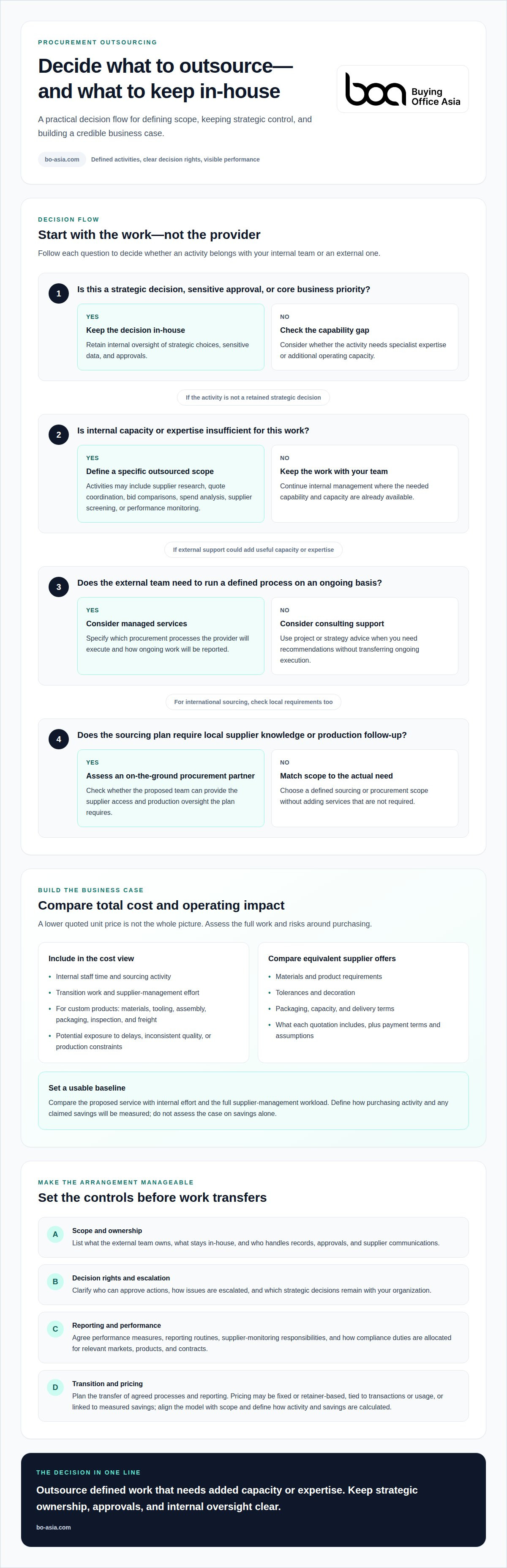
Governance defines who can select suppliers, approve commitments, and resolve performance issues. Clear decision rights help your organization maintain control while a service provider handles agreed activities. For example, an outsourced team might recommend a supplier, while your internal owner approves the award and contract.
Set measurable KPIs and service-level agreements around the outcomes stakeholders need. For a production supplier, measures could cover delivery performance, product quality, cost performance, lead times, and responsiveness. Regular governance meetings should review results, assign corrective actions, and determine whether the supplier relationship or sourcing plan needs adjustment.
Compliance controls should reflect the product, market, and supplier relationship. A promotional item, a toy, and an electrical product may involve different requirements depending on their intended use and destination. The outsourced team can coordinate relevant supplier information and records, while internal owners retain oversight of approvals, sensitive data, and applicable obligations.
Strategic sourcing and supplier identification should follow documented requirements, not price alone. A sourcing brief can specify materials, production capabilities, quality expectations, delivery needs, and evaluation criteria. Supply market intelligence can then help assess supplier options, capacity, regional conditions, and potential concentration risks before an award.
Supplier qualification timelines depend on the category and the evidence needed to assess a factory. Reviewing capabilities, production processes, quality controls, and relevant documentation takes coordination. A new supplier for a complex product may need more technical review than a routine indirect purchase, so qualification milestones should match the actual scope.
Good supplier management also makes scheduling a shared process. The buyer and supplier need visibility into forecast changes, material readiness, production milestones, and delivery expectations. A service provider can coordinate updates and flag slippage, while agreed information-sharing routines help prevent surprises caused by late changes or unclear ownership.
Keep reporting useful and secure. A practical dashboard can show supplier status, open corrective actions, upcoming milestones, and performance against agreed measures. Set access according to each user’s role, especially when records contain commercial terms, product specifications, or supplier data. Regular reviews turn this information into decisions rather than passive reporting.
Governance should also address provider compensation. A commission or referral arrangement involving supplier payments can create a potential conflict in recommendations. Clear disclosure, documented evaluation criteria, and buyer approval help protect supplier selection decisions. The contract should identify responsibilities, data handling, escalation routes, and the process for changing scope.
For international sourcing, local-market knowledge can support supplier communication and awareness of relevant business practices. Pair that knowledge with internal review of compliance obligations and performance evidence. This helps your organization balance access to supplier markets with accountability for sourcing decisions.
An international procurement office connects a company’s global purchasing priorities with suppliers and production activity in a local market. Outsourcing can provide local coordination without requiring the business to establish and manage a separate internal office. The decision depends on which responsibilities require a local presence, how much control the internal team needs to retain, and whether outsourced coverage fits the company’s operating model.
A small internal team may struggle to cover supplier communication, production follow-up, and purchase order coordination across several categories. An outsourced team can handle defined activities while internal procurement retains supplier approval, budget authority, and strategic decisions. For example, local staff could track production milestones and report delays, while the home office decides whether to change suppliers or adjust the purchasing plan.
This model can also suit companies building their procurement function over time. They might outsource supplier research and coordination in a new market, then bring selected work in-house as local knowledge and staffing develop. The transition works best when responsibilities, records, and supplier relationships remain visible to internal owners. Otherwise, knowledge may become concentrated outside the business.
Scope matters. Direct procurement for products used in manufacturing may require close alignment with specifications, production schedules, and quality expectations. Indirect procurement, such as local office services, may need different approval and reporting routines. A purchasing office should not treat these categories as interchangeable because their effects on product availability, operations, and supplier continuity differ.
Supplier relationships also rely on clear communication channels. A local team can resolve routine purchase order questions, clarify production updates, and escalate issues promptly. Your company should still define who can change specifications, accept revised terms, or approve additional spending. These boundaries help local coordination move quickly without transferring decisions that belong to internal stakeholders.
Compare the ongoing requirements of an owned office with outsourced coverage, including management oversight, local expertise, systems access, supplier communication, and continuity when demand changes. Outsourcing may suit specialized workloads or those that fluctuate with launches and production cycles. An internal office may be more suitable when daily local decisions are central to the company’s strategy and operations.
Whichever model you choose, establish a reporting rhythm that links local activity to global priorities. Useful reports can summarize supplier status, open purchase orders, delivery changes, and decisions awaiting approval. Regular reviews help internal stakeholders stay informed and adjust the scope as market needs change, keeping local relationships connected to the wider procurement strategy.
If you’re assessing local sourcing coverage in Asia, discuss your procurement requirements and the responsibilities you want managed locally.
Buying Office Asia helps growing brands manage sourcing and supplier relationships in Asia through coordinated procurement support. Turn to the team when internal capacity is stretched, supplier coordination is fragmented, or you need local purchasing support that connects sourcing decisions with production requirements.
Buying Office Asia’s End-to-End Sourcing & Procurement and Dedicated Asia Procurement Team can support supplier research, negotiations, and ongoing coordination. For businesses with broader purchasing needs, coordinated support can help manage supplier activity across categories. The right scope depends on your categories, oversight needs, and the decisions your team wants to retain.
Share your product requirements, sourcing priorities, and current operational challenges to start a practical discussion about the support you need. Contact Buying Office Asia to discuss your procurement requirements.
Make your next move a focused scope decision, not a blanket transfer of responsibility. Identify the business outcome that matters most, the activity that can support it, and the decisions that must stay with your team. A concise scope gives procurement outsourcing services a practical starting point and keeps accountability visible as needs change.
Connect that scope to a real business priority, such as preparing for a new product launch or expanding into an unfamiliar supplier market. This keeps the discussion grounded in your operating plans rather than an abstract list of procurement tasks. Buying Office Asia can discuss how its sourcing support may fit your priorities and the level of oversight your team defines.
Share your priorities and contact Buying Office Asia to discuss a practical next step. A clear starting point can help your team move forward with greater confidence.
These are contracted arrangements in which an external team carries out specified procurement work under agreed responsibilities. The scope may include defined deliverables, reporting formats, systems access, and handover expectations. For example, a contract might require a supplier comparison to show quotation validity, specification deviations, and delivery assumptions in a standard format. This makes recommendations easier to review and gives stakeholders a consistent record for future purchasing decisions.
Potential benefits include a more repeatable procurement process, while drawbacks can include transition effort and reliance on an external relationship. Consider how the arrangement handles changing demand, staff turnover, and termination. For instance, a seasonal business should understand how workload changes affect the agreed scope. The business case should also distinguish savings from better purchasing decisions from changes caused by market conditions or product specifications.
Companies should consider dependence on a single external team, unclear scope changes, and loss of institutional knowledge if working records remain inaccessible. Supplier discussions, for example, may include production assumptions that never make it into the purchasing file. Protect continuity by retaining usable records of quotations, decisions, specifications, and supplier communications. An exit plan should explain how open orders and unresolved supplier matters will transfer to internal owners.
There is no single set of requirements that applies identically to every outsourced procurement arrangement in the United States. Obligations depend on the information involved, the industry, contractual commitments, and whether regulated products or data are part of the work. Start by classifying the records the provider will handle, including payment details, personal information, and technical files. Define permitted access and use in the agreement, and identify who owns compliance decisions.
Keep final authority over decisions that define the product, commit the budget, or create material commercial obligations. External support can handle preparatory work, such as consolidating supplier quotations or tracking purchase order acknowledgments, when the organization sets approval limits. Ask whether an activity can be transferred with clear inputs and outputs. If it depends on tacit product knowledge or an unrecorded executive judgment, retain the decision internally.

The main types of quality inspections in manufacturing are pre-production, during-production, final and pre-shipment inspections. Each addresses a different point in the production cycle: pre-production checks materials and components before work begins, while later inspections assess products as th...

The biggest risk in complex board game manufacturing isn’t any single component, but the handoffs between them. A game with cards, boards, miniatures, inserts and custom packaging needs coordinated sourcing, assembly and quality checks to ensure the finished set matches the approved design.It’s natu...

Alibaba can work well when your team can manage supplier checks, samples, production follow-up, and quality control. Moving from Alibaba to a sourcing agent makes more sense when you need coordinated oversight, have complex specifications, or cannot manage every factory detail in-house. The better o...