


The most expensive document in your supply chain isn't your purchase order; it's the inspection report you never received before the container doors were sealed. You've likely felt that hollow pit in your stomach after wiring a final payment, only to realize the shipment waiting at the port is riddled with defects. Relying on "trust" or the vague promises of a middleman often leads to unforeseen rework costs and damaged retail relationships that your business cannot afford. It's a high-stakes gamble that turns international procurement into a source of constant anxiety rather than a strategic advantage.
This 2026 guide empowers you with a professional on-site quality inspection checklist to eliminate these manufacturing risks and reclaim total control over your production. You'll learn how to master the essential components of a rigorous inspection, ensuring that your goods meet every technical requirement before they leave the factory floor. We'll walk through the specific testing protocols, AQL sampling standards, and reporting requirements used by seasoned insiders to secure zero-defect shipments and protect your bottom line across Asia.
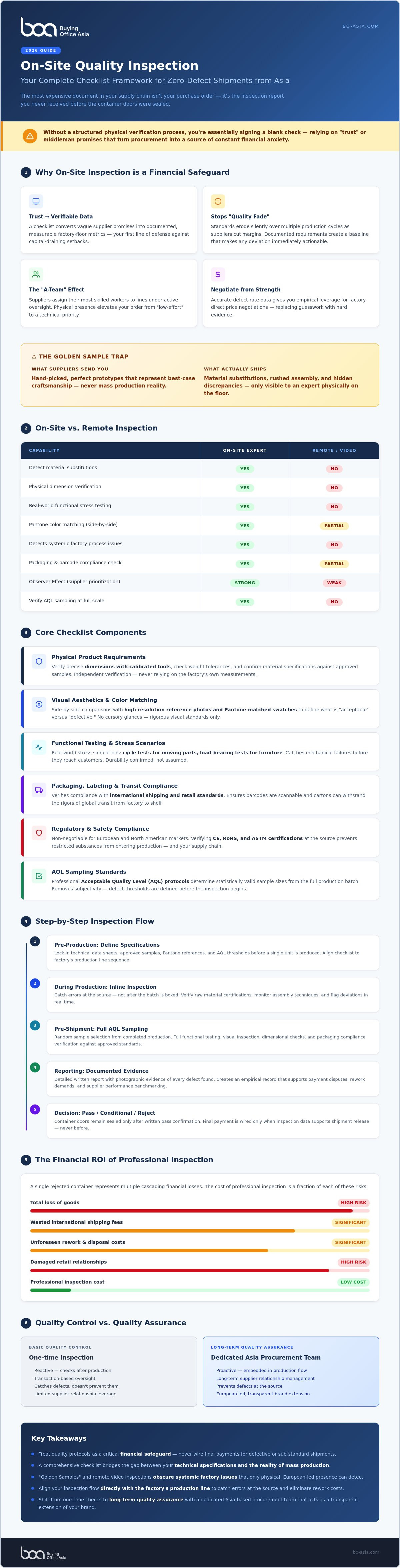
• Treat your quality protocols as a critical financial safeguard to ensure you never wire final payments for defective shipments or sub-standard goods.
• Develop a comprehensive on-site quality inspection checklist that bridges the gap between your technical specifications and the reality of mass production.
• Identify why "Golden Samples" and remote video inspections often obscure systemic factory issues that only a physical, European-led presence can detect.
• Align your inspection flow directly with the factory's production line to catch errors at the source and eliminate the burden of unforeseen rework costs.
• Shift from basic quality checks to long-term quality assurance by leveraging a dedicated Asia-based procurement team that acts as a transparent extension of your brand.
An on-site quality inspection checklist is far more than a technical formality; it's a primary financial instrument that converts "trust" into verifiable data at the factory gate. In the complex landscape of Asian manufacturing, a checklist serves as your first line of defense against operational setbacks that can drain your capital. Without a structured, physical verification process, you're essentially signing a blank check and hoping for the best. This approach is not a sustainable sourcing and procurement strategy for businesses looking to scale in 2026.
Relying on "remote trust" often leads to the trap of the Golden Sample. Factories frequently send hand-picked, perfect prototypes to your office while the actual mass production suffers from material substitutions or rushed assembly. These hidden discrepancies are only visible when an expert is physically present on the floor. A rigorous checklist prevents the pervasive "quality fade" where standards slowly erode over multiple production cycles as the supplier seeks to increase their own margins at your expense. By documenting every requirement, you create a baseline that makes any deviation immediately actionable.
Suppliers naturally prioritize clients who demonstrate active oversight. This is known as the "Observer Effect" in manufacturing. When a factory knows an expert will be verifying every point on an on-site quality inspection checklist, they're more likely to assign their most skilled workers, often called the "A-team," to your production line. Physical oversight ensures that the factory adheres to specified material grades and assembly techniques rather than substituting cheaper alternatives during unmonitored production shifts. This presence changes the supplier's internal calculus, moving your order from a "low-effort" category to a priority that demands technical precision.
The ROI of a professional inspection is measured by the catastrophic costs it prevents. A single rejected container can result in a total loss of goods, wasted shipping fees, and the high cost of environmentally responsible disposal. Beyond the immediate financial hit, consistent batch-to-batch reliability is the foundation of your brand reputation. Maintaining this transparency on the ground doesn't just stop defects; it also provides the leverage needed for more effective factory direct price negotiations. When you possess accurate data about factory performance and defect rates, you negotiate from a position of strength and empirical evidence rather than guesswork.
A professional quality control framework translates your brand’s technical vision into measurable factory floor metrics. Your technical data sheets are the blueprint, but the factory floor is where they often get lost in translation. The foundation of any on-site quality inspection checklist begins with physical product requirements. This includes verifying precise dimensions with calibrated tools, checking weight tolerances, and confirming material specifications against your approved samples. Relying on a factory's internal measurements is a risk; independent verification ensures the product you designed is the product being boxed.
Visual aesthetics require more than a cursory glance. They demand side-by-side comparisons with high-resolution reference photos and Pantone-matched swatches to define what is "acceptable" versus "defective." Functional testing then puts the product through real-world stress scenarios to ensure durability. Whether it's a cycle test for moving parts or a load-bearing test for furniture, these on-site checks catch mechanical failures before they reach your customers. Packaging and labeling are equally vital; we verify compliance with international shipping and retail standards, ensuring barcodes are scannable and cartons can withstand the rigors of global transit.
Incorporating standards like CE, RoHS, or ASTM into the checklist is non-negotiable for the European and North American markets. Verification of raw material certifications at the source prevents the use of restricted substances before production begins. This level of technical oversight is an essential phase of deep supplier vetting, ensuring your partners aren't just capable of manufacturing, but are also compliant with the latest legal frameworks for 2026.
To provide a clear "Pass/Fail" result, we categorize every finding into three distinct levels based on the latest AQL (Acceptable Quality Level) standards. A Critical Defect is any issue that poses a safety risk or legal liability. Major defects are those that render the product unsellable or significantly reduce its utility, while Minor defects are aesthetic issues that don't affect function. Establishing these thresholds early allows for decisive action when a batch doesn't meet the mark. If you need to refine your own production standards, you can discuss your requirements with our on-the-ground team.
The "Video Call Inspection" is a dangerous illusion of control that many importers mistake for genuine oversight. While technology promises transparency, a camera lens is easily manipulated by factory staff to avoid showing structural flaws, material inconsistencies, or poor workspace conditions. In contrast, an on-site quality inspection checklist executed by a physical representative ensures that every corner of the facility is scrutinized. You aren't just seeing what the factory wants to show; you're seeing the unvarnished reality of your production run. Physical presence allows an inspector to feel the weight of a product, smell chemical residues, and hear the mechanical health of the machinery, sensory data that a digital screen simply cannot convey.
Many importers fall victim to the "Golden Sample" trap, where the initial prototype is perfect but the mass production fails to meet those standards. Traditional middlemen often obscure these quality issues because their commissions depend on the shipment moving forward. They have a vested interest in "smoothing over" friction rather than protecting your capital. By choosing dedicated on-the-ground oversight, you eliminate this conflict of interest. You gain a partner whose only priority is the technical and financial integrity of your shipment, providing a steady defense against the operational setbacks common in unmanaged supply chains.
Unauthorised subcontracting is a silent profit killer. When a factory reaches overcapacity, they often outsource your order to smaller, unvetted workshops without your knowledge. Your on-site quality inspection checklist acts as a verification tool to ensure the production site actually matches the audited facility you originally approved. This isn't just about quality; it's about comprehensive risk management. Unmanaged subcontracting frequently leads to breaches in ESG standards, exposing your brand to ethical and legal liabilities that are impossible to detect from a remote office in Europe or North America.
The greatest advantage of physical presence is the ability to implement immediate corrective action. Remote feedback loops are notoriously slow. By the time you receive a PDF report and send an email, the factory might have already finished another thousand defective units. On-site intervention allows for "stop-production" moments where issues are fixed in real-time. During a recent high-volume order, our team identified a structural assembly flaw early in the shift. By pausing the line and recalibrating the machinery immediately, we saved the client from a total batch loss and weeks of rework delays. This level of pragmatism is what separates a passive observer from a strategic partner.
A generic template is a liability in high-volume manufacturing. To secure your investment, your on-site quality inspection checklist must be a living document tailored to the specific technical DNA of your product. This systematic approach ensures that nothing is left to the factory's interpretation. By engineering a custom defense, you move from a reactive posture to a position of operational command.
Gather every specification, from material grades to tolerance levels. Your inspector needs the "Golden Sample" on-site to provide a physical baseline for comparison.
Don't wait until the end of the line. Align your checks with critical assembly stages to identify systemic errors before they are buried under final components.
Specify the exact tools required, such as digital calipers, tension testers, or colorimeters. Ensure these tools are calibrated and available on the factory floor.
Remove subjectivity from the process. Every checklist item should have a binary outcome based on the AQL standards discussed in previous sections.
Define the chain of command. If a batch fails, the inspector must have the authority to stop production and trigger an immediate briefing with your procurement team.
Projects involving custom product development require an additional layer of scrutiny. Your on-site quality inspection checklist must include specific verification for tool wear and maintenance schedules. In mass production, even slight degradation in a mold can lead to dimensional drift that compromises the entire shipment. Integrating sampling support into the final inspection ensures that the first units off the line are functionally identical to the last, protecting the integrity of your custom tooling investment.
The journey from an Asian factory to a European warehouse is brutal. We utilize the "Drop Test" to ensure your packaging survives the physical stresses of transit. Beyond durability, we verify carton markings and barcode scannability to prevent costly warehouse delays or retail rejections. Verifying palletisation and container loading on-site is the final safeguard to ensure your goods are secured against moisture, shifting, and theft during the long sea voyage. If you're ready to build a protocol that protects your margins, contact our team to start your technical briefing.
An on-site quality inspection checklist is a powerful blueprint, but its effectiveness depends entirely on the expertise of the team executing it. In the high-stakes environment of Asian manufacturing, a checklist alone cannot negotiate with a factory manager or identify the root cause of a production stall. You need a dedicated presence that understands the cultural and technical nuances of the region. This is where your strategy moves from simple Quality Control, which focuses on catching defects, to comprehensive Quality Assurance, which focuses on preventing them through systemic oversight.
Our operational model creates a European management bridge between Helsinki and Hong Kong. You benefit from the steady confidence of a local partner combined with the technical rigor of an on-the-ground team that speaks the factory's language. This ensures your requirements are never lost in translation or obscured by layers of middlemen. By integrating these inspections into an end-to-end sourcing solution, we manage every variable from the first prototype to the final container seal, providing the same level of oversight usually reserved for major global enterprises.
When an on-site quality inspection checklist returns a "Fail" result, the real work begins. A passive third-party agency might simply hand you a PDF report and walk away, leaving you to handle the fallout. We initiate a Corrective Action Plan (CAP) immediately. We don't just report the defect; we negotiate the rework or replacement of goods without sacrificing your delivery timelines. This data is then used to drive long-term supplier development, turning a technical failure into a permanent performance improvement for future production runs.
Transparency is the cornerstone of a resilient supply chain. Unlike traditional intermediaries who often obscure factory details to protect their own margins, we provide 100% transparent reporting and factory-direct data. We act as an integrated extension of your own team, giving you the clarity needed to make informed financial decisions. This partnership approach eliminates the hidden costs and communication barriers that plague unmanaged sourcing. If you're ready to secure your shipments and eliminate manufacturing anxiety, you can contact Buying Office Asia for a comprehensive audit of your current QC process.
Transitioning from unmanaged trust to verifiable data is the only way to protect your capital in a complex global market. Your on-site quality inspection checklist serves as a strategic defense against the quality fade and middleman blind spots that frequently erode profit margins. By shifting your focus from reactive troubleshooting to proactive quality assurance, you ensure that every shipment meets your technical standards before the factory doors are ever sealed. This level of rigor converts manufacturing risk into a measurable business advantage.
True supply chain security requires more than a document; it demands a partner who functions as a transparent extension of your own organization. Buying Office Asia provides European-managed oversight based in Finland and Hong Kong, delivering direct accountability without hidden intermediary fees. Our proven track record in mass production oversight ensures your high-volume orders are handled with the precision your brand reputation deserves. You don't have to navigate the complexities of Asian manufacturing alone.
Secure your supply chain with a dedicated Asia procurement team and eliminate the anxieties of international sourcing. You're now equipped to turn your procurement process into a predictable, results-driven engine for long-term growth.
Quality control is the holistic management strategy used to maintain production standards, while an on-site quality inspection checklist is the specific technical instrument used during a physical audit. While the broader strategy focuses on long-term supplier development, the checklist provides the empirical, itemized data required to make an immediate "Pass/Fail" decision at the factory gate. It's the practical application of your quality requirements on the factory floor.
The number of units depends on your total lot size and the chosen AQL level, usually following ISO 2859-1 sampling standards. Inspectors don't check every single item in a mass production run; instead, they select a statistically significant sample to determine the quality of the entire batch. This mathematical approach provides a high degree of confidence in the shipment's integrity without the prohibitive cost of 100% inspection.
Using a generic template for custom-manufactured or OEM products is a significant operational risk that often leads to defects. Custom items require specific verification of unique tooling, proprietary dimensions, and specialized functional tests that standard templates simply don't cover. Your on-site quality inspection checklist must be engineered around the technical data sheet of your specific project to ensure every custom specification is met.
Relying on a factory’s internal report is hazardous due to the inherent conflict of interest. Factories are naturally inclined to minimize reported defects to ensure final payment and avoid the high costs of rework or replacement. Independent, European-led oversight provides the 100% transparency necessary to identify "quality fade" or material substitutions that internal reports frequently omit to protect the supplier's own margins.
AQL defines the maximum number of defects allowed in a sample before the entire shipment is rejected. In a professional checklist, these levels are categorized into critical, major, and minor defects. For example, a common 2026 standard is 0/2.5/4.0, which means there is zero tolerance for critical safety risks, while allowing small, predefined percentages for functional flaws or minor aesthetic issues.
A supplier’s refusal to allow an on-site inspection is a major red flag that often indicates unauthorized subcontracting or systemic production failures. You should always include the right to inspect in your initial manufacturing contract. If a factory denies access, it's a breach of transparency that warrants an immediate stop-payment and a formal audit to protect your brand reputation and financial investment.
You should revise your checklist after every production cycle or whenever you implement a Corrective Action Plan. As you identify recurring issues or update your product's technical specifications, the checklist must evolve to address these specific risks. Continuous refinement is the most effective way to prevent the gradual "quality fade" that often occurs during long-term manufacturing partnerships in Asia.
On-site inspections are vital for repeat orders because factory conditions, staff turnover, and raw material batches change constantly. Many suppliers prioritize new clients over established ones, which can lead to "corner-cutting" on subsequent production runs. Regular verification ensures that the high standards of your initial shipment are maintained consistently across every future batch, protecting your bottom line from unforeseen defects.

Scaling production to millions of units isn't a purchasing task; it's a high-stakes risk management discipline where a single percent of quality fade can liquidate your annual margin. You likely understand that the leap from mid-scale orders to massive procurement runs often exposes cracks in even t...

In 2026, the traditional sourcing agent isn't just an expense; they're a strategic liability that obscures your true cost of goods. Most procurement leaders recognize that supplier selection in asia has become a defensive maneuver where the goal is to eliminate the "Middleman Tax" before it erodes y...

Successful oem sourcing asia isn't just a search for a factory, but the implementation of a transparent, on-the-ground management ecosystem. You likely already know that the traditional intermediary model is flawed, often hiding true costs behind layers of markups and opaque communication. It's frus...