


Opening a shipping container to discover thousands of dollars in defective inventory isn't just a logistical setback; it's a preventable financial disaster that erodes your brand's credibility. You've likely experienced the anxiety of the "black box" period, where you've paid a deposit but have zero physical oversight of the final production quality. It's a common frustration to feel that your technical requirements are being lost in translation or sidelined for the factory's convenience. Most procurement leaders agree that once the final balance is paid and the vessel leaves the port, your leverage with a supplier vanishes instantly.
A rigorous pre-shipment inspection in China acts as your final strategic firewall, ensuring you never pay for a manufacturer's mistakes. This article provides the technical blueprint to master ISO 2859-1:2026 sampling standards and navigate the latest 2026 regulatory shifts, such as the mandatory CCC certification transitions for 16 product categories. You'll gain 100% confidence in your product quality and the actionable data needed to negotiate repairs before ownership transfers. We will explore how to transform inspections from a checkbox exercise into a sophisticated tool for financial optimization and total supply chain security.
• Understand why a pre-shipment inspection China is your final opportunity to exercise leverage and reject defective goods before the final balance is paid.
• Learn how to apply the latest ISO 2859-1:2026 AQL standards to ensure your sampling sizes and defect tolerances are statistically sound.
• Discover how physical on-site oversight prevents factory-inspector collusion and allows for immediate corrective actions on the production floor.
• Master the art of interpreting inspection reports to differentiate between minor cosmetic flaws and critical failures that threaten your brand reputation.
• Shift from transactional quality checks to a dedicated procurement team model that provides 100% transparency and professional European management.
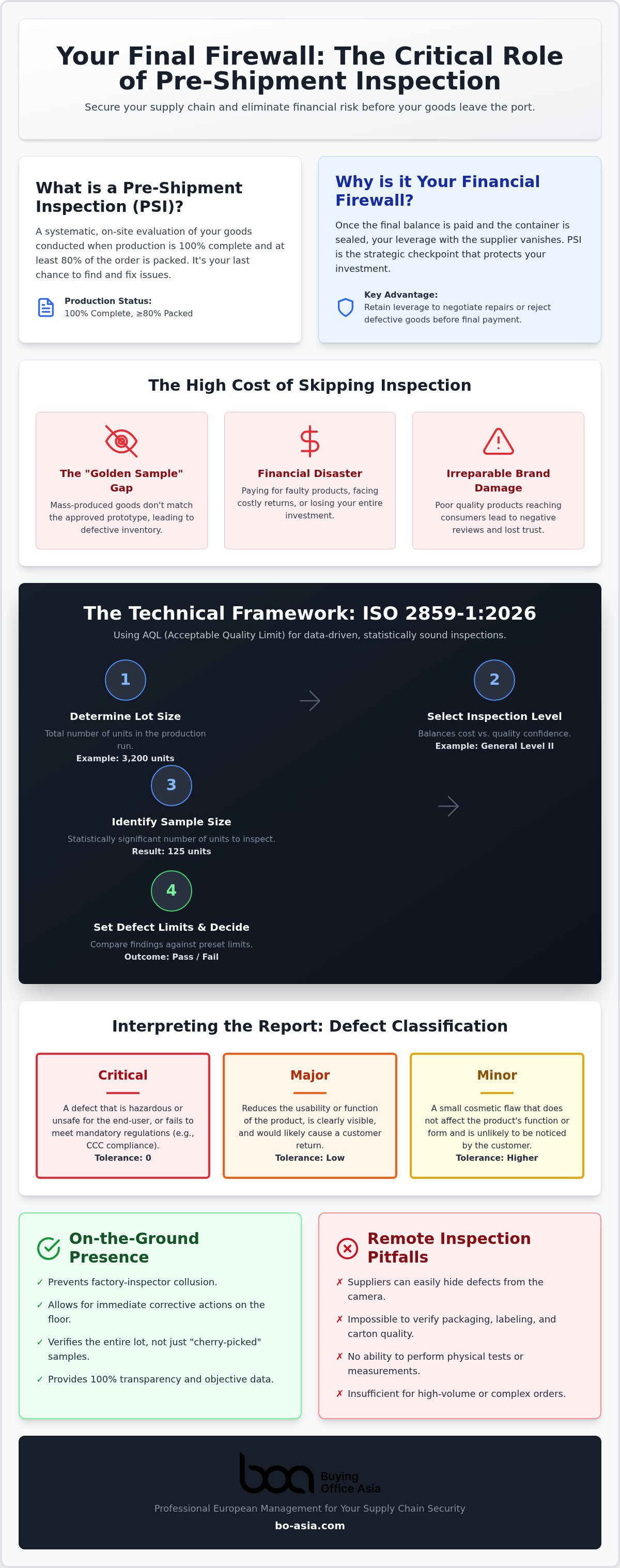
A Pre-Shipment Inspection (PSI) is a systematic, on-site evaluation of your goods conducted when production is 100% complete and at least 80% of the order is packed. In the context of a pre-shipment inspection China, this step represents your final opportunity to exercise leverage before ownership of the goods transfers from the manufacturer to your business. It's a critical financial firewall. Once the final balance is paid and the container is sealed, your ability to demand repairs or discounts vanishes instantly. You're left with the inventory you received, regardless of its condition.
Factories often perform their own internal quality control, but this internal reporting is inherently biased. A factory's primary goal is to maintain production speed and clear floor space. Independent oversight provides the objective data you need to make an informed decision. Legally, once goods leave the Chinese port, the cost of returns or local rework usually exceeds the value of the shipment itself. Without a neutral third party on the floor, you're essentially accepting the factory's word as truth.
For businesses utilizing end-to-end sourcing and procurement, PSI is the culmination of a rigorous oversight process. It's the transition point from mass production monitoring to final verification. As we move into 2026, the complexity of global trade is increasing. New standards like ISO 2859-1:2026 require precise statistical sampling, while updated China Compulsory Certification (CCC) mandates for 16 product categories mean that compliance isn't just about quality; it's about legality. A failed pre-shipment inspection China allows you to halt the process before non-compliant goods ever enter your supply chain.
Skipping this step creates a dangerous "Golden Sample" gap. The high-quality prototype you approved months ago often bears little resemblance to the mass-produced reality when the factory is rushing to meet a deadline. Remote verification via photos or videos is insufficient for high-volume orders. Suppliers can easily cherry-pick the best items for the camera while hiding defects in the rest of the lot.
The hidden costs of skipping this step are often catastrophic. You face potential customs delays if documentation doesn't match the physical goods, high rates of consumer returns, and irreparable brand damage. Without physical oversight, you're gambling with your capital. Real-time, on-site data is the only way to mitigate these risks effectively and secure your financial interests.
A successful pre-shipment inspection China relies on a standardized, mathematical framework rather than subjective guesswork. AQL is the statistical tool that balances inspection cost with quality confidence. By utilizing the ANSI/ASQ Z1.4 sampling standard, you determine exactly how many units must be pulled from a total lot size to achieve a statistically significant result. For instance, in a production run of 3,200 units, a General Inspection Level II typically requires a sample size of 125 pieces. This methodology ensures that your quality assessment is grounded in data rather than a random, non-representative sample of a few convenient boxes.
This technical rigor aligns with the broader WTO Agreement on Pre-Shipment Inspection, which establishes the international legal and procedural framework for trade transparency. It ensures that the "Pass/Fail" threshold is based on predetermined limits for critical, major, and minor defects. You aren't just hoping for the best; you're using a proven system to validate the entire production run before the final balance is paid. If you need assistance defining these parameters for your specific product category, you can speak with our technical procurement specialists for a customized consultation.
A generic checklist often misses the nuances that protect your brand. A professional inspector verifies every detail against your approved OEM manufacturing specifications. This comprehensive review includes:
Checking for surface scratches, color consistency, and finishing quality to ensure the product matches the approved master sample.
Verifying that the product performs as intended under load, including power-on tests for electronics or stress tests for furniture.
Confirming that barcodes are scannable, shipping marks are accurate, and retail box integrity is sufficient to survive international transit.
Using calibrated tools to confirm that weight and dimensions fall within your specified tolerances.
Not all defects carry the same weight. You must define clear boundaries to ensure the inspector can make an objective call on the factory floor. Defects are typically categorized into three tiers:
These are non-negotiable failures that create safety hazards or regulatory non-compliance. A failure to meet the new 2026 CCC certification standards for electronics, for example, is a critical defect that mandates immediate rejection.
These issues render the product unsellable or highly likely to be returned, such as a non-functioning component or significant structural damage.
These are slight deviations from the standard, like small cosmetic blemishes, that don't affect function but might impact the perceived quality for the end consumer.
Relying on digital dashboards or unmanaged inspection platforms for your pre-shipment inspection China creates a dangerous disconnect between the data you see and the reality on the factory floor. The "Inspector's Integrity" problem remains a significant risk in international trade. Unvetted third-party contractors, often hired through gig-economy style platforms, lack the long-term accountability of an integrated procurement team. This environment can lead to collusion, where inspectors overlook major defects in exchange for factory incentives, leaving you with a container of unsellable goods. True security requires a physical presence that cannot be bypassed by a 5-star review system or a polished PDF report.
Our Finnish-led management team serves as a critical bridge between Western quality expectations and the practicalities of Asian manufacturing. With leadership based in Finland and operational headquarters in Hong Kong, we provide the steady confidence of an established expert. This structure allows for real-time communication. When a deviation is discovered, it's resolved on the factory floor before the inspector leaves the premises. You receive clear, actionable data that allows for immediate negotiation or repair, rather than discovering a failure weeks later when the goods arrive at your warehouse.
Conventional sourcing agents often operate on a commission-based model that creates a fundamental conflict of interest. If a production batch fails, an agent might obscure the severity of the issues to ensure the shipment proceeds and their commission is secured. The Buying Office Asia approach explicitly rejects this model. We provide 100% transparency with no hidden markups or obscured costs. By positioning our team as an integrated extension of your own company, we ensure that our only priority is your financial health. In the complex landscape of 2026, physical proximity is the only genuine guarantee of accountability.
A professional on-site presence does more than verify product quality; it functions as a defense for your intellectual property. Our inspectors verify that proprietary molds and tooling are stored correctly and aren't being used for unauthorized third-party production runs. We also monitor for production overruns, ensuring that your custom designs don't end up on secondary markets. These findings are directly linked to our ongoing supplier vetting process. This integrated strategy moves you away from transactional interactions and toward a secure, long-term partnership with reliable manufacturers.
Receiving the final report for your pre-shipment inspection China is a pivotal moment in your procurement cycle. This document is not merely a summary; it's your primary tool for financial leverage. The summary page typically indicates a "Pass," "Fail," or "Pending" status. A pending status often arises when specific lab tests are still in progress or when the inspector requires additional clarification on a technical specification. You must look beyond the headline status and scrutinize the defect gallery. High-resolution photo evidence allows you to identify patterns. For instance, if multiple units exhibit the same surface abrasion, it suggests a systemic issue with factory tooling rather than an isolated handling error.
You should immediately compare these findings against the benchmarks established during the product development and sampling phase. If the mass production quality deviates from the approved master sample, you face a critical decision. You may choose to accept a "Fail" report in exchange for a significant price discount if the defects are purely cosmetic and won't affect sellability. However, if functional integrity is compromised, you must demand a full rework. Making this call requires a cold, analytical approach to your inventory needs and brand standards.
When a shipment fails, you shouldn't simply wait for the factory to fix it. You must enforce a formal Corrective Action Plan. This plan mandates that the manufacturer rectifies all major and critical defects at their own expense. It also establishes a strict timeline for a follow-up re-inspection to verify that the repairs were successful. By documenting these failures, you build a performance history that's essential for long-term supplier management and development. This data ensures that your manufacturer understands that quality is a non-negotiable requirement for continued partnership.
The "Pass" report serves as the trigger for your final financial obligations. You should link the release of your Letter of Credit or final T/T payment directly to a successful inspection outcome. This ensures the factory remains motivated to maintain high standards throughout the entire production run. Additionally, a professional on-site presence prevents "stock swapping," a practice where a factory might attempt to substitute inspected goods with uninspected inventory during the loading process. To secure your 2026 supply chain, you can contact our team to review a sample inspection report and discuss your specific quality requirements.
Treating quality control as a one-off transactional task is a high-risk strategy that often leads to inconsistent results. To achieve true supply chain resilience, you must move beyond isolated checks and integrate your quality standards into a broader procurement strategy. Transitioning to a dedicated Asia procurement team allows you to maintain continuous oversight from the initial factory audit to the final container loading. This holistic approach ensures that the insights gained during a pre-shipment inspection China are used to drive long-term supplier improvements rather than just solving immediate crises.
Our unique organizational structure provides a significant competitive advantage. With European leadership based in Finland and our operational headquarters in Hong Kong, we combine Western professional rigor with deep local expertise. We understand the nuances of international quality standards and have the regional networks to enforce them effectively on the factory floor. This dual presence eliminates the communication barriers and cultural misunderstandings that frequently compromise unmanaged manufacturing projects.
We further strengthen your operations by integrating quality oversight with logistics and shipping management. By aligning the inspection timeline with your shipping schedule, we prevent costly delays and ensure that only verified, compliant goods enter the logistics chain. This coordination is essential for meeting the tighter regulatory deadlines of 2026, such as the updated CCC certification requirements and new GB standards for electronics and automotive components. Buying Office Asia acts as a protective extension of your own office, ensuring your capital is never at risk.
Our history is defined by the disasters we prevent. We have consistently identified critical defects, such as incorrect internal wiring in high-volume electronics and structural weaknesses in furniture, before these goods left the factory. These interventions have saved our clients thousands of dollars in potential recall costs and international shipping fees. You can explore our client success stories to see how a consistent pre-shipment inspection China strategy transforms supplier behavior, leading to lower defect rates and higher manufacturing precision over time.
Securing your production starts with a clear, technical assessment of your needs. You can request a comprehensive quote for on-site inspection services by providing your product specifications and factory location. Once engaged, we handle the complex process of onboarding your supplier to our oversight protocols, ensuring they understand that final payment is strictly contingent on a "Pass" report. Contact our leadership teams in Helsinki or Hong Kong to discuss how we can stabilize your supply chain and protect your financial interests in the Asian market.
Mastering the technicalities of a pre-shipment inspection China is the most effective way to eliminate quality risks before they impact your bottom line. You've seen how AQL standards provide the mathematical certainty you need and why physical oversight is the only way to prevent factory-inspector collusion. In the shifting regulatory landscape of 2026, a "check-box" approach is no longer sufficient to protect your capital. You need a partner that functions as a seamless extension of your own operations.
Buying Office Asia offers the security of European-managed oversight combined with a permanent on-the-ground presence in Hong Kong and Mainland China. Our 100% transparent pricing model removes the hidden costs of middlemen, ensuring your investment is focused entirely on product excellence. By integrating these rigorous standards into your supply chain, you move from reacting to defects to proactively managing your brand's integrity. We are ready to help you navigate the complexities of global trade with confidence.
Secure your supply chain: Contact our expert team today
A During Production inspection occurs when 20% to 50% of the lot is completed, while a pre-shipment inspection China is conducted only when at least 80% of the goods are packed. DUPRO is designed to catch systemic manufacturing errors early enough to adjust the process. PSI serves as the final financial firewall, providing the data needed to approve or reject the shipment before the final payment is released.
Industry rates for on-site inspections generally follow a flat "man-day" rate that covers the inspector's time, travel, and report generation. While these rates vary based on the factory's location and the complexity of the product, professional firms provide transparent, all-inclusive pricing to avoid hidden expenses. You should prioritize providers who offer clear fee structures that align with the technical rigor required for your specific product category.
You can technically perform an inspection yourself, but it's often a poor use of corporate resources and carries significant operational risks. Professional inspectors use calibrated tools and standardized ISO 2859-1:2026 sampling protocols that are difficult to replicate without specific training. The travel expenses and time required for a Western manager to visit a remote factory often exceed the cost of hiring an established team with a permanent regional presence.
If a factory fails the inspection, you should immediately issue a formal Corrective Action Plan (CAP) that outlines the required re-work. The manufacturer is typically responsible for the costs of repairing defective units and the subsequent re-inspection fees. This failure provides you with the necessary leverage to negotiate price adjustments or demand that the factory replaces sub-standard components before you authorize the final balance payment and shipment.
Most professional inspection firms deliver a comprehensive digital report within 24 hours of the inspector leaving the factory floor. This rapid turnaround is essential for maintaining your shipping schedule and making quick decisions regarding rework or payment release. A high-quality report includes a clear summary of the status, detailed photo galleries of any discovered defects, and a verification of the packaging and labeling against your approved specifications.
While not legally mandatory for every product category, a pre-shipment inspection China is often a requirement for specific regulated goods or financial instruments. Some banks mandate a clean inspection report before releasing funds under a Letter of Credit. Additionally, products falling under the 2026 CCC certification updates must undergo rigorous verification to ensure they meet the latest safety and compliance standards before entering the market.
Choosing the right AQL level depends on your product's value, intended use, and the potential impact of a failure. Most consumer goods utilize General Inspection Level II, which provides a balanced statistical confidence for standard retail items. If you're importing safety-critical automotive components or high-value electronics, you may require Level III or a "Zero Defect" policy to minimize the risk of costly consumer returns and brand damage.
Buying Office Asia specializes in high-volume sourcing and end-to-end procurement for established businesses. Our model is designed to provide maximum value through integrated supply chain management, which is most effective for significant production runs and complex manufacturing projects. We focus on long-term partnerships where our European-managed oversight and regional expertise can deliver measurable financial optimization and total risk mitigation for professional importers.

As of July 2026, the average effective tariff rate on Chinese imports has climbed to 22.8%, but is the cost on the invoice really your biggest financial risk? You likely feel the mounting pressure of managing a supply chain where the rules of engagement change every quarter. The challenges of sourci...

Is your current China manufacturing management strategy robust enough to survive the regulatory shifts of 2026? With the recent implementation of Decree 834 and the new "Made in China" procurement standards, the distance between a successful product launch and a costly supply chain failure has never...

What if your final quality check isn't just a formality, but the only thing standing between a successful product launch and a container full of unsellable defects? For many businesses, the fear of receiving substandard goods from overseas is a constant anxiety, often compounded by communication bar...