


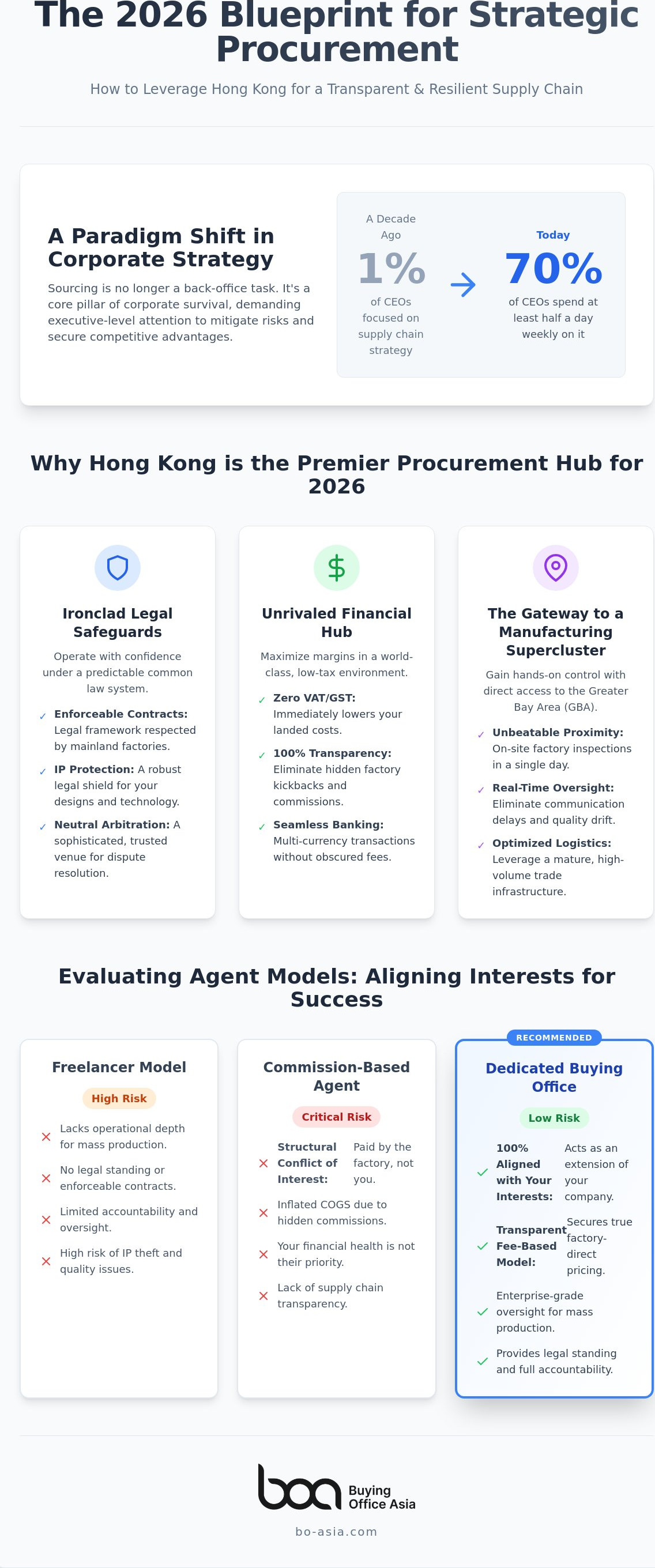
Did you know that 70% of CEOs now spend at least half a day every week focused on supply chain strategy? This massive shift from just 1% a decade ago proves that sourcing is no longer a back-office task; it's a core pillar of corporate survival. When evaluating procurement services Hong Kong remains the most strategic hub for global trade, provided you have an on-the-ground team to defend your interests against quality drift and opaque pricing structures.
You probably feel the constant pressure of rising costs and the lack of visibility into true factory margins. It's a common anxiety for enterprises that want to scale without losing control over their intellectual property or production standards. This guide will show you how to leverage Hong Kong's unique 2026 financial landscape, including its zero-VAT status, to secure factory-direct pricing and 100% supply chain transparency. We'll examine how to use enforceable contracts under Hong Kong law and optimized logistics to transform your procurement from a source of risk into a measurable competitive advantage.
• Leverage Hong Kong's common law legal system to ensure your manufacturing contracts are fully enforceable and your intellectual property remains protected.
• Discover why professional procurement services Hong Kong are shifting toward a transparent fee-based model to eliminate hidden factory commissions and inflated costs.
• Identify the critical risks of the freelancer model and learn why a dedicated buying office provides the mass production oversight required for enterprise-scale operations.
• Implement a risk mitigation framework that audits your agent's revenue model, ensuring 100% visibility into your supply chain and true factory-direct pricing.
• Bridge the gap between Western business ethics and Asian manufacturing through Helsinki-led leadership with over 15 years of physical presence in the region.
Hong Kong isn’t just a dot on the map; it’s the operational nerve center for Asian trade. In 2026, while other regions face supply chain fragmentation, Hong Kong’s "One Country, Two Systems" framework offers a unique hybrid of Western legal stability and Eastern manufacturing access. Utilizing procurement services Hong Kong offers means your business gains immediate proximity to the Greater Bay Area (GBA), the world’s most dense manufacturing cluster, without sacrificing the security of international business standards. It’s a strategic bridge that allows you to manage Mainland China’s production capacity from a base that prioritizes your financial safety.
The city's infrastructure is built for high-volume trade. With no Value Added Tax (VAT) or Goods and Services Tax (GST), and a competitive two-tiered profits tax system, the fiscal environment is designed to keep your landed costs low. This isn't just about geography. It’s about the maturity of a system that has facilitated global trade for decades. Historically, the structured approach to sourcing in the region is exemplified by institutions like Hong Kong's Government Logistics Department (GLD), which underscores the city's long-standing commitment to professional procurement standards and accountability.
Contract enforcement is the single biggest anxiety for international buyers. When you operate through Hong Kong, your agreements are governed by common law, providing a level of predictability that is often missing in other manufacturing hubs. If a supplier fails to meet quality standards or attempts to replicate your designs, you have a clear, enforceable path to resolution. In 2026, global brands increasingly prefer HK-governed arbitration because it offers a neutral, sophisticated venue for resolving disputes. Your intellectual property is protected by a legal shield that Mainland factories respect, simply because the consequences of a breach are enforceable in a court they cannot ignore.
Hidden costs are the silent killers of manufacturing margins. Hong Kong’s banking infrastructure is world-class, allowing for seamless multi-currency transactions without the obscured exchange fees or bank markups common in less developed markets. This financial clarity is essential for achieving 100% transparency in your supply chain. By using a Hong Kong office to verify factory-direct pricing, you eliminate the risk of "kickbacks" or unrecorded commissions that often inflate COGS when dealing directly with factories. It’s about ensuring that every dollar you spend is accounted for, from the raw material purchase to the final shipping container.
Strategic logistics also play a vital role. Being next door to the GBA means your procurement team can conduct on-site inspections and return to the office the same day. This proximity reduces communication delays and ensures that quality oversight happens in real-time, not through a screen thousands of miles away.
Effective logistics are not limited to manufacturing; for example, shift2fresh.com applies similar supply chain rigor to ensure the quality and freshness of agricultural imports from the Philippines to the UAE.
Choosing the right partner determines whether your supply chain is a strategic asset or a constant liability. In the landscape of procurement services Hong Kong, three distinct models exist, each with varying levels of risk and accountability. Freelancers often act as "personal shoppers," but they lack the operational depth and legal standing required for enterprise-scale mass production. Commission-based agents present a different risk: a structural conflict of interest. When an agent’s income depends on a factory’s payout, your cost of goods sold (COGS) is no longer their priority. For high-volume operations, a dedicated Asia procurement team is the only model that aligns entirely with your financial health.
The buying office model functions as an integrated extension of your own company. Instead of acting as a third-party intermediary, this team operates as your local office, providing the same level of oversight you would expect from your own employees. This shift from transactional interactions to long-term partnership is what separates professional procurement from simple brokering. It’s a defense against the operational setbacks that affect unmanaged supply chains, ensuring that your interests are protected at every stage of the manufacturing process.
Many agents claim to offer "free" sourcing, but in international trade, nothing is truly free. These intermediaries typically collect undisclosed "kickbacks" from factories, which are then baked into your unit price. This lack of loyalty means the agent will rarely push for the best price or hold a factory accountable for quality drift. They’re effectively sales reps for the manufacturer, not a defense for your brand. While the official government procurement portal provides a transparent framework for public tenders, the private market is often a "Middleman Trap" where obscured costs erode your margins. You don't just need a contact; you need a partner whose revenue model is based on your success, not the factory's volume.
Reliability in sourcing comes from bridging the cultural and ethical gap between Western management and Asian production. European-led leadership in Hong Kong ensures that Western business ethics are enforced on the factory floor every day. This "Helsinki to Hong Kong" bridge provides a level of calm assurance that freelancers simply cannot match. By utilizing supply chain management retainers, you treat your procurement team as a fixed-cost investment rather than a variable expense. This model incentivizes your team to find the lowest possible factory-direct pricing because their loyalty is bought by you, not the supplier. It’s a protective posture that secures your mass production oversight and long-term brand equity.
If you're currently struggling with quality drift or suspect your landed costs are being inflated by hidden commissions, it might be time to review your current sourcing structure with an expert team.
In 2026, transparency isn't just a buzzword; it's the non-negotiable standard for any resilient supply chain. Many businesses fall into the "Black Box" trap, where they receive a single, all-inclusive price from an agent without knowing the true factory cost. This lack of visibility hides inefficiencies and, more dangerously, misaligns your interests with those of your representative. Professional procurement services Hong Kong must provide a clear window into every transaction. If you can't audit the original factory invoice, you're likely paying a hidden premium that erodes your competitive edge.
Vetting a partner requires more than a cursory glance at a website. You need to probe their operational mechanics. Start by asking if they allow direct, unmediated communication with the factory management. A transparent partner has nothing to hide and encourages these connections. Next, ask for proof of financial flow. Can you audit the original bank transfers between the agent and the manufacturer? Finally, demand a detailed breakdown of their process for supplier vetting and factory audits. If they can't provide a documented methodology for verifying a factory’s capacity and compliance, they aren't managing your risk; they're ignoring it.
The rise of digital platforms has created a surge in "laptop agents" who operate virtually without ever stepping foot on a factory floor. These intermediaries offer no real defense against quality drift. You need a team with a physical headquarters in Hong Kong to ensure legal and operational accountability. Proximity matters because it allows for unannounced on-site inspections. Don't rely on generic PDF reports that could be years old. Insist on timestamped and geo-tagged quality control reports that prove your team was physically present during production. This level of on-the-ground oversight is the only way to ensure that the samples you approved match the mass production units hitting your warehouse.
Securing procurement services Hong Kong requires a methodical approach to ensure alignment between your corporate goals and local execution. You shouldn't just hire an agent; you're building a regional extension of your company. This process begins with a clear definition of your procurement scope. Are you sourcing off-the-shelf components, or do you require OEM manufacturing involving custom tooling and complex product development?
Once your scope is defined, shortlist partners based on their category expertise and, crucially, their volume capacity. High-volume sourcing requires a team capable of managing mass production oversight without quality drift. During initial consultations, conduct a "Transparency Audit." If a partner cannot provide a breakdown of their fee structure or refuses to allow direct factory communication, they aren't a strategic ally. They're a middleman.
Before onboarding, calculate the volume thresholds that justify a dedicated team. For many enterprises, the savings generated by factory-direct pricing and reduced quality rejections far outweigh the cost of a professional retainer. You need to set clear benchmarks for success. These should include specific KPIs for quality standards, lead time consistency, and year-over-year cost-savings. Distinguishing between simple procurement and complex contract manufacturing is vital. OEM projects require a higher level of technical oversight and on-site engineering support to ensure that your designs are executed perfectly every time.
Don't rush into a total supply chain overhaul. Start with trial projects to test the partner's responsiveness and quality control rigor. A successful trial should lead to a long-term strategic partnership where the procurement team is fully integrated into your internal communication tools, such as Slack or Microsoft Teams. This ensures real-time updates and eliminates the information silos that plague unmanaged sourcing.
Reviewing savings examples from previous case studies can help you understand the realistic ROI of this model. Finally, formalize the partnership with a contract governed by Hong Kong law. This legal framework provides the security and enforceability you need to protect your intellectual property and financial interests in the Asian market. It's the final piece of the puzzle that turns a connection into a secure, scalable operation.
If you're ready to move away from high-risk intermediaries and build a transparent supply chain, get in touch with our team to discuss your 2026 sourcing strategy.
Buying Office Asia (BOA) operates as a seamless extension of your internal team, specifically designed to eliminate the risks of international manufacturing. Our European-managed structure, featuring Helsinki-led leadership and a permanent Hong Kong headquarters, creates a stable bridge between Western expectations and Asian production reality. This "Helsinki to Hong Kong" advantage ensures that your brand standards are never lost in translation. Unlike traditional China sourcing companies that often act as simple intermediaries, we provide a protective presence on the factory floor. We don't just find suppliers; we manage them with the same rigor you'd apply in your own facility.
Proximity is accountability. With over 15 years of physical presence in the region, our team understands the nuances of procurement services Hong Kong better than any remote agent. We don't hide behind digital platforms. Instead, we use our regional networks to secure factory-direct pricing and 100% supply chain transparency. This model removes the "middleman markup" and replaces it with a transparent fee structure that aligns our success entirely with your financial health.
Our model is built on measurable ROI. We've explicitly rejected the commission-based structures that lead to obscured costs and inflated margins. By focusing on direct negotiation, we ensure your COGS remains competitive and predictable even as global markets fluctuate. Our multi-lingual, multi-cultural management team navigates the complexities of regional trade, handling everything from initial product development and sampling to final quality inspections. This holistic approach provides the scalability that growing enterprises need to compete globally without increasing their internal overhead. We focus on high-volume mass production oversight, ensuring that the quality you approve in the sample stage is exactly what arrives in your warehouse.
Securing your supply chain starts with a professional audit of your current sourcing strategy. We customize our dedicated procurement teams to match the specific technical requirements of your industry, ensuring that the personnel on the ground have the category expertise needed for your products. Our consultation process is designed to identify hidden inefficiencies in your existing model and replace them with a transparent, high-performance alternative. We don't just offer a service; we provide a defense against the operational setbacks that threaten unmanaged supply chains. It's time to move toward a model defined by reliability and financial viability. You can consult with Buying Office Asia to audit your procurement strategy and discover how a dedicated regional partner can stabilize your bottom line.
Navigating the complexities of international trade requires more than just a list of suppliers. It demands a strategic presence that prioritizes legal security and financial clarity. By leveraging the unique regulatory landscape and choosing a partner that operates with 100% transparency, you move beyond the "middleman trap" and into a model of sustainable growth. The most successful enterprises in 2026 won't just buy products; they'll build an integrated, on-the-ground extension of their own internal teams to defend their margins and brand reputation.
Buying Office Asia provides exactly this level of sophisticated oversight. As a European-managed firm with over 15 years of physical presence in the region, we ensure Western business ethics are met with local execution. Our model eliminates hidden commissions and kickbacks, offering you end-to-end management from factory-direct negotiations to final delivery. When you choose our procurement services Hong Kong, you're investing in the stability and financial viability of your entire supply chain. It's time to transform your sourcing from a source of anxiety into a measurable strategic advantage. Secure your supply chain with Buying Office Asia’s dedicated team and take full control of your manufacturing future today.
A sourcing agent acts as your dedicated representative, whereas a trading company operates as a vendor. Trading companies typically add an undisclosed markup to factory prices and obscure the manufacturer's identity to protect their profit margins. Professional agents work on a transparent fee basis, providing you with direct factory access and 100% visibility into the true production costs.
Professional teams generally move away from commission-based models to eliminate conflicts of interest. You'll usually encounter transparent fee structures or monthly retainers that align the agent’s incentives with your own cost-saving goals. This approach ensures you aren't paying hidden margins that are often baked into the unit price by traditional intermediaries.
Hong Kong is the safer choice for enterprise sourcing because it offers a common law legal system and superior banking infrastructure. While proximity to the factory floor is necessary, the ability to enforce contracts and manage multi-currency transactions without obscured bank fees makes a Hong Kong partner a more reliable stabilizing force for your supply chain.
Your intellectual property is protected through agreements governed by Hong Kong law, which provides a predictable and internationally recognized legal framework. A local partner also conducts rigorous on-site vetting to ensure the factory has no history of unauthorized replication. This legal and physical oversight acts as a defense against brand risks and design theft.
A comprehensive procurement team manages both functions to ensure end-to-end production reliability. Factory audits occur during the initial vetting phase to verify a supplier's technical capacity and ethical compliance. Quality control inspections are then performed at multiple stages of mass production to prevent quality drift before your goods are ever loaded onto a container.
Red flags include a lack of a physical office in the region and a refusal to allow direct communication with factory management. If an agent insists on a commission-only model and won't provide original factory invoices, they're likely hiding markups. These "black box" operations are a primary source of unforeseen expenses and operational setbacks.
Online directories are starting points, not a substitute for on-the-ground oversight. Utilizing procurement services Hong Kong ensures that the "Gold Supplier" you found is a legitimate manufacturer rather than a shell company. A dedicated team provides the mass production oversight and physical inspections that digital platforms simply cannot offer from a distance.
A Hong Kong office serves as the central hub for your logistics, coordinating directly with freight forwarders to optimize container loading and documentation. They ensure all export paperwork is handled correctly to reduce the risk of port delays. This hands-on management keeps your supply chain moving efficiently from the factory floor to your final delivery destination.

A factory audit can look reassuring while leaving a critical question unanswered: will the same materials, processes and controls be used for your production run? Responsible toy manufacturing in China requires more than reviewing a certificate. You need to understand factory conditions, subcontract...

A final inspection can show you what came off the production line, but it can’t change the decisions that shaped it. That’s the key distinction in standalone quality inspections vs procurement services: one checks product output at a defined point, while the other can coordinate work across supplier...

A factory quote is not a shipment plan. Sourcing products from China to USA involves more than finding a manufacturer and agreeing on a unit price. Unclear specifications, samples that differ from production, or overlooked packaging and freight details can put quality and commercial viability at ris...