


The €150 duty exemption you've relied on for years is gone, and the regulatory wall between China and Europe has never been higher. If you're managing high-volume Sourcing from China to Europe, you already know that finding a supplier is the easy part. The real challenge lies in protecting your margins against the 2026 CBAM certificates and the sudden expiration of critical RoHS lead exemptions this July. You're likely tired of the middleman trap where hidden markups and quality fade during mass production eat away at your bottom line.
Successful procurement in this climate requires an integrated, on-the-ground team that functions as a direct extension of your European office. This guide provides the strategic framework you need to secure factory-direct pricing while ensuring 100 percent compliance with evolving EU standards. We'll examine how to implement rigorous on-site quality oversight, navigate the new €3 customs duty per tariff sub-heading, and build a resilient supply chain that eliminates the risk of unmanaged manufacturing. By the end of this briefing, you'll have a roadmap to reduce procurement costs and stabilize your logistics from the factory floor to your European warehouse.
• Learn how to leverage high-volume procurement as a strategic competitive advantage to protect your margins in the shifting 2026 trade landscape.
• Understand why manufacturer self-declarations for CE and REACH compliance are insufficient and how to implement non-negotiable verification standards.
• Expose the "Middleman Trap" to eliminate hidden 15-30% markups and secure factory-direct pricing for your Sourcing from China to Europe.
• Follow a structured 5-step roadmap to align technical specifications and prevent quality fade during the transition from sampling to mass production.
• Discover the "Helsinki-Hong Kong" advantage of using a dedicated on-site procurement team that functions as a physical extension of your own company.
High-volume sourcing is no longer a simple procurement exercise; it's a strategic pillar for European firms seeking to maintain market share. As of May 2026, the trade environment has shifted from a transactional "buy-and-ship" model to one defined by intense regulatory scrutiny and geopolitical complexity. While China remains the world's manufacturing powerhouse, producing over 28 percent of global goods, the methods used to access this capacity have evolved. Relying on basic online platforms is no longer sufficient for enterprise-level brands that require absolute transparency and ironclad compliance.
The current state of EU-China trade relations reflects a deep economic interdependency, yet it's marked by a goods trade deficit that reached €360 billion in 2025. This imbalance has prompted a coalition of EU member states, including France and the Netherlands, to advocate for a more aggressive trade policy. For your business, this means Sourcing from China to Europe now requires a sophisticated procurement partnership that anticipates trade defense measures and shifts in industrial capacity before they impact your landed cost.
Inventory management has become a high-stakes balancing act due to fluctuating logistics. As of May 21, 2026, shipping rates from Shanghai to Genoa jumped 10 percent to $4,082 per 40ft container, while rates to Rotterdam surged 15 percent to $2,773. These spikes, combined with the definitive compliance phase of the Carbon Border Adjustment Mechanism (CBAM), demand a move toward sustainable sourcing. Digital transparency is now the industry standard, replacing the "black box" models of the past with real-time data on carbon footprints and ethical manufacturing standards. Successful importers are those who treat their supply chain as a transparent asset rather than a series of obscured transactions.
The allure of the lowest unit price often hides a minefield of operational hazards. Unvetted suppliers frequently lead to catastrophic delays, manufacturing defects, and severe legal liabilities under the updated EU REACH and RoHS directives. When you ignore the necessity of on-site vetting, you risk the "Middleman Trap," where quality fade during mass production destroys your brand equity. True profitability is found by looking at the big picture rather than the initial quote.
Total Cost of Ownership is the comprehensive sum of all direct and indirect costs associated with a product, encompassing the purchase price, logistics, quality assurance, regulatory compliance, and the mitigation of supply chain risks.
Calculating this figure accurately is the only way to ensure financial viability. If a low-cost supplier results in a 5 percent defect rate or a customs seizure due to non-compliant documentation, the perceived savings vanish instantly. Professional Sourcing from China to Europe focuses on optimizing the entire lifecycle of the product to protect your margins and your reputation.
Sourcing from China to Europe requires an uncompromising approach to regulatory standards. In the European Union, CE Marking and REACH compliance are legal prerequisites, not optional quality markers. If your products lack the correct certifications, you face more than just customs delays; you risk total shipment seizure and heavy fines. As of mid-2026, the regulatory landscape has tightened significantly. You must account for the definitive phase of CBAM and the expiration of critical lead solder exemptions under the RoHS Directive on July 21, 2026. These aren't just bureaucratic hurdles; they're financial risks that require active management.
Many importers fall into the trap of accepting a manufacturer's "self-declaration" of compliance. This is a high-risk strategy that rarely holds up under scrutiny. A factory's internal test report often fails to meet the rigorous standards of European market surveillance. You must verify these claims through independent, third-party laboratory testing. This process ensures that the materials used in mass production actually match the samples originally approved. Without this verification, you're essentially gambling with your brand's reputation and financial health.
Maintaining a robust documentation trail is essential for seamless market entry. This includes technical files, declarations of conformity, and comprehensive test reports. For a detailed breakdown of these requirements, consult the EU guide for importing goods. This paper trail is your primary defense during customs inspections and future market surveillance audits. If you're unsure about your current compliance status, it's wise to discuss your procurement strategy with an expert before placing your next high-volume order.
Electronics demand specialized oversight. You need to ensure compliance with RoHS for hazardous substances, LVD for low voltage safety, and EMC for electromagnetic compatibility. Labels must be accurate and legible. While "Made in PRC" is technically valid, "Made in China" remains the standard for European consumer clarity and trust. When you are developing OEM manufacturing projects for regulated industries, these technical specifications must be integrated into the initial design and tooling phase to avoid costly re-engineering later.
Don't confuse a digital "Verified Supplier" badge with a comprehensive factory audit. A digital badge only confirms that a business license exists. A physical, on-site audit evaluates production capacity, quality management systems, and social compliance. European consumers increasingly demand ethical manufacturing standards, and an on-site presence is the only way to verify these conditions. Look for red flags like unorganized assembly lines, a lack of internal QC stations, or inconsistent record-keeping during inspections. These are early indicators of potential quality fade.
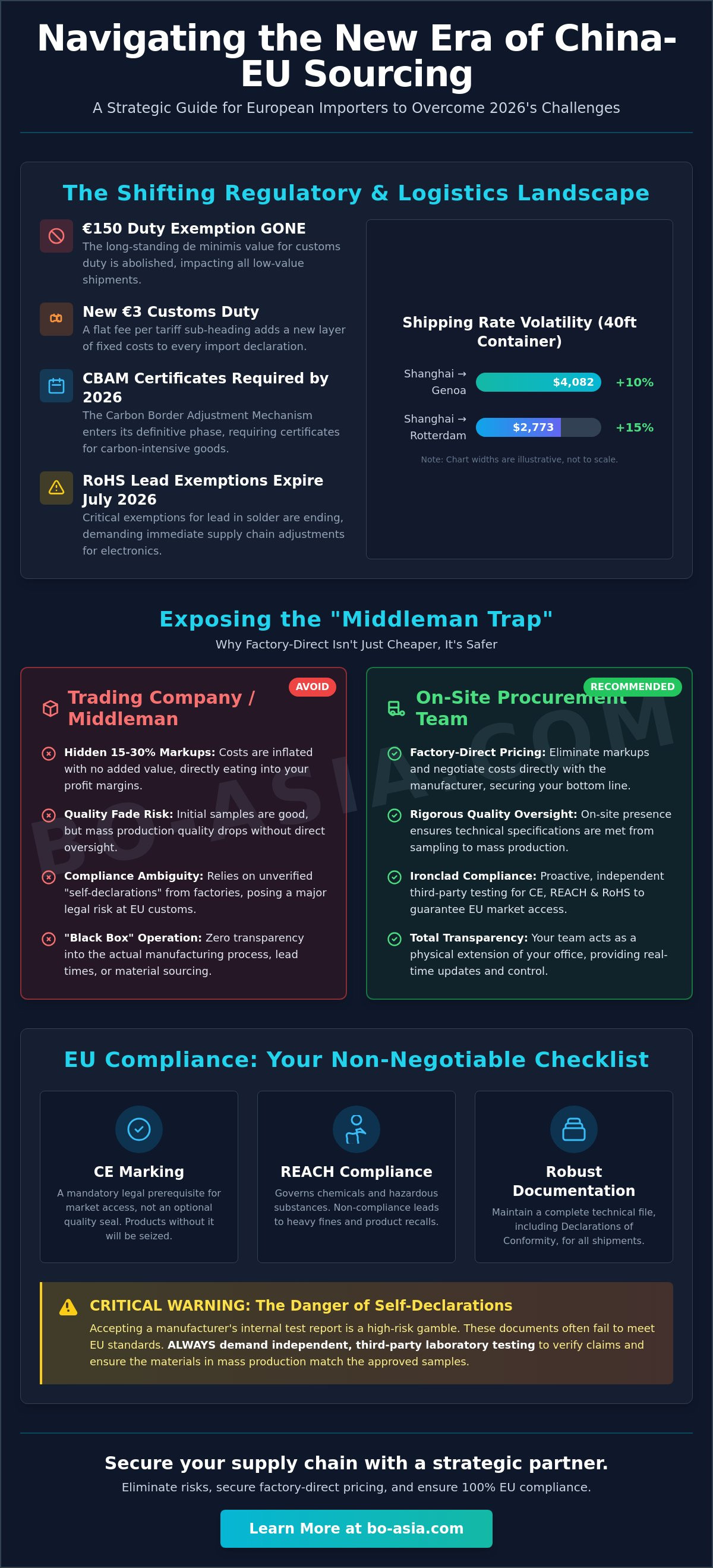
The "Middleman Trap" is the single greatest threat to your procurement margins. Many European firms unknowingly partner with trading companies that present themselves as direct manufacturers, using polished websites and English-speaking sales teams to mask their true identity. These intermediaries often add hidden margins of 15 to 30 percent to the unit price without contributing a single operational advantage. When you're managing Sourcing from China to Europe at scale, these obscured costs compound quickly, turning a profitable venture into a financial burden. True ROI is only achievable when you strip away these layers and implement 100 percent transparency in pricing.
Traditional sourcing agents frequently operate on commission models that create an inherent conflict of interest. If an agent receives a percentage of the total order value or undisclosed kickbacks from the factory, their primary motivation is to close the deal, not to protect your interests. This lack of alignment often leads to "Quality Fade." As intermediaries squeeze factory margins to protect their own commissions, the manufacturer is forced to use cheaper raw materials or skip critical QC steps to maintain profitability. You won't hear about these compromises until the defective stock arrives at your warehouse, at which point the agent has already collected their fee.
Identifying a real manufacturer requires more than a cursory glance at a website or a digital badge. You should verify business licenses and VAT records to ensure the entity's registered scope includes "manufacturing" rather than just "trading." Real factories invest in heavy machinery and raw material stockpiles, while traders typically operate out of high-rise office buildings with small showrooms. Resellers almost always struggle with custom product development and complex tooling because they lack direct control over the production floor. Ask technical questions about machine capacity or sub-supplier management to flush out a "ghost" trading company that is simply outsourcing your order to a third party.
You gain the leverage to demand favorable payment terms, such as a 30/70 split, when you negotiate directly with the factory owner. This direct line of communication allows you to include strict penalty clauses for production delays, ensuring the factory treats your order as a priority rather than a secondary concern. Achieving "local" pricing that isn't inflated for the international market is only possible when the factory knows they're dealing with a professional procurement team. Having an on-the-ground presence transforms your position from a distant buyer into a local partner with immediate oversight. This shift in dynamic is essential for successful Sourcing from China to Europe and long-term supply chain stability.
Successful Sourcing from China to Europe requires a departure from haphazard buying toward a disciplined, five-stage procurement lifecycle. You've already seen how regulatory shifts and hidden intermediary margins can erode your profitability. This roadmap is designed to neutralize those risks by establishing a physical presence at every critical junction of the supply chain. It's about moving beyond digital interfaces and implementing a system that prioritizes financial security and operational control.
We utilize the "Helsinki-Hong Kong bridge" to combine European management standards with local execution. This ensures every supplier undergoes a rigorous physical audit before you commit capital.
We bridge the communication gap by translating your European quality expectations into precise manufacturing instructions. This phase eliminates the "lost in translation" errors that lead to defective prototypes.
You bypass the middleman entirely. We negotiate directly with factory owners to secure "local" pricing and favorable 30/70 payment terms, ensuring your interests are protected by contract.
Monitoring the factory floor is non-negotiable. We implement multi-stage quality control, from raw material inspection to final container loading, to prevent quality fade.
We coordinate the seamless movement of goods while ensuring all documentation meets the latest 2026 EU requirements, including CBAM certificates and EORI filings.
The prototyping phase is where most procurement projects fail. Technical specifications often get lost when dealt with through a trading company. To mitigate this, you must establish a "Golden Sample" that serves as the contractually binding benchmark for the entire production run. This sample isn't just a reference; it's your primary defense against deviations in material or finish. If you're currently evaluating partners for this stage, read our guide on choosing a China sourcing company to ensure they have the technical depth your project requires.
Waiting for a final inspection is a strategic error. You should implement During Production Inspections (DUPRO) when the order is 20 to 30 percent complete. This allows you to catch and correct defects before they affect the entire batch, saving months of potential delays. As you move toward shipping, managing the consolidation of goods from multiple suppliers can significantly reduce your freight costs. With container rates to Rotterdam surging 15 percent this month, these efficiencies are vital. Ensure your VAT and EORI documentation is flawless to avoid seizures at the European border. To stabilize your supply chain and protect your 2026 margins, connect with our procurement team today.
Sourcing from China to Europe at high volumes demands a level of oversight that traditional, commission-based agents simply cannot provide. The "Helsinki-Hong Kong" model represents a paradigm shift in how European firms manage their supply chains. By combining European management standards with local, on-the-ground execution, you create a defensive perimeter around your production. This isn't about hiring a third party; it's about establishing an integrated procurement office that prioritizes your financial health over transaction volume. This structural alignment ensures that your interests are protected at every stage of the manufacturing process.
A dedicated team functions as a physical extension of your own company. While a traditional agent might juggle dozens of conflicting clients, an integrated team focuses entirely on your technical specifications and quality benchmarks. This approach eliminates the "Middleman Trap" by ensuring every negotiation is conducted with 100 percent transparency. When you remove hidden commissions and markups, the impact on your bottom line is immediate. Our high-volume clients often see significant returns on investment by reclaiming the 15 to 30 percent margins typically lost to trading companies, as evidenced in these savings examples.
Physical proximity to the factory floor is the only real guarantee of quality in a volatile market. When your procurement team is located within hours of the production site, accountability is no longer a theoretical concept. The European leadership team ensures that your corporate values, ESG standards, and legal requirements are translated accurately into local manufacturing practices. This dual-layered approach provides the "Helsinki-Hong Kong" advantage, protecting your brand from the operational setbacks that plague unmanaged supply chains. You can explore the strategic ROI of a dedicated Asia procurement team to see how this model stabilizes long-term growth.
Transitioning from small-batch testing to high-volume mass production is the point where most supply chains break. A dedicated team manages this scaling process by identifying secondary suppliers and optimizing tooling for larger runs. They ensure that the quality standards established during the sampling phase are maintained throughout the entire production lifecycle. If you're ready to move beyond transactional buying and secure your margins, the first step is a customized sourcing proposal tailored to your specific product category. Contact Buying Office Asia to optimize your China-to-Europe supply chain and establish a resilient procurement strategy for the 2026 fiscal year.
Mastering the complexities of high-volume Sourcing from China to Europe requires a shift from transactional buying to a disciplined, integrated procurement strategy. Success in this landscape depends on your ability to navigate the 2026 regulatory shifts and eliminate the hidden costs inherent in traditional intermediary models. By establishing a direct, transparent line to the factory floor, you ensure that your quality standards remain non-negotiable throughout the entire production lifecycle.
Buying Office Asia serves as your strategic defense, combining European management standards from our Finland leadership with a physical presence in Hong Kong that's been active since 2010. We operate with 100 percent pricing transparency and zero hidden kickbacks, functioning as a seamless extension of your own team. This level of oversight is the only way to protect your margins and maintain the reliability your European customers expect. It's time to build a supply chain that is resilient, compliant, and focused entirely on your financial growth.
Scale your manufacturing with a dedicated Asia procurement team today to secure your competitive advantage in a complex global market.
High-value green technologies, electric vehicle components, and renewable energy equipment are currently the most profitable sectors for European importers. China produces over 28 percent of the world's manufactured goods, and its dominance in advanced electronics offers significant cost advantages. You should focus on categories where China's industrial overcapacity creates competitive pricing for enterprise buyers despite the new 2026 CBAM certificate requirements.
You ensure compliance through rigorous on-site factory audits and the verification of primary data for carbon reporting. As of January 2026, the Carbon Border Adjustment Mechanism (CBAM) has entered its definitive phase, requiring precise documentation of embedded emissions. A dedicated procurement team performs the physical vetting necessary to confirm that environmental and social standards meet European legal expectations rather than relying on unverified digital certificates.
The primary hidden costs are undisclosed kickbacks and "Quality Fade," which can quietly erode your margins by 15 to 30 percent. Commission-based agents have an inherent conflict of interest because their income is tied to the total order value, which often prevents them from negotiating the lowest factory-direct price. You eventually pay for this lack of transparency through inflated unit costs and the financial burden of defective inventory.
Sourcing from China to Europe at high volumes without a regional presence is a high-risk strategy that often leads to operational failure. Without a physical team to conduct mass production oversight and on-site inspections, you lack the control required to prevent manufacturing defects or regulatory non-compliance. An integrated procurement office serves as your stabilizing force, providing the same level of oversight usually reserved for major global enterprises.
A direct manufacturer owns the production assets and specialized tooling, while a trading company is a middleman that adds a markup to another factory's output. You can distinguish them by checking the scope of their business license; a factory is registered for "manufacturing," whereas a trader is limited to "sales." Trading companies generally lack the technical depth required for custom product development and cannot provide direct accountability for quality management.
Sea freight from Shanghai to Rotterdam typically takes 35 to 45 days, though China-Europe rail freight has become a popular alternative with significantly shorter transit times. In May 2026, container rates have seen fluctuations, with Shanghai to Genoa jumping 10 percent to $4,082 per 40ft container. You must factor in these transit times and potential port congestion when planning your European inventory cycles.
Yes, you need a valid VAT number and an Economic Operators Registration and Identification (EORI) number to clear customs in any EU member state. These identifiers are essential for managing import duties and the new €3 customs duty applied to low-value imports as of July 2026. Correct documentation is the only way to ensure your Sourcing from China to Europe remains compliant and avoids costly seizures at the border.
If an on-site inspection identifies defects, the manufacturer is contractually obligated to rectify the issues at their own expense before the goods leave the factory. This is why During Production Inspections are more effective than final checks; they allow you to catch errors while they are still correctable. Your procurement contract should include clear penalty clauses for delays caused by these failures to protect your financial viability and project timelines.

What if the first clear sign of a production problem arrives after the goods are packed? Manufacturing risk management in Asia works best when controls are connected from the start, not left to a final inspection or occasional supplier update. You need visibility into factory activity, early warning...

What if the lowest unit quote isn’t the lowest-cost way to make your board game? Board game manufacturing costs depend on more than the number of boxes ordered. Component materials, custom tooling, assembly, packaging and delivery scope can all change what a quote covers, making headline prices diff...

What if the factory’s lowest quote isn’t the lowest-cost option? A lower unit price can hide differences in materials, tooling, packaging, quality checks or production terms. Understanding how sourcing agents negotiate factory prices starts with making those differences visible, not simply asking a...