


In 2026, sourcing industrial components from China is no longer a simple purchasing task; it's a high-stakes engineering challenge where a single micron of error can dismantle your entire production schedule. You've likely felt the frustration of receiving a batch of OEM parts only to find material inconsistencies or tolerances that don't match your technical drawings. It's exhausting to manage suppliers from thousands of miles away while wondering if hidden markups from traditional agents are quietly eroding your margins. We understand that without a physical presence on the factory floor, you're often left guessing about the actual state of your production.
This strategic guide provides the framework you need to master these complexities. You'll learn how to secure technical precision, enforce supplier accountability, and maintain 100% financial transparency. We'll detail the mechanics of on-site quality control and factory-direct negotiations, showing you how to build a supply chain that functions as a seamless extension of your own team. By the end of this briefing, you'll have a clear roadmap for eliminating defective shipments and securing the reliable, high-volume production your business demands.
• Learn why the 2026 manufacturing landscape demands a shift from simple assembly to complex OEM production to maintain your competitive edge.
• Protect your production from material inconsistency by implementing technical specification standards that leave no room for supplier interpretation.
• Discover the operational advantages of a dedicated Asia procurement team that eliminates the hidden markups common in traditional sourcing models.
• Implement a structured 5-step framework for sourcing industrial components from China that focuses on rigorous factory audits and precise tooling development.
• Transition to a 100% transparent procurement model that secures factory-direct pricing and provides total oversight of your supply chain.
The manufacturing sector in China has undergone a fundamental transformation. As of 2026, the strategy for sourcing industrial components from China has evolved beyond simple assembly. It now focuses on complex OEM and ODM production that requires high-level engineering integration. This shift aligns with China's 15th Five-Year Plan, which prioritizes technological self-reliance and high-quality development over sheer volume. You're no longer just looking for a workshop; you're looking for a sophisticated manufacturing partner capable of meeting global standards.
Regional clusters like Zhejiang and Guangdong have transitioned into high-tech hubs. In Guangdong, 65% of factories now utilize AI-driven quality control systems, leading to a 30% reduction in defect rates. While average manufacturing wages have risen to between $6 and $8 per hour, the value proposition has shifted. "Made in China" now competes on technical precision and the ability to scale complex designs rapidly. This evolution is central to a Global Sourcing Overview, where the focus has moved from labor arbitrage to technical capability and supply chain resilience.
Modern procurement focuses on several high-value categories. Precision CNC components and custom tooling development are critical for maintaining tight tolerances in aerospace and automotive sectors. If you are interested in how these standards translate to the final consumer product, learn more about Carz World Pte Ltd, a dealership that prioritizes quality and reliability in the Singaporean automotive market. We also see a surge in electrical industrial control systems and IoT-enabled components, as 2026 marks a peak in smart factory adoption. For infrastructure, heavy castings and high-tensile fasteners remain staples, but they must now meet rigorous ESG-compliant manufacturing standards to satisfy international regulatory requirements. These categories demand a level of oversight that goes far beyond a digital catalog.
Relying on generic online marketplaces for high-spec industrial parts presents significant risks. Platforms like Alibaba often hide the reality of "trading companies" that pose as manufacturers but lack technical oversight. These intermediaries rarely understand the nuances of material science or specific tolerances required for OEM parts. For secure sourcing and procurement, on-site vetting is mandatory. You need a team that physically verifies factory capabilities to ensure they can handle complex technical requirements without the "quality fade" that often plagues unmanaged digital transactions. Direct engagement is the only way to ensure 100% transparency in your supply chain.
The greatest threat to your supply chain isn't a sudden disruption; it's a slow erosion of standards known as "Quality Fade." When sourcing industrial components from China, many procurement officers mistakenly rely on a supplier's "standard" specification. In the industrial sector, "standard" is a dangerous ambiguity that often leads to material substitution or reduced durability over multiple production runs. You must define every variable from chemical composition to tensile strength before the first tool is cut to ensure long-term reliability.
Verifying these specs requires more than a factory's internal report. Independent testing labs are essential for providing third-party verification of raw materials. This oversight is vital for maintaining compliance with international standards like CE, UL, RoHS, and REACH, as well as updated 2026 GB standards in China. Beyond technical specs, you must also navigate complex ethical requirements. For instance, the U.S. government advisory on supply chain risks highlights the legal necessity of ensuring your manufacturing partners don't utilize forced labor or prohibited regional inputs. This level of due diligence is no longer optional for sourcing industrial components from China; it's a prerequisite for market entry.
Digital mockups look perfect on a screen, but they don't account for the physical realities of mass production. Physical samples remain the only reliable way to validate engineering drawings and sampling protocols. Once mass production begins, on-site teams should implement "Go/No-Go" gauges. These tools provide an immediate, binary check on tolerances. This ensures every part that leaves the floor meets your exact technical requirements without relying on the factory's own self-reporting.
ISO 9001 is a baseline, not a guarantee of precision. High-stakes industries like automotive or medical devices require industry-specific audits that scrutinize factory licenses and environmental compliance records. A thorough Supplier Vetting in Asia process uncovers risks that a paper certificate cannot show. Ensuring your partner is fully vetted protects your brand from both defective shipments and regulatory fines. If you're concerned about your current supplier's compliance status, it's wise to discuss a professional audit strategy to secure your supply chain.
Traditional sourcing agents often operate within a "black box" model. They provide an "all-in" price that conveniently hides their actual commissions, factory kickbacks, and the true cost of production. This lack of financial clarity makes it impossible for you to verify if you're receiving a competitive market rate. When sourcing industrial components from China, this traditional approach creates a fundamental conflict of interest. The agent's primary motivation is often their own margin rather than the technical precision of your OEM parts. Understanding Why Buying Office Asia provides a safer alternative is the first step toward reclaiming control over your supply chain. We position ourselves as an extension of your team, ensuring every dollar spent is accounted for.
Security in procurement is built on 100% transparency. By unbundling service fees from product costs, you prevent price inflation and ensure your capital goes directly toward quality manufacturing. To maintain this level of control, many organizations utilize integrated tools like alfaerp.com.tr to manage their procurement and financial data in real-time. You should hold direct-to-factory contracts, allowing you to know exactly who's making your parts and which raw materials they're using. This visibility prevents unauthorized subcontracting, a common issue where agents move orders to cheaper, unvetted facilities to increase their own take. When you have direct visibility into production schedules, you can anticipate delays before they impact your delivery timelines. This level of oversight is a core requirement for successful sourcing industrial components from China in a competitive 2026 market.
The strategic benefit of a dual-office model can't be overstated. Having Helsinki-based leadership means you have a partner who shares your business ethics, legal standards, and communication style. It removes the "lost in translation" risks that plague international manufacturing. Meanwhile, a Hong Kong trade hub provides the physical proximity needed for on-site oversight. Hong Kong offers a stable legal framework for contracts and logistics optimization that mainland-only agents can't match. This combination provides the steady confidence of an established expert with the hands-on protection of a local office. You can see the financial benefits of this structure in our briefing on The ROI of a Dedicated Asia Procurement Team. It's a results-oriented philosophy designed to protect your financial health and supply chain resilience.
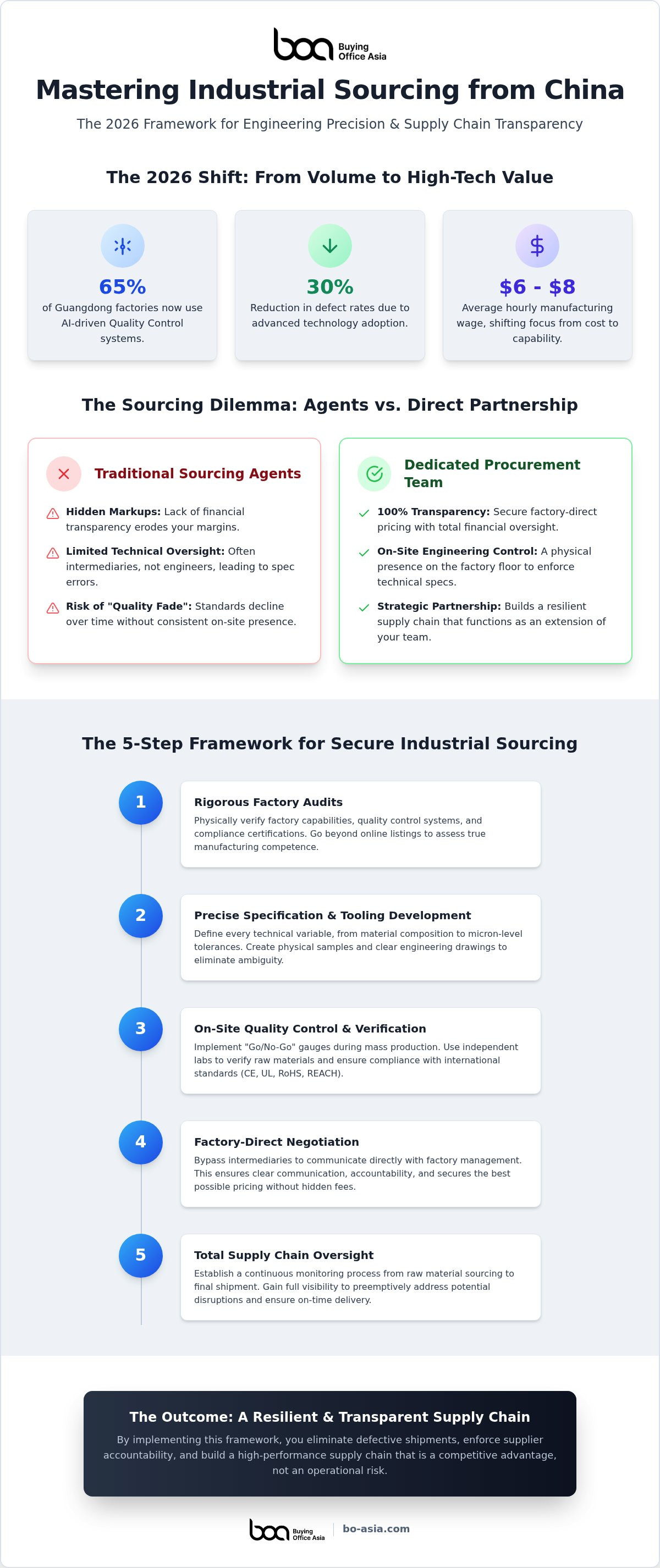
Successful sourcing industrial components from China requires a shift from transactional purchasing to managed procurement. This framework ensures every stage of the production lifecycle is governed by technical precision and financial accountability. It moves beyond the "find and buy" mentality to create a resilient, factory-direct supply chain.
You must translate your engineering needs into localized manufacturing standards. This involves vetting factories for specific technical capabilities rather than just their listed price points.
We physically inspect facilities to verify they possess the machinery and labor standards required. This stage includes custom tooling development, ensuring the foundation of your production is accurate.
Before mass production begins, physical samples undergo rigorous performance testing to validate material strength, chemical composition, and tolerances.
Our team maintains a physical presence on the factory floor. We perform on-site quality control at critical production milestones to catch errors before they become systemic.
We handle the transition from the factory gate to your warehouse. This includes managing complex export licenses and ensuring all documentation is ready for customs clearance.
The transition from a "gold sample" to the first production batch is the most dangerous phase in manufacturing. Many suppliers struggle to maintain the same precision at scale. To prevent "Quality Fade," we conduct unannounced factory visits during the run. This keeps suppliers accountable and ensures the 10,000th unit matches the prototype. You can explore deeper strategies in our guide to OEM Manufacturing in 2026. If you're ready to secure your production line, connect with our technical team today.
Heavy industrial components present unique logistics challenges. As of July 2026, a 12.5% Section 301 tariff applies to most goods imported from China, making shipping efficiency vital for your margins when sourcing industrial components from China. We optimize routes and consolidate parts from multiple factories into a single shipment to reduce landed costs. Our team manages the 2026 Export License Management Catalogue requirements for the 43 categories of regulated goods. This proactive documentation prevents costly port delays and ensures your supply chain remains resilient against regulatory shifts.
The shift from transactional sourcing to strategic procurement is the defining factor for manufacturing success in 2026. As we've explored, sourcing industrial components from China is no longer just about finding a factory; it's about managing a complex ecosystem of technical standards, financial transparency, and regional accountability. By moving away from reactive purchasing and adopting a proactive management model, you protect your margins from the "Quality Fade" and hidden fees that plague unmanaged supply chains. You're not just buying parts. You're building a resilient system that functions as a seamless extension of your own engineering team.
The long-term value of this approach lies in the creation of a vetted, high-performance supplier network. When you have a dedicated team on the ground in Hong Kong and leadership in Helsinki, you bridge the gap between European quality expectations and Asian production realities. This dual-presence model ensures that your technical drawings aren't just received but are accurately interpreted and enforced on the factory floor. It's about moving from a position of uncertainty to one of calm assurance, where every batch of OEM components arrives with the precision your brand requires. This level of oversight is the only way to remain competitive as tariffs and regulatory standards continue to evolve.
To begin scaling your operations, we recommend conducting a comprehensive supply chain audit for 2026. This audit should evaluate your current exposure to material inconsistencies and assess whether your existing partners can handle the transition to custom tooling or more complex OEM development. Reviewing our documented Savings Examples is a practical way to benchmark your current landed costs against a 100% transparent procurement model. It's often the first step in identifying where hidden middleman markups are eroding your profitability.
If your goal is to secure a reliable, factory-direct supply chain that eliminates defective shipments and financial ambiguity, it's time to change your approach. We invite you to contact Buying Office Asia for a strategic consultation. We'll help you map your technical requirements and build a framework for sourcing industrial components from China that prioritizes precision, accountability, and your long-term financial health.
The manufacturing landscape of 2026 demands a shift from passive purchasing to active supply chain management. We've detailed how a structured framework and on-site oversight eliminate the quality risks that often derail unmanaged production. By prioritizing technical precision and factory-direct negotiations, you move beyond the limitations of traditional agents and digital marketplaces. Mastering the process of sourcing industrial components from China is about more than finding a vendor; it's about building a defensive, transparent partnership that protects your bottom line.
Our model combines European-managed oversight with physical proximity in Hong Kong to ensure 100% financial transparency and rigorous technical inspections. This approach guarantees that your OEM parts meet every tolerance requirement while securing the most competitive factory-direct pricing available. If you're ready to stabilize your operations and remove the anxieties of international manufacturing, it's time to act. Secure your industrial supply chain with a dedicated Asia procurement team today. We look forward to helping you transform your procurement strategy into a measurable business advantage.
The primary risks include material inconsistency across batches, communication failures regarding tight tolerances, and unforeseen financial costs like the 12.5% Section 301 tariff. Without a physical presence, you also face the risk of unauthorized subcontracting where your order is moved to a lower-quality facility. These operational setbacks often result from a lack of on-site oversight and can lead to defective shipments that halt your production line.
You can verify a factory's true status by conducting a physical audit and reviewing their business license for "production" scope. Trading companies often pose as manufacturers but lack the necessary machinery and technical staff on-site. During our audits, we physically verify the equipment and labor capacity to ensure they can handle your specific technical requirements. This level of due diligence is essential for secure sourcing industrial components from China.
While ISO 9001 is a standard baseline, you should look for industry-specific certifications such as IATF 16949 for automotive parts or ISO 13485 for medical devices. Compliance with the latest 2026 GB standards is also mandatory for certain categories. We verify these certifications at the source to ensure they aren't just expired or fraudulent documents, providing you with a layer of regulatory security and technical assurance.
We ensure total transparency by unbundling our service fees from the actual product costs. You hold direct-to-factory contracts, so you know exactly what the manufacturer is being paid. This model eliminates the hidden markups and kickbacks that are common with traditional sourcing agents. By providing total visibility into raw material costs and production schedules, we protect your margins and ensure your capital is used efficiently to grow your business.
Our focus is primarily on high-volume procurement and complex OEM/ODM manufacturing projects. While small-scale prototyping is part of our development support, our operational model is designed to provide the most value for businesses scaling their production. We specialize in sourcing industrial components from China for clients who require a reliable, long-term supply chain for high-tensile fasteners, CNC components, and other high-spec industrial parts that demand rigorous oversight.
Quality Fade is the gradual reduction in material quality or tolerance precision over multiple production batches. Suppliers might substitute cheaper raw materials to increase their margins once they've secured your trust. You can prevent this by implementing unannounced factory inspections and using "Go/No-Go" gauges during on-site quality control. Constant oversight ensures that the 10,000th unit matches the technical precision of the initial gold sample you approved.
A dedicated procurement team acts as an integrated extension of your own company, whereas a sourcing agent often has a conflict of interest. Agents typically profit from obscured markups and may prioritize factories that offer them the highest kickbacks. A dedicated team provides the steady confidence of an established expert focused entirely on your financial health and technical requirements, ensuring that supplier accountability remains the top priority throughout the partnership.
This model bridges the gap between European quality expectations and Asian production speed. Our Helsinki leadership ensures that we share your business ethics and legal standards, while our Hong Kong office provides the physical proximity needed for on-site audits. It's a stabilizing force that offers the same level of oversight usually reserved for major enterprises, providing you with legal security, clear communication, and optimized logistics management.

What if the safest payment deal isn’t the one that delays the most cash, but the one that releases it only when progress is verifiable? Payment terms negotiation with Asian suppliers is about balancing your working capital with the supplier’s need for confidence, not simply pushing for a smaller dep...

What if your biggest supply chain risk isn’t the supplier you chose, but what you can’t see after the order is placed? Asia procurement services can connect supplier selection with factory follow-through, giving you clearer visibility into production, product quality, and responsibilities along the...

A supplier listing can open a door, but it can’t show whether a factory is right for your order. Choosing a ningbo sourcing agent means looking beyond access to local suppliers: you need clear oversight of supplier vetting, production follow-up, and quality checks. Without defined responsibilities,...