


The "China+1" strategy is no longer a boardroom theory; it's a competitive necessity that helped drive India’s cumulative exports to 860.09 billion dollars this past fiscal year. While the opportunity is vast, sourcing products from India for importers often feels like a choice between significant growth and the "middleman trap" that inflates costs. You likely see the immense potential in India's specialized manufacturing hubs. However, the fear of high defect rates and opaque pricing structures often makes the transition feel like an unacceptable risk to your bottom line.
We're here to replace that uncertainty with the steady confidence of a seasoned insider. This strategic guide provides the framework you need to bypass intermediaries, negotiate direct factory pricing, and implement rigorous on-site oversight. We'll detail how to master the 2026 regulatory landscape, from mandatory IEC requirements to the latest FSSAI labeling standards. This ensures your procurement remains transparent, predictable, and financially viable as you scale your operations in one of the world's most complex global markets.
• Identify the specific regional hubs specializing in sustainable textiles and electronics to ensure your production aligns with 2026 market demands.
• Eliminate the "middleman trap" by implementing strategies for direct factory negotiations that provide 100% pricing transparency.
• Establish a robust quality control framework for sourcing products from India for importers that replaces digital verification with rigorous on-site physical inspections.
• Understand how a dedicated, local procurement team manages complex supply chain risks and ensures regulatory compliance at every stage of mass production.
• Leverage the 2026 regulatory landscape and current tariff advantages to build a resilient, diversified supply chain that safeguards your financial health.
India has transitioned from a secondary manufacturing alternative to a primary strategic pillar for global procurement. The "China+1" strategy is no longer a reactive measure; it's a refined operational standard that leverages the evolving Foreign trade of India to build resilient supply chains. For businesses planning their 2026 trajectory, sourcing products from India for importers offers a stable defense against geopolitical volatility and the rising operational costs found in traditional hubs. This shift is fueled by a massive influx of technical talent and a national movement toward high-value manufacturing in sectors like precision engineering and sustainable textiles.
Relying on unmanaged sourcing through digital directories often leaves your brand exposed to quality fluctuations and hidden fees. A professional sourcing and procurement approach replaces these risks with the steady confidence of an integrated partner. By establishing direct factory relationships, you secure the same level of oversight usually reserved for major enterprises, ensuring your financial health remains the priority throughout the production cycle.
Section 301 duties continue to pressure margins for Western importers, making India's duty-free potential under specific trade agreements a critical advantage. The Indian government's 2.68 billion dollar manufacturing incentive scheme has accelerated the development of world-class facilities, particularly in the electronics and consumer goods sectors. These incentives, coupled with the extension of the RoDTEP scheme through March 2026, provide a tax-efficient environment that rewards long-term commitment. You aren't just finding a factory; you're entering a subsidized ecosystem designed to lower your landed costs while maintaining high output standards.
Low factory wages provide a starting point, but they're only one component of a successful ROI equation. The true value of the Indian market lies in its sophisticated management tier. India’s vast pool of English-speaking engineers and project managers simplifies complex OEM and custom tooling projects, drastically reducing the risk of the expensive miscommunications that plague other regions. Strategic sourcing in this context is the proactive alignment of procurement activities with India's evolving trade agreements to maximize long-term fiscal stability and supply chain resilience. This focus on high-level communication ensures that mass production oversight is handled with the technical rigor your brand requires.
Treating India as a uniform manufacturing block is a common mistake that leads to logistics delays and quality mismatches. Success when sourcing products from India for importers depends on recognizing that the country is a collection of highly specialized industrial clusters. Each region possesses its own infrastructure, labor expertise, and raw material supply chains, making geographic selection a primary driver of your final landed cost. By aligning your product category with the correct regional hub, you ensure access to a mature ecosystem that understands the specific technical requirements of your industry.
Mapping your product to the correct hub is vital for operational efficiency. Tirupur and Ludhiana are the pillars of the textile industry. Tirupur dominates the cotton knitwear market, while Ludhiana serves as the center for hosiery and synthetic fabrics. For leather and footwear, Agra and Chennai offer established ecosystems that handle everything from tanning to final assembly. These regions have built specialized logistics corridors that streamline the movement of goods to major ports, reducing internal transit risks.
Bangalore, Pune, and the National Capital Region (NCR) have become the go-to destinations for electronics and precision engineering. These hubs provide the technical infrastructure and engineering talent required for sophisticated OEM manufacturing and custom tooling projects. As you evaluate these regions, refer to the U.S. government guide to importing from India to ensure your procurement strategy aligns with current documentation and compliance mandates for technical hardware.
India's leadership in organic cotton and the rapid adoption of recycled materials present a unique opportunity for brand differentiation. Many manufacturers are now integrating solar power and zero-liquid discharge systems to meet global environmental demands. By sourcing from these facilities, you protect your brand from the reputational risks associated with non-compliant factories. This shift toward sustainable production is particularly evident in the home decor and apparel sectors, where ethical certifications are becoming a standard requirement for Western markets.
Adhering to BOA ESG standards allows you to verify that your suppliers maintain ethical labor practices and environmental stewardship. This level of transparency is difficult to achieve remotely but becomes a competitive advantage when managed by a dedicated on-ground team. If you need to verify the legitimacy of a regional supplier, reach out to our sourcing specialists for a comprehensive factory assessment.
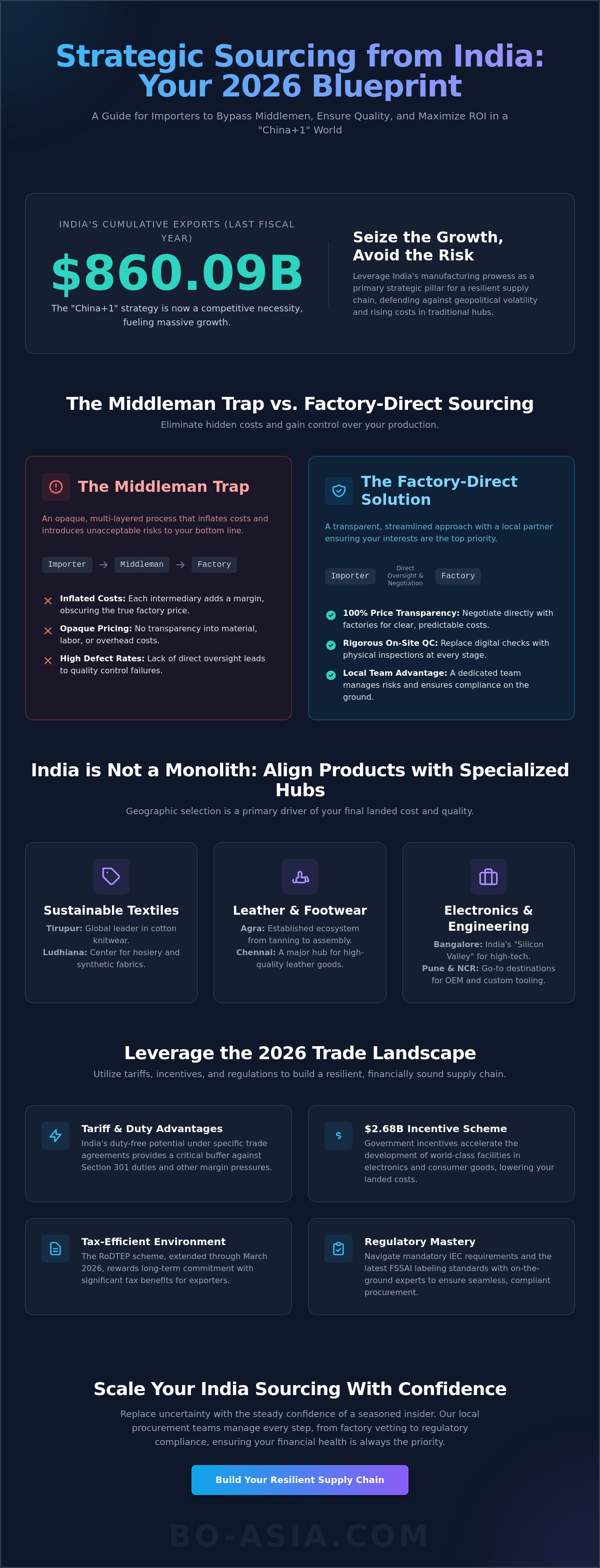
Traditional intermediaries often market themselves as a bridge between cultures, but in practice, they frequently act as a barrier to your financial health. When sourcing products from India for importers, the presence of an unvetted agent usually introduces a layer of obscured costs that erode your competitive edge. These trading companies thrive on a lack of transparency. They often present themselves as the factory while adding significant markups to every unit produced. By moving toward a factory-direct model, you reclaim control over your margins and ensure that every dollar spent is an investment in product quality rather than an intermediary’s commission.
Hidden commissions are a pervasive risk in unmanaged supply chains. These fees aren't just a one-time expense; they're embedded into your unit price, making long-term scaling unnecessarily expensive. Beyond the financial impact, middlemen frequently engage in "factory hopping." This occurs when an agent moves your production to a cheaper, unvetted facility without your consent to increase their own profit margin. This practice compromises raw material quality and risks your brand's commitment to ethical standards. You lose the ability to verify who is actually making your goods, which creates a dangerous gap in your regulatory compliance.
The loss of control extends to your intellectual property and production timelines. When you don't have a direct line to the factory floor, you're forced to rely on filtered information. This lack of direct communication often leads to delays that the middleman may hide until they become critical failures. Establishing a direct relationship is the only way to ensure that your technical specifications and ethical mandates are followed to the letter.
A professional buying office functions as an integrated extension of your own team, not a third-party entity looking for a quick transaction. Unlike the commission-based agent model, a dedicated sourcing team operates with 100% transparency. This model ensures that you pay the actual factory price, with all service fees clearly defined upfront. With European leadership based in Helsinki, accountability is built into the structure, providing Western brands with a familiar legal and ethical framework. This physical proximity and regional presence in India allow for real-time adjustments and direct factory negotiations that intermediaries simply cannot match.
Transitioning to factory-direct relationships isn't just about cost reduction; it's about building a predictable supply chain. When you negotiate directly, you establish a partnership that prioritizes your specific technical requirements and production timelines. You can see the impact of this approach in these savings examples, which demonstrate the significant ROI achieved by removing the middleman. By stabilizing your procurement costs, you create the financial room needed to invest in product innovation and market expansion.
Digital storefronts and B2B marketplace badges often mask operational incompetence. A "gold supplier" status usually signifies a paid membership tier rather than a verified production capability. When sourcing products from India for importers, relying on these digital indicators alone is a high-risk gamble with your capital. Real security requires a transition from remote assumptions to physical, on-site reality. You need to know that the machines exist, the workers are skilled, and the facility can actually meet your technical specifications before a single dollar is wired.
Implementing a rigorous quality framework protects your brand from the high defect rates common in unmanaged mass production. This process begins with an exhaustive Supplier Vetting pillar that goes beyond basic document checks. By placing a dedicated team on the factory floor, you establish a stabilizing force that prevents operational setbacks before they reach your warehouse.
The vetting process must verify the legal and financial standing of a potential partner. This includes a deep dive into business licenses, export permits, and tax compliance to ensure you aren't dealing with a shell company or an insolvent entity. Beyond legality, social and environmental compliance audits like SEDEX or BSCI are essential to safeguard your brand's reputation in Western markets. A factory audit is a non-negotiable insurance policy for your supply chain. These inspections confirm that the facility possesses the specialized machinery and technical talent required for your specific product category.
Quality control is not a single event; it's a continuous oversight strategy. We utilize a three-stage inspection protocol to maintain total control over the production lifecycle. This begins with pre-production checks of raw materials, followed by During Production (DUPRO) inspections to catch errors while they are still correctable. The process concludes with a Final Random Inspection (FRI) based on strict Acceptable Quality Level (AQL) standards. This methodical approach ensures that every batch meets your exact requirements for tolerances, finish, and packaging.
An on-the-ground team provides the immediate accountability that digital platforms lack. If a defect is identified during DUPRO, your representatives are there to halt production and mandate corrective actions instantly. This level of mass production oversight is the only way to ensure predictable supply chains and transparent procurement costs. To secure your production line with an expert assessment, schedule a professional factory audit today.
Transitioning from a single trial order to a high-volume supply chain requires a level of oversight that remote management cannot provide. When sourcing products from India for importers, the operational complexity increases exponentially as production scales. Buying Office Asia (BOA) manages the entire end-to-end procurement lifecycle, ensuring that your growth is supported by a stable, predictable foundation. Our team eliminates the communication gaps that lead to delays by speaking the local language and navigating the regional business culture on your behalf. This physical proximity allows us to act as your eyes and ears on the factory floor, providing a level of accountability that digital platforms lack.
Our service delivery includes comprehensive logistics and shipping management to ensure your goods move seamlessly from the factory hub to the final destination. We handle the technical documentation and regulatory requirements detailed in previous sections, ensuring your shipments comply with the latest 2026 mandates. This end-to-end oversight protects your financial health and allows you to focus on market expansion while we manage the technical rigors of Mastering Sourcing and Procurement in Asia.
Successful scaling begins in the product development phase. We provide on-site support to ensure your technical specifications are met during the sampling process, preventing costly errors before mass production begins. Our team works directly with factory engineers to refine tooling and custom molds, ensuring the final product matches your exact requirements. By actively managing production schedules on-site, we reduce lead times and ensure your inventory arrives when needed. You can see how this integrated approach has helped other brands achieve sustainable growth in our cases section, which highlights successful India-to-Europe scaling.
We don't operate as a third-party intermediary; we function as a dedicated extension of your own company. This partnership model is designed to alleviate the anxieties of international manufacturing by providing a protective force that defends your brand against operational setbacks. You'll benefit from the security of European-managed contracts and 100% transparent fee structures, removing the financial risks associated with unmanaged agents or commission-based middlemen. Our presence on the ground means we're the first to know about potential issues, allowing us to implement solutions before they impact your bottom line. We're here to provide the steady confidence you need to scale. Contact Buying Office Asia to start your India sourcing journey and secure your supply chain for 2026.
Establishing a resilient supply chain in a dynamic manufacturing hub like India requires more than just a digital connection. Regional specialization and factory-direct negotiations form the foundation of a profitable procurement strategy. By removing the "middleman trap," you reclaim your margins and ensure that your technical specifications are met with precision. Sourcing products from India for importers is a high-stakes transition that demands the steady confidence of an established expert on the ground.
Our European-managed office in Helsinki provides a familiar legal framework, while our dedicated teams in India deliver on-site quality control and rigorous factory audits. This combination ensures 100% transparency and predictable supply chains, moving you away from the risks of unmanaged sourcing. You don't have to navigate these complexities alone. We're here to act as an integrated extension of your team, defending your financial health at every stage of mass production. It's time to replace operational anxiety with the security of a managed ecosystem. Your transition to a more stable, diversified supply chain begins with a single strategic partnership.
Secure Your Supply Chain with a Dedicated India Procurement Team
Total landed costs often favor India due to current US Section 301 tariffs on Chinese goods and India's competitive direct labor rates. While China maintains a lead in component infrastructure, India's government incentives for electronics and textiles have narrowed the gap. It depends on the category. For handcrafted items or sustainable textiles, India provides superior value; however, high-tech components may still require a hybrid approach to remain financially viable.
High defect rates in unmanaged mass production and opaque pricing from intermediaries are the primary risks. When sourcing products from India for importers, the "middleman trap" often leads to orders being shifted to unvetted facilities without your consent. Navigating the regulatory landscape, including mandatory 10-digit IEC codes and specific FSSAI labeling for food products, also presents significant operational hurdles if you lack on-ground oversight.
You should utilize a dedicated procurement team with a physical presence in the region rather than relying on digital B2B directories. Marketplace badges are often paid memberships and don't guarantee production capability. A professional buying office conducts on-site factory audits, verifies business licenses, and assesses financial health. This ensures you're partnering with a legitimate manufacturer that can meet your technical specifications and ethical standards.
Standard terms typically involve a 30% deposit via Telegraphic Transfer (T/T), with the remaining 70% payable upon presentation of the Bill of Lading. Established relationships may allow for Letters of Credit (L/C) or more flexible terms. You should avoid 100% upfront payments to maintain leverage. Clear, documented terms protect your capital and ensure the factory remains incentivized to meet your quality standards and production deadlines.
Tirupur is the global hub for cotton knitwear, while Ludhiana specializes in hosiery and synthetic fabrics. For high-fashion garments and woven materials, the National Capital Region (NCR) offers sophisticated design and production capabilities. Regional specialization is critical. Choosing a factory within these established clusters ensures your project benefits from a workforce with category-specific expertise and a mature raw material supply chain that reduces lead times.
Quality control in India requires more frequent physical presence during the production cycle to prevent batch defects. While China has highly standardized automated processes, many Indian sectors still utilize manual craftsmanship. This makes During Production (DUPRO) inspections and strict adherence to Acceptable Quality Level (AQL) standards essential. You can't rely on a final inspection alone; active oversight on the factory floor is the only way to ensure consistency.
You must provide a Commercial Invoice, Packing List, Bill of Lading, and a Certificate of Origin. Specific categories may require additional paperwork, such as FSSAI certifications for food or specialized permits for precious metals. Ensuring all documentation aligns with the 10% median Basic Customs Duty and applicable IGST rates prevents expensive port delays. A dedicated team ensures these technical requirements are met before the goods leave the factory.
Yes, India's precision engineering hubs in Bangalore and Pune are ideal for complex OEM and custom tooling projects. The country’s large pool of English-speaking engineers simplifies the communication of technical specifications and tolerances. This technical talent ensures that your product development and sampling phases stay on schedule. By negotiating directly with these specialized facilities, you secure the custom molds and tooling needed for high-volume, proprietary production.
What if your signed OEM agreement protects the product on paper but leaves the factory unclear about what to make, when to deliver it, or how quality will be judged? That gap is where an oem manufacturing agreement china project can lose control: responsibilities blur between buyer, sourcing interme...

What if the safest payment deal isn’t the one that delays the most cash, but the one that releases it only when progress is verifiable? Payment terms negotiation with Asian suppliers is about balancing your working capital with the supplier’s need for confidence, not simply pushing for a smaller dep...

What if your biggest supply chain risk isn’t the supplier you chose, but what you can’t see after the order is placed? Asia procurement services can connect supplier selection with factory follow-through, giving you clearer visibility into production, product quality, and responsibilities along the...