


Fewer suppliers can simplify procurement, but fewer shipments don’t automatically mean a better supply chain. Supplier consolidation in Asia works best when you reduce overlap in suitable categories, protect supply options for critical parts, and coordinate production schedules before combining cargo. For goods from factories in Vietnam or China, freight consolidation brings shipments from multiple suppliers together into one larger cargo load.
That can improve container utilization and reduce freight and handling costs, but it requires close coordination of timing and documentation. If one factory finishes late, the combined shipment may be delayed or leave with unused capacity. Inconsistent invoices or packing lists can also hold up cargo. Consolidation is therefore an operational decision as much as a freight decision.
This article explains how to assess suppliers, purchasing volumes, and contract terms before consolidating, then phase changes without weakening supplier relationships or supply continuity. You’ll also learn what to coordinate when combining factory shipments, from production readiness and cargo details to packing lists and quality checks. This will help you judge where fewer suppliers or a consolidated shipment genuinely fits your operation.
• Assess supplier spend, overlap, lead times, quality, and dependencies before deciding which categories are suitable for consolidation.
• Phase supplier changes and use contract terms, performance measures, and qualified alternatives to protect capacity and continuity.
• Coordinate production readiness, cargo details, documentation, and quality checks when combining goods from factories in Vietnam or China.
• Weigh potential freight and procurement efficiencies against concentration risk, and retain alternate sources for critical products or components.
• Buying Office Asia can support supplier vetting, procurement, production oversight, quality inspections, and logistics coordination as part of a managed sourcing approach.
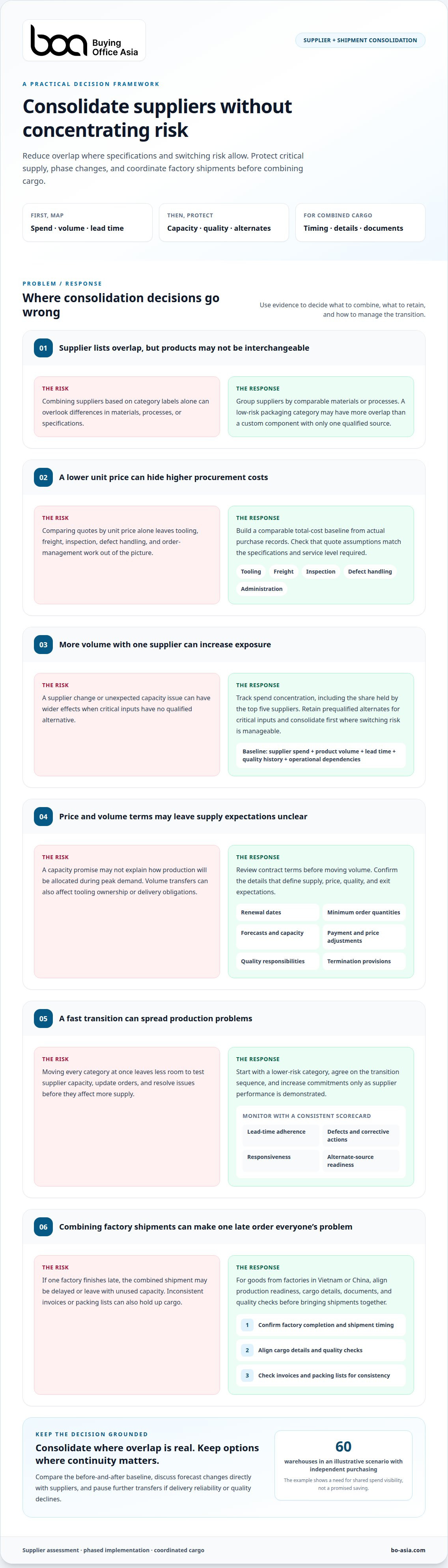
Start with a category-level baseline, not a target supplier count. For each product or component, map supplier spend, purchase volume, lead time, quality history, and operational dependencies. Then group suppliers that provide similar materials or processes. This reveals overlap without treating different specifications as interchangeable. A low-risk packaging category may offer more potential for consolidation than a custom component with only one qualified source.
Compare total procurement costs, not just unit prices. Include tooling, freight, inspection, defect handling, and the administrative work involved in managing separate orders. For example, two factories may quote the same unit price, but one may require separate tooling and more coordination. Record annual volume by supplier and product, then calculate the share of spend held by the top five suppliers. This helps track supplier concentration as the supply chain changes.
Consider a hypothetical company whose 60 warehouses purchase independently, with little oversight and limited company-wide spend visibility. A review could bring purchase data into one view, identify duplicate categories, and distinguish primary suppliers from prequalified alternates. Keep alternates for critical inputs; use consolidation first where supplier overlap and switching risk are manageable.
Review contracts as closely as prices. Check renewal dates, minimum order quantities, forecast commitments, capacity, payment terms, price-adjustment clauses, quality responsibilities, and termination provisions. Confirm whether transferring volume changes tooling ownership or delivery obligations. Competitive sourcing can help test whether proposed pricing and production capability fit the consolidated volume. A lower quote is useful only if its assumptions match the required specifications and service level.
As a hypothetical example, a metalworking machinery company with annual revenue of $50M, 200 employees, and products comprising 1,000-2,000 parts per unit would need to trace spend by component and supplier, rather than assume volume alone reveals savings. These figures are illustrative, not a documented case study, and provide no savings figure to apply elsewhere. Build a comparable baseline using actual purchase records, quality costs, lead times, and contract terms.
Procurement technology can support this analysis when supplier names, categories, purchase orders, and contract records use consistent fields. Begin with a shared spend dashboard and supplier register; then flag duplicate vendors, expiring agreements, and unusual price movements. Predictive tools can use historical demand, lead-time variation, and supplier performance to identify potential shortages or timing pressure. Treat alerts as planning signals, not substitutes for supplier review. Clear procurement data and coordination make consolidation decisions easier to assess and adjust.
Move volume in stages rather than transferring every category at once. Start with a lower-risk category, agree on the transition sequence, and keep qualified alternatives for critical inputs. Phasing gives procurement teams time to test supplier capacity, update purchase orders, and resolve production issues before increasing commitments. It also gives existing suppliers a clear opportunity to discuss revised forecasts and future roles.
Before awarding consolidated volume, negotiate terms that protect supply, not just a preferred price. Define expectations for forecast sharing, capacity allocation, order confirmation, delivery windows, quality responsibilities, and escalation contacts. Record how price changes are handled and which specifications apply to each product. A contract that promises capacity without explaining how it will be allocated during peak demand leaves an important gap. Select suppliers based on demonstrated performance and operational fit, not volume alone.
Use a consistent scorecard to monitor each supplier after the transition. Track lead-time adherence, defect patterns, responsiveness, service levels, and consistency with approved specifications. Compare results with the pre-consolidation baseline and note changes in order mix or production complexity. If delivery reliability declines after more volume shifts to one factory, for example, pause further transfers and review capacity before disruption spreads across the supply chain.
Compare confirmed dates with actual dispatch and receipt records.
Record recurring defects, corrective actions, and repeat outcomes.
Note response speed, issue ownership, and forecast communication.
Monitor spend concentration and the readiness of alternate suppliers.
Hold regular performance reviews with the primary supplier and document decisions, owners, and deadlines. If a factory misses an agreed corrective-action date, set a follow-up point and limit additional volume until there is evidence of improvement. Supplier management works best when discussions use shared records, specific examples, and agreed measures rather than general impressions. Keep communication direct, especially when forecasts or order patterns change.
Rebalance when evidence shows that concentration creates more risk than efficiency. Increasing lead-time variation, repeated quality failures, capacity constraints, or changes in product requirements may justify shifting selected orders to a prequalified alternative. Review contract terms before moving volume, since notice periods, forecast commitments, and tooling arrangements can affect the transition. Periodic reviews can streamline the supplier base without locking procurement into a fixed selection.
For teams planning a phased transition, discuss supplier management support as part of the review. A structured approach to supplier consolidation in Asia can connect contract commitments, production follow-up, and performance monitoring, keeping the strategy responsive as demand and operating conditions change.
Shipment consolidation combines smaller consignments from different suppliers into one larger cargo load. This is a freight arrangement, not the same as reducing your supplier base. You can retain separate factories and coordinate their goods for a shared part of the journey. Confirm the route, cargo compatibility, receiving cutoffs and documentation with the forwarder before deciding where to combine the consignments.
For factories in Vietnam or China, start with a shared cargo plan. Collect production-ready dates, carton counts, dimensions, weights, packaging details, and purchase-order references from each supplier. Use this information to plan warehouse receiving and cargo space. Incorrect measurements can waste capacity, create loading problems, or delay dispatch, so make sure the data matches the goods prepared for collection.
Align each factory’s expected completion and dispatch dates with warehouse receiving and the planned departure.
Give suppliers consistent instructions for carton labels, order references, packaging, and delivery to the consolidation point.
Match received goods against purchase orders, quantities, and supplier packing information; record damage or discrepancies.
Select sea freight, air freight, or express courier according to cargo needs and delivery priorities.
A consolidation warehouse can receive, sort, label, and match goods to orders before combining them. Checks on receipt can include quantity, packaging condition, and visible damage. Where suitable, repacking goods into export-ready cartons or pallets may reduce shipment volume. The value depends on cargo dimensions, handling requirements, routes, and each factory’s timing, not on consolidation alone.
Differences in schedules create a practical trade-off. If one supplier finishes late, ready cargo may wait, the shipment may leave partially filled, or the late goods may need a separate dispatch. Build a buffer around production readiness and agree how to handle delays before cargo moves. Hazardous, oversized, or moisture-sensitive cargo may require separate handling or re-sorting, affecting the plan and potential savings.
Hypothetical example: A buyer sources printed boxes in Vietnam and molded components in China. Compare separate origin departures with multi-country consolidation through a forwarder’s hub. Ask the forwarder and customs broker to confirm each origin leg, the hub’s handling and customs arrangements, and the onward departure. Compare total cost and delivery dates, including hub handling and storage if one consignment arrives late.
Match supplier invoices and packing lists to the cargo and purchase orders. Keep an itemized consolidated cargo record with each supplier’s quantities and shipment references. Have the forwarder confirm which transport documents apply to each leg, who issues them and how each consignment will be identified. Resolve quantity and description discrepancies before dispatch.
Reducing the number of suppliers can make procurement easier to coordinate when products share specifications, production methods, and delivery needs. A closer relationship with a supplier may also support clearer planning and commercial discussions. These benefits depend on whether the selected factory can meet the full requirement, including materials, process controls, documentation, and expected order patterns.
The main trade-off is concentration. A single supplier may become a key dependency for several products, and changes to its capacity or performance could affect multiple orders. Keeping alternative sources can reduce that exposure, but adds qualification, communication, and purchasing work. The right balance varies by product: a repeatable item may suit a primary source, while a critical or specialized component may justify more than one qualified option.
Choose production countries based on factory capability and the full operating model, not a broad preference for one market. For factories in China or Vietnam, assess how each location fits the required processes, materials, supplier base, production oversight, and destination plan. A geographically broader network can reduce overconcentration in one region, but may also add coordination and transport interfaces. The key question is whether that diversity offsets the added complexity for the products concerned.
Categories with stable specifications may be easier to consolidate than those with frequent design changes or highly specialized production. For example, repeat orders for a standard component may be easier to organize than a custom product involving multiple materials, decoration, tooling, and assembly stages. Suitability also depends on the consequences of a defect or delay and how readily another factory could produce an equivalent item.
Categories with repeatable specifications, comparable supplier capabilities, and manageable production transitions.
Essential inputs, specialized processes, or products with limited replacement options.
Compare factory capability, coordination needs, and geographic exposure rather than treating countries as interchangeable.
Review the structure when product design, demand, supplier capacity, or business priorities change.
A business producing several product types could consolidate a stable category while retaining separate sources for specialized items. This avoids forcing different processes into one supplier relationship. A category-level assessment can also show when the extra work of managing another source is justified by resilience, capability, or product requirements.
If you’re evaluating supplier concentration across Asian markets, discuss your sourcing strategy with Buying Office Asia to consider category fit, supplier risk, and practical options.
Buying Office Asia helps procurement teams assess supplier overlap, coordinate sourcing decisions, and manage purchasing across Asian factories. Its end-to-end sourcing and procurement support connects supplier selection, volume planning, and price discussions, giving your team a clearer view of how consolidation affects the wider supply chain.
This support is useful when separate factories serve similar categories, purchasing data is fragmented, or contract discussions need to account for combined volumes. Buying Office Asia can help map requirements and compare suppliers against each product’s needs, rather than treating a lower unit quote as the sole deciding factor. Capacity, specifications, lead times, and continuity all matter when deciding whether shifting volume is operationally sound.
For a company moving from several suppliers to a smaller primary group, high-volume sourcing and procurement can bring purchasing needs into a coordinated process. A dedicated Asia procurement team can support communication with factories and keep requirements, forecasts, and supplier discussions aligned. This is especially useful when procurement staff manage multiple product categories or production partners across countries.
Negotiations should reflect the actual scope of the relationship. Factory-direct price negotiations can account for product specifications, order volumes, and the commercial terms of the supply arrangement. The goal is to understand the complete offer and its assumptions, then align discussions with your cost and continuity priorities. Consolidation does not mean simply transferring every order to the supplier with the lowest initial price.
For example, a brand buying printed boxes and molded components from separate factories may find that only one category is suitable for consolidation. The factories use different processes, so bringing them under one supplier could add complexity rather than reduce it. A sourcing review can distinguish categories that share supplier capabilities from those needing distinct production expertise, keeping the transition practical.
Buying Office Asia can support a phased approach. The team can help organize procurement around selected categories first, while your business retains alternatives for critical products or components. This lets you coordinate volumes without assuming that every supplier relationship should be reduced. As order patterns or product requirements change, you can revisit the sourcing plan in light of supplier performance and business priorities.
Whether you are reviewing suppliers in Vietnam, China, or across multiple Asian markets, the right support depends on your product mix, purchasing structure, and supply continuity needs. Buying Office Asia brings sourcing and procurement coordination together with supplier communication and factory-direct negotiations. This helps you assess the practical case for consolidation instead of pursuing a lower supplier count as an end in itself.
Contact Buying Office Asia to discuss your supplier and procurement requirements.
Turn the review into a decision your procurement, production, and finance teams can act on. Choose a category for closer assessment and define what a successful change needs to achieve, such as clearer accountability, a more workable order process, or better continuity. Record the current arrangement and the main concern driving the review. This gives stakeholders a shared reference point without assuming every supplier relationship needs to change.
Next, agree who owns the decision, which teams need to contribute, and what evidence will support a go, pause, or no-go decision. Include the people responsible for product requirements and delivery planning, not procurement alone. A concise decision record can capture the options considered, the operational implications, and the conditions that would trigger another review. If the assessment points toward a practical sourcing change, contact Buying Office Asia to discuss your requirements and possible next steps.
A measured decision gives your team a clear basis for action while leaving room to adjust as business priorities evolve.
Freight consolidation combines compatible cargo for part or all of its journey. Suppliers in one country may deliver to the same origin warehouse. Shipments from different countries may need separate origin legs before a shared onward departure. Ask your forwarder to compare the routing, cutoffs, handling charges and documents for each option.
It is the planned reduction or organization of suppliers for selected purchasing categories across Asian markets. The aim is to make sourcing easier to manage while keeping suitable alternatives for products with greater continuity risks. A company might direct repeat orders for a standard component to a primary source while retaining another qualified factory for a specialized part. The right structure depends on product requirements and supplier capability, not a universal supplier count.
There is no universal cost or savings outcome: project expenses and commercial effects depend on the category, transition work, supplier terms, freight, and quality requirements. To assess the business case, compare current and proposed total costs, including setup, oversight, inventory implications, and disruption exposure. For example, a lower unit quote for packaging may be offset by new setup work or different order conditions. Evaluate the complete arrangement, not just the quoted price.
Group suppliers by product specifications and manufacturing process, then compare documented quality, delivery history, capacity, communication, and contract terms. Use consistent evaluation criteria: compare a standard-carton supplier with relevant alternatives, not with a factory producing custom components. Assess production capability against precise product requirements and document why each source is selected as primary or alternate. This makes later supplier reviews more objective and easier to explain internally.
Begin by defining the categories and intended business outcome. Map current suppliers, orders, and dependencies, then assess candidate factories against product requirements and production capability. Agree on specifications, forecasts, responsibilities, and commercial terms before shifting orders. Make the change in phases and monitor results after each transition. For cross-country sourcing, include production locations, order timing, document coordination, and destination requirements in the transition plan.
Trade arrangements can affect landed costs and documentation when production moves between countries. The relevant treatment depends on the product, origin, destination, route, and applicable trade arrangements. Before changing a sourcing location, identify how product origin and supplier details will be recorded and who will coordinate import documents. Keep product descriptions consistent across purchasing and shipping records. Assess current requirements for the specific product and destination rather than assuming a change has no trade implications.
Concentrating orders can increase exposure if a primary factory or production region faces an interruption, capacity pressure, or changing trade conditions. Map which products depend on the same supplier, facility or location. For critical inputs, ask whether your primary and backup suppliers use the same subcontractor, material source, tooling or transport hub. A backup sharing the same bottleneck may be unable to step in. Confirm its qualification status and the time needed to transfer an order before counting it as a fallback.
Define product and operating expectations before orders begin, then maintain records for ongoing review. Use approved specifications, sample references, production records, and a clear corrective-action process. Product compliance requirements depend on intended use and destination, so assess each category accordingly. Supplier assessments can also examine workplace practices, subcontracting, and relevant labor records. Follow up on identified gaps and record whether agreed corrective steps were completed.

Supplier coordination works best when everyone knows when decisions will be made, what can happen asynchronously, and which local time zone applies to each deadline. Managing different time zones with suppliers means setting a practical window for live discussions, documenting updates for people who...

A shipment can be ready to move and still be held at the border. The customs clearance process for imports determines whether goods can enter their destination market, which documents are reviewed, and what duties or fees may be due. The exact requirements depend on the goods and the country they’re...

Distance can turn a small production issue into a coordination problem. The benefits of having a team on the ground in Asia include closer alignment between regional operations and your wider business. Local presence can connect strategy with supplier activity, product decisions, and day-to-day coll...