


In 2026, the traditional sourcing agent isn't just an extra expense; they're a liability that could compromise your entire supply chain. You're likely already feeling the pressure from the April 1, 2026, cancellation of VAT rebates for photovoltaic products and the reduction of battery rebates to 6%. It's exhausting to fight for margins when opaque middlemen take hidden commissions and leave you vulnerable to production delays. You deserve a partner that acts as a shield, not a barrier, between you and your manufacturers.
This article explains why shifting to a dedicated China sourcing team is the only way to ensure full transparency and factory-direct pricing in this new era of procurement. You'll learn how to implement European-level oversight with local execution to stop leaving money on the table. We will cover the impact of the 15th Five-Year Plan and how to meet the mandatory ESG reporting standards that became law for over 400 large companies on April 30, 2026. By the end of this guide, you'll know exactly how to structure your operations for a simple, safe, and profitable future in Asia.
• Transition from a passive buyer to a supply chain architect to ensure your operations remain resilient against increasing global volatility.
• Stop leaving money on the table by identifying the hidden margin traps that traditional agents use to inflate your factory costs.
• Compare the transparency and efficiency of freelance agents versus a dedicated China sourcing team to find the right fit for your high-volume needs.
• Implement a rigorous framework for supplier vetting and on-site inspections to meet the strict 2026 ESG and quality standards.
• Discover how to leverage local expertise and European oversight to transform your procurement into a simple, safe, and profitable operation.
The year 2026 marks a definitive end to the era of the traditional buying agent. As China enters its 15th Five-Year Plan, the national focus has shifted from low-cost mass production to high-quality development and advanced industrial upgrading. This transition has forced the procurement occupation to evolve rapidly. Today, successful brands don't look for middlemen to find the lowest price; they employ supply chain architects. These professionals build resilient networks capable of withstanding the global volatility that has defined the first quarter of 2026. A professional China sourcing team now prioritizes 100% transparency in the procurement process, ensuring every cent is accounted for. Value creation has replaced simple cost-cutting. Direct factory relationships now allow for better tooling development and material selection that remote agents simply cannot manage from overseas.
The traditional commission-on-top model is effectively dead. In 2026, professional firms have rejected the opaque margins and kickbacks that once defined the industry. Modern teams focus on long-term supplier development instead of chasing one-off deals. They use real-time data and comprehensive reporting to monitor factory performance across every stage of production. This shift ensures your business isn't just getting a temporary discount; it's building a sustainable, scalable supply chain. By removing the hidden markups of traditional agents, you gain the financial clarity needed to reinvest in your own product innovation. It's about moving away from the frantic energy of price-hunting toward the steady confidence of strategic asset management.
Relying on digital platforms like Alibaba from a desk in Europe is no longer a viable strategy for high-volume buyers. With the Regulations on Industrial and Supply Chain Security taking effect on April 7, 2026, the complexity of compliance has reached a new peak. A remote approach leaves you blind to factory-floor realities. This often leads to batch defects that are three times higher than those managed by on-site professionals. A local China sourcing team acts as your physical shield. They conduct audits and inspections before goods ever reach a shipping container. This proactive presence prevents the reputational damage caused by ESG non-compliance or unexpected production delays. You can learn more about mastering sourcing and procurement in Asia to protect your bottom line and secure your future growth.
Many wholesalers and brand owners believe they have a firm handle on their manufacturing costs. Yet, if you rely on a traditional agent, you're likely caught in a "hidden margin" trap. These middlemen often present themselves as low-cost or even free services while securing 5% to 15% kickbacks directly from the factory. This isn't just a simple fee; it's a direct tax on your profitability that stays hidden in your unit price. When your China sourcing team operates without full transparency, you lose the ability to negotiate from a position of strength. You're left with a "black box" procurement model where you see the final invoice but never the original factory contract or the true cost of materials.
Traditional sourcing models thrive on information asymmetry. If your partner prioritizes their commission over your bottom line, they'll steer you toward factories that pay the highest kickback rather than those with the best technical capabilities or ESG compliance. Factory-direct pricing is the elimination of all unearned markups, ensuring you pay only for the value created at the production level. Without this clarity, you're essentially funding your agent's profit at the expense of your own growth. You can evaluate your current cost structure to see where these financial leaks are occurring in your supply chain.
A lack of physical presence leads to "supplier drift." As China's minimum wage in tier-1 cities like Shanghai reaches RMB 2,740 in 2026, factories are under immense pressure to maintain their own margins. Without on-site oversight, they might swap specified components for cheaper alternatives or skip critical quality control steps. This is a primary driver behind why defect rates in unmanaged supply chains can be three times higher than those with professional oversight. Staying ahead of 2026 procurement trends requires a shift toward integrated, digital, and transparent management. A dedicated China sourcing team acts as your shield, catching these material swaps on the factory floor before the goods are ever packed. This level of control is impossible through "remote-only" management via digital platforms. If you're still operating from a distance, it's vital to understand how to handle China procurement without a local team in 2026, though the risks to your reputation and profitability remain significant.
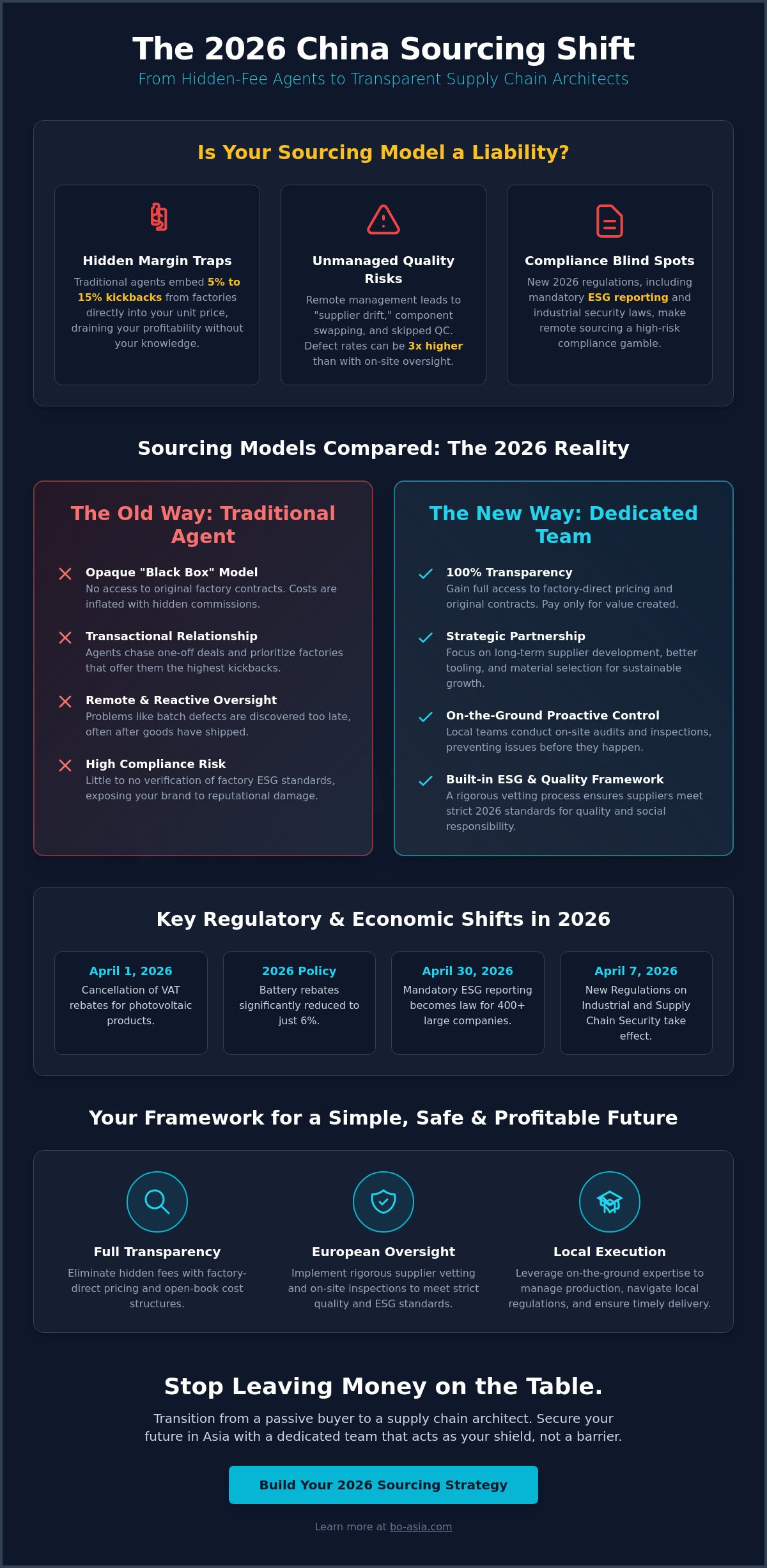
Selecting the right operational structure is the most critical decision a wholesaler makes when scaling in Asia. You must choose between freelance agents, traditional trading companies, or a dedicated Asia procurement team. While trading companies offer a "one-stop-shop" feel, they often act as a barrier between you and the manufacturer. This opacity allows them to bury 10% to 15% markups in your unit price, effectively skimming your profits before the goods even leave the factory. In contrast, a professional China sourcing team operates on a transparent service fee model. This structure ensures that every negotiation benefit and cost-saving goes directly to your bottom line. When evaluating these models, transparency and risk mitigation must outweigh the perceived convenience of a middleman.
Relying on a single freelancer creates a dangerous single point of failure in your supply chain. If your agent falls ill or switches loyalties, your entire production stops without warning. In 2026, professional firms provide the corporate backing necessary to manage complex future of procurement trends, such as mandatory ESG reporting. Since the April 30, 2026, deadline, over 400 large companies in China are now required to publish sustainability reports. A freelance agent simply lacks the infrastructure to audit these technical requirements. A professional firm acts as your shield, ensuring your suppliers meet these legal standards before a compliance failure damages your brand reputation.
Building your own "in-house" team in China involves massive administrative hurdles and legal risks. You'd need to establish a foreign-owned legal entity, manage local HR, and stay compliant with the updated 2026 minimum wage standards, which reached RMB 2,740 in Shanghai. Outsourcing this function to a dedicated "Buying Office" provides the same level of control without the administrative burden. You gain a local China sourcing team that functions as a seamless extension of your own company. This approach offers the same strategic advantages discussed in our guide on Procurement Consulting: Strategic Benefits for Global Enterprises in 2026. It's about achieving the elite oversight of a large corporation while remaining lean and focused on your core business growth.
Securing your supply chain in 2026 requires more than a casual agreement; it demands a structured framework built on four pillars: vetting, inspection, ethics, and transparency. Step one involves implementing rigorous supplier vetting and factory audits. Under the Regulations on Industrial and Supply Chain Security enacted on April 7, 2026, you're now legally responsible for the integrity of your partners. A professional China sourcing team conducts these audits on-site to verify that a factory possesses the technical capacity and legal standing they claim. Step two establishes a boots-on-the-ground quality inspection schedule. This covers everything from pre-production material checks to final container loading, creating a physical barrier against defects. Step three integrates ESG standards into every supplier contract to ensure long-term viability. Finally, step four ensures 100% financial transparency through open-book accounting, which removes the hidden markups that traditionally drain your profitability.
European and US brands face intense pressure to prove their supply chains are free of forced labor and environmental waste. Your sourcing team must act as a protective shield by conducting unannounced factory audits to verify real-world conditions. These audits are critical because, since April 30, 2026, mandatory sustainability disclosures apply to over 400 large companies in China, setting a new benchmark for all exporters. ESG compliance is a mandatory requirement for 2026 market access. By verifying these standards locally, you protect your brand from the reputational damage that follows compliance failures.
Modern procurement relies on cloud-based platforms for order tracking and document management. This digital trail prevents miscommunication and ensures that your China sourcing team can file inspection reports instantly for your review. These digital reports are essential for preventing quality fade during mass production, as they provide a measurable record of factory performance. Utilizing these tools allows you to manage high-volume procurement with the same precision as a Fortune 500 company. For a deeper look at integrating these systems, read our Source to Contract Outsourcing: The Strategic Guide to Asia Procurement in 2026. If you're ready to modernize your operations and secure your margins, contact our team for a comprehensive supply chain assessment.
Buying Office Asia (BOA) positions itself as the stabilizing force your supply chain needs in a volatile market. By acting as your dedicated China sourcing team, we provide the elite oversight usually reserved for global corporations while remaining accessible to growing wholesalers. Our model is built on a professional commitment to 100% transparency. You see the factory price, and you pay the factory price. We've eliminated the "black box" approach of traditional agents who rely on hidden commissions and opaque markups. This results-oriented philosophy ensures that your margins are protected and your procurement process remains simple, safe, and profitable. Our case study highlights demonstrate that by removing the middleman, our clients gain the financial clarity required to reinvest in their own product innovation and market expansion.
Our unique structure provides the best of both worlds: Western management rigor combined with local execution. With our leadership office in Helsinki, we offer seamless communication and the legal security of a European partner. You won't face the frustrations of time zone delays or cultural misalignments when discussing your high-level strategic goals. Meanwhile, our Hong Kong base serves as the strategic hub for all Asian manufacturing operations. This dual presence ensures that while your contracts are managed with professional rigor, your production is overseen by experts who are physically present on the factory floor. You can view our pricing and savings examples to see how this boots-on-the-ground approach translates into measurable bottom-line growth for your business.
We handle every aspect of the procurement cycle to ensure your production remains on track. This includes everything from OEM/ODM development and custom tooling to final logistics coordination. Unlike transactional agents, our retainer model aligns our interests perfectly with yours. We don't profit from your unit price; we profit from your long-term stability and success. This partnership approach allows us to act as a shield against the production delays and material swaps that often occur in unmanaged supply chains. By establishing a China sourcing team that functions as an extension of your own company, you gain full control over your quality and costs. It's time to stop leaving money on the table and secure your future in the Asian market. Contact Buying Office Asia to build your dedicated team and experience the steady confidence of working with a seasoned industry insider.
The landscape of Asian procurement has fundamentally changed. You can no longer afford to leave your profitability in the hands of opaque middlemen who prioritize their own commissions over your growth. By transitioning to a professional China sourcing team, you replace manufacturing uncertainty with the steady confidence of a seasoned insider. You gain the on-site oversight necessary to navigate the strict ESG regulations that came into force on April 30, 2026, while securing factory-direct pricing that protects your bottom line. It's about moving from a reactive stance to becoming a strategic architect of your own supply chain.
Buying Office Asia brings over 15 years of experience to your operation. As a European-managed firm, we provide the legal security of our Helsinki leadership alongside the boots-on-the-ground execution of our Hong Kong hub. Our 100% transparent, no-commission model ensures every negotiation benefit stays in your pocket. We act as your shield against production delays and reputational risk through rigorous on-site quality control and ESG auditing. You don't have to settle for unmanaged risks when a simple, safe, and profitable alternative exists.
Build your dedicated, transparent China sourcing team with Buying Office Asia and take command of your manufacturing future today.
A dedicated China sourcing team acts as a transparent extension of your own company, whereas a traditional agent often functions as an opaque middleman. Traditional agents typically charge a commission on top of factory prices and may take hidden kickbacks from suppliers. A dedicated team provides full visibility into factory-direct pricing and prioritizes your long-term supply chain architecture over one-off, transactional deals.
A procurement team manages ESG compliance by conducting unannounced on-site audits and verifying factory sustainability reports. Since April 30, 2026, over 400 large Chinese companies must publish mandatory sustainability disclosures. Your team acts as a shield; they ensure your suppliers adhere to these legal standards to prevent reputational damage and ensure continued market access in Europe and the US.
Yes, a professional team manages the entire product development cycle, including custom tooling and sampling support. They coordinate directly with factory engineers to ensure technical specifications are met without the miscommunication common in remote sourcing. This hands-on approach allows for higher levels of innovation and customization while maintaining strict control over your intellectual property and design integrity.
In 2026, professional firms have largely moved away from commission-based models toward transparent retainer or service fee structures. This shift aligns the team’s incentives with your profitability rather than the total order value. While specific costs depend on volume and service scope, industry data shows that transparent models can save wholesalers 10% to 15% by eliminating the hidden markups common in traditional agency models.
You can identify hidden commissions by comparing your final unit price with the actual factory-direct contract. If your partner refuses to provide open-book accounting or blocks direct communication with the production facility, they're likely prioritizing their own margins. A transparent China sourcing team ensures you see the original invoices to verify that no unearned markups are being added to your manufacturing costs.
Outsourcing to a buying office provides the same level of control as an in-house team without the administrative burden of establishing a legal entity in Asia. Setting up a foreign-owned entity requires managing local HR and compliance with 2026 minimum wage laws, such as the RMB 2,740 monthly standard in Shanghai. An outsourced team offers immediate local expertise and scalability without these high overhead costs.
If a quality issue is detected during a pre-production or loading inspection, the team halts the process immediately to implement corrective actions. They act as your on-site shield, negotiating with the factory to repair or replace defective goods before they leave the facility. This proactive intervention prevents the high costs associated with receiving faulty batches, which are often three times higher in unmanaged supply chains.
The team manages the complex coordination between production schedules and logistics providers to ensure timely delivery. They oversee the final loading process and verify that all export documentation is accurate and compliant with the latest 2026 regulations. This end-to-end oversight minimizes production delays and ensures that your goods move efficiently from the factory floor to your destination warehouse without unexpected administrative hurdles.

What if the first clear sign of a production problem arrives after the goods are packed? Manufacturing risk management in Asia works best when controls are connected from the start, not left to a final inspection or occasional supplier update. You need visibility into factory activity, early warning...

What if the lowest unit quote isn’t the lowest-cost way to make your board game? Board game manufacturing costs depend on more than the number of boxes ordered. Component materials, custom tooling, assembly, packaging and delivery scope can all change what a quote covers, making headline prices diff...

What if the factory’s lowest quote isn’t the lowest-cost option? A lower unit price can hide differences in materials, tooling, packaging, quality checks or production terms. Understanding how sourcing agents negotiate factory prices starts with making those differences visible, not simply asking a...