


Hiring a billion-dollar strategy firm to manage your Asian production is often like hiring an architect to lay the bricks. You pay a premium for a vision that rarely survives the reality of the factory floor. Most executives realize that a 200-page slide deck can't stop a production delay in Ningbo or catch a 12% defect rate before it leaves the port. When evaluating supply chain consulting firms for 2026, the real divide isn't between brands; it's between those who provide high-level theory and those who provide a physical, on-site presence.
You already know that opaque pricing and a lack of quality control are the primary drivers of reputational damage. You deserve a partner who acts as a shield against these risks rather than another layer of bureaucracy. We'll show you how to bridge the gap between boardroom strategy and factory-floor execution to ensure your operations remain simple, safe, and profitable. This article compares global strategic giants with specialized execution partners to help you secure factory-direct pricing and rigorous oversight without the hidden margins of traditional agents.
• Identify the critical "Implementation Gap" where strategic advice fails and learn how to translate high-level roadmaps into tangible results on the factory floor.
• Discover how to evaluate supply chain consulting firms based on their physical presence and ability to provide a protective, boots-on-the-ground partnership in Asia.
• Master the 2026 requirements for ESG compliance and geopolitical stability to shield your brand from reputational damage and unmanaged supply chain risks.
• Learn why a dual-office structure between Europe and the APAC region is the most effective way to eliminate opaque middlemen and stop leaving money on the table.
• Transition from risky remote sourcing to a model that provides the elite oversight typically reserved for global corporations, ensuring your production is simple, safe, and profitable.
Supply chain consulting firms act as the vital bridge between your high-level business goals and the gritty reality of global manufacturing. By 2026, this field has moved far beyond simple logistics advice. It now encompasses a complex landscape of ESG compliance, geopolitical shifts, and a "post-Alibaba" environment where basic digital vetting is no longer enough to protect your brand. You need a partner who doesn't just provide a map but actually walks the terrain with you.
Effective Supply chain management (SCM) in 2026 requires a physical presence to verify factory claims and ensure ethical standards are met. Strategy is no longer the primary differentiator in a volatile global market. Many firms fail because their plans look excellent in a boardroom but crumble when faced with a local power shortage or a sudden raw material tariff. We've entered an era where "Execution-First" consulting is the only reliable driver of ROI, ensuring that theoretical cost savings actually manifest on your balance sheet.
Moving from "just-in-time" to "just-in-case" has increased inventory complexity by 30% for most wholesalers. This shift requires sophisticated oversight that internal teams often can't manage from a home office. Regulatory pressure is also at an all-time high, with 2026 marking the strict enforcement of new ethical sourcing laws across major Asian manufacturing hubs. Remote management won't stop quality fade; it usually accelerates it, leading to a 15% drop in product consistency over just three production cycles when on-site inspections are skipped.
Hidden margins are the silent killers of brand profitability. Traditional agents often secure 5% to 10% in undisclosed commissions from factories, which means you're leaving significant money on the table with every order. Beyond the financial loss, unmanaged factory relationships lead to reputational damage that can take years to repair if a sub-tier supplier violates labor laws. The transparency gap is the dangerous information void that exists when a brand lacks direct, on-site visibility into its own manufacturing process.
Success in 2026 requires a shift in perspective. To remain competitive, brands must move away from opaque middlemen and toward a dedicated sourcing team that prioritizes transparency and ground-level control. This approach makes your procurement simple, safe, and profitable.
Selecting the right partner requires a clear understanding of the hierarchy of supply chain consulting firms. The market currently splits into three distinct tiers, each serving a different stage of the business lifecycle. If you hire for strategy when you need execution, you'll likely end up with an expensive slide deck and the same production delays you started with. In 2026, the gap between theoretical planning and physical oversight is where most mid-market brands lose their margins.
Tier 1 consists of the global giants: McKinsey, BCG, and the Big 4 (Deloitte, PwC, EY, and KPMG). These firms excel at high-level digital transformation and M&A due diligence. They're the right choice for Fortune 500 companies undergoing multi-billion dollar organizational restructuring. Their strengths lie in their global network and ability to process massive datasets to predict long-term market shifts.
However, these firms often carry significant weaknesses for brands focused on manufacturing outcomes:
Entry-level strategy engagements often start at $500,000, a price point that doesn't always correlate with immediate ROI.
These consultants operate from high-rise offices, not factory floors. They don't spend their Tuesdays in a workshop in Ningbo or Dongguan.
Their advice is often top-down. It looks great in a boardroom but fails to address the granular reality of raw material price fluctuations or local labor shortages.
Tier 2 and Tier 3 firms focus on the "Execution Tier." While Tier 2 firms often specialize in logistics technology and warehouse optimization, Tier 3 partners provide the essential boots-on-the-ground management. For 2026, a local presence in trade hubs like Hong Kong is non-negotiable. This physical proximity allows for factory-direct negotiations and real-time quality control that remote consultants simply can't match.
These specialized partners represent a shift away from the "traditional agent" model. Unlike agents who survive on "kickbacks" and "hidden margins," modern procurement partners offer 100% transparency. You see the direct factory invoices. You know exactly what you're paying for. This model acts as a shield against the reputational damage caused by compliance failures or sub-par materials. It's about moving from a transactional relationship to a dedicated sourcing team that functions as an extension of your own office.
By 2026, the most successful brands will stop leaving money on the table by replacing opaque middlemen with transparent, on-site experts. This approach makes overseas manufacturing simple, safe, and profitable by focusing on measurable outcomes rather than abstract theories.
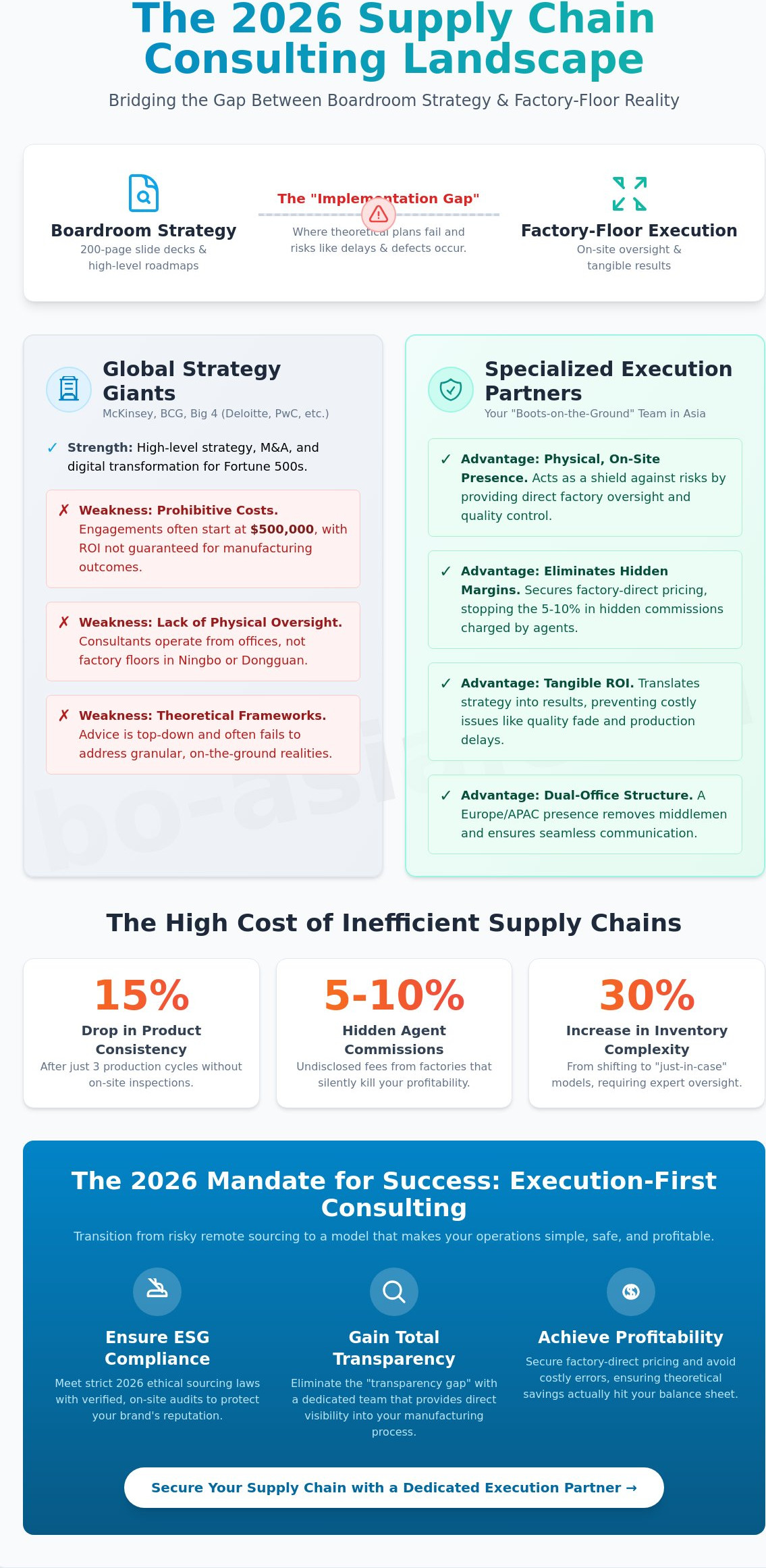
Most supply chain consulting firms provide you with a roadmap. They deliver polished PowerPoint decks and high-level strategy documents from offices in London or New York. While these roadmaps define your goals, they don't produce goods. There is a massive difference between a strategic recommendation and a factory-direct contract that secures your margins. Execution requires more than a plan; it requires a physical presence on the factory floor to ensure that the strategy survives the reality of Asian manufacturing. You need inspection reports and signed agreements, not just slides.
The "Implementation Gap" is where most supply chains fail. You might have a strategy to diversify into Vietnam, but without seasoned insider knowledge, you'll likely face opaque middlemen and hidden costs. We focus on closing this gap by moving away from theoretical advice and toward tangible results. This means negotiating directly with factory owners to stop you from leaving money on the table. It involves securing transparency in pricing and ensuring compliance with ESG standards, rather than just hoping your supplier follows the code of conduct you emailed them.
A consultant sitting 5,000 miles away cannot effectively vet a factory in Ningbo or Ho Chi Minh City. Remote oversight relies on Zoom calls and digital documents, which are easily manipulated. This distance creates a vacuum where "Quality Fade" thrives. You might receive a perfect initial sample, but without on-site monitoring, the factory may quietly substitute cheaper components during the third or fourth production run. Data from 2023 shows that 15% of unmanaged production runs in Southeast Asia suffer from significant material quality drops after the first year. Strategy doesn't stop quality fade; only physical inspections do.
Being on-site changes the financial equation of your procurement. Traditional agents often bake a 10% to 15% markup into your unit price without your knowledge. By establishing a direct link to the manufacturer, you eliminate these hidden margins immediately. The ROI of a physical presence is also measured in disaster prevention. A single catastrophic batch defect can result in a 100% loss of inventory and months of shipping delays. Mass production oversight ensures that your standards are met every day, making your supply chain simple, safe and profitable. We act as your shield, protecting your reputation and your bottom line through every production cycle.
Selecting from the vast array of supply chain consulting firms requires a framework that prioritizes execution over theory. In 2026, the global market doesn't reward those who only plan; it rewards those who control their production. You need a partner that bridges the gap between your corporate headquarters and the factory floor. This means prioritizing firms with local leadership in both your home market and your production hub. Without a physical presence where your goods are made, a consultant is just a remote observer. They can't stop a production delay or verify a quality defect from a laptop in another time zone.
Transparency is the bedrock of a profitable partnership. You must vet every firm for their revenue model. Professional consultants charge a clear service fee for their expertise. In contrast, opaque middlemen often hide their profits within inflated unit costs, sometimes adding a 15% margin that you never see. By demanding 100% transparency on factory-direct pricing, you ensure your capital goes toward product quality rather than hidden commissions. This approach makes your supply chain simple, safe and profitable.
Before signing a contract, use this checklist to verify that a firm can actually protect your interests on the ground. A Seasoned Insider doesn't just manage data; they manage people and machines. Ensure your chosen supply chain consulting firms meet these three non-negotiable standards:
Does the firm own a physical office and a registered legal entity in the manufacturing country? This is essential for local accountability and contract enforcement.
Can they provide detailed factory audit reports, including ISO 9001 and ESG compliance, along with real-time production updates?
Do they offer 100% transparency on factory-direct pricing, allowing you to pay the manufacturer directly if required?
Avoid agencies that operate in the shadows. If a consultant refuses to disclose specific factory sources, they're likely protecting a hidden markup rather than your brand. Another major red flag is a firm whose consultants have never personally visited the production lines they recommend. Digital sourcing has its place, but it can't replace on-site oversight. Finally, be wary of commission-only models. These often lead to biased recommendations where the consultant favors the factory that pays the highest kickback, rather than the one that delivers the best quality. To secure your margins, partner with a dedicated sourcing team that acts as your protective shield.
Most supply chain consulting firms stop at the strategy phase, leaving you to handle the complex realities of Asian manufacturing alone. Buying Office Asia (BOA) operates differently. We act as your physical bridge between European strategic leadership and Asian production hubs. With our dual-office structure in Helsinki and Hong Kong, you benefit from a seamless communication loop. You deal with European project managers who understand your standards while our Hong Kong team manages the daily factory output. This setup eliminates the 12 hour delay that often cripples international projects.
Our "Simple, Safe, and Profitable" philosophy is the foundation for our high-volume sourcing operations. We don't just offer advice; we provide a protective shield for your capital. By positioning ourselves as a seasoned insider, we help you avoid the "hidden margins" that traditional agents frequently bake into their quotes. You gain the same level of procurement oversight that large corporations enjoy, without the massive internal overhead. We focus on results that impact your bottom line directly.
Transparency isn't a buzzword for us; it's a financial requirement. BOA removes the opaque middlemen who traditionally obscure factory-direct pricing, often saving clients between 12% and 18% on unit costs. Our dedicated on-site teams perform rigorous quality inspections directly on the factory floor, not just at the shipping port. To ensure your interests are protected, BOA manages the Source to Contract process by identifying 100% compliant vendors and negotiating ironclad agreements that hold manufacturers accountable for every defect.
Moving from a prototype to mass production is where most brands fail. In a recent 2024 project, we helped a growing wholesaler scale their inventory from 2,000 units to 50,000 units within a single quarter while maintaining a 99.8% quality pass rate. We handle the heavy lifting of logistics and shipping coordination, optimizing routes to reduce transit times by an average of 14 days. This methodical approach ensures your growth is sustainable and your supply chain remains resilient against market shifts.
Take control of your manufacturing future. Schedule a consultation with our Asia procurement team to audit your supply chain and stop leaving money on the table.
By 2026, the gap between boardroom strategy and factory floor reality will define which brands scale and which fail. Most supply chain consulting firms offer high-level frameworks that look excellent in a slide deck but often crumble during a local labor shortage or a logistics bottleneck. Real ROI isn't found in a report. It's secured through physical presence. You need a partner who bridges the 8,000 kilometer gap between your headquarters and your manufacturing base.
Buying Office Asia eliminates the opaque middleman model that has historically cost wholesalers millions in hidden margins. We provide a European-managed solution with leadership based in Helsinki and a strategic headquarters in Hong Kong. This structure ensures your operations meet 100% transparency standards through on-site factory inspections. Our deep APAC networks act as your shield against reputational damage and production delays. We make overseas procurement simple, safe, and profitable by putting our team directly on the factory floor. We don't just advise; we execute.
Secure your supply chain with Buying Office Asia’s on-the-ground expertise
Your path to a stable and scalable production line starts with local accountability.
A supply chain consultant provides strategic oversight and transparent management, while traditional sourcing agents often operate as middlemen with hidden margins. Consultants focus on long term profitability and risk mitigation by building your internal capabilities. Unlike agents who just pass orders through, a consultant acts as your dedicated boots on the ground to ensure every step of the process is simple, safe and profitable.
Most supply chain consulting firms structure their fees through project-based retainers or a transparent percentage of the managed spend. Industry reports from SourceGlobal Research indicate that fees are tailored to the complexity of the global network and the specific cost-saving targets. This professional fee structure prevents the 5 percent to 10 percent hidden markups that are common when using traditional commission-based agents.
A local presence eliminates the 12 hour time difference and cultural barriers that frequently lead to production delays or quality disputes. Having a physical office in the manufacturing hub allows for unannounced factory visits, which are 40 percent more effective at catching defects than scheduled inspections. You gain a protective shield that ensures your specifications are met exactly as ordered without the risks of remote management.
Consultants provide the rigorous oversight required to meet the EU Corporate Sustainability Due Diligence Directive (CSDDD) and other global standards. We implement 25 point compliance checklists to verify that every factory in your network adheres to labor laws and environmental regulations. This proactive approach stops you from leaving money on the table due to potential legal fines or the reputational damage of unethical sourcing.
A professional report must include a quantitative score based on ISO 9001 standards, photographic evidence of the production lines, and verified business licenses. It should detail the factory’s actual production capacity, machinery maintenance logs, and social compliance status. These 20 to 30 page documents provide the transparency you need to make an informed decision before committing your capital to a new supplier.
A dedicated team improves your bottom line by eliminating the 15 percent inefficiency often found in unmanaged supply chains. We negotiate directly with manufacturers to remove middleman markups and optimize shipping consolidation for better freight rates. By reducing your landed cost and preventing expensive stockouts, we ensure your procurement process remains a steady engine for growth rather than a source of hidden costs.
Big 4 firms are suited for high level corporate strategy, but boutique supply chain consulting firms offer the execution and local expertise needed for daily manufacturing management. While a global firm provides theoretical roadmaps, a boutique partner delivers on-site oversight to manage your production in real time. This choice depends on whether you need a boardroom presentation or a practical shield against the risks of overseas production.

What if the first clear sign of a production problem arrives after the goods are packed? Manufacturing risk management in Asia works best when controls are connected from the start, not left to a final inspection or occasional supplier update. You need visibility into factory activity, early warning...

What if the lowest unit quote isn’t the lowest-cost way to make your board game? Board game manufacturing costs depend on more than the number of boxes ordered. Component materials, custom tooling, assembly, packaging and delivery scope can all change what a quote covers, making headline prices diff...

What if the factory’s lowest quote isn’t the lowest-cost option? A lower unit price can hide differences in materials, tooling, packaging, quality checks or production terms. Understanding how sourcing agents negotiate factory prices starts with making those differences visible, not simply asking a...