


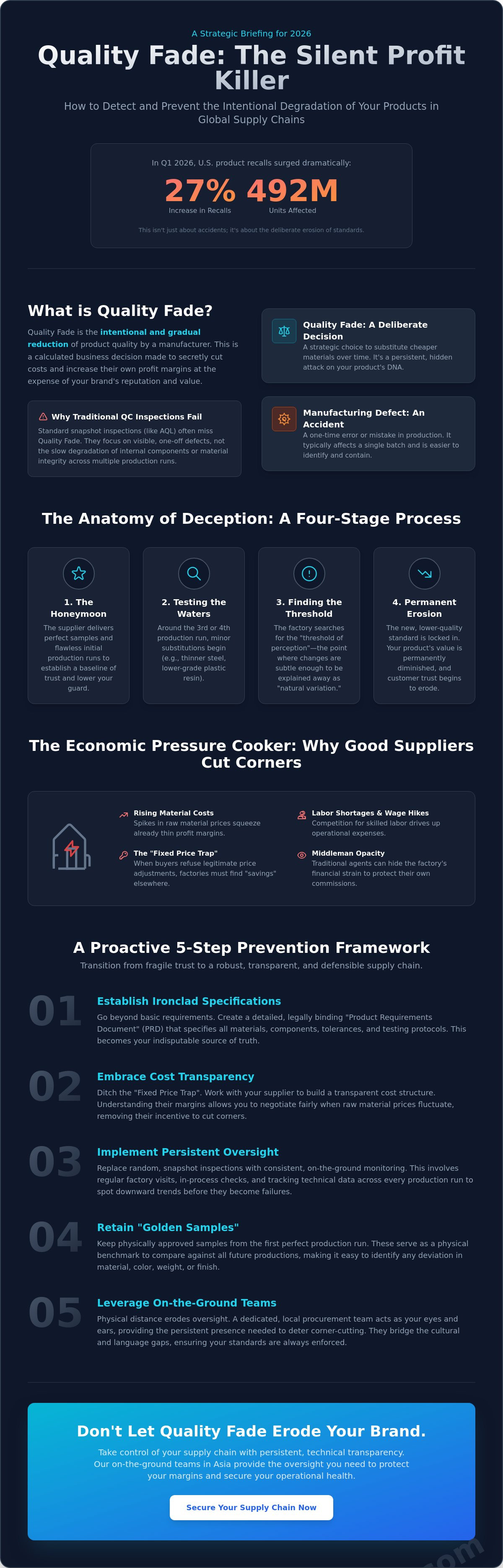
In the first quarter of 2026, U.S. product recalls surged by 27 percent, impacting 492 million units. This staggering volume of defective goods isn't always the result of a single catastrophic failure; more often, it's the cumulative effect of a quiet, deliberate erosion of standards. You've likely felt the frustration of rising return rates even though your specifications haven't changed. Understanding what is quality fade and how to prevent it is now a critical requirement for any brand that values its reputation and financial viability. It's a common anxiety for businesses where physical distance often obscures factory-level decisions and erodes oversight.
This strategic guide will teach you how to identify the subtle signs of degradation before they reach your customers. We'll examine the mechanics of supplier psychology, the indicators of material substitution, and the specific on-site protocols required to protect your margins. By the end of this briefing, you'll have a clear roadmap to replace blind trust with persistent, technical transparency and secure the operational health your business depends on. We'll move beyond transactional interactions to help you build a defense against the risks that affect unmanaged supply chains.
• Recognize how incremental, deliberate reductions in material quality can bypass standard inspections and erode your profit margins over time.
• Gain a comprehensive understanding of what is quality fade and how to prevent it by addressing the economic pressures that force factories toward material substitution.
• Identify technical red flags in mass production, specifically differentiating between minor aesthetic changes and critical functional degradation.
• Implement a five-step strategic defense that transitions your supplier relationships from fragile, trust-based agreements to robust, contract-backed partnerships.
• Leverage the proximity advantage of a dedicated Asia procurement team to provide the persistent oversight necessary to deter supplier corner-cutting.
Quality fade is the intentional, incremental reduction of product quality by a manufacturer to expand their own profit margins. Unlike a sudden manufacturing error, this process is calculated and persistent. It represents a significant strategic threat because it targets the core of your brand equity. When you ask what is quality fade and how to prevent it, you're essentially seeking a defense against a slow-motion theft of your product specifications. The changes are often too small for a single, isolated inspection to catch, making the process insidious by design.
It's vital to distinguish this phenomenon from "one-off defects." A defect is an accident; quality fade is a business decision. While a defect might result in a single batch of rejected goods, quality fade results in a permanent downward shift in your product's DNA. This isn't just a quality control hurdle. It's a direct attack on your financial viability. Every cent a factory saves by substituting a cheaper component is a cent stolen from your brand's value and customer trust.
The timeline for quality fade rarely begins with the first shipment. Factories often deliver perfect samples and flawless initial production runs to establish a baseline of trust. The erosion typically starts around the third or fourth production cycle. Suppliers begin testing your boundaries with minor material substitutions, such as using a slightly thinner gauge of steel or a lower-grade plastic resin. They're searching for the "threshold of perception." This is the specific point where a change is significant enough for a consumer to notice but subtle enough for the factory to explain away as natural variation.
Conventional inspection methods are often ill-equipped to handle this specific risk. Standard Acceptable Quality Level (AQL) inspections provide a snapshot of a single batch. They focus on visible defects rather than long-term material integrity. If a factory swaps a high-quality internal component for a cheaper alternative, a standard visual inspection won't flag the change. This failure is often compounded by "technical complacency." As business relationships mature, buyers often reduce the intensity of their oversight. They mistakenly believe that past performance is a guarantee of future results. True prevention requires moving beyond snapshot inspections toward consistent, on-the-ground mass production oversight that tracks technical data across every production cycle to identify trends before they become failures.
Quality fade is rarely born from a desire to deliver a poor product. It is almost always a calculated response to shifting economic pressures. In the competitive manufacturing hubs of Asia, factories operate on razor-thin margins. When raw material costs spike or labor shortages drive up wages, a factory's profitability can vanish overnight. If you've locked a supplier into a "fixed price" contract without accounting for these variables, you've inadvertently set the stage for quality degradation. Understanding what is quality fade and how to prevent it requires looking past the product and into the factory’s balance sheet.
The "Fixed Price Trap" is a primary driver of this behavior. When a buyer refuses to accept legitimate price adjustments despite rising costs, the factory faces a choice: lose money on every unit or find "savings" within the production process. Without active oversight, they will choose the latter. This problem is often worsened by middleman opacity. Traditional sourcing agents often obscure the true cost of production to protect their own commissions, leaving you blind to the financial strain your supplier is under. In high-volume sourcing, quality fade isn't just a possibility; it's an inevitable outcome of unmanaged supply chains. To protect your interests, you must move toward a model of transparent cost structures and active partnership.
In 2026, manufacturers are navigating significant economic headwinds, including tariff-related cost pressures and a persistent skilled labor gap. These factors, combined with local inflation in manufacturing hubs, create a vacuum that corner-cutting quickly fills. Industries involving complex assemblies, such as consumer electronics or regulated medical devices, are particularly susceptible. When "factory-direct" pricing is negotiated without technical oversight, the supplier often feels entitled to recoup their margins through material substitution. This risk is compounded by the fact that global supply chain disruptions now cost businesses an average of $1.5 million per day. A small saving on a plastic resin can quickly escalate into a multi-million dollar recall.
International procurement often suffers from an "out of sight, out of mind" dynamic. When a factory knows you are thousands of miles away and only see the finished product, the temptation to substitute components increases. A lack of physical presence signals that your quality standards are negotiable. This is why initial supplier vetting is so critical. You need to identify partners who value long-term stability over short-term gains. If you suspect your current margins are being protected at the expense of your product's integrity, it's time to consult with an on-the-ground expert who can restore transparency to your operations.
Detecting quality degradation requires a shift from casual observation to a disciplined, data-driven methodology. You cannot rely on the factory to self-report changes in their internal processes. Mastering the technical warning signs is the first step in understanding what is quality fade and how to prevent it from eroding your customer base. Prevention starts with the realization that the first signs of fade are often found in areas you aren't looking at, such as secondary packaging or non-critical internal components.
The most effective detection tool at your disposal is the "Batch-to-Batch" comparison. By maintaining a "Golden Sample" from your initial production run, you create a permanent technical benchmark. You should also monitor secondary indicators that signal internal factory stress. High turnover in key management positions or a sudden shift in sub-suppliers often precedes a decline in product integrity. When a factory changes its upstream sources for raw materials, they are almost certainly searching for lower costs that will eventually manifest as quality issues in your finished goods.
Factories frequently test a buyer's vigilance by swapping "Tier 1" brand-name components for generic alternatives. In the current manufacturing climate, the use of "regrind" plastics—recycled production waste—and lower-grade metal alloys has become a common way to pad margins. These substitutions are technically sophisticated; the product may look identical but will fail prematurely under stress. Utilizing independent lab analysis to verify chemical compositions or tensile strength is the only definitive way to detect subtle material shifts before they cause field failures.
Beyond material swaps, factories often "optimize" their production schedules by cutting corners on labor-intensive steps. This might include reducing curing times for adhesives or lowering molding temperatures to speed up cycle times. While these changes increase factory throughput, they compromise the long-term durability of your product. You must also watch for "Packaging Fade," where thinner corrugated cardboard or cheaper protective foam is introduced. These small savings for the factory lead to significantly higher transit damage rates for you. Adhering to strict OEM Manufacturing standards ensures that every process step is documented and audited, removing the vacuum where these unauthorized optimizations thrive.
Effective supply chain management requires a transition from hope-based oversight to a rigorous, contract-based framework. Trust is a byproduct of consistent performance, not a management tool for international manufacturing. To secure your brand's future, you must implement a system where accountability is baked into every production run. Understanding what is quality fade and how to prevent it involves more than just better specifications; it demands a shift in the power dynamic between you and your supplier. This five-step strategic defense replaces blind faith with technical transparency:
• Establish a technical baseline through a certified Golden Sample.
• Implement a "Locked" Bill of Materials (BOM) with no-substitution clauses.
• Conduct unannounced on-site inspections during active production.
• Perform longitudinal testing to track material consistency across batches.
• Integrate quality performance KPIs directly into your Pricing and Savings model to reward stability.
The "Golden Sample" serves as the immutable benchmark for all future production. It is the physical manifestation of your requirements, signed and sealed by both parties. This sample must be supported by a "Locked" Bill of Materials (BOM) that explicitly lists every component, from the primary material down to the grade of adhesive used in packaging. Unauthorized swaps are common when these details are left vague. By utilizing professional Product Development and Sampling Support, you establish a baseline that makes even the most subtle quality fade legally and technically indefensible.
Scheduled inspections are insufficient because they allow factories to prepare a "perfect" batch for the inspector. True prevention requires On-site Quality Control that occurs without prior notice. This persistent presence deters the temptation to cut corners. Furthermore, you should implement longitudinal testing, where random components are pulled from the line and sent to third-party labs for chemical and stress analysis. This data-driven approach identifies material drift before it reaches the threshold of consumer perception. If you're ready to secure your supply chain with this level of professional rigor, connect with our technical team today to discuss a tailored oversight strategy.
While technical frameworks and "Golden Samples" provide the necessary foundation, their execution depends entirely on the eyes and ears you have on the production floor. A dedicated Asia procurement team represents the only sustainable solution to the problem of gradual quality erosion. The psychological deterrent of a local presence cannot be overstated. When a factory knows that a technical representative can walk onto the line at any hour, the incentive to test your "threshold of perception" with material swaps disappears. Understanding what is quality fade and how to prevent it ultimately leads to a single conclusion: physical proximity equals accountability.
The "Proximity Advantage" goes beyond simple inspections. It involves building a relationship where the factory views you as a partner rather than a distant transaction. By conducting direct factory negotiations, we remove the obscured costs and miscommunications that often lead to desperation-led corner-cutting. When a supplier's margins are healthy and transparent, they're less likely to seek "savings" through unauthorized substitutions. This integrated approach ensures that your specifications remain the absolute standard for every batch, regardless of high-volume pressures or shifting market conditions.
Traditional sourcing often operates as a "black box," where agents hide factory identities to protect their own commissions. This lack of transparency is a breeding ground for quality issues; if you don't know the true factory-direct price, you can't identify when a supplier is being squeezed to the point of failure. Buying Office Asia functions as an extension of your own team, providing 100 percent transparency into the supply chain. You gain complete visibility into factory-level decisions and cost structures. Our documented case studies highlight how this level of openness has successfully stabilized quality for brands navigating complex international markets.
The BOA "Defense-in-Depth" strategy is built on three non-negotiable pillars: rigorous vetting, persistent on-site oversight, and direct, unfiltered communication. We reject the conventional intermediary model in favor of a partnership that prioritizes your brand's financial health and reputation. Your dedicated sourcing team manages the entire product lifecycle, identifying technical red flags long before they reach your customers. This proactive stance ensures that the challenge of what is quality fade and how to prevent it is met with daily operational excellence. You gain the security of European-managed oversight and the regional expertise required to maintain a stable, profitable supply chain in Asia.
Protecting your brand margins in 2026 requires a shift from reactive quality control to proactive, technical oversight. You've seen how incremental material swaps and process optimizations can erode your profitability without a single red flag appearing in a standard inspection. By implementing a "Locked" Bill of Materials and maintaining a physical presence on the factory floor, you replace vulnerability with operational certainty. Understanding what is quality fade and how to prevent it is the first step toward reclaiming control over your manufacturing outcomes.
True supply chain security isn't found in a contract alone; it's found in the persistent vigilance of a partner who treats your business as their own. We provide European-managed oversight from our offices in Finland and Hong Kong, ensuring 100 percent transparency with no hidden middleman markups. Our on-the-ground presence functions as a permanent defense against factory complacency and unmanaged risk. It's time to move beyond the anxieties of international sourcing and build a foundation of reliability. Protect your production with a Dedicated Asia Procurement Team and secure your brand's financial health today.
Quality fade is a deliberate, incremental reduction in quality to increase factory margins, while a manufacturing defect is an accidental failure in the production process. A defect is usually a one-time event or a machine error. Fade is a calculated strategic decision made by factory management to substitute cheaper materials or skip steps. Understanding what is quality fade and how to prevent it requires recognizing this hidden intent behind product degradation.
Factories use initial orders to build trust and establish a baseline of acceptability with the buyer. Once they feel the relationship is stable and your oversight has likely decreased, they begin testing your "threshold of perception" with minor changes. This "honeymoon period" allows the supplier to secure long-term business before they start incrementally cutting corners to recoup their own rising operational costs or labor expenses.
A Golden Sample serves as a physical contract anchor that provides a clear technical benchmark for dispute resolution. While it isn't a replacement for a formal legal agreement, it is the primary evidence used in factory-direct negotiations to prove a deviation from specifications. When you pair this sample with a signed Bill of Materials, it makes it much harder for a factory to claim that substitutions were within tolerance.
Suppliers frequently substitute primary materials like high-grade alloys with cheaper scrap metals or replace virgin plastics with "regrind" resins. In consumer electronics, they may swap brand-name capacitors for generic alternatives. Packaging is also a common target, where thinner corrugated cardboard or lower-density foam is used. These changes are often invisible to the naked eye but significantly impact the long-term durability and safety of the finished product.
You should conduct unannounced audits at least once during every major production cycle, particularly during the assembly phase. Relying on scheduled inspections gives the factory time to hide non-conforming materials. Randomizing the timing prevents the supplier from developing a pattern of compliance only when they expect a visitor. This persistent oversight is a core component of what is quality fade and how to prevent it from becoming an embedded habit.
Recovery is possible but requires an immediate shift to a high-intensity oversight model. You must confront the supplier with technical evidence and re-negotiate terms based on absolute transparency. If the factory is unwilling to return to the original specifications, you must be prepared to migrate production to a vetted alternative. Often, the threat of losing a high-volume account is enough to force a return to quality standards.
A dedicated procurement team acts as an integrated extension of your business, whereas an inspection company provides a transactional, one-off service. Inspectors only report what they see on a specific day; a procurement team manages the entire supplier relationship, from price negotiations to mass production oversight. We provide the regional expertise and persistent presence required to manage supplier development and deter corner-cutting throughout the entire year.
Industries with complex bills of materials, such as consumer electronics, medical devices, and high-volume consumer goods, face the highest risk in 2026. These sectors are currently navigating significant tariff-related cost pressures and labor gaps, which incentivize factories to find savings internally. Products with hidden internal components are especially vulnerable because the fade is difficult to detect without destructive testing or professional lab analysis of raw material samples.

What if the first clear sign of a production problem arrives after the goods are packed? Manufacturing risk management in Asia works best when controls are connected from the start, not left to a final inspection or occasional supplier update. You need visibility into factory activity, early warning...

What if the lowest unit quote isn’t the lowest-cost way to make your board game? Board game manufacturing costs depend on more than the number of boxes ordered. Component materials, custom tooling, assembly, packaging and delivery scope can all change what a quote covers, making headline prices diff...

What if the factory’s lowest quote isn’t the lowest-cost option? A lower unit price can hide differences in materials, tooling, packaging, quality checks or production terms. Understanding how sourcing agents negotiate factory prices starts with making those differences visible, not simply asking a...