


Agree the audit duration and reporting timetable from the actual scope, factory access and evidence required. An on-site audit, remote review and document-only check answer different questions, so request a written plan rather than assuming a universal duration.
A short visit can uncover important issues, but it cannot establish whether a supplier can deliver consistently. Before committing to production, you need a clear picture of the factory’s capacity, quality controls, documentation, and working conditions.
This guide explains what an audit checks, which operational or social-compliance red flags may warrant pausing an order, and how to assess audit costs in Southeast Asia. You’ll also learn how an audit differs from a product inspection, what affects timing and budget, and how to use the findings to make a more confident sourcing decision.
• Define the audit scope around your product, order volume and production risks so the assessment focuses on evidence that matters.
• Compare the factory’s records and stated capacity with what you can observe on site, including its quality controls and production flow.
• Treat serious workplace safety or social-compliance findings as production risks that need clear corrective action before you proceed.
• Use a written report with supporting photos to assign priorities, responsibilities and follow-up steps.
• Assess audit costs by scope, location, access and reporting needs, rather than comparing headline prices alone.
Assess the factory’s records alongside its actual production flow, not just its sales presentation. A useful audit compares documents, equipment, quality controls, and workplace practices with your product and order requirements.
Review quality procedures from incoming materials through in-process checks and finished-goods release. Ask to see a completed inspection record, a defect log, and evidence of how staff handled a previous quality issue. Check that current procedures match what workers do on the factory floor, rather than relying on a polished manual.
Verify each certificate’s scope, issuing organization, and expiry date. A certificate may be expired, outside the relevant scope or issued to a different legal entity. That does not establish the quality of every product, but it shows why document review must include the holder, issuing body, dates and scope.
Compare stated capacity with machinery, staffing, shifts, production records, and the work visible during the visit. A supplier’s headline capacity can differ from demonstrated output once staffing, shifts, maintenance and existing commitments are considered. Ask how the factory would fit your order alongside current work, and which process limits output.
Trace a product through materials, production, inspection, and packing. Check whether recorded controls cover incoming materials, work in progress, and finished goods. A sample may meet your specification while full production varies. Before approving volume, compare the approved sample with production checks, tolerances, and defect records.
Common factory audits in Asia include supplier or factory capability audits, quality-system audits, and social-compliance audits. Some assessments cover several areas, while product inspection focuses on manufactured goods rather than the supplier’s wider systems. Choose the scope based on the risks your order creates.
Quality management checks examine documented procedures and their use. Social-compliance reviews may draw on standards or guidance selected for the assignment. ISO 26000 provides guidance on social responsibility and is not a certifiable management-system standard. Specify the actual assessment criteria, then inspect records and practices. Check whether any production is subcontracted, which sites perform it, and whether the same specifications and quality controls apply there.
Across China, India, Vietnam, Thailand, and Bangladesh, the core audit questions are the same: who operates the factory, what can it produce, and how does it control quality and compliance? The evidence and local documentation to review depend on the factory’s operations, product, workforce, and destination-market requirements.
Set the scope by country and site, then check relevant company records, production arrangements, worker documentation, and safety procedures. A factory audit should reflect the actual location and supply chain, including subcontracting. Pair these checks with an on-the-ground sourcing approach when local production oversight is part of your risk controls.
Before approval, record the verified site address, named production processes, capacity evidence, current certificates, and quality checkpoints. For each gap, document the evidence, production impact, corrective action, and owner. This turns the findings into a decision tool: proceed, require corrective work before production, or reject the supplier if critical controls are absent.
A factory’s production plan depends on safe working conditions and credible labor practices. Treat severe hazards, coercion, or falsified records as reasons to pause approval and investigate before placing or continuing an order.
A building safety audit examines the condition and use of work areas, safety procedures, emergency arrangements, and maintenance records. During the walkthrough, compare written procedures with visible practices. Blocked exits, unsafe storage, missing machine safeguards, or inaccessible emergency equipment demand prompt attention.
Ask how the factory records hazards, assigns corrective actions, and trains workers. Review drill records and maintenance documents, then observe whether staff can explain the relevant procedures. Set drill frequency according to the site's risks and applicable local requirements, and review evidence that workers understand emergency procedures. A written checklist helps connect each finding to its location, evidence, severity, and required action.
A serious hazard that puts workers at immediate risk is a sound reason to hold production until the factory addresses it and evidence supports closure. Base the decision on the specific finding, not a pass mark that could hide critical risks.
A social-compliance review assesses working conditions, hours and wages, rest and vacation time, underage or forced labor, disciplinary practices, and discrimination. Compare attendance and payroll records with worker interviews and observed practices. Inconsistencies can reveal risks that management’s documents alone won’t show.
Focus scrutiny on time records, wage documentation and how workers describe their hours. Country-level reports can inform questions, but they are not a substitute for assessing the individual factory and its current evidence.
Some audits allow too little time, use inadequate checklists, or provide weak incentives to investigate root causes. The Clean Clothes Campaign East Asia describes these weaknesses in social auditing. A useful report should distinguish evidence from claims and identify corrective action, ownership, and follow-up. Buying practices also matter: unrealistic deadlines or repeated order changes can contribute to excessive hours, so review your own planning alongside factory conduct.
Use the ESG approach to responsible sourcing to frame follow-up around evidence and remediation, not just a score. Before production proceeds, document critical findings, corrective actions, and the evidence needed to close each issue. If a serious safety or labor concern remains unresolved, pause the order rather than treating the audit as routine paperwork.
Audit and travel time depend on the number of facilities, processes, records and interviews in scope. Ask each provider to separate preparation, on-site work, travel, evidence review and final reporting in its proposed timetable. The schedule depends on audit scope, access, records, and factory complexity.
Use this sequence to plan the work:
Shortlist a few serious supplier candidates, define the product and order requirements, and agree on factory access.
Review records, observe production, verify equipment and staffing, and discuss findings with relevant managers.
Review the written report, assign follow-up actions, and decide whether the supplier fits the order.
Each step affects the schedule. Reviewing one production line takes less coordination than assessing several processes, buildings, or subcontractors. Missing records, unavailable managers, or restricted access can also delay evidence gathering. Before scheduling, share the product specification, expected volume, key components, and critical risks so the auditor can plan relevant checks.
Keep timing separate from supplier selection. An audit generally follows initial screening, once importers have narrowed the supply chain to serious candidates. First compare the supplier’s stated capabilities with your order needs. Then use the audit to verify that production arrangements, equipment, quality controls, and staffing support the proposed work. For products with multiple components, identify which ones the supplier makes and which come from outside sources.
A useful assessment tests reliability, not just current capacity. Ask how the supplier handles a production delay, a rejected component, or a change to the approved sample. Review how management tracks corrective actions and communicates changes. These discussions help show whether the supplier can respond consistently when production pressures arise after the audit.
Allow time for the report as well as the visit. Agree a written report-delivery deadline for the specific assignment, including time for evidence review and any clarification of findings. The report should connect findings to evidence, risks, and follow-up guidance. Use it to distinguish critical gaps from improvements that can be managed during supplier development. A suitable supplier may need corrective actions before production, while unresolved critical weaknesses can justify choosing another candidate.
Build the audit into the sourcing schedule before confirming production dates. Allow time for planning, factory access, the audit, report review, and corrective-action follow-up. This sequence gives your team a practical decision point before committing to tooling, components, or order volume.
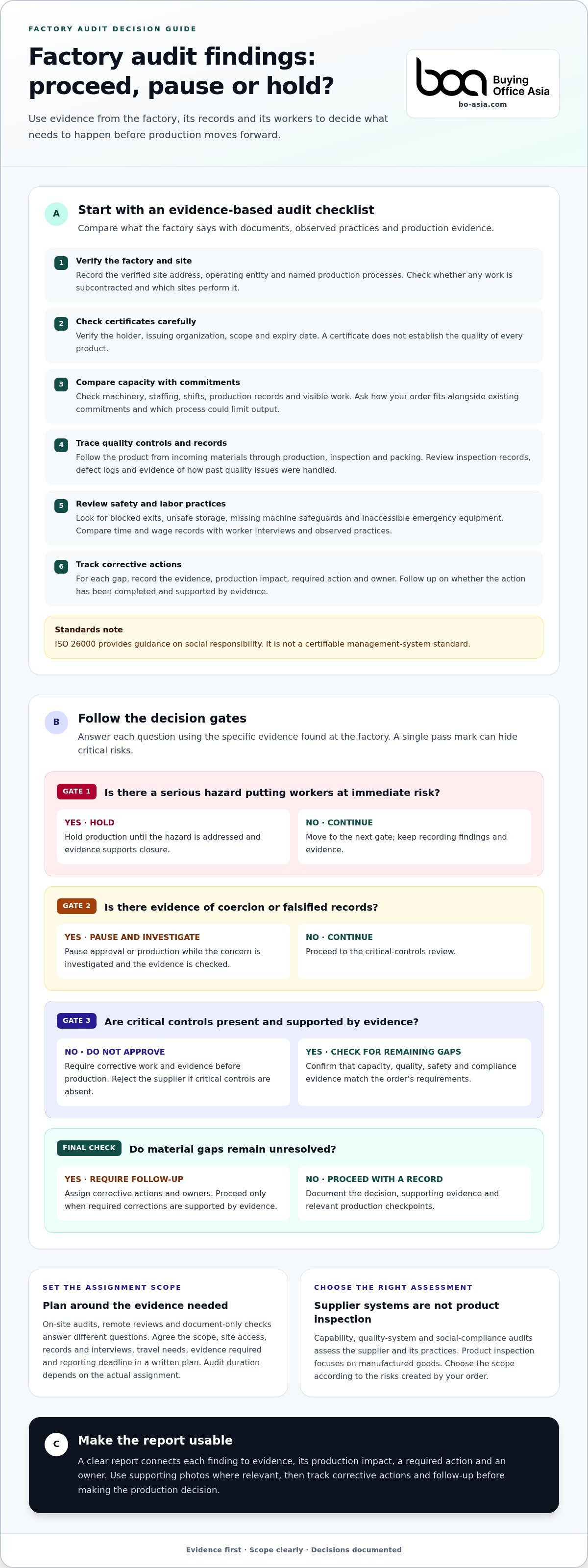
A factory audit is useful only when its findings support a clear purchasing decision. The written report should link each observation to evidence, explain its operational impact, and recommend a practical next step. Photos help locate issues, while records show whether a problem is isolated or reflects a wider weakness in the factory’s controls.
Start with the factory identity, site location, audit scope, date, and departments visited. Distinguish documents reviewed from conditions observed, then explain any limits on access. For example, a photo of a machine is more useful when its caption identifies the process, observed issue, and relevant control record.
Give each finding a consistent structure: evidence, risk, priority, corrective action, and follow-up method. A rigorous report avoids vague statements such as “quality control needs improvement.” It identifies the missing or ineffective control and explains what evidence would demonstrate that it has been corrected. This gives procurement teams a clear basis for discussing actions with factory management.
Photos can document equipment, material storage, production flow, inspection stations, and packing conditions. Pair each image with a written observation and the related record. A photograph of inspection equipment, for instance, cannot establish that staff use it correctly; the assessment should also examine relevant procedures and completed quality-control records.
Organize images by department or production stage, and write specific captions. Separate direct observations from explanations provided by factory staff. If a photo illustrates a concern, link it to the finding number in the report. This makes it easier to trace the issue during supplier discussions or a later corrective-action review.
Scores can help compare sections, but they shouldn’t conceal critical weaknesses. A strong facilities score can coexist with weak quality controls or final testing. Read the evidence behind each section rather than relying only on an overall result.
Use recommendations to sort findings into actions required before production, improvements that need follow-up, and lower-priority observations. Assign each action to a responsible factory contact and define the evidence needed to close it. If the report identifies a recurring cause, such as an unclear inspection procedure, address the cause rather than requesting only a new record.
Audit and reporting time should be planned separately. Actual report turnaround depends on evidence review, scope and findings that need clarification. Agree on the report format and photo documentation before the visit, so the final evaluation answers the questions that matter to your order.
Audit fees depend on the assessment scope, factory location, travel, facilities covered, and reporting requirements. Compare quotes by what they include, not just by the headline figure.
Factory audits across Asia are conducted by regional inspection firms, international assurance organizations, and local audit teams. Compare their proposed scope, on-the-ground coverage, auditor expertise, evidence standards, and report detail. A social-compliance assessment and a production-capability review require different expertise, so match the service to your sourcing risks.
Ask each provider to itemize the work: site coverage, departments reviewed, documentation checks, interviews, photo evidence, report delivery, and follow-up. Clarify whether travel, translation, or an additional facility changes the quote. A lower fee may reflect a narrower assessment, while a broader scope can address more operational risks. Compare equivalent scopes.
For a global buyer, a clear report and consistent methodology matter as much as local access. Check whether findings are supported by records and observations, and whether recommendations identify specific actions. The best fit is the provider whose assessment answers your decision questions, not necessarily the one with the longest checklist.
Start by identifying the supplier, factory address, product, order stage, and reason for the audit. Then define the assessment scope, such as production capability, quality management, social conditions, or a combined review. Share relevant specifications and known concerns so the audit focuses on the processes and facilities tied to your order.
Next, coordinate factory access, the audit date, and manager availability. Agree on which records can be reviewed, whether workers can be interviewed, and how photos will support findings. Set expectations for report format and delivery. If the supplier uses subcontractors, include those production arrangements in the assessment scope.
The final quote should clarify the scope and cost drivers. Fees may vary with site location, travel, audit duration, number of facilities, requested checks, and reporting requirements. Audit pricing depends on the specific case and is provided after a quote request, with the assessment scope and logistics shaping the cost.
Once the audit is complete, use its findings to decide whether to proceed, require corrective action, or pause supplier approval. An audit is a snapshot of conditions at the time of assessment; production follow-up may be needed to track remediation. For support planning an assessment around your sourcing requirements, contact the team about a factory audit.
Buying Office Asia connects factory audit findings to the wider sourcing decisions they affect. If you’re assessing a supplier for a significant order, End-to-End Sourcing & Procurement can align supplier selection, production planning, and factory-direct price negotiations. This coordinated approach helps address capacity or quality-system gaps before they become production issues, then manage supplier follow-up as work progresses.
For high-volume sourcing, a Dedicated Asia Procurement Team can support communication and oversight across supplier relationships. If you already have a supplier and need a focused assessment, start by defining the audit scope and the decision it needs to inform.
Contact Buying Office Asia to discuss your sourcing and procurement requirements.
Before your next supplier review, agree internally on who owns the decision and what evidence they need for approval. Keep the criteria tied to the order’s actual priorities, so factory audits in Asia inform a specific purchasing decision rather than becoming paperwork filed after the fact.
Set a review point before committing to the next production milestone. Bring procurement, product, and compliance stakeholders together to resolve competing priorities and document the decision. This gives your team a consistent record to revisit if the project scope or supplier arrangements change.
When you’re ready to discuss your manufacturing plans, contact Buying Office Asia. Take the next step with a clear decision process and a stronger basis for supplier approval.
An audit helps determine whether a supplier’s operating controls suit your business relationship; an inspection evaluates a defined product lot against purchase requirements. Set decision criteria before booking either. An audit brief should identify the supplier risks to assess, while an inspection plan should define the sample, defect categories, and acceptance criteria. Keep those records with the purchase order so the findings inform the same decision.
A manufacturing audit examines how a factory turns an order into finished goods, including handoffs between departments and people. Ask how a revised drawing reaches production, who approves the change, and how obsolete instructions are removed from the work area. These questions test whether engineering changes are controlled without relying on informal messages or one manager’s memory.
Auditors may assess a factory against quality-management or social-responsibility frameworks selected for the assignment. A certificate alone doesn’t establish that its scope covers the audited site, product, or process. Use the audit brief to identify which standards matter to your requirements, then record any exclusions. This prevents a general certification from being mistaken for evidence about a specific production activity.
The audit scope depends on the factory’s role in your order. If a supplier only performs final assembly, focus on component receipt, identification, assembly instructions, and reconciliation of packed quantities. If it also makes components, include the relevant production processes. Before the visit, map the product’s route through the site and identify the departments that must be assessed.
Country and audit label alone aren’t enough to compare quotes. Ask for separate line items covering assessment scope, facilities included, travel arrangements, report format, and follow-up. Then compare proposals covering the same scope. If one quote excludes a site or social-compliance review included in another, the headline totals don’t represent equivalent work. Keep the agreed scope with the purchase decision.
Scheduling depends on factory coordination and the readiness of the records and people needed for the assessment. Reduce avoidable delays by sending the site address, supplier contact, product documents, and requested scope together. Name the managers whose input is essential, and have the factory confirm their availability. If the order involves multiple production sites, identify each one before arranging access.
Watch for answers that change between departments, records that appear prepared only for the visit, or managers who cannot explain who approves production changes. These signals call for targeted follow-up, not an automatic conclusion. Ask for the underlying record, compare it with the relevant work instruction, and note who supplied each explanation. Escalate unresolved inconsistencies before relying on the supplier’s stated process.
Ask the audit firm to identify the auditor responsible for the report and explain their relevant experience for its subject. Check that the report names the correct legal entity and site, and that its findings refer to evidence from the assignment. Request clarification for unclear scoring or an image without context. Retain the final report version with your supplier file, including any documented corrections or follow-up.

Distance can turn a small production issue into a coordination problem. The benefits of having a team on the ground in Asia include closer alignment between regional operations and your wider business. Local presence can connect strategy with supplier activity, product decisions, and day-to-day coll...

A container can be ready to move and still incur port charges. The practical question is what demurrage is and how to avoid it: demurrage is a charge for cargo left at a port or terminal beyond its agreed free time. The amount depends on the applicable rate and how long the cargo remains there.That...

Knowing how to manage overseas manufacturing projects starts with comparing total landed cost, not just the factory quote. Include tooling, freight, tariffs and duties, insurance, management time, and the cost of correcting problems. Weigh those expenses against product quality, delivery risks, and...