


The lowest commission rate on paper often conceals the highest total cost of ownership. While it is natural to ask how much do procurement agents charge, the real question is how much of your margin is being lost to hidden markups and undisclosed factory kickbacks. In a global market where 43% of supply chains shifted sourcing locations last year, the difference between a transactional middleman and a strategic partner is measured in transparency and long-term financial viability. Choosing the wrong partner does not just cost you a fee; it risks the integrity of your entire production line.
You likely understand the frustration of navigating complex fee models that seem designed to keep you in the dark. This 2026 guide breaks down the prevailing fee structures across Asia, from traditional commission models to the rising demand for fixed-price transparency. You will gain a clear framework to evaluate the true value of your sourcing partners and learn how to identify experts who act as a direct extension of your own team. By the end of this article, you will know how to secure a partnership that eliminates unnecessary intermediaries and prioritizes your bottom line.
• Analyze the three primary fee models—commission, flat fee, and retainer—to select the structure that best protects your project margins.
• Uncover how much do procurement agents charge by stripping away hidden markups and undisclosed factory kickbacks common in "free" sourcing models.
• Assess the impact of purchase order volume and product complexity on your total procurement costs and service requirements.
• Calculate your potential ROI by weighing professional fees against the 10-25% savings typically realized through direct factory negotiations.
• Master a framework to vet high-value partners who offer 100% transparency and act as a secure extension of your internal team.
Determining how much do procurement agents charge requires a strategic evaluation of your specific supply chain needs. In the current global market, fee structures have evolved to reflect the complexity of modern manufacturing and the necessity for total cost control. A fundamental grasp of Understanding Procurement is essential before committing to a specific fee structure. Most professional partners operate under three primary models: commission-based, flat fee, or retainer-based agreements. Each model serves a distinct purpose, ranging from transactional support to the deep integration of dedicated Asia procurement teams that function as a direct extension of your business.
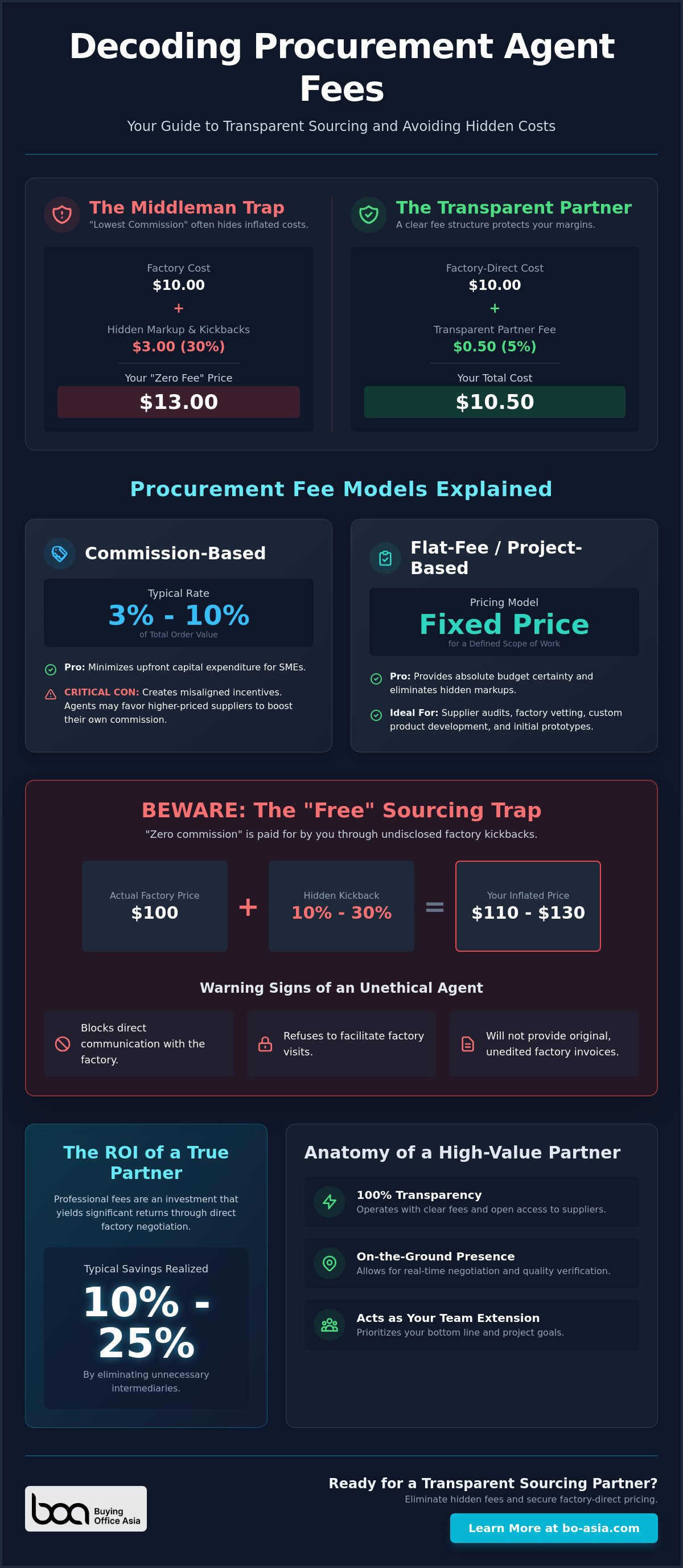
Commission rates typically range from 3% to 10% of the total order value. This percentage often fluctuates based on the scale of your purchase order; high-volume production usually commands a lower percentage, while smaller, more complex trial runs sit at the higher end of the spectrum. For businesses seeking budget certainty for specific objectives, the flat fee model is becoming the standard for supplier vetting and factory audits. This approach ensures you pay for a defined outcome rather than a variable percentage, which is particularly effective for one-time sourcing projects or initial product development phases.
Small to medium enterprises often gravitate toward commission-based agents because it minimizes upfront capital expenditure. This performance-linked structure suggests that the agent only profits when your goods are successfully ordered. However, you must remain vigilant regarding misaligned incentives. When an agent's income is a direct percentage of the purchase price, they may lack the motivation to negotiate the lowest possible factory-direct cost. This conflict of interest can lead to agents favoring higher-priced suppliers to maximize their own cut. Commission structures typically scale with the complexity of mass production oversight to ensure quality is maintained throughout the manufacturing cycle.
Flat-fee pricing is the ideal choice for surgical interventions in your supply chain, such as supplier audits, factory vetting, or custom product development. This model provides absolute budget certainty, which is vital for new manufacturing ventures where every dollar of seed capital must be accounted for. By decoupling the agent's fee from the product price, you eliminate the risk of hidden markups and ensure the partner's focus remains entirely on your technical requirements. Success in this model depends on clear deliverables. Your contract should explicitly define the scope of work, whether it is a comprehensive factory audit report or a validated prototype, to ensure the investment yields a measurable return on your financial health.
The allure of zero-commission sourcing is a common pitfall for businesses entering the Asian market. It sounds like an immediate cost-saving measure. In reality, it's often a financial trap. When you ask how much do procurement agents charge and receive a quote of "zero", you're likely entering the hidden markup model. In this scenario, the agent secures their profit through undisclosed factory kickbacks. These "commissions" paid by the supplier are simply added back into your unit price, often inflating your costs by 10% to 30% without your knowledge.
Hidden fees do more than just erode your profit margins; they compromise the integrity of your supply chain. A transparent sourcing and procurement partner acts as an extension of your own team, whereas a trading company thrives on keeping the factory relationship opaque. True factory-direct pricing is only achievable when your representative has a physical, on-the-ground presence that removes these unnecessary intermediaries. This proximity allows for real-time negotiation and verification that a "remote" agent simply cannot provide.
Warning signs of an unethical partnership include a refusal to facilitate factory visits or a reluctance to provide original, unedited factory invoices. When an agent blocks direct communication with the manufacturer, they're usually protecting a hidden margin. Factories forced to pay kickbacks must recoup those costs elsewhere. They often do so by substituting cheaper materials or reducing labor hours, which directly compromises your product quality. The Buying Office Asia pricing model is built on 100% transparency to eliminate these risks, ensuring that every dollar you spend contributes to product value rather than an agent's secret profit. Understanding how much do procurement agents charge in a transparent model allows you to budget with precision and maintain full control over your manufacturing standards.
Effective supply chain management requires more than just local contacts; it demands a resilient procurement strategy that bridges the gap between Western business standards and Asian manufacturing realities. Our Helsinki-based leadership team ensures that ethical standards and clear communication are never sacrificed for speed. This European oversight provides a protective layer of accountability that is often missing in traditional sourcing models. Simultaneously, our Hong Kong operations provide the physical proximity needed to verify factory-direct pricing and manage production in real time. This dual-layer approach is particularly critical when protecting your intellectual property through professional OEM manufacturing agreements. If you are concerned about hidden costs in your current supply chain, you can discuss your specific requirements with our team to discover a more secure path forward.
The total cost of professional sourcing is rarely a static figure. While the base fee model provides a framework, several operational variables dictate the final investment required to secure your supply chain. Understanding how much do procurement agents charge involves analyzing the depth of involvement required across your production cycle. A high-volume industrial project demands a different level of oversight than a simple off-the-shelf product acquisition. By identifying these cost drivers early, you can align your procurement budget with your long-term margin protection goals.
Scale is your primary lever for negotiation. As your order volume increases, the percentage fee typically decreases, yet the management requirements become more intensive. High-volume procurement necessitates robust systems to track multiple shipments and maintain factory accountability.
If your project involves custom tooling or technical product development, expect higher service costs. These projects require significant engineering hours and technical oversight to ensure that prototypes transition into mass production without failure.
Sourcing across multiple Asian countries, such as balancing production between Vietnam and China, increases logistical complexity. Managing a diverse regional footprint requires more coordination than sourcing from a single industrial province.
The level of "boots on the ground" directly impacts the fee. A final random inspection is a basic safeguard, whereas full-time production oversight provides a proactive defense against defects before they leave the factory floor.
High-volume sourcing requires the infrastructure of a dedicated team rather than the limited capacity of a solo agent. As your business grows, your procurement partner must manage increased scalability during peak production cycles to prevent bottlenecks. This level of professional rigor is explored further in our guide to Mastering Sourcing and Procurement in Asia. A dedicated team ensures that as your PO volume fluctuates, your quality standards and factory-direct price advantages remain constant. This institutional support is what separates elite procurement from basic middleman services.
The depth of your quality control protocols is a significant factor in determining how much do procurement agents charge for their services. Basic visual checks might suffice for simple commodities, but technical components often require lab-tested compliance verification and rigorous on-site audits. These audits are essential to ensure your suppliers meet modern ESG and ethical manufacturing standards, protecting your brand from regulatory and reputational risks. Proactive supplier vetting prevents costly batch defects by identifying factory weaknesses before production begins. Investing in comprehensive QC is not a cost; it is a strategic defense of your financial health.
Evaluating a procurement partner requires looking past the immediate line item on your balance sheet. While you must understand how much do procurement agents charge, the most critical metric is your total landed cost and your exposure to risk. A professional service fee is a strategic investment. It secures your margins against the cost of failure, which includes the catastrophic expense of defective batches, late shipping, and unmanaged factory relationships.
When you bypass trading companies and engage in factory-direct negotiations, you typically realize savings between 10% and 25%. This reduction in unit price often covers the procurement fee several times over. The alternative to outsourcing is the substantial overhead of establishing an in-house presence in Asia. This includes regional salaries, legal compliance, and physical office space. For most businesses, a managed service provides the same elite oversight at a fraction of the fixed cost. You can review documented savings examples to see how this translates to real-world financial health.
A 30% defect rate discovered after a container arrives at your warehouse is a financial disaster that few independent brands can absorb. Professional quality control (QC) pays for itself by identifying these issues at the source before you make the final payment. Beyond quality, an active production management approach reduces lead times by coordinating logistics and factory schedules in real time. The financial benefit of having a dedicated Asia procurement team lies in this proactive defense against operational setbacks. Determining how much do procurement agents charge is only half of the ROI equation; the other half is the cost of the risks you successfully avoid.
Expert logistics management significantly impacts your total landed cost. Procurement partners create value through container consolidation and route optimization. This ensures you aren't paying for empty space in half-filled shipments. Navigating complex customs documentation and regulatory requirements also prevents expensive port storage fees and delivery delays. These operational efficiencies ensure that your products move from the factory floor to your customers without unforeseen expenses. To secure your supply chain and optimize your manufacturing ROI, contact our team for a professional assessment.
Buying Office Asia (BOA) provides the structural integrity your supply chain requires by rejecting the opaque models of traditional sourcing. Instead of wondering how much do procurement agents charge in hidden commissions, you receive a clear, fixed-fee proposal. This 100% transparency guarantee ensures you see the actual factory-direct price, allowing you to maintain absolute control over your financial health. Our model functions as a protective shield, moving your business away from the risks of unmanaged sourcing and toward the steady growth of a professional partnership.
Our leadership team in Helsinki establishes the ethical and regulatory framework, while our Hong Kong operations provide the physical proximity needed for mass production oversight and factory-direct price negotiations. This combination offers the elite oversight usually reserved for major enterprises, delivered with the hands-on care of a dedicated partner. We act as an integrated extension of your own team rather than a third-party entity. This vocal signature of reliability ensures that your manufacturing interests are defended against the operational setbacks common in digital-only sourcing.
Eliminating the "hidden middleman" is the only way to protect your long-term profitability. Conventional intermediaries often thrive on the lack of visibility between the buyer and the manufacturer, but BOA dismantles this barrier. When you build direct relationships with vetted manufacturers through a transparent partner, you gain better terms and higher reliability. This direct connection is essential for maintaining quality control and ensuring that your engineering requirements aren't lost in translation. You can explore our full value proposition by learning why Buying Office Asia is the preferred choice for businesses seeking industrial-scale results without the risk of hidden markups.
Engaging BOA for a high-volume sourcing project begins with a comprehensive briefing on your technical and commercial requirements. We don't provide generic estimates because we understand that every supply chain has unique complexities. Instead, we provide a clear breakdown of service fees based on your specific needs, from initial factory audits to end-to-end logistics management. This level of professional briefing ensures you can calculate your ROI with precision before production begins. When analyzing how much do procurement agents charge, the value of total cost certainty cannot be overstated. To move forward with a partner who prioritizes your margin protection, view our pricing and savings examples here.
Understanding the nuances of professional fees is the first step toward reclaiming control of your manufacturing costs. Professional sourcing is not a transactional expense; it's a strategic defense against the "middleman trap" and the high cost of production failure. By prioritizing 100% transparency and factory-direct negotiations, you eliminate hidden markups that erode your bottom line. While determining how much do procurement agents charge is an essential starting point, the true measure of success is the long-term ROI generated through risk mitigation and operational efficiency.
Buying Office Asia brings over 15 years of regional expertise to your project. As a European-managed firm with a physical on-the-ground presence in Hong Kong and China, we provide the accountability and ethical standards your brand deserves. We don't just facilitate connections; we act as a secure extension of your own team. It's time to move away from opaque intermediaries and embrace a partnership built on financial viability and steady growth.
Get a Transparent Procurement Quote for Your Asia Production and take the next step toward a more resilient supply chain. Your path to a secure and profitable manufacturing future begins with professional oversight.
Standard commissions in China typically range between 3% and 10% of the total purchase order value. The exact rate often depends on the scale of your production; larger orders frequently command lower percentages, while smaller trial runs sit at the higher end. It's essential to clarify whether this fee includes quality control or if those services require additional investment.
Professional procurement agents secure factory-direct pricing by eliminating trading companies and secondary wholesalers from your supply chain. By establishing a direct link to the manufacturer, you gain transparency into the actual production costs. This approach ensures your negotiations are based on raw material and labor realities rather than arbitrary middleman markups.
Using a procurement agency is generally more cost-effective than hiring an in-house team, especially when accounting for the overhead of regional salaries and legal compliance in Asia. An agency provides immediate access to established networks and local expertise without the fixed costs of physical office space. This model allows you to scale your operations based on production cycles.
Hidden costs in sourcing contracts often manifest as undisclosed factory kickbacks or inflated logistics handling fees. You should also look for administrative charges that aren't tied to specific deliverables. A transparent contract should clearly define how much do procurement agents charge for their professional time versus the actual cost of the goods being manufactured.
You can identify kickbacks if your agent refuses to provide original factory invoices or prevents you from visiting the production site. Ethical partners operate with 100% transparency, allowing you to see the direct financial interactions with the supplier. If the agent is defensive about factory contact, it's a strong indicator that they're protecting an undisclosed margin.
Many procurement agents charge separately for factory audits and quality inspections if they aren't part of a comprehensive monthly retainer. These are often flat fees designed to cover the travel and technical hours required for on-site verification. Bundling these services into a total procurement package is a common strategy for high-volume clients seeking end-to-end oversight.
A sourcing agent acts as a service provider and an extension of your team, while a trading company functions as a reseller that adds an opaque markup to the product. Trading companies often hide the factory's identity to protect their profit margins. In contrast, a professional procurement partner focuses on supply chain visibility and long-term margin protection.
A 10% commission is considered standard for lower-volume orders or highly complex product developments involving custom tooling. However, for high-volume mass production, this rate may be significantly higher than the market average for large-scale operations. When evaluating how much do procurement agents charge, you must weigh the percentage against the level of risk mitigation and quality assurance they provide.

If your current sourcing agent claims their services are free, you're likely paying a hidden tax of 10% to 30% through inflated unit prices and factory kickbacks. This lack of transparency doesn't just erode your margins; it creates a dangerous barrier between you and the factory floor. Finding a re...

A perfect golden sample is often the most dangerous document in your supply chain. If a prototype is handcrafted by a master technician rather than built using scalable factory processes, your sample development phase isn't a success; it's a liability. This gap between a one-off masterpiece and a hi...

Scaling production to millions of units isn't a purchasing task; it's a high-stakes risk management discipline where a single percent of quality fade can liquidate your annual margin. You likely understand that the leap from mid-scale orders to massive procurement runs often exposes cracks in even t...