


Paying for a full container of goods before you've seen them isn't an investment; it's a high-stakes gamble that your brand's reputation can't afford to lose. You're likely familiar with the silent dread that sets in after sending a final wire transfer, wondering if the pre-shipment inspection process will truly catch defects before they leave the floor. It's a valid concern when high defect rates and a lack of physical presence at the factory can quickly turn a profitable season into a logistical nightmare.
This guide helps you master the mechanics of quality control to eliminate manufacturing errors and secure your Asian supply chain with the precision of a seasoned insider. We'll examine the critical 2026 updates to ISO 2859-1 and the new mandatory CPSC eFiling requirements that now dictate international trade. You'll learn how to transform inspections from a reactive hurdle into a strategic firewall. We'll break down the mechanics of on-site verification, data-driven reporting, and the exact steps needed to ensure your goods meet every ethical and technical standard before they ever reach the port.
• Identify the 80% production milestone as the critical final gate to stop sub-standard goods before they leave the factory floor.
• Master the rigorous seven-step pre-shipment inspection process to ensure your quantity counts and random sampling protocols match your contractual requirements.
• Navigate the 2026 updates to ISO 2859-1 standards and set realistic Acceptable Quality Limits that protect your brand's financial health.
• Implement a buyer’s checklist that prioritizes the "Golden Sample" and clear specifications to eliminate inspector ambiguity and factory excuses.
• Understand the strategic advantage of integrated on-site oversight over standalone services to maintain a transparent and secure supply chain.
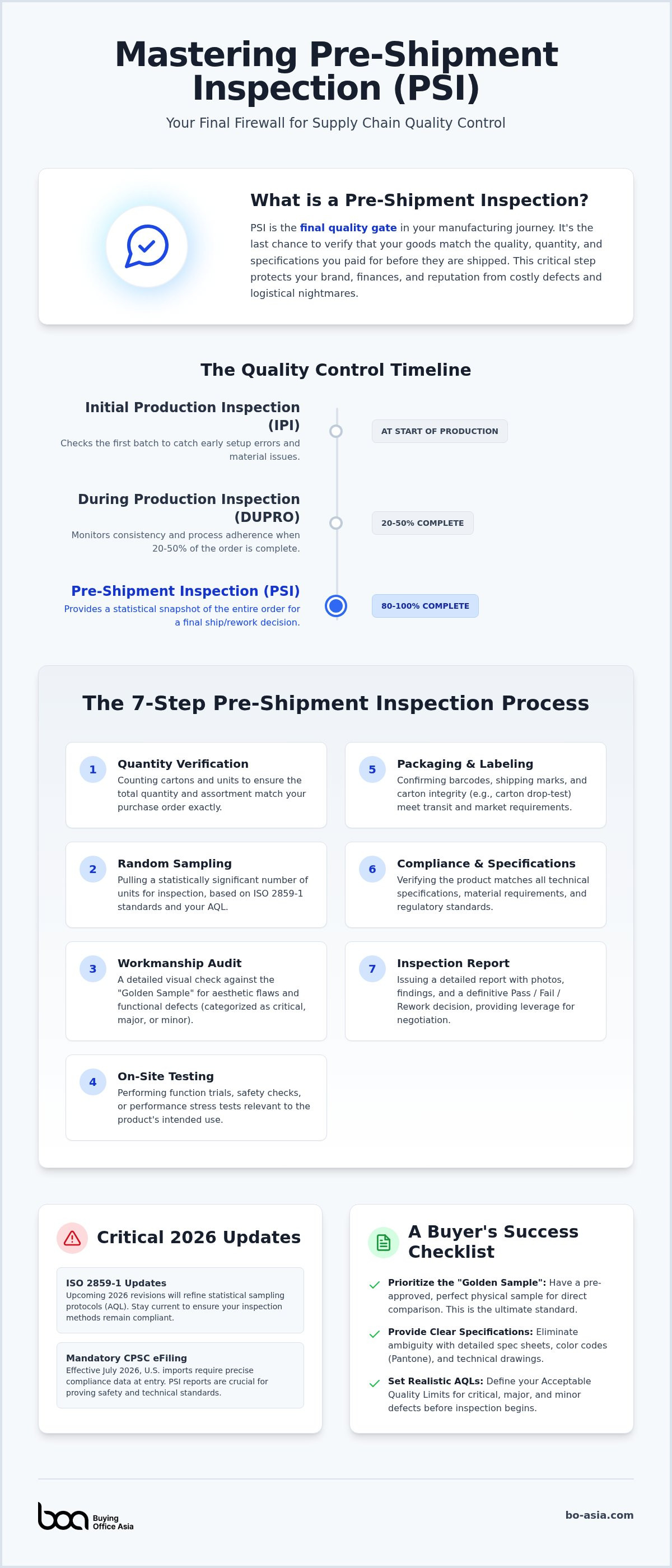
Pre-shipment inspection (PSI) is the final quality gate in your manufacturing journey. It occurs when production is between 80% and 100% complete. It's the last chance to verify that the goods you've ordered match the quality you're paying for before they leave the factory. In the broader "Source to Contract" lifecycle, this is where your theoretical quality standards meet physical reality.
It's vital to distinguish this step from earlier interventions. An Initial Production Inspection (IPI) checks the first batch to catch early setup errors. A During Production Inspection (DUPRO) happens when 20% to 50% is finished to monitor consistency. The pre-shipment inspection process is unique because it provides a statistical snapshot of the entire order, allowing for a definitive decision on whether to ship or rework.
In 2026, a simple "pass" or "fail" result is no longer sufficient for complex global markets. New regulatory hurdles, such as the mandatory U.S. CPSC eFiling rules effective July 8, 2026, require precise compliance data at the time of entry. You need granular reporting that proves your goods meet specific safety and technical standards, not just a vague thumbs up from a factory manager.
A professional PSI doesn't just look for broken parts; it validates the entire commercial agreement. The primary goals include:
Verifying that the total unit count and the breakdown of sizes, colors, or styles match your purchase order exactly.
Comparing the mass-produced items against your pre-approved "golden sample" to ensure material and finish consistency.
Confirming that packaging, inner cartons, and shipping labels meet international transit requirements and local market regulations.
Returns and recalls are brand killers that carry silent costs far beyond the initial purchase price. A rigorous pre-shipment inspection process protects your financial health by providing the leverage needed to demand reworks while the goods are still in the factory. Once you've sent the final payment and the container is on the water, your influence over the supplier vanishes. This is why PSI must be a non-negotiable step before any final wire transfer.
Many traditional agents operate on commissions, which creates a conflict of interest; they often want the shipment to move so they get paid. By integrating this step with robust supplier vetting and on-the-ground oversight, you remove the middleman risk. You gain a protective partner who prioritizes your long-term supply chain security over a quick transaction.
A professional pre-shipment inspection process isn't a casual walkthrough; it's a rigid, technical protocol designed to remove human bias and factory influence. It transforms your quality requirements into a measurable checklist that determines whether a shipment is a financial asset or a liability. While every product has unique variables, the execution follows a standardized path to ensure total transparency.
The process begins with the inspection visit and random sampling. The inspector arrives on-site once the factory confirms production is at least 80% finished and packed. They immediately move to quantity verification. By counting cartons and individual units against the packing list, they ensure you aren't paying for "ghost" inventory or missing assortments that could disrupt your retail distribution.
Next, the workmanship audit involves a detailed visual check for aesthetic and functional defects. Inspectors categorize findings into critical, major, and minor defects based on your pre-defined standards. This is followed by on-site testing. Depending on the product, this might include function trials, safety checks, or performance stress tests. Finally, the inspector validates packaging and labeling. They verify barcodes, shipping marks, and perform carton drop-tests to ensure the goods survive the journey to your warehouse.
The WTO Agreement on Preshipment Inspection establishes the international principles of transparency and non-discrimination that govern these activities. Adhering to these global standards ensures that your pre-shipment inspection process remains a legitimate tool for trade facilitation rather than a bureaucratic hurdle. If you're concerned about how these steps apply to your specific product, you can consult with our on-the-ground team for a tailored strategy.
True oversight requires total independence. A common factory tactic is the "Prepared Pile," where staff present a pre-selected group of perfect items for the inspector to check. A seasoned professional rejects this immediately. They perform a "Warehouse Pull," choosing samples randomly from the entire finished lot. This random sampling is the only way to get a statistically valid representation of the total order's quality. Our inspectors maintain a strict distance from factory management, refusing gifts or hospitality that could compromise their objectivity.
Testing protocols must be as unique as your products. For electronics, this involves voltage checks, battery cycle tests, and verifying FCC or CE compliance in real-time. For soft goods, the focus shifts to seam strength, fabric weight, and colorfastness. The criteria for these tests are often established during the custom product development phase. By defining these benchmarks early, you ensure the inspector has a clear, unarguable standard to hold the factory against during the final gate. This real-time verification of regulatory marks like UKCA or UL is your primary defense against costly customs seizures or market withdrawals.
Checking every single unit in a 10,000-piece order is operationally impossible and financially draining. To maintain efficiency without sacrificing security, the industry relies on the ISO 2859-1 standard. A revised version, ISO 2859-1:2026, was published in January 2026 to formally incorporate skip-lot sampling procedures. This standard provides the mathematical framework for the pre-shipment inspection process, allowing you to reach a high confidence level through a representative random sample. This U.S. government trade guide emphasizes how these objective standards prevent disputes by establishing a clear, pre-negotiated definition of what constitutes an acceptable shipment.
The Acceptable Quality Limit (AQL) is the core of this framework. It defines the maximum number of defective units that can exist in a batch before the entire lot is rejected. AQL isn't about accepting mediocrity; it's about calculating risk. By using statistical tables, you determine a sample size that provides a reliable snapshot of the total production. This protects the manufacturer from arbitrary rejections based on a single outlier and protects you from paying for a container filled with sub-standard goods.
In a professional inspection, not all errors are equal. Findings are categorized into three distinct tiers to guide your final decision:
These are safety hazards or legal non-compliances that could harm a user or trigger a recall. In 2026, with stricter U.S. CPSC eFiling rules, a single critical defect usually results in an automatic "Fail" for the entire batch.
These are functional failures or significant aesthetic flaws that make the product unsaleable. For example, a garment with a broken zipper or an electronic device that won't power on.
These are small deviations from the "golden sample" that don't affect performance but miss the mark on perfection, such as a slight color variance or a loose thread.
Setting your AQL levels is a strategic balancing act. While the industry standard is often 0 for critical, 2.5 for major, and 4.0 for minor defects, you should customize these based on your market's expectations. High-precision industries often tighten these limits to 1.0 or 1.5 for major defects to ensure brand integrity. As you progress in mastering sourcing, you'll learn to adjust these levels based on supplier history. If a factory shows signs of "quality fade," increasing the inspection level from General II to General III provides a larger sample size and a more rigorous defense against manufacturing erosion.
The pre-shipment inspection process is only as effective as the data you provide. If you leave the criteria to "industry standards," you're giving the factory permission to interpret quality on their own terms. Success begins weeks before the inspector arrives on-site. You must establish a clear, unarguable framework that leaves no room for ambiguity or factory excuses. This preparation ensures that the final gate is a objective verification of facts rather than a subjective negotiation.
Your preparation should center on four critical pillars. First, provide a crystal-clear Inspection Specification (IS) document. Second, ensure your inspector holds the actual "Golden Sample" rather than relying on the factory's copy. Third, set clear consequences for a failed result during your initial factory direct price negotiations. Finally, schedule the inspection with a 10-day buffer before your shipping deadline. This window is essential for addressing any necessary re-works without missing your vessel or incurring air-freight costs.
The IS document is your inspector's bible. It must detail every measurable attribute, including exact dimensions, weights, Pantone colors, and functional requirements. In 2026, this document should also integrate ESG and ethical standards to ensure your supply chain remains compliant with evolving global regulations. Most importantly, it must define "Fail" parameters. If a specific AQL limit is exceeded, the document should state exactly what happens next. This prevents the factory from pressuring you to "accept as is" when production misses the mark.
A "Failed" report isn't a disaster; it's the system working as intended to protect your brand. It's vital to distinguish between a "Pending" result, which often requires your technical review of a minor deviation, and a "Fail," which indicates the batch has exceeded the allowed defect count. When a failure occurs, you have the leverage to negotiate re-work, sorting of the entire lot, or price credits. Contractually, any second inspection should be at the factory’s expense. This financial penalty encourages the manufacturer to prioritize quality during the initial production run. If you need assistance drafting these protective clauses into your supplier agreements, reach out to our sourcing experts for a professional briefing.
Most third-party inspection firms treat the pre-shipment inspection process as a transactional policing action. They arrive, check boxes, and leave. While they might catch a surface-level defect, they often lack the contextual understanding of your long-term business goals or the original factory negotiations. This siloed approach creates a friction-heavy dynamic that often leads to hidden costs and delayed shipments. At Buying Office Asia (BOA), we view quality control as an inseparable component of your broader procurement strategy rather than a standalone hurdle.
By utilizing a dedicated Asia procurement team on the ground, you gain a protective partner that understands the entire manufacturing history of your product. We don't just report on the final batch; we manage the supplier relationship from the first sample to the final container loading. This regional presence functions as a signature promise of accountability. Our European leadership, based in Helsinki, ensures that western quality expectations are met with the pragmatism required on Asian factory floors. It's a model built on 100% transparency, where you receive the unedited reality of production without the interference of hidden commissions or obscured results.
Conventional intermediary models are often sources of obscured costs and operational inefficiency. Unmanaged agents sometimes profit from "passing" sub-standard goods to ensure their own commissions are paid quickly. This conflict of interest is a primary cause of supply chain erosion. We reject this model entirely. Our reporting is direct, providing you with high-resolution evidence and data-driven insights that allow you to make informed financial decisions. You can review real-world examples of how this integrated oversight has saved our clients from significant financial losses by identifying critical errors before they reached the port.
Scaling a business in 2026 requires the steady confidence that your supply chain can handle high-volume demands without a drop in workmanship. Our integrated "Source to Ship" process provides the elite level of oversight usually reserved for major enterprises, yet it remains accessible to independent business owners. We manage the factory-direct price negotiations, the mass production oversight, and the final pre-shipment inspection process as a single, cohesive defense against risk. Your next step is to move away from unmanaged sourcing and toward a stabilized, professional framework. Contact us today to request a custom quality control plan that secures your next project from the first production run to the final delivery.
Mastering the pre-shipment inspection process is the single most effective way to protect your brand from the financial erosion caused by manufacturing defects. By shifting from a reactive policing mindset to a strategic, integrated framework, you eliminate the risks inherent in unmanaged sourcing. You've seen how precise AQL standards and rigorous on-site verification provide the leverage needed to demand excellence before final payment is ever sent.
Success in 2026 requires more than just a checklist; it demands a partner who understands the reality of Asian production. Our European-managed team provides 100% transparency and a factory-direct model that removes the obscured costs of traditional intermediaries. With a proven track record in high-volume sourcing, we act as a stabilizing force in your international operations, ensuring every container meets your technical and ethical benchmarks.
Secure your next shipment with a dedicated procurement partner and move forward with the steady confidence of a seasoned industry insider. Your supply chain deserves the protection of on-the-ground expertise.
Pre-shipment inspections are mandatory only for specific countries and regulated product categories. For example, Tanzania requires a Pre-Shipment Verification of Conformity for vehicles, and Jamaica mandates inspections for used cars with specific fees updated in June 2026. While not universally required by law, most professional buyers treat the pre-shipment inspection process as a mandatory internal protocol to mitigate financial risk and ensure regulatory compliance before goods enter international transit.
The buyer usually covers the cost of the initial inspection as part of their quality assurance budget. However, it's standard industry practice to include a clause in your supplier agreement stating that the manufacturer must pay for any necessary re-inspections following a failed result. This structure provides a financial incentive for the factory to meet your quality standards during the first production run and prevents you from incurring unexpected expenses due to their errors.
You can perform inspections in-house if you have a dedicated team physically located near the factory. For most independent businesses, this isn't financially viable due to travel costs and regional logistics. Utilizing an integrated on-the-ground partner provides the same level of oversight as an in-house team without the overhead. This approach ensures your interests are protected by professionals who understand local production realities and can navigate the complexities of the pre-shipment inspection process.
Standard sample sizes are determined by the ISO 2859-1 tables, which were updated in early 2026. Most inspections utilize General Inspection Level II to balance cost and statistical confidence. For a lot size of 3,201 to 10,000 units, a typical sample size is 200 units. If your product is high-value or carries significant safety risks, you might opt for Level III, which increases the sample size to provide a more rigorous defense.
A standard inspection usually takes one man-day to complete for a single product lot. This timeframe includes the warehouse pull, workmanship audit, on-site testing, and packaging verification. If your order involves multiple SKUs or complex technical trials, it may require additional man-days or multiple inspectors. You should receive a detailed, illustrated report within 24 hours of the inspector leaving the factory floor, allowing for rapid, data-driven decisions regarding the shipment.
A factory's refusal to allow an inspection is a critical red flag that usually indicates significant quality issues or "quality fade." Legally, this is often treated as a breach of the purchase agreement if inspection rights were clearly defined during negotiations. In such cases, you should immediately withhold final payment. Professional procurement teams use their local presence to resolve these standoffs, ensuring the factory fulfills its contractual obligations before any goods leave the premises.
No, a PSI report is a snapshot of a specific batch's quality at a point in time, whereas a quality certificate proves a product design meets legal standards. While the PSI report verifies that the mass-produced goods match the certified samples, it doesn't replace the mandatory certification data required by customs. Effective July 8, 2026, the U.S. CPSC requires electronic filing of these compliance certificates at the time of entry for regulated consumer products.
Digital reporting in 2026 utilizes AI-powered visual detection and live video streaming to provide immediate transparency. These tools allow you to review defects in high-definition as they're discovered, rather than waiting for a PDF. Integration with blockchain technology ensures that inspection certificates are tamper-proof, providing a secure audit trail for your entire supply chain. This technological shift transforms the pre-shipment inspection process from a static document into a dynamic, real-time risk management tool.

As of July 2026, the average effective tariff rate on Chinese imports has climbed to 22.8%, but is the cost on the invoice really your biggest financial risk? You likely feel the mounting pressure of managing a supply chain where the rules of engagement change every quarter. The challenges of sourci...

Is your current China manufacturing management strategy robust enough to survive the regulatory shifts of 2026? With the recent implementation of Decree 834 and the new "Made in China" procurement standards, the distance between a successful product launch and a costly supply chain failure has never...

What if your final quality check isn't just a formality, but the only thing standing between a successful product launch and a container full of unsellable defects? For many businesses, the fear of receiving substandard goods from overseas is a constant anxiety, often compounded by communication bar...