

A supplier’s polished profile is no proof that it can deliver your product. Supplier vetting in China is a structured review of a company’s legal identity, factory capabilities, product quality and business risks before you commit to production. It combines document checks with practical evidence, including factory assessments and samples tested against your specifications.
The distinction matters because a supplier may be a factory, trading company or workshop, and each setup affects oversight, communication and production control. A disciplined review helps uncover gaps before they lead to costly delays or quality problems.
This article explains which Chinese company records to examine, what to check at a factory, and how to assess quotations, certificates and payment details. You’ll also learn when warning signs justify rejecting a supplier and how to monitor performance once production starts.
• Compare factory claims with on-site evidence of equipment, processes, workforce and production capacity, then assess samples against your specifications.
• Match the supplier’s Unified Social Credit Code, which has 18 characters, to official company records and review relevant legal history.
• Check that quotation terms, certificates and payment details align with the registered company; treat requests to pay a personal account or changes to bank details as serious warning signs.
• Pause or disqualify a supplier if key details cannot be verified, production may be subcontracted without your approval, or intellectual property protections are unclear.
• Re-vet suppliers at least once a year and track quality, delivery performance and responsiveness so emerging problems are easier to address.
Supplier vetting is a structured assessment of a manufacturer’s identity, capabilities, quality controls and risks before you commit to production. In China, compare company documents with factory evidence, production records and product samples. A sales presentation may describe capacity, but an audit tests whether the actual factory, machinery and processes support those claims. The findings help guide supplier selection and define the controls needed for the working relationship.
A factory audit should examine the production flow for your product, not just the reception area. Review machinery, workspace, worker skills, incoming-material checks, in-process and final inspections, and records of rejected goods. Ask how the factory schedules your product alongside other orders and maintains equipment. For a moulded part, for example, confirm that the relevant moulding equipment and quality checks are available at the proposed production site.
There is no single standard price for a third-party factory audit in China. The quote depends on the factory’s location, audit scope, time required, reporting detail and whether technical or social-compliance checks are included. The fee is set after defining the scope and requesting a quote.
Video verification can help establish whether a named facility appears to exist and show visible equipment or production activity. It cannot reliably replace an on-site audit: camera angles may miss work areas, records or processes, and a live call leaves limited time for follow-up. Use video as an initial check, then arrange an on-site visit when production capability, subcontracting or working conditions present material risks.
Match the audit checklist to the product’s failure risks. A process audit can trace materials from receipt through production, inspection and packing, while checking who records results and corrects defects. Products with multiple components, tight fit requirements or detailed decoration need checks at the relevant assembly and finishing stages. For higher-risk products, review applicable product-testing records and confirm that the factory’s test equipment suits the required measurements.
Ask for samples or a prototype before approving full production, then compare them with written specifications for materials, dimensions, function, finish and packaging. Record an approved sample as the reference point for later checks. An audit may also review quality systems, including procedures associated with ISO 9001, but a certificate alone does not prove that a factory can make your product consistently.
Include audit access, required records, reporting frequency and corrective-action follow-up in the quality agreement. Specify which production stages need reports and the evidence they should include, such as inspection results, defect records or test data. An audit provides only one part of the picture. Scheduled reviews and sample evaluations provide evidence as production progresses.
Start with the supplier’s full Chinese legal name and Unified Social Credit Code. According to the State Administration for Market Regulation (SAMR), the code contains 18 characters and can be checked through the National Enterprise Credit Information Publicity System, which SAMR runs. Compare the registry entry with the business license, quotation, contract, invoice details and proposed bank-account name. Differences may reflect a separate contracting entity, so resolve them before signing or paying.
To determine whether a China supplier is a manufacturer or trading company, compare its registered business information with its claimed product range, then verify the production site and capabilities. A factory visit or audit can show whether the equipment and processes match the offer. Ask who will handle each stage and require subcontracting to be disclosed in writing. A trading company can still coordinate production, but the contract should identify the responsible legal entity and factory arrangements.
Search the supplier’s legal name in Chinese court records, including China Judgments Online, for litigation, payment defaults or dishonest-debtor listings. Interpret results carefully: a record may concern a different entity with a similar name. Compare the company’s Chinese and English profiles, address, product range and contact details. Search for negative news and customer feedback, then request business references and check whether they relate to comparable products.
Use Alibaba, Made-in-China and Global Sources to find potential suppliers, but treat each profile as a starting point for independent checks. Compare the legal name and factory address across the profile, business licence and quotation. Badges on Alibaba and Made-in-China do not replace registry checks, an audit or sample evaluation. Request a sample and confirm that the entity issuing the quotation matches the business records before discussing a production order.
Use this document checklist before approving the supplier:
business license, Chinese legal name, Unified Social Credit Code and registered address.
factory address, product scope, manufacturing-process details and subcontractor disclosure.
certificate number, holder name, scope and issuing body; validate each relevant certificate with its issuer. ISO 9001 alone does not prove the company is a manufacturer, because traders may also hold it.
references, relevant customer feedback, online reviews and court-record results.
Ask procurement and quality teams to apply the same checklist to each candidate. Meeting the checklist supports a risk assessment, but does not make a supplier risk-free. Unresolved identity or capability mismatches call for further review. Put the verified legal entity, product specifications, payment terms and dispute-resolution arrangements in the contract. For a structured review of Chinese supplier records and factory evidence, explore supplier vetting and factory audits.
A quotation should identify the legal seller, product specifications, price basis, order quantity, tooling charges, payment schedule and delivery terms. Compare each item with your approved sample and purchase requirements. For a product with multiple components, request a breakdown by component so material, assembly, decoration and packaging costs are visible. Agree in advance how price changes, replacement parts and rework will be handled.
Ask the manufacturer to state its capacity for the specific process and product, rather than giving only its general monthly output. Clarify whether the schedule depends on tooling, material availability, artwork approval or another production step. Compare the quotation with the contract and pro forma invoice. Names, quantities, specifications, currency and payment details should match across all three documents. Resolve any mismatch in writing rather than overlooking it.
For certificates, compare the named holder, product or facility scope, certificate number and validity details with the supplier’s claims. Validate ISO 9001 with its issuing body; the certificate supports review of a quality-management system, but does not establish that a particular sample meets your specification. For product-testing reports, match the model, materials, test scope and report details to the item you intend to buy. A report for a similar-looking product may not cover the same construction.
Ask for the testing laboratory’s name and verify the report through the laboratory’s own verification channel. Check that it identifies the tested sample and the requested tests. If the supplier provides only a summary, request the full report and compare its findings with your product requirements. A certificate or test report is useful only when its scope applies to the actual product and order.
US buyers should use a written contract that identifies the correct legal entities and sets out specifications, quality-control steps, delivery schedules, payment milestones, intellectual property protections and dispute-resolution mechanisms. State the governing terms and dispute process clearly, and have qualified counsel review the agreement for the transaction. Also define what happens after delays, rejected goods or unauthorized subcontracting.
Before transferring funds, confirm the bank-account name matches the registered company. Don’t pay 100% upfront or wire payment to a personal account. If bank details change, independently re-confirm the change by phone using a previously verified contact, not the number in the change request. Treat urgency or unexplained account substitutions as a stop signal.
reconcile the quotation, contract and invoice.
link the approved sample and specifications to the order.
verify the account name and confirm any changes by phone.
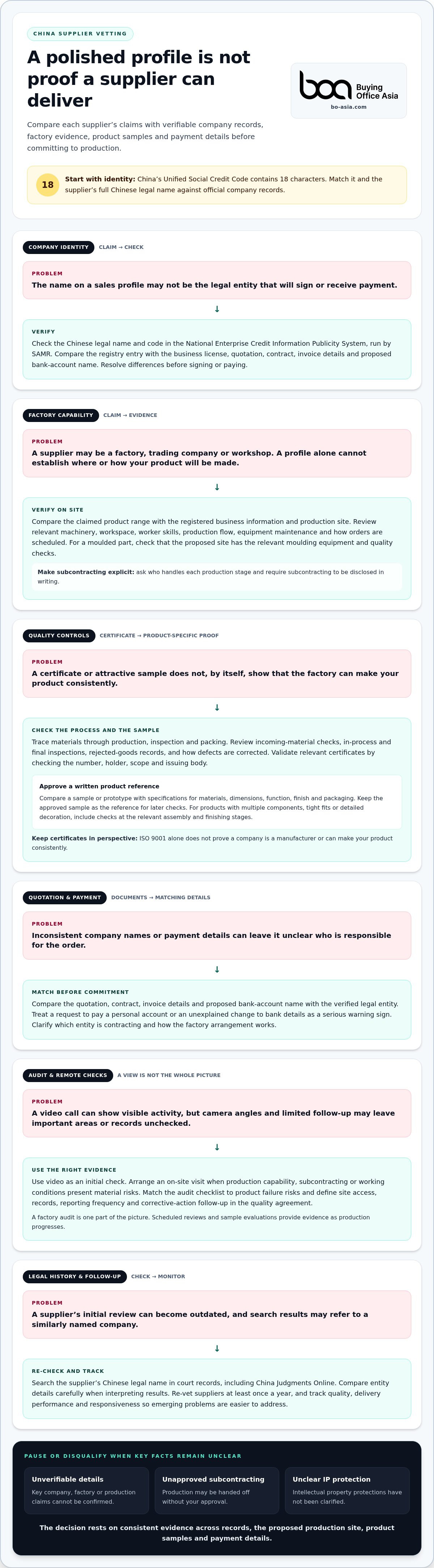
Set rejection rules before comparing suppliers, so a low quotation cannot outweigh a serious risk. Stop the evaluation if a company refuses reasonable factory access, changes the named production site without explanation or will not disclose subcontracting. An unexplained request to send funds to a personal account, inconsistent legal documents or pressure to pay before contract terms are settled also warrants a pause. Record the evidence and decision instead of relying on verbal assurances.
Certificates, samples and references each show only part of a supplier’s performance. An ISO 9001 certificate does not prove a specific product meets your specification, while a sample may differ from mass production in materials, workmanship or process control. References can be selective, and a customer’s experience may concern a different product or production period. Cross-check those sources against factory evidence, written specifications and production records.
A risk assessment should distinguish correctable gaps from disqualifying problems. A missing production record may be addressed through a corrective-action plan and follow-up review; refusal to identify the actual factory undermines the basis for sourcing. For a product with several components, assess whether the supplier can trace material changes, maintain assembly consistency and protect approved artwork or designs. Set clear acceptance criteria before committing to tooling or a larger order.
Use a documented evaluation to compare suppliers on identity, capability, quality controls, communication, delivery performance and ethical practices. Mark each finding as verified, unresolved or unacceptable, and assign an owner and next step. Don’t average a serious failure against other strengths to create a passing score. For example, a strong sample cannot offset evidence that production will move to an undisclosed subcontractor.
material identity inconsistencies, concealed subcontracting, falsified records or refusal to cooperate with essential checks.
unexplained certificate differences, changing bank instructions or missed commitments without a credible corrective plan.
manageable process gaps with documented corrective actions, responsible owners and review points.
Supplier vetting in China can reduce exposure, but no review removes every sourcing risk. A supplier may subcontract without notice, disappear after receiving a deposit or misuse product designs. Protect the relationship with written approval of the production site, access to relevant records and clear change-control steps. Limit access to sensitive design files to what each production stage requires, and document ownership and permitted use in the agreement.
Develop a backup supplier for products where production interruptions could affect your market commitments. Keep the alternative’s specifications, sample status and evaluation records current, rather than starting qualification after the first supplier fails. Track corrective actions through to completion, then treat repeated quality or communication failures as a sourcing decision. This provides a practical response without treating one certificate or inspection as proof of ongoing performance.
Re-vet existing suppliers at least once a year, and sooner after material changes. A new factory address, ownership change, production-site move or updated business licence can alter your risk profile. Compare the supplier’s current registered details with the records approved during onboarding. Confirm that the factory, production processes and subcontracting arrangements still match your agreement.
Track performance using measures tied to your order requirements. Review delivery timeliness, product quality and customer satisfaction alongside supplier responsiveness. For each production run, record defects, missed milestones, unresolved corrective actions and changes to approved materials. A supplier that responds quickly but repeats a quality failure needs a different rating from one that identifies the cause and prevents it from happening again.
Build a scorecard that separates results from explanations. Record the target, actual outcome, evidence and follow-up owner for each measure. For example, document whether a shipment met the agreed schedule, whether inspection findings were corrected and whether production updates arrived as promised. Compare periods consistently so a delayed order or successful sample does not obscure a developing pattern.
log inspection results, recurring defects and corrective-action closure.
compare agreed milestones with actual production and shipment dates.
track response quality, issue escalation and production updates.
recheck registration details, factory location and relevant certificates.
Apply supplier vetting throughout the relationship, not just before the first payment. Set review points around significant events, such as a new product, revised tooling, a production-site change or repeated quality findings. If a supplier changes its bank instructions, pause payment and re-verify them through an established contact channel. This protects financial controls while keeping routine order reviews focused on production performance.
Supplier audits and data reports can reveal different risks. An on-site review examines current conditions and processes; scheduled reports show whether performance remains stable between visits. Specify in the quality agreement which records the supplier must provide, who reviews them and how corrective actions are closed. For regulated sectors, track the share of products meeting internal guidelines and applicable government requirements.
Share evidence-based findings with the supplier and agree on corrective actions, owners and review dates. Assessment data can help identify improvements to quality and logistics capacity. Escalate repeated failures through a defined process: require corrective action, increase oversight, suspend new orders or qualify an alternative source. Keep backup-supplier records current so sourcing decisions do not begin only after a disruption.
Buying Office Asia supports businesses that need supplier vetting linked to procurement and production decisions. Its End-to-End Sourcing & Procurement service can coordinate supplier assessment, purchasing and production follow-up, helping you act on audit findings instead of treating them as isolated paperwork. This approach suits projects where supplier selection, quality requirements and delivery planning are interconnected.
For larger purchasing programmes, High-volume sourcing & procurement and a Dedicated Asia Procurement Team provide ongoing coordination. Factory Direct Price Negotiations can support commercial discussions with manufacturers. If you need a sourcing partner to assess suppliers and manage procurement through production, contact Buying Office Asia to discuss your project.
Turn your supplier evaluation into a working procurement control by assigning responsibility for reviewing performance, recording changes and escalating unresolved risks. This keeps decisions connected to evidence gathered during supplier vetting in China, rather than leaving important findings in a report that no one revisits.
As your product range or production needs evolve, revisit the controls that matter most to your business. A new design, material or supplier can change what your team needs to verify. Buying Office Asia can connect supplier selection with procurement oversight through its End-to-End Sourcing & Procurement support, with a Dedicated Asia Procurement Team for ongoing coordination.
Bring your sourcing priorities and current supplier challenges into the next conversation. Talk with Buying Office Asia about your sourcing needs and take a practical next step toward more controlled manufacturing.
Supplier vetting is a decision process for determining whether a supplier meets your commercial, operational and product requirements. Use the outcome to set approval conditions, identify unresolved questions and assign responsibility for follow-up. For example, if a launch depends on custom tooling, make tooling access and ownership part of the approval decision instead of treating supplier selection as a stand-alone purchasing task.
Use the supplier’s Chinese legal name and Unified Social Credit Code to identify the precise entity you intend to contract with. Save a dated copy of the record you review, then confirm that the contract names the same entity. Also verify who will sign for the supplier and receive purchase orders. These steps help prevent a sales contact or related company from being mistaken for your contracting counterparty.
Beyond basic identity records, request project-specific documents that turn expectations into controlled production inputs. These may include a revision-controlled bill of materials, production schedule, tooling register, packaging artwork files and a list of approval responsibilities. For a product with several components, request a responsibility matrix showing who supplies, assembles and checks each part. Keep the approved versions with the purchase order.
Distinguish the factory’s physical location from the company responsible for operating production. Ask which entity controls the workers, equipment and production schedule, and identify any separate production partners in the project plan. To assess capacity, focus on the likely bottleneck, such as a finishing or assembly stage, rather than relying on a headline output figure. Request a schedule showing how your order fits alongside existing commitments.
Assess legal-record findings by checking whether the supplier was claimant or defendant, whether the case concerns the same legal entity and whether similar disputes recur. Ask the supplier for a written explanation of relevant findings and compare it with the proposed contract and payment structure. A single record needs context; a pattern involving comparable commercial disputes may call for tighter approval controls or a different sourcing decision.
Capability, process and social-compliance audits answer different questions, so define the decision each audit should support before setting its scope. Give the auditor product-specific checkpoints, identify records to review and request an action log that assigns each finding to an owner. For example, an audit for a product with several assembly stages should focus on the stages most likely to affect fit, finish or component completeness.
Create a compliance matrix for each product version and destination market. Record the intended use, product claims, applicable evidence, responsible reviewer and any change that would trigger reassessment. A material substitution, revised design or new age grading may affect which evidence applies. The matrix helps procurement, product and quality teams use the same release criteria instead of relying on disconnected files.
Build payment controls into your internal workflow, not just the supplier relationship. Separate purchase approval from funds release, and reconcile each invoice against the approved order and documented production milestone. Keep communications about commercial changes in a controlled project record. This creates an audit trail for finance and procurement teams and makes unusual requests easier to spot before they affect the order.

Distance can turn a small production issue into a coordination problem. The benefits of having a team on the ground in Asia include closer alignment between regional operations and your wider business. Local presence can connect strategy with supplier activity, product decisions, and day-to-day coll...

A container can be ready to move and still incur port charges. The practical question is what demurrage is and how to avoid it: demurrage is a charge for cargo left at a port or terminal beyond its agreed free time. The amount depends on the applicable rate and how long the cargo remains there.That...

Knowing how to manage overseas manufacturing projects starts with comparing total landed cost, not just the factory quote. Include tooling, freight, tariffs and duties, insurance, management time, and the cost of correcting problems. Weigh those expenses against product quality, delivery risks, and...