


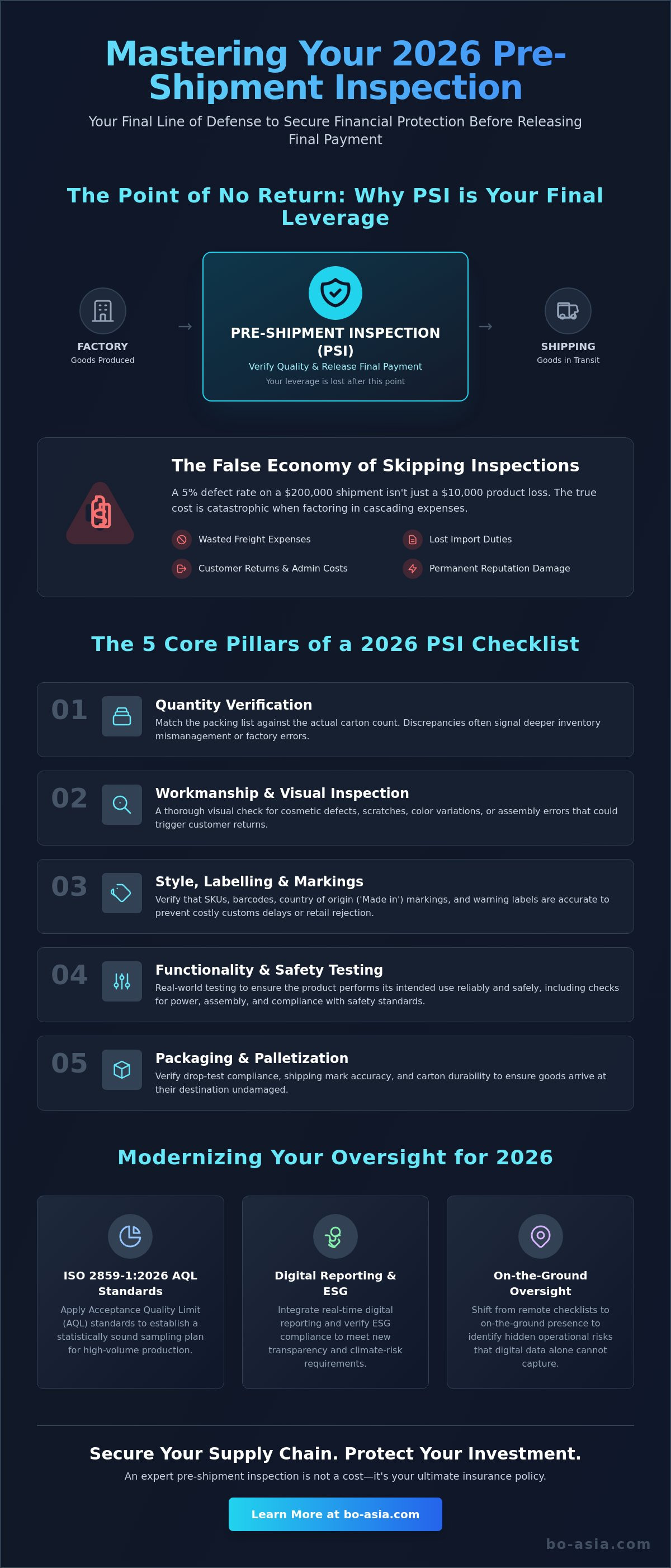
A pre-shipment inspection is not a simple quality check; it is a strategic financial audit that triggers the final transfer of risk from the factory to your balance sheet. In the current manufacturing climate, the cost of a single container of substandard goods arriving at your warehouse can be catastrophic to your margins and your reputation. This is why mastering your pre-shipment inspection checklist 2026 is no longer optional for brands sourcing from Asia. It's your final opportunity to verify that every unit meets your specifications before you release the final payment and lose your leverage.
You likely already know that relying on a factory's internal reports is a gamble you can't afford to take. We'll help you master the exact criteria and strategic framework needed to verify product quality and compliance before your goods leave the factory floor. This guide provides a foolproof verification document designed to ensure zero-defect delivery and financial protection against substandard production. You'll learn how to integrate the latest ISO 2859-1:2026 sampling standards and navigate the complexities of new ESG regulations, such as California's SB 253, to keep your supply chain secure and profitable.
• Define the pre-shipment inspection as your final point of leverage to secure financial protection before releasing the final payment to your factory.
• Implement a comprehensive pre-shipment inspection checklist 2026 that covers quantity verification, workmanship, and functional testing to ensure zero-defect delivery.
• Apply the latest ISO 2859-1:2026 AQL standards to establish a statistically sound sampling plan for high-volume production oversight.
• Integrate real-time digital reporting and ESG verification to meet evolving 2026 transparency and climate-risk reporting requirements.
• Shift from remote checklists to on-the-ground oversight to identify hidden operational risks that digital data alone cannot capture.
A Pre-shipment inspection (PSI) acts as your final gatekeeper in the manufacturing process. It's the strategic moment where you verify that what you ordered is actually what has been produced before you release the final balance payment. In 2026, global trade demands a higher level of accountability than ever before. Relying on a factory's internal quality report is no longer a viable business strategy. Once your goods are loaded onto a vessel and clear customs, you've reached the point of no return. Attempting to return defective products from a warehouse in North America or Europe back to a factory in Asia is logistically complex and financially ruinous. Your pre-shipment inspection checklist 2026 is the tool that prevents this scenario by ensuring defects are caught while the goods are still on the factory floor.
The shift toward total supply chain transparency in 2026 means that "good enough" is a relic of the past. Independent third-party oversight provides the objective reality that factory-led QC often obscures. While a factory's goal is to ship on time, your goal is to receive perfection. These objectives are often at odds. By deploying an autonomous team to the factory floor, you eliminate the conflict of interest and gain a transparent view of your production's actual state. This oversight is your primary defense against the operational setbacks that plague unmanaged supply chains.
Skipping a professional inspection is a false economy. Consider a high-volume order where 5% of the units possess major defects. On a $200,000 shipment, that represents $10,000 in direct product loss. The true cost is significantly higher when you factor in wasted freight expenses, import duties, and the administrative burden of customer returns. For consumer brands, the damage to your reputation is often permanent. Middlemen who skip on-site verification are effectively gambling with your capital. They prioritize their own convenience over your financial security, leaving you exposed to the risk of receiving substandard goods that cannot be sold.
Timing is everything in quality control. A PSI is conducted when 80% to 100% of the production is finished and export-packed. It is the mandatory minimum for any professional sourcing operation. While a DUPRO inspection happens earlier to catch systemic issues in the assembly line, the PSI provides the final statistical proof of quality. For complex electronics or high-precision industrial components, utilizing both is the only way to achieve maximum security. This layered approach ensures that early errors don't snowball and that the final packaging meets international shipping standards. Your pre-shipment inspection checklist 2026 should serve as the definitive audit that triggers your final transfer of risk.
Your pre-shipment inspection checklist 2026 must function as a rigorous audit of five core pillars to ensure your goods are market-ready. A checklist isn't just a list of tasks; it's a strategic document that defines your quality expectations. While the WTO Agreement on Preshipment Inspection provides the global regulatory backdrop for these procedures, your specific checklist must be tailored to your unique product requirements. These pillars include:
We match the packing list against the actual carton count. Discrepancies here often signal deeper inventory mismanagement or factory errors.
This involves a thorough visual check for defects, scratches, or assembly errors that could trigger customer returns.
We verify that SKUs, barcodes, and 'Made in' markings are accurate. Incorrect labelling can lead to costly customs delays or retail rejections.
This pillar focuses on real-world testing to ensure the product performs its intended use reliably.
We verify drop-test compliance and shipping durability to protect your investment during the rigors of ocean freight.
By systematically addressing these five areas, you create a comprehensive barrier against substandard production. If you need assistance developing a bespoke protocol for your next production run, you can connect with our technical team to refine your oversight strategy.
Safety is non-negotiable. For electronics, we conduct electrical safety testing, including Hi-pot and earth continuity tests, to prevent future liability. Physical stress tests are particularly vital for OEM manufacturing, where custom components may have unique failure points under pressure. We also integrate chemical and material compliance checks, such as RoHS and REACH, to ensure your goods meet the evolving environmental standards of 2026. These on-site tests provide the technical assurance that your production is both safe and legally compliant before it leaves the factory floor.
High-volume production requires a mathematically sound approach to risk management. You cannot personally inspect every single unit in a 50,000-piece order without incurring prohibitive costs and delays. This is where the ISO 2859-1 standard, commonly known as the Acceptable Quality Limit (AQL), becomes the backbone of your pre-shipment inspection checklist 2026. AQL is a statistical tool that determines the maximum number of defective units allowed in a sample before the entire lot is rejected. These standards align with the WTO Agreement on Pre-Shipment Inspection, ensuring that your quality control procedures are transparent, non-discriminatory, and globally recognized.
Choosing the right inspection level is a strategic decision. General Inspection Level II is the industry standard for most consumer goods, providing a balanced trade-off between confidence and cost. If you are dealing with a new factory or a high-risk product, you might escalate to Level III to increase the sample size and decrease your exposure. Conversely, Level I might be appropriate for established, high-performing partners. The math protects you by establishing a clear 'Accept' vs. 'Reject' threshold. If the number of defects found exceeds the pre-defined limit, the report triggers an immediate 'Fail,' giving you the leverage to demand a total re-work before the goods leave the floor.
In 2026, standard AQL levels typically sit at 0 for critical defects, 2.5 for major defects, and 4.0 for minor defects. However, consumer electronics often require tighter thresholds compared to textiles. Your choice should be heavily influenced by your supplier vetting history. For mission-critical components, we may recommend a 'Zero Defect' (C=0) sampling plan. This aggressive stance ensures that if even one defect is found in the sample, the entire batch is rejected, providing an elite level of oversight for your most sensitive production runs.
The integrity of your data depends entirely on the randomness of the sample. We enforce the 'Box-Pulling' rule, where our inspectors personally select cartons from the entire batch, including the bottom and middle of the pallets. We never allow the factory to pre-select samples, as this leads to biased results that mask systemic issues. Once the inspection is complete, we verify that cartons are sealed with tamper-evident tape. This prevents the factory from swapping out inspected units for substandard ones after our team has left the site. This physical proximity and hands-on selection process are what transform a simple checklist into a robust defense against operational fraud.
The transition from paper-based audits to real-time digital reporting represents a seismic shift in supply chain security. In 2026, your pre-shipment inspection checklist 2026 is no longer just a static document; it's a live data stream. By utilizing GPS-stamped photos and encrypted timestamps, we provide absolute proof of physical presence on the factory floor. This digital chain of custody links your inspection results directly to the Bill of Lading. It ensures the goods that were verified are the exact items loaded into the container. This level of transparency effectively eliminates the risk of post-inspection tampering, a common pitfall in unmanaged sourcing.
To streamline these processes, many professionals explore generate report in one click to see how modern site management platforms can automate the synthesis of field data into professional, audit-ready documents.
Modernizing your oversight also means addressing the complex regulatory environment of 2026. With California’s SB 253 requiring detailed emissions reporting and the ISO 9001:2026 update integrating climate considerations into quality systems, your inspection must serve a dual purpose. It's the final opportunity to verify not just the physical product, but the ethical and environmental claims made by the manufacturer. If you want to ensure your production meets these elite standards, you can request a consultation with our regional experts to review your current protocols.
Verification of ESG compliance happens on the factory floor, not in a boardroom. During the final walk-through, our team checks for excessive packaging waste and ensures that recyclable materials are used as specified. We look beyond the product to verify ethical labor practices, such as proper safety equipment and fair working conditions. This on-site reality check ensures your brand isn't exposed to the legal and reputational risks associated with non-compliant supply chains. It's about protecting your brand's integrity before the goods depart.
AI-driven defect recognition is now a standard feature in digital reporting, helping to identify microscopic flaws from high-resolution inspection photos. While some suggest remote video inspections, we view these as a risky compromise. A camera only sees what the factory wants it to see. By integrating on-site data into your dedicated procurement team's dashboard, you get the best of both worlds: advanced technological analysis backed by a physical presence. This integrated approach ensures your financial health is protected by verified facts, not curated video feeds.
A pre-shipment inspection checklist 2026 provides the necessary structure for quality control, but a checklist is only as reliable as the person holding it. In the complex landscape of Asian manufacturing, data on a screen can be manipulated; physical presence cannot. While digital reports offer speed, they often fail to capture the operational atmosphere of a factory. An experienced inspector on-site notices the subtle indicators of trouble, such as a disorganized assembly line, inadequate lighting, or a workforce that appears undertrained for the technical complexity of your product. These "vibe" checks are leading indicators of quality drift that a remote report will always miss.
Our approach at Buying Office Asia is to function as your protective, on-site partner rather than a detached third-party service. We use the results of the inspection as a strategic tool for your financial benefit. For example, a failed report isn't just an operational hurdle; it's a powerful negotiation lever. It provides the objective evidence needed to enforce factory-direct pricing adjustments or demand immediate, no-cost re-works. By maintaining physical proximity to the production source, we ensure that your factory remains accountable to the original terms of your agreement. This oversight transitions seamlessly into logistics and shipping management, ensuring that your verified goods are handled with the same rigor during transit as they were during production.
Having European-managed teams stationed directly in Hong Kong and Mainland China provides a unique cultural and professional bridge. We understand the high standards your brand requires and possess the regional expertise to manage factory relationships when things go wrong. When an inspection reveals major defects, our team doesn't just send a "Fail" notification; we stay on the floor to manage the corrective action plan. This was recently demonstrated when our on-site team saved a 50,000-unit consumer electronics order. By identifying a systemic battery calibration error during the final walk-through, we prevented a catastrophic recall that the factory's internal QC had completely overlooked.
The Container Loading Inspection (CLI) serves as the final seal on your quality assurance process. It's the critical step that closes the loop between your pre-shipment inspection checklist 2026 and the actual dispatch of goods. Our inspectors supervise the entire loading process to ensure that the specific batches marked as "Passed" are the ones actually placed into the container. We verify carton conditions, container integrity, and the application of tamper-evident seals. This level of supervision ensures that the product quality verified on the factory floor is the exact quality that arrives at your warehouse, providing the final layer of financial and legal protection for your supply chain.
Protecting your margins in 2026 requires more than a digital paper trail. You've seen how a rigorous pre-shipment inspection checklist 2026 serves as your final financial defense, ensuring that defects are caught before your capital is committed. By integrating modern ESG verification and strict AQL sampling, you transform quality control from a reactive chore into a strategic audit. This level of oversight is what separates successful global brands from those struggling with costly recalls and terminal reputational damage.
Real security comes from physical proximity and a partner who acts as an extension of your own team. Buying Office Asia offers 100% transparency with no hidden middlemen, providing the steady confidence of an established expert. With European-managed leadership headquartered in Hong Kong and a permanent on-the-ground presence across major Asian manufacturing hubs, we ensure your production meets every technical and ethical standard. Secure your supply chain with Buying Office Asia’s on-site inspection services today. Your path to zero-defect delivery starts with the right ally on the factory floor. We're ready to help you build a more resilient and profitable supply chain.
A Pre-Shipment Inspection is the final quality gate before your goods leave the factory floor and you release the final payment. It's mandatory because it serves as your primary defense against receiving a container of defective products. By verifying quality, quantity, and compliance at the source, you eliminate the financial risk of discovering issues after the goods have cleared customs and arrived at your warehouse.
Professional inspection costs are typically structured around a "man-day" rate, which covers one inspector's work for a full business day. The total expense depends on the factory's geographic location, the technical complexity of the product, and the total sample size required by your AQL plan. Investing in this service is a minor operational cost compared to the catastrophic expense of a full product recall or mass customer returns.
You can visit the factory personally, but hiring an independent partner provides a level of objective rigor that's difficult to maintain alone. Third-party teams possess the regional expertise and technical equipment to execute a professional pre-shipment inspection checklist 2026 with total impartiality. This removes the conflict of interest inherent in factory-led reporting and ensures your quality standards are enforced without compromise or cultural bias.
You should immediately withhold the final balance payment and issue a formal corrective action plan to the manufacturer. The factory is responsible for sorting, re-working, or replacing the defective units at their own expense. Once the factory claims the issues are resolved, a re-inspection is conducted to verify the fix. This process ensures you only pay for goods that meet your exact specifications.
A standard inspection for a single product category usually takes one full business day to complete. If your order involves high volumes or requires specialized electrical and safety testing, it may require multiple man-days or a larger team of inspectors. We coordinate the schedule to ensure the inspection happens when at least 80% of your order is finished and packed for export.
These figures represent the maximum allowable percentage of defects within your sampled lot. AQL 1.5 is a stricter standard often reserved for critical components or high-end luxury goods. AQL 2.5 is the global industry standard for major defects in consumer products, while 4.0 is typically used for minor cosmetic issues. Choosing the right level balances your tolerance for risk against the cost of the inspection.
No, a PSI is a statistical sampling method designed to provide a high confidence level rather than a 100% guarantee. It identifies systemic production issues and ensures the overall batch stays within your agreed quality limits. While it's the most cost-effective way to manage risk in mass production, it's a tool for statistical probability rather than a piece-by-piece manual check of every unit.
We prevent post-inspection tampering by applying tamper-evident seals and unique stamps to the cartons our team has verified. To close the security loop entirely, you should utilize a Container Loading Inspection (CLI). During a CLI, an inspector stays on-site to witness the loading process, ensuring that the specific cartons listed on your pre-shipment inspection checklist 2026 are the ones actually placed into the shipping container.

The traditional commission-based sourcing agent in India is no longer an asset; they're often your greatest financial risk in a market rapidly scaling toward a $2 trillion export target. You likely recognize the inherent conflict when an agent's income rises alongside your factory costs, or the anxi...

If your current sourcing agent claims their services are free, you're likely paying a hidden tax of 10% to 30% through inflated unit prices and factory kickbacks. This lack of transparency doesn't just erode your margins; it creates a dangerous barrier between you and the factory floor. Finding a re...

A perfect golden sample is often the most dangerous document in your supply chain. If a prototype is handcrafted by a master technician rather than built using scalable factory processes, your sample development phase isn't a success; it's a liability. This gap between a one-off masterpiece and a hi...