


The most powerful legal document in your supply chain isn't a signed PDF; it's the physical object sitting in your master sample cabinet. You've likely felt the sting of receiving a "hero sample" that looks perfect, only to find the factory can't replicate that quality at scale. This discrepancy often leads to costly delays and eroded margins. By mastering a rigorous golden sample approval process, you transform a simple prototype into a binding benchmark that protects your brand from quality fade.
We understand the pressure to maintain control over international production, especially as the industry prepares for the new ISO 9001:2026 standards. In this guide, you'll learn how to secure your manufacturing lifecycle to ensure mass-produced goods match your exact specifications. We'll examine how to establish clear communication with Asian manufacturers and use physical samples as your ultimate defense against operational setbacks. This strategy provides the regional expertise and oversight needed to turn your procurement into a stable, predictable asset for your business.
• Distinguish between marketing samples and manufacturing benchmarks to protect your production from quality fade and inconsistent output.
• Implement a structured golden sample approval process to create a legally binding physical contract that ensures mass production matches your exact specifications.
• Identify the "Hand-Made Fallacy" and avoid bait-and-switch tactics where factories use premium materials only for initial prototypes.
• Use a professional verification checklist covering Pantone matching and surface finishes to eliminate discrepancies before the first shipping container is loaded.
• Leverage an on-the-ground procurement team in Asia to remove middlemen and maintain 100% transparency during the critical sampling phase.
In the B2C retail world, a sample is often just a marketing tool designed to entice a buyer. In industrial manufacturing, however, the sourcing and procurement lifecycle treats the sample as a binding technical contract. The golden sample approval process serves as the definitive bridge between a conceptual design and a container full of viable products. It functions as the "immutable truth" for your quality control teams. While a factory representative might promise high-tier performance during a sales pitch, the physical sample reveals their actual technical capability. It strips away the marketing gloss and exposes whether their machinery, labor, and material chains can truly meet your specific tolerances.
Industrial sampling is a rigorous validation of your Bill of Materials (BOM) against physical reality. You need to ensure that the specified resins, alloys, or textiles aren't just listed on a spreadsheet but are actually present in the final build. This stage allows you to test durability, aesthetics, and functionality in real-world environments before you commit capital to high-volume production. This process also establishes the baseline for all future quality control and Acceptable Quality Level (AQL) inspections. It mirrors the professional rigor found in the Production Part Approval Process (PPAP), ensuring every stakeholder agrees on the exact physical standard for the entire run.
Relying on high-resolution photos or digital renders is a high-risk strategy that frequently leads to catastrophic production failures. Digital files mask technical flaws, such as poor surface tension, structural weak points, or incorrect tactile finishes, that only appear once physical tooling is engaged. You can't verify the weight of a component or the smooth operation of a mechanical hinge through a computer screen. Physical verification is non-negotiable. Without a physical benchmark locked in through a formal golden sample approval process, you leave your shipment vulnerable to quality fade. This is a common scenario where factories slowly substitute cheaper materials over time because no tangible standard was ever signed, dated, and held as a defense against deviations.
Moving from a conceptual design to physical reality requires a disciplined, multi-stage approach. You can't afford to rush the transition between a digital file and a physical product if you want to protect your margins. The sampling lifecycle is a funnel that narrows your focus from general design concepts to a specific, immutable production standard. This journey consists of four distinct milestones: the initial prototype for form and fit, the pre-production sample (PPS) using actual materials, the finalized golden sample, and the shipping sample pulled from the first batch. Each stage serves as a checkpoint where you either validate the factory's progress or halt production to correct deviations.
Transitioning from rapid prototyping, such as 3D printing or CNC machining, to factory tooling is the point of no return in your financial commitment. Once you invest in custom molds, design changes become prohibitively expensive. You must manage this feedback loop with "red-pen" critiques that provide the factory floor with actionable technical instructions. It's during the PPS stage that you verify final finishes, surface textures, and packaging durability. High-stakes industries often rely on rigorous quality control systems to ensure consistency, and your procurement strategy should mirror this level of detail. If you find the technical iterations are stalling, you can consult with our on-site team to facilitate direct communication with the factory engineers.
The golden sample approval process reaches its peak with the creation of three identical physical benchmarks. You must never rely on a single sample. One copy stays at the factory as a daily reference for the assembly line workers. You retain the second copy at your headquarters. The third copy is held by your independent inspector to serve as the master reference during AQL inspections. In your OEM manufacturing contract, this sample functions as the legal standard for acceptance or rejection. Every sample must be signed, dated, and sealed with tamper-evident tape to prevent "sample swapping" or unauthorized modifications. This physical protocol ensures the golden sample approval process remains your ultimate defense against quality fade. Once mass production begins, the shipping sample acts as the final verification, proving that the factory can maintain the golden standard under the pressure of high-volume output.
A flawless prototype is often a dangerous distraction. You've likely experienced the frustration of approving a perfect unit only to receive a shipment plagued by defects. This discrepancy usually stems from the "Hand-Made Fallacy." Factories often task their most senior engineers to hand-craft samples using specialized equipment. While the result is impressive, it represents a standard that the standard assembly line, with its high-speed processes and varied labor skill, simply can't replicate. Without a structured golden sample approval process that accounts for mass-production realities, you're essentially approving a work of art rather than a manufacturing benchmark.
Technical drift and "Sample Bait-and-Switch" tactics further complicate the transition to high-volume manufacturing. Some suppliers use premium materials to secure your order, only to substitute them with lower-cost alternatives once mass production begins. This is why supplier vetting is a mandatory prerequisite. You must confirm that the factory's supply chain for raw materials is stable and that they aren't relying on one-off batches for your samples. Identifying these risks early prevents the operational setbacks that occur when a shipment fails to meet your specifications.
Remote buyers frequently fall victim to the "Golden Sample" paradox. They approve a physical sample in isolation without knowing the factory's actual capacity or machinery state. It's a high-stakes gamble. Middlemen often exacerbate this by cherry-picking the best units from a flawed batch to hide factory weaknesses. This lack of transparency obscures the truth about the factory's technical limitations. If you can't see the machines producing your sample, you can't be certain they can produce 10,000 more just like it.
To eliminate these risks, your golden sample approval process must include on-site verification. Our teams monitor sample production on the actual mass-production machinery to ensure the process is repeatable at scale. We also utilize third-party lab testing to verify that material composition matches your Bill of Materials (BOM) exactly. It's also critical that the sample reflects final retail-ready packaging and labeling. If the box strength or barcode placement is incorrect on the sample, it will almost certainly be incorrect in the final shipment. By verifying every detail on the ground, you secure the financial viability of your procurement strategy.
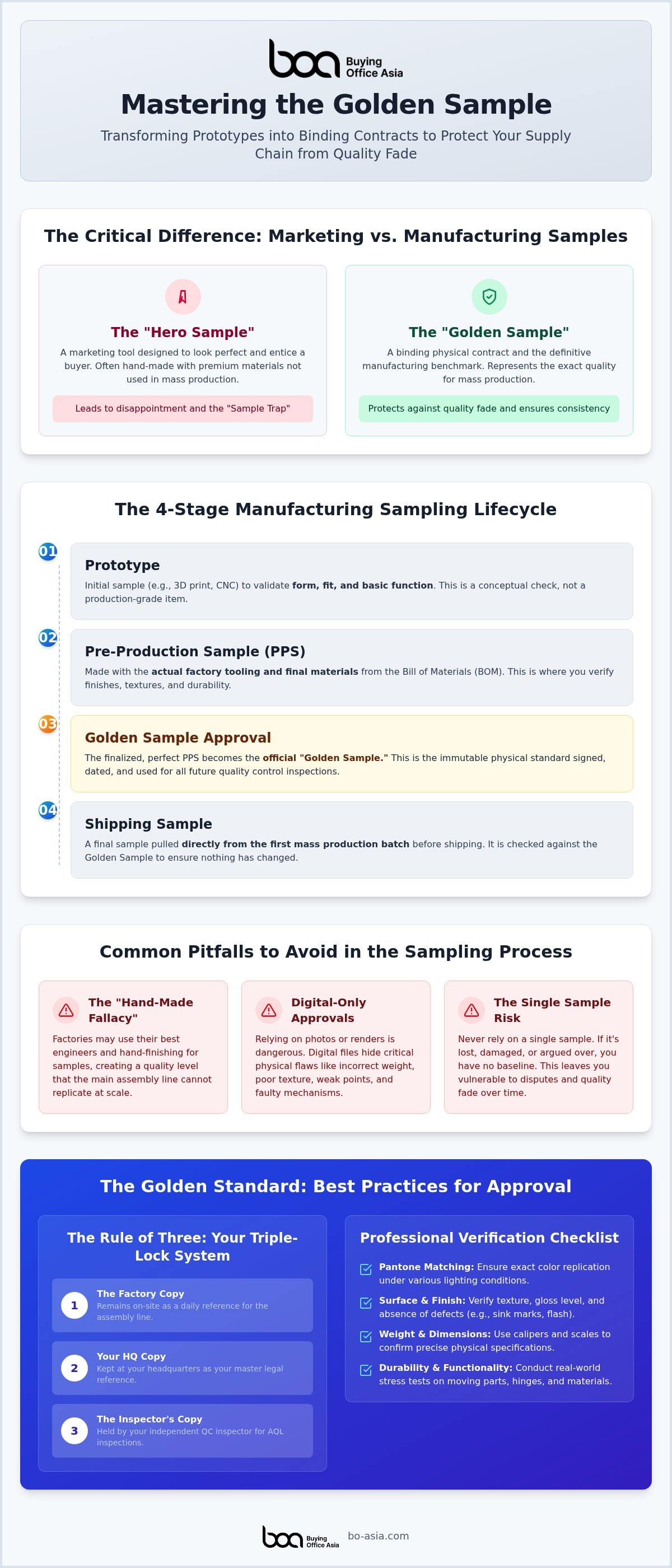
The final sign-off in the golden sample approval process is the most critical checkpoint before you commit capital to mass production. You shouldn't rely on a casual visual check. A structured verification protocol ensures that your physical benchmark meets every technical requirement. Visual inspection must confirm Pantone color matching, surface finishes, and precise branding placement. Functional testing is equally vital; for performance-driven apparel brands like Ants In Your Pants (AYP), ensuring the product performs under stress conditions is a non-negotiable part of the sampling phase. You need to verify dimensional accuracy using precision instruments like calipers and gauges to ensure tolerances remain within your technical specifications. Finally, a compliance check confirms the sample meets regional safety standards such as CE, UL, or REACH, protecting your brand from legal and regulatory risks at the border.
Effective communication with Asian manufacturers requires precise documentation to avoid misunderstandings. Using the "Red-Pen" method, you physically mark the sample to indicate required revisions. These critiques are then formalized into a comprehensive Sample Evaluation Report (SER). This document provides the factory with clear, unambiguous instructions for the next iteration. Tracking these rounds carefully prevents "specification creep," where small, unrecorded changes over time degrade the original design intent. By maintaining a strict version history, you ensure the factory floor works from the most recent, approved data set.
Managing the movement of samples across borders requires strategic oversight to maintain your project timeline. Courier lead times from South China to Europe in 2026 typically range from 3 to 5 business days for express services. You must account for these transit times and customs declarations to avoid project delays. Always maintain a "Control Sample" in your own office. This unit serves as your immutable reference point if the factory later claims a production flaw was present in the approved version. For comprehensive support in moving these critical benchmarks, our Logistics Management team provides the necessary oversight to ensure safe, transparent arrival. To secure your supply chain with a verified physical standard, connect with our experts today for a professional briefing on your project needs.
Buying Office Asia acts as your dedicated Asia procurement team, providing the oversight needed to manage the complexities of international production. We don't just facilitate a connection; we function as an integrated extension of your own team. By eliminating the traditional intermediary models that obscure costs and hide factory weaknesses, we provide 100% transparency between your office and the factory floor. Our on-the-ground presence in Asia ensures that every iteration of your golden sample approval process is guided by your specific technical requirements rather than the factory's "best guess." This proximity allows us to verify that the materials and processes used for your sample are the same ones intended for your mass production run.
Securing your investment begins with rigorous contract negotiation. We establish factory-direct terms that include clearly defined sampling milestones and financial penalties for non-compliance. This proactive approach ensures the manufacturer remains focused on quality from the initial prototype. Our team performs on-site inspections during the PPS stage to catch technical errors before they incur shipping costs or project delays. You can review our case studies to see how this hands-on management has successfully resolved complex sampling challenges for various industrial categories. We handle the technical feedback loops directly with factory engineers to maintain project momentum and ensure your specifications are never "lost in translation."
Once you finalize the golden sample approval process, the benchmark is set for the entire production run. We leverage this physical standard during mass production oversight to perform rigorous, on-site quality control inspections. Our European leadership and Hong Kong operations bridge the geographical and cultural gaps that often lead to "quality fade" in unmanaged supply chains. You gain the steady confidence of an established expert who possesses the regional networks and technical expertise you need to scale. We protect your brand and your financial health by ensuring the final shipment mirrors the approved sample in every detail. To secure your next production project with a partner who prioritizes accountability and transparency, contact us at Buying Office Asia for a strategic consultation.
Mastering the golden sample approval process is the most effective way to eliminate production risks and ensure your mass-produced goods match your exact specifications. By treating the master sample as a physical contract rather than a mere prototype, you protect your business from the "Hand-Made Fallacy" and material bait-and-switch tactics. Success in 2026 requires more than just digital sign-offs; it demands on-the-ground accountability and technical rigor.
Buying Office Asia provides the stability your supply chain needs. As a European-managed firm with 15+ years of on-the-ground regional expertise, we offer 100% transparency with factory-direct pricing and no hidden commissions. Our comprehensive end-to-end service includes on-site factory inspections during the sampling phase to verify every detail before full production begins. Don't leave your margins to chance. Secure your production with Buying Office Asia’s on-the-ground sampling support. We look forward to helping you achieve manufacturing excellence in the Asian market.
A golden sample is the final, approved version of a product that serves as the physical benchmark for mass production. It represents the "immutable truth" for your quality control teams. Both the buyer and the manufacturer must sign and date this unit. This physical standard is your primary defense against quality fade and ensures that every unit produced matches your exact technical specifications.
Most new OEM projects require two to four rounds of sampling before reaching final approval. The process begins with a rapid prototype to test form and function. It then moves into pre-production samples made with actual materials and tooling. Complex products may require additional iterations to refine surface finishes or mechanical tolerances. Rushing this stage often leads to expensive errors during the mass production phase.
The buyer generally pays for sampling fees and international courier costs. These expenses are a necessary investment to secure the production standard. While some factories might offer to credit the sample fee back once you place a high-volume order, the shipping costs remain your responsibility. Managing these costs requires clear communication and efficient feedback loops to minimize the number of required shipments and avoid unnecessary expenses.
Standard courier lead times from South China to Europe in 2026 are typically 3 to 5 business days for express services. However, you must also account for the factory's internal lead time to produce the unit. Depending on product complexity and the current production schedule, a factory might take 7 to 21 days to prepare a pre-production sample. Planning for a total window of 3 to 4 weeks is a pragmatic approach.
Skipping the sampling process is a high-risk strategy that frequently results in catastrophic shipment failures. A CAD drawing cannot replicate the physical reality of material textures, weight distribution, or assembly tolerances. The golden sample approval process is essential because it reveals technical flaws that digital renders often mask. Without a physical benchmark, you have no legal or technical recourse if the final shipment doesn't meet your expectations.
If the production batch deviates from the golden sample, you have the right to reject the shipment based on your manufacturing contract. The signed and sealed sample serves as your primary evidence during a quality dispute. This is why on-site inspections are critical; they catch these discrepancies before the goods leave the factory floor. Without a physical benchmark, proving a breach of quality standards becomes nearly impossible in international trade.
A prototype is an early-stage model, often 3D printed or CNC machined, used to test basic design and function. In contrast, a pre-production sample is made using the actual materials, tooling, and assembly processes intended for mass production. While a prototype helps you visualize the concept, only the pre-production sample can verify the factory's technical capability to manufacture the product at scale under the pressure of a full run.
You should use established express couriers and ensure all customs declarations are accurate to avoid delays. For samples, it's common practice to declare a nominal value for customs purposes, provided the items are clearly marked as commercial samples and not for resale. The golden sample approval process depends on these items arriving intact. Proper documentation is vital as global trade regulations continue to evolve alongside the new ISO 9001:2026 standards.

The lowest freight quote can carry the highest operational risk if supplier readiness, documentation, and exception handling are left outside the plan. If you’re asking how to choose a freight forwarder for Asia, look beyond the headline rate. A smooth shipment depends on who coordinates each handof...

What if your signed OEM agreement protects the product on paper but leaves the factory unclear about what to make, when to deliver it, or how quality will be judged? That gap is where an oem manufacturing agreement china project can lose control: responsibilities blur between buyer, sourcing interme...

What if the safest payment deal isn’t the one that delays the most cash, but the one that releases it only when progress is verifiable? Payment terms negotiation with Asian suppliers is about balancing your working capital with the supplier’s need for confidence, not simply pushing for a smaller dep...