


The true cost of a production mold isn't the invoice you pay today; it's the risk of your intellectual property being used by a competitor tomorrow. For many independent business owners, the custom tooling development process feels like a high-stakes gamble where communication gaps and uncertain lead times can derail a product launch before it even begins. You've likely felt the anxiety of sending significant capital overseas, only to wonder if the physical assets you've funded are being stored securely or utilized for third-party production without your consent.
We understand that you need more than just a vendor; you need a strategic partner who acts as an integrated extension of your own team. This guide provides a professional framework to help you master the complexities of manufacturing in Asia, ensuring every milestone is verified through on-site oversight. You'll learn how to implement a repeatable process that reduces lead times for T1 samples and guarantees verified ownership and storage of your physical assets. By the end of this briefing, you'll have the roadmap needed to transform tooling from a source of financial stress into a protected, high-precision asset for your business.
• Learn how to optimize technical drawings and conduct formal DFM analysis to eliminate costly production bottlenecks before manufacturing begins.
• Protect your intellectual property by vetting toolmakers independently and securing legal ownership of both physical molds and CAD data.
• Master the custom tooling development process through a structured T-series sampling framework that includes on-site validation of tool performance.
• Reduce financial risk and lead times by leveraging a dedicated Asia procurement team to manage every milestone of your tooling project.
• Eliminate obscured costs and achieve true factory-direct pricing by removing unnecessary intermediaries from your supply chain.
Custom tooling refers to the specialized machinery, molds, and patterns engineered for a specific manufacturing task. Unlike off-the-shelf components, these assets are unique to your proprietary design. If your product requires high-precision tolerances or a distinct aesthetic form, standard solutions will inevitably fail. They lack the rigidity and specificity needed to maintain consistency across thousands of cycles. You can't achieve market-leading quality by forcing a unique design into a generic mold.
The custom tooling development process represents the most critical "point of no return" in your procurement strategy. Once the steel is cut, your design is largely locked in. Mistakes at this stage aren't just inconveniences; they're financial anchors that can sink a project's viability. However, when managed with professional oversight, tooling shifts from a sunk cost to a strategic asset. It's the physical manifestation of your intellectual property and the primary driver of your long-term unit cost. High-quality tools don't just make parts; they protect your margins.
In OEM manufacturing, custom tooling is what separates a generic product from a market leader. It allows you to control every dimension, texture, and mechanical property of your part. While some buyers seek the lowest possible quote for tool construction, seasoned insiders focus on the long-term ROI. High-quality tool steel might require a larger initial outlay, but it prevents the premature wear and frequent maintenance that plague cheaper alternatives. Investing in durability at the start ensures your production remains stable as your business scales.
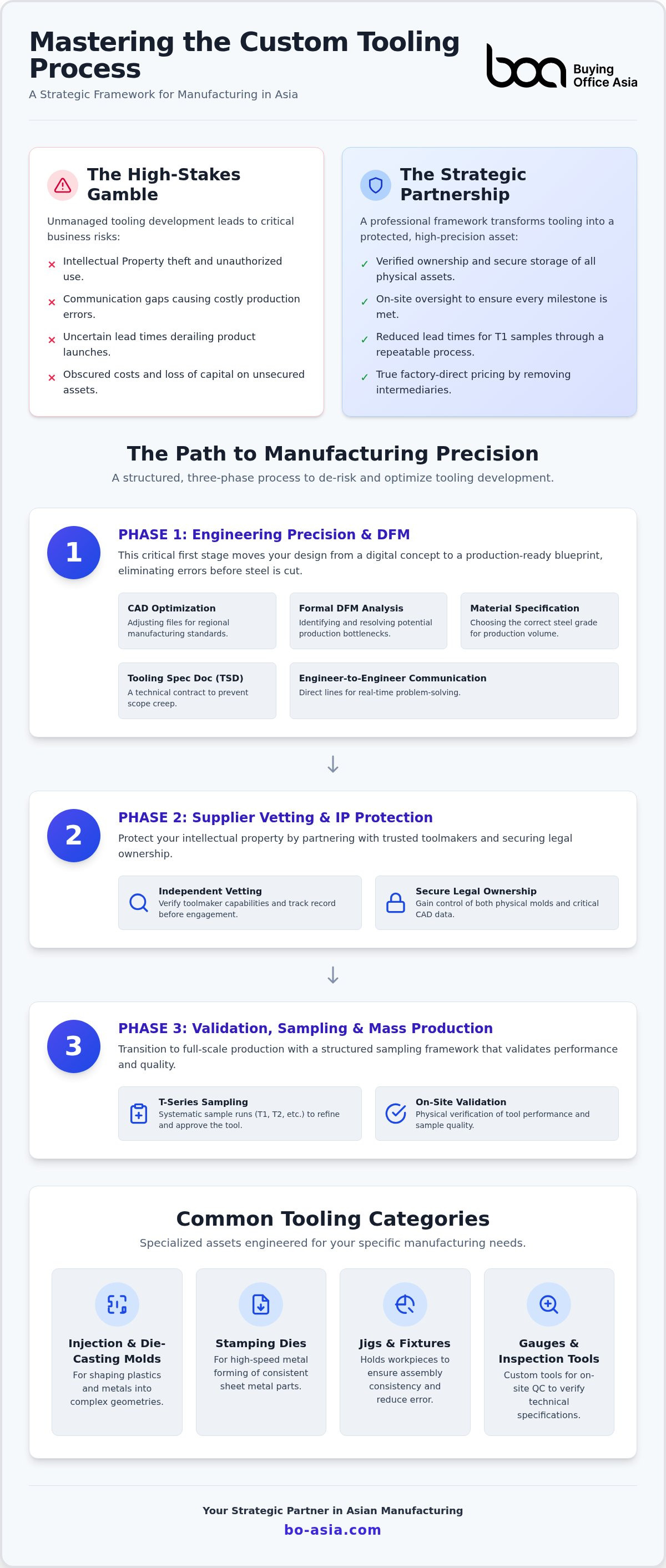
Successful manufacturing in Asia requires a broad understanding of the hardware involved. We categorize these assets based on their function in the production line to ensure nothing is left to chance:
These are the most common assets, used for shaping plastics and metals under high pressure to achieve complex geometries.
These tools are essential for high-speed metal forming and creating consistent sheet metal parts.
These specialized tools hold workpieces in place during manufacturing. They ensure assembly consistency and significantly reduce human error.
Custom-built instruments used for on-site quality control. They verify that every part meets your exact technical specifications before it leaves the factory floor.
By defining these requirements early in the custom tooling development process, you protect your brand from the variability that often affects unmanaged supply chains. This level of technical detail is what builds a foundation for manufacturing precision.
The custom tooling development process begins long before any steel is cut. It starts with a rigorous digital audit. Your CAD files might look perfect on a high-resolution monitor in Europe, but they must be optimized for the specific machine tolerances and standards used in Asian tool shops. We begin by reviewing technical drawings to ensure every dimension is clear and every tolerance is achievable. This stage prevents the design ambiguities that often lead to "lost in translation" errors during physical construction.
To ensure a seamless transition from concept to reality, we follow a structured five-step engineering protocol:
Adjusting files to meet regional manufacturing standards and machine capabilities.
Identifying potential production bottlenecks before they become physical defects.
Choosing the correct steel grade based on your projected production volume.
Creating a definitive technical contract that prevents scope creep and unexpected costs.
Establishing direct lines between your designers and the toolmakers to resolve technical queries in real-time.
If you're unsure if your current designs are optimized for mass production, you can consult with our technical team to initiate a preliminary review.
DFM is the bridge between "perfect on paper" and "possible on the factory floor." Without this analysis, you risk discovering critical flaws only after the tool is finished. We scrutinize draft angles to ensure easy part ejection, check wall thicknesses to prevent sink marks, and strategically place gate locations to minimize visible knit lines. This proactive approach reduces the need for expensive mold modifications later, which can cost thousands of dollars and add weeks to your timeline. It's about getting the physics right before the first spark of the EDM machine.
The longevity of your asset depends entirely on the steel grade selected. For prototype or low-volume runs, P20 steel is often sufficient and more cost-effective to machine. However, if your roadmap includes millions of cycles, hardened H13 steel is mandatory to resist wear and thermal fatigue. We provide 100% transparency in steel sourcing to prevent "grade swapping," a common tactic where inferior metals are substituted to pad a factory's margins. By matching the steel to your projected ROI, we ensure you don't overpay for a prototype tool or under-equip a high-volume production line. Every choice in the custom tooling development process is balanced against your long-term financial health.
Selecting the right partner to execute your designs is a high-stakes procurement decision that dictates your manufacturing future. Many buyers mistakenly assume that the factory assembling their final product should also build the molds. This is a common oversight. In reality, a dedicated Asia procurement team often vets toolmakers separately to ensure the highest level of precision. By decoupling tool construction from mass assembly, you maintain greater leverage and ensure that your asset is built by specialists rather than a generalist factory's in-house shop.
This stage of the custom tooling development process is where you must secure your legal and physical interests. Before a single CAD file is shared, we implement robust NNN agreements: Non-use, Non-disclosure, and Non-circumvention. These documents are specifically drafted to be enforceable in regional courts, preventing the "Tooling Ownership" trap where a factory claims the mold belongs to them because they designed the cooling channels or housing. You must explicitly own both the physical asset and the final CAD data; otherwise, your production can be held hostage during future price negotiations.
Specialized tool shops typically offer superior results because their entire business model relies on the precision of their CNC and EDM machinery. When we conduct on-the-ground supplier vetting, we don't just look at their sample room. We audit the age of their equipment, their climate control systems to prevent metal expansion, and their digital tracking for material certifications. If a shop can't prove the origin of their H13 steel or doesn't maintain a dust-free environment for high-polish molds, they aren't equipped to handle your proprietary designs.
Protecting your brand requires a defensive mindset that goes beyond paperwork. For highly sensitive projects, we often recommend "splitting" tooling components between different shops. This strategy ensures that no single vendor possesses the complete set of molds required to produce a finished product, effectively neutralizing the risk of unauthorized third-party production. Additionally, every tool must be physically engraved with your company's ownership mark and stored in a secure, audited location between production runs. By utilizing Hong Kong legal frameworks as a secondary layer of protection, we provide the steady confidence that your intellectual property remains an exclusive business advantage rather than a shared industry secret.
The physical completion of a mold is not the end of your project; it's the beginning of the validation phase. In the custom tooling development process, the transition from a finished tool to a production-ready asset requires a methodical approach to sampling. You shouldn't accept the first part that comes out of the machine as a final representation of quality. Instead, we utilize a T-series progression to systematically identify and resolve mechanical or aesthetic flaws before they reach the assembly line.
During the "First Shot" or T0 trial, our team maintains an on-site presence at the tool shop. Being physically present allows us to witness the tool’s performance firsthand, observing how the material flows and how the part ejects under pressure. This immediate feedback loop is essential for managing the "Tooling Debugging" phase. If adjustments are needed to wall thickness or gate pressure, they're identified and addressed on the spot. This prevents the endless cycle of shipping samples back and forth across oceans, which often leads to blown budgets and missed launch dates.
We break down the validation process into distinct milestones to ensure total transparency and control over your capital investment:
These initial samples focus on dimensional accuracy and basic functionality. We verify that the part meets the technical drawings established during the design phase.
Once the dimensions are locked, we refine surface textures, colors, and cycle times. T3 represents the production-ready state where the tool is optimized for speed and consistency.
Skipping these validation steps is a common mistake that leads to high defect rates during the first mass production run. By the time you reach the T3 stage, you'll have established a "Golden Sample." This sample serves as the immutable standard for all future mass production oversight, ensuring your factory has a physical benchmark that cannot be disputed during quality disputes.
Once the tool is validated, it must be moved safely from the toolmaker to the production factory. This transition involves more than just logistics; it requires a formal handover of the Quality Control Plan (QCP). This plan is built directly from the performance data gathered during the tooling trials. We also establish a maintenance schedule to address "wear and tear" over the product lifecycle, protecting your physical asset for years to come. If you're ready to secure your manufacturing future with a verified sampling framework, contact our team today to discuss your specific project requirements.
Maximising the return on your manufacturing investment requires a shift from transactional purchasing to strategic asset management. In the traditional custom tooling development process, costs are often obscured by layers of intermediaries who add markups without adding technical value. Buying Office Asia (BOA) eliminates these middlemen, providing you with direct access to the toolmaker's original pricing. By combining European leadership with a permanent physical presence in Hong Kong and Mainland China, we act as a stabilizing force that protects your financial interests in a volatile global market.
Our approach integrates tooling development into a broader end-to-end sourcing strategy. We don't just facilitate a purchase; we manage a critical phase of your supply chain. This ensures that the tools built today are perfectly aligned with the mass production requirements of tomorrow. When you partner with us, you gain the oversight usually reserved for major enterprises, allowing your business to scale with the steady confidence of a seasoned industry insider.
True transparency means seeing exactly what the toolmaker is charging for every component of the project. We provide a comprehensive breakdown of every quote, including raw steel costs, specific machining hours, and engineering fees. This level of detail allows us to identify and remove the hidden "kickbacks" and inflated margins that are common when buyers deal directly with unmanaged factories. You can review our pricing and savings examples to see how this rigorous financial optimization translates into measurable capital preservation for our clients.
Engaging directly with an overseas factory without on-the-ground representation carries significant operational risks. One of the most pervasive issues is "ghost" tooling, where a factory charges for a new tool but actually utilizes refurbished or existing molds. Our on-site inspections prevent this by verifying the age, condition, and origin of the steel at every milestone. We bridge the cultural and technical communication gaps that often lead to design errors, ensuring your headquarters' requirements are translated accurately into factory-floor reality.
By positioning ourselves as an integrated extension of your team, we dismantle the barriers of distance and language. We don't just describe a connection; we provide a defense against the brand risks and unforeseen expenses that plague unmanaged supply chains. If you're ready to secure your manufacturing assets and optimize your production margins, contact Buying Office Asia today to discuss your next project.
Mastering the transition from design to mass production requires a shift in perspective. You've learned that technical precision in DFM and robust IP protection are the non-negotiable pillars of a successful project. By following a structured validation framework, you eliminate the guesswork that often leads to costly delays and compromised quality. A well-managed asset is more than a tool; it's the foundation of your long-term manufacturing viability and financial health.
Navigating the custom tooling development process successfully means bridging the gap between engineering theory and factory-floor reality. With our European-managed on-the-ground presence and a 100% transparent pricing model, we provide the steady confidence you need to scale. Our proven track record in complex OEM projects ensures your physical assets are managed with the highest level of professional rigor. We act as your eyes and ears in the factory, protecting your margins and your brand. Secure your manufacturing future with Buying Office Asia’s expert tooling management and take control of your supply chain today. We look forward to helping you build a more resilient and profitable production model.
Lead times for tooling usually range from 30 to 60 days depending on the mold's complexity and the material being processed. Simple stamping dies might be ready in 4 weeks; however, complex multi-cavity injection molds with intricate cooling channels can take up to 10 weeks. This timeline includes the design phase, CNC machining, and initial assembly. You should factor in an additional 2 to 3 weeks for the sampling and validation stages to ensure the final output meets your specifications.
You legally own the tools and molds provided you have an enforceable agreement that explicitly states ownership of both the physical asset and the CAD data. Without a clear contract, some factories in Asia may claim the mold as their property, citing their "engineering input" during the design phase. We ensure your ownership is documented and recognized, allowing you to move the asset if production requirements change or if the supplier fails to meet performance standards.
T0 is the "first shot" used to verify that the mold functions mechanically, while T1 and T2 samples focus on refining dimensions and aesthetics. T1 samples are the first parts produced for your review, often revealing minor dimensional inaccuracies. T2 samples follow after the toolmaker has "tuned" the mold to correct those issues, focusing on surface finish and texture. This T-series progression is a vital part of the custom tooling development process to ensure mass production consistency.
Preventing unauthorized use requires a combination of robust NNN agreements and physical security audits. You should insist on a contract that prohibits the toolmaker from using your molds for third-party orders. Additionally, having a team on the ground to perform unannounced inspections ensures your assets are being stored securely and only used for your specific production runs. Marking the tool with a unique, permanent identification tag also establishes clear physical proof of ownership.
Tooling failures usually stem from poor material selection or insufficient DFM analysis before the steel is cut. Using low-grade steel for high-volume production leads to premature wear and dimensional drifting. Delays often occur due to communication gaps between the design team and the tool shop, resulting in multiple rounds of costly revisions. Establishing a clear Tooling Specification Document (TSD) at the start of the project is the most effective way to mitigate these operational risks.
A DFM review is essential because it identifies design features that are physically impossible or financially inefficient to manufacture. By checking draft angles, wall thicknesses, and gate locations early, you prevent the need for expensive mold modifications after the tool is built. This proactive audit ensures your design is optimized for the specific machinery and tolerances of the chosen factory. It's the most reliable way to shorten lead times and reduce the total cost of ownership.
You calculate the ROI of high-grade tool steel by comparing the cost of mold maintenance and replacement cycles against the projected total volume of your product. While hardened H13 steel has a higher upfront cost than P20, it can withstand over a million cycles without significant wear. If your production volume is high, the reduced downtime and consistent part quality provided by superior steel far outweigh the initial savings of a cheaper, less durable alternative.
You can move your custom tooling between factories in China, provided you have physically verified its location and have a clear legal right to the asset. This process requires careful logistics management to ensure the mold isn't damaged or "held hostage" by the original supplier during a dispute. We manage these transitions by conducting a final on-site inspection before the tool is crated and shipped to the new production facility, ensuring a seamless handover.

Scaling production to millions of units isn't a purchasing task; it's a high-stakes risk management discipline where a single percent of quality fade can liquidate your annual margin. You likely understand that the leap from mid-scale orders to massive procurement runs often exposes cracks in even t...

In 2026, the traditional sourcing agent isn't just an expense; they're a strategic liability that obscures your true cost of goods. Most procurement leaders recognize that supplier selection in asia has become a defensive maneuver where the goal is to eliminate the "Middleman Tax" before it erodes y...

Successful oem sourcing asia isn't just a search for a factory, but the implementation of a transparent, on-the-ground management ecosystem. You likely already know that the traditional intermediary model is flawed, often hiding true costs behind layers of markups and opaque communication. It's frus...