


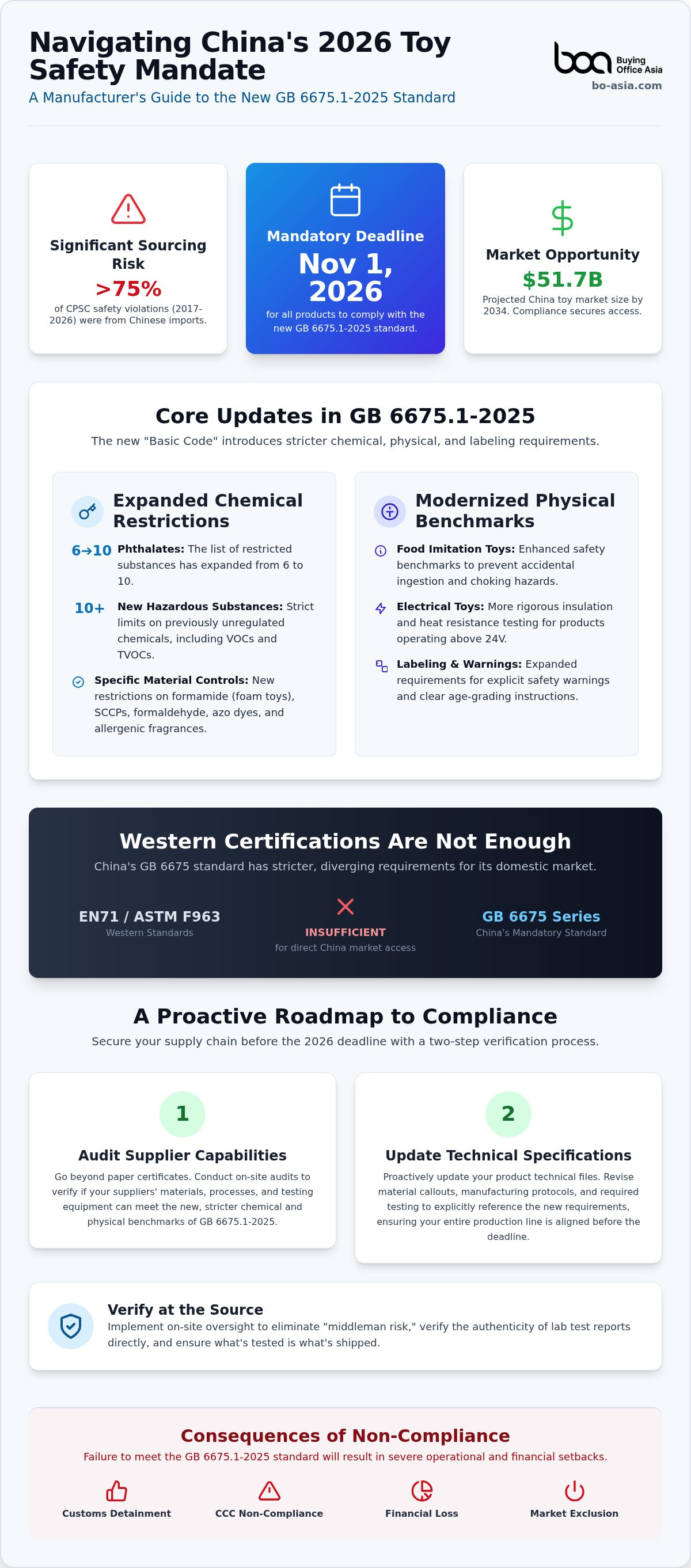
Chinese imports represented over 75% of safety violations recorded by the CPSC between 2017 and 2026. This data underscores the inherent risk of unmanaged sourcing as we approach the November 1, 2026, implementation of GB 6675.1-2025. You likely feel the pressure of the upcoming chemical restrictions on VOCs and phthalates. It's a complex shift that could lead to rejected shipments or CCC non-compliance if handled incorrectly. This guide provides a comprehensive strategy for managing the mandatory Toy Safety Standards China requirements. We'll examine the specific 2026 updates, offer a roadmap for auditing your suppliers, and explain how to verify test reports directly at the source. By the end, you'll have the technical clarity needed to mitigate brand risk and maintain a stable, profitable supply chain. We'll move past the "paper" certifications and look at the operational reality of the factory floor. This is about securing your financial viability in a market projected to reach $51.7 billion by 2034. You need more than a middleman; you need a defense against operational setbacks.
• Prepare for the mandatory transition to the GB 6675.1-2025 "Basic Code" by November 1, 2026, to secure your market access and CCC compliance.
• Navigate the expanded chemical restrictions, including new limits for VOCs and phthalates, that require a proactive update to your testing protocols.
• Understand why Western certifications like EN71 are insufficient and where Toy Safety Standards China diverge with stricter requirements for the domestic market.
• Implement a two-step roadmap to audit supplier capabilities and update technical specifications before the regulatory deadline impacts your production.
• Leverage on-site oversight and a transparent sourcing model to eliminate the "middleman risk" and ensure your factory's test reports are authentic.
The regulatory environment for children's products in the Chinese market is undergoing its most significant transformation in over a decade. At the center of this shift is the transition from the legacy GB 6675-2014 to the new GB 6675.1-2025, titled "Safety of toys - Part 1: Basic code." This mandatory national standard serves as the legal foundation for all Toy Safety Standards China compliance. For global brands, the November 1, 2026, deadline is not a suggestion; it is a hard cutoff. Products manufactured or imported after this date must adhere to the 2025 revisions to maintain their China Compulsory Certificate (CCC). Without a valid CCC, your goods will be detained at customs, leading to significant financial loss and market exclusion. Professional oversight is required to bridge the gap between these new legal requirements and your factory's current output.
The GB 6675 series applies to any product or material designed or clearly intended for use in play by children under 14 years of age. Understanding the hierarchy of these Toy safety standards is vital for effective sourcing and procurement. Part 1, the Basic Code, sets the overarching safety requirements and administrative rules. Parts 2 through 4 detail the specific technical specifications for mechanical and physical properties, flammability, and the migration of certain elements. While most traditional playthings fall under this umbrella, items like professional sports equipment, fashion jewelry for children, and certain collectible models are often categorized as edge cases. Precise classification is the first defense against regulatory rejection, as mislabeled products are a primary cause of customs delays.
The updated "Basic Code" introduces several critical adjustments that directly impact product design and manufacturing oversight. These updates to Toy Safety Standards China require a proactive approach to supplier management. One specific addition involves stricter regulations for food imitation toys. These products must now meet enhanced safety benchmarks to prevent accidental ingestion or choking hazards. Additionally, the standard for electrical toys has been modernized. Products operating at voltages higher than 24V now face more rigorous insulation and heat resistance testing. Labeling requirements have also been expanded to include more explicit safety warnings and age-grading instructions. These changes reflect a broader movement toward consumer protection and require immediate auditing of your current production specifications to avoid non-compliance and maintain your brand's financial health.
Compliance with Toy Safety Standards China is no longer just a matter of passing a single lab test. The 2026 regulatory shift introduces a granular level of chemical and physical oversight that demands a total reassessment of your material supply chain. Failure to account for these changes doesn't just risk a failed inspection; it risks the financial viability of your entire seasonal inventory. The new GB 6675.1-2025 framework significantly expands the list of restricted substances, moving closer to, and in some cases exceeding, international benchmarks. You must ensure your factory floor reality matches the technical documentation provided by your suppliers.
The most pressing update involves the expansion of restricted phthalates from six substances to ten. Beyond phthalates, the new standards introduce strict limits for over ten additional hazardous substances that were previously unregulated or less scrutinized. This includes Volatile Organic Compounds (VOCs), Total Volatile Organic Compounds (TVOCs), and specific requirements for formaldehyde and azo dyes. For manufacturers of foam toys, the restrictions on formamide and Short-Chain Chlorinated Paraffins (SCCPs) are critical milestones. If you produce scented products, be aware that allergenic fragrances are now subject to rigorous control. These chemical shifts often require a change in raw material sourcing, which can impact your lead times if not managed proactively.
Physical safety requirements under GB 6675.2-2025 have been modernized to address new toy categories and consumer behaviors. Projectile toys now face stricter kinetic energy limits to prevent injury, while flying toys and yo-yo balls have specific new safety criteria. For large or heavy playthings, the introduction of tip-over tests ensures stability during active use. Flammability testing under GB 6675.3-2025 has also expanded its reach. It now includes specific methods for toy tents, face masks, and dress-up costumes. Even the "odor" of a toy is now a regulated factor, as hygiene and sensory requirements become a new frontier for Chinese customs officials. These physical benchmarks are often where material substitutions by unmanaged factories lead to immediate CCC rejection.
Managing these technical nuances requires a presence where the production actually happens. If you're concerned about how these new chemical limits will affect your 2026 production cycle, it's time to discuss a strategic audit of your current manufacturing specifications. We provide the on-site oversight necessary to ensure your products meet every physical and chemical benchmark before they ever reach a shipping container. This hands-on approach eliminates the uncertainty of unverified test reports and protects your brand from the expenses of non-compliance.
Many global brands operate under the dangerous assumption that a product compliant with European (EN71) or American (ASTM F963) regulations will naturally pass Chinese inspections. This assumption is a significant operational risk that often leads to unforeseen expenses. While these frameworks share a common foundation in the ISO 8124 series, Toy Safety Standards China have evolved with unique technical nuances that can lead to immediate customs detention. You cannot rely on "Western" certifications to secure your position in the Chinese market. The 2026 regulatory shift further widens the gap between these international standards, making on-the-ground verification a necessity rather than an option.
The European Union's EN71 is frequently cited as the most rigorous standard for chemical testing, covering 19 distinct elements. However, the new GB 6675.1-2025 introduces specific limits for substances like VOCs and phthalates that don't always align with EU thresholds. Small parts testing protocols also differ, particularly regarding the tension and torque applied to components during safety evaluations. If your product is labeled for a specific age group in Europe, it might require different grading or specific warning formats in Simplified Chinese to meet the strict administrative requirements of the CCC. Failure to adapt your packaging and testing to these local specifics is a primary cause of shipment rejection.
For brands targeting the United States, ASTM F963 is the mandatory benchmark. Yet, when compared to the 2026 Chinese updates, critical gaps emerge in projectile toy safety. The kinetic energy limits and the definition of a "projectile" vary, meaning a toy deemed safe for the US could be illegal for sale in China. Heavy metal migration testing also utilizes different methodologies. GB standards often require more rigorous testing for specific coatings and base materials that ASTM might overlook. Electronic toy safety, specifically regarding battery compartment accessibility and electromagnetic compatibility (EMC), is another area where China's requirements are increasingly stringent and distinct from US norms.
Non-compliance results in more than just a paperwork delay. It leads to the revocation of your CCC certificate, expensive market recalls, and long-term damage to your brand's reputation in a market projected to reach $51.7 billion by 2034. To navigate these complexities, you need a partner who understands the intersection of product development and local law. You can read our guide on OEM manufacturing to see how we manage these global production variables for our clients. This proactive oversight is the only way to bridge the gap between "paper" certifications and the reality of the factory floor.
Moving from regulatory theory to operational reality requires a structured, hands-on approach. Testing is merely the final verification; true compliance is built during the manufacturing process. To maintain your Toy Safety Standards China adherence, you need a roadmap that begins long before a single unit leaves the assembly line. This process ensures your financial investment is protected from the risk of non-compliant production and subsequent customs rejection. It's about building a defense against the operational setbacks that plague unmanaged supply chains.
Conduct a technical audit of your supplier's understanding of the GB 6675.1-2025 updates. You must verify they've reviewed the new chemical limits for VOCs and phthalates rather than assuming they're prepared.
Update your technical product specifications and tooling. The 2026 requirements for projectile toys or electrical components may necessitate physical changes to your molds or material compositions.
Implement on-site mass production oversight. This is where you prevent the "material substitution" that often occurs when a factory attempts to cut costs mid-run.
Navigate the CCC certification process through accredited laboratories. Proper documentation management ensures your paperwork is as robust as your product.
Identifying the right partner is the foundation of your supply chain security. You should prioritize factories that already hold valid CCC certifications and maintain transparent, clean audit histories. This isn't just about safety; it's about financial optimization. By negotiating factory-direct pricing without the obscured costs of middlemen, you secure your margins while maintaining high standards. Effective supplier management ensures these standards don't slip over time. Learn more about our supplier vetting process to see how we identify reliable partners in a complex market.
You can't manage a toy supply chain from a desk thousands of miles away. During Production (DUPRO) inspections are essential for Toy Safety Standards China compliance. These visits allow you to verify raw material certificates for chemical compliance at the actual source before they're processed. Don't rely on factory-provided "golden samples" which are often hand-picked for perfection. Instead, implement randomized sampling from the actual production line. This level of rigor is your primary defense against brand risk and unforeseen expenses. If you're ready to secure your 2026 production cycle, contact our on-site team today to discuss a preliminary factory audit.
Achieving compliance with Toy Safety Standards China is not a task that can be managed from a distance. The complexity of the GB 6675.1-2025 shift requires a physical presence at the point of production to verify that technical requirements are being met in real-time. Buying Office Asia (BOA) functions as your integrated extension in the region, combining European management standards from our Helsinki leadership with deep local operational expertise in Hong Kong and mainland China. This proximity is non-negotiable for toy safety. It allows us to move beyond digital reports and conduct the hands-on oversight necessary to protect your brand from the financial hazards of non-compliant manufacturing.
A primary failure point in international sourcing is the misinterpretation of technical standards. Our dedicated sourcing team acts as your internal compliance department, translating complex regulatory language into actionable instructions for factory managers. We operate on a 100% transparency model, which explicitly rejects the traditional intermediary model. By eliminating the middleman, we remove the obscured costs and communication filters that often hide regulatory risks. This direct connection also empowers us to conduct expert price negotiations based on actual material costs and compliance requirements, ensuring your financial health remains a priority.
The transition to the November 1, 2026, deadline demands a proactive strategy to avoid production delays. Our on-site quality control teams are the "eyes and ears" of your operation, conducting rigorous inspections that go far beyond superficial checks. We manage the entire supply chain, from initial supplier vetting to the final CCC certification process, ensuring that every unit meets the new chemical and physical benchmarks. This protective nature is a core part of our service delivery, designed to dismantle the anxieties of international trade. You can see our previous procurement successes to understand how our methodology has stabilized complex supply chains for our partners. By positioning our team as your regional defense, we mitigate brand risk and ensure your entry into the Chinese market is both secure and profitable.
The transition to GB 6675.1-2025 represents more than a technical update; it's a fundamental shift in how global brands must manage their supply chains. You've seen that relying on Western certifications or distant oversight is no longer a viable strategy for maintaining compliance. Success in this evolving landscape requires a proactive roadmap that prioritizes on-site verification and rigorous material auditing. By addressing the expanded chemical and physical requirements now, you protect your brand from the expenses of customs detention and market exclusion.
Toy Safety Standards China compliance is a moving target that demands the steady hand of a seasoned insider. As a European-managed firm with strategic leadership in Helsinki and specialized on-site quality control teams in China, Buying Office Asia provides the 100% transparency you need to eliminate middleman risk. We act as your integrated defense, ensuring your production reality matches the highest regulatory benchmarks. You can successfully navigate this regulatory shift and secure your market position with the right regional partner.
Secure your toy supply chain with Buying Office Asia's on-the-ground expertise.
Yes, GB 6675 is the mandatory national standard for all toys intended for children under 14 years of age in the Chinese market. Any product falling under this category must comply with these Toy Safety Standards China to be legally imported or sold. This requirement applies regardless of whether the product was manufactured domestically or abroad. Failure to adhere to these standards results in immediate rejection at the border and a total loss of market access.
The implementation date for GB 6675.1-2025 is November 1, 2026. After this milestone, all newly manufactured or imported toys must meet the updated "Basic Code" requirements to maintain legal compliance. There's a transition period where products compliant with the 2014 version manufactured before this date can be sold until October 31, 2027. However, you should begin auditing your production lines now to ensure a seamless shift without inventory disruptions.
Yes, you must obtain a China Compulsory Certificate (CCC) even if your products carry the European CE mark. While both frameworks aim for safety, they utilize different testing methodologies and administrative protocols. The Chinese authorities don't recognize CE marking as a substitute for the CCC. Selling toys in China without a valid CCC is illegal and will lead to significant fines and the destruction of non-compliant inventory at your expense.
Authentic verification requires a two-step approach involving digital cross-referencing and on-site oversight. You should first verify the report number directly with the accredited laboratory that issued it, ensuring they hold CNAS or CMA credentials. However, digital checks alone aren't enough to prevent material substitution. You need on-ground specialists to perform randomized sampling and factory audits to confirm that the production units actually match the "golden sample" sent to the lab.
The 2026 update introduces limits for over ten additional hazardous substances, including Volatile Organic Compounds (VOCs), Total Volatile Organic Compounds (TVOCs), and formaldehyde. The list of restricted phthalates has also expanded from six to ten. These Toy Safety Standards China now also include specific restrictions on azo dyes, SCCPs, and allergenic fragrances. These chemical changes often necessitate a full review of your raw material suppliers to ensure every component meets the new toxicity benchmarks.
Non-compliance by the November 2026 deadline leads to severe operational and financial consequences. Your products will be detained by customs officials, and your existing CCC certificates may be revoked. This results in expensive market recalls and potential blacklisting within the Chinese trade registry. Beyond the immediate financial loss, the reputational damage to your brand can take years to repair in a market that increasingly prioritizes consumer safety and rigorous regulatory adherence.
A professional sourcing partner acts as your regional compliance department by managing the entire CCC lifecycle. This includes vetting factories for existing certifications, coordinating with accredited labs for testing, and ensuring that technical documentation is accurate. By integrating this oversight into your procurement process, you eliminate the risk of "paper" compliance. This hands-on management ensures that your factory's production reality always aligns with the legal requirements needed for a successful market entry.
Toys packaged with or imitating food are subject to enhanced safety and hygiene requirements under the new GB 6675.1-2025 standard. These items must undergo specific testing to prevent accidental ingestion and choking hazards. The standards also introduce stricter benchmarks for the migration of elements and sensory properties like odor. If your product line includes food-related playthings, you must update your specifications to meet these modernized hygiene protocols and avoid non-compliance during customs inspections.

A supplier listing can open a door, but it can’t show whether a factory is right for your order. Choosing a ningbo sourcing agent means looking beyond access to local suppliers: you need clear oversight of supplier vetting, production follow-up, and quality checks. Without defined responsibilities,...

What if the supplier with the strongest online profile isn’t the factory best suited to your shoes? In footwear manufacturing in China, a directory listing can start your search, but it can’t confirm who will make your product, whether the factory can handle its construction and materials, or how cl...
What if the mold you paid to develop couldn’t be released when you needed to change suppliers? Managing tooling and molds with a foreign factory means more than tracking where production equipment is stored. Payment alone may not establish clear ownership, access, or transfer rights. Without visibil...