


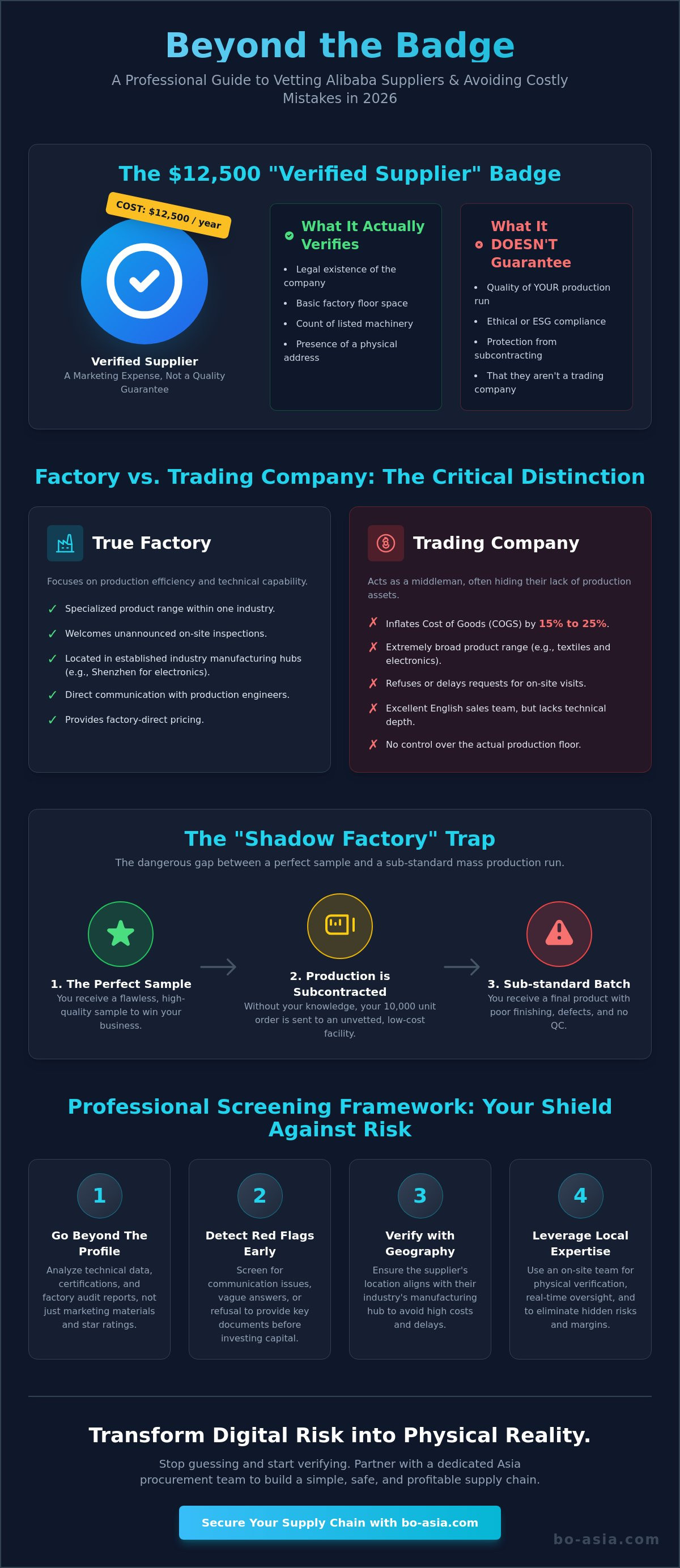
That "Verified Supplier" badge on an alibaba factory profile costs exactly $12,500 per year, which means it's often a marketing expense rather than a quality guarantee. You've likely felt the frustration of receiving a perfect $100 sample only to watch your mass production batch arrive with sub-standard finishing. It's common to feel confused when you're trying to distinguish between a legitimate manufacturer and an opaque trading company hiding behind a polished digital storefront. We understand the anxiety of risking your capital on a partner you've never met in person.
You'll learn how to move beyond these digital badges to secure a partner that prioritizes your profitability and safety. This briefing breaks down the hidden 2% to 3% transaction fees baked into Trade Assurance, the reality of 2026 on-site audits, and the exact steps to vet a partner before you leave money on the table. We'll show you how to transform a risky digital search into a simple, safe, and profitable manufacturing relationship by focusing on physical reality over online reviews.
• Distinguish between paid marketing badges and actual manufacturing capability to avoid the high cost of sub-standard production batches.
• Identify a legitimate alibaba factory by analyzing technical data and factory audits that move beyond the surface-level "Verified" status.
• Uncover the risks of "shadow factories" where your mass production is subcontracted to unvetted facilities without your knowledge.
• Implement a professional screening framework to catch communication red flags before you waste capital on non-conforming samples.
• Leverage local, on-site expertise to eliminate hidden margins and ensure your supply chain remains simple, safe, and profitable.
The 2026 procurement environment is defined by a digital veneer that makes every supplier look like a world-class manufacturer. The Alibaba Group ecosystem has fully integrated AI tools like Accio Work, which saw adoption by 230,000 businesses in its first month of May 2026. While these tools help with demand forecasting, they also allow trading companies to generate hyper-realistic factory profiles. High-volume buyers are moving away from simple platform browsing because they've realized that a "Verified" badge doesn't stop a sub-standard batch from hitting the warehouse. Finding a legitimate alibaba factory now requires a transition from digital search to physical verification.
Hong Kong serves as the essential strategic gateway for managing this complexity. By partnering with a dedicated Asia procurement team that operates out of Hong Kong, you gain a protective shield against the risks of remote sourcing. This local presence allows for real-time oversight that large corporations have enjoyed for decades, ensuring your supply chain remains simple, safe, and profitable. It's about moving from a transaction-based model to a partnership-based one that eliminates the "black box" of overseas production.
Trading companies often win the "first impression" battle because they employ aggressive sales teams with excellent English. However, these opaque middlemen often inflate your COGS by 15% to 25% while providing zero oversight of the actual production floor. You're paying for a facade. A true alibaba factory focuses on production efficiency, not marketing. Red flags of a trading operation include a product range that is too broad or a refusal to allow an unannounced on-site inspection. Don't leave money on the table by paying factory-direct prices to a home-office middleman.
Geography is a powerful vetting tool. Industry clustering remains dominant in 2026, with Shenzhen holding the lead for high-end electronics and Zhejiang remaining the primary hub for technical textiles. Regional labor trends as of May 2026 show a 4.2% wage increase in coastal provinces, forcing some legitimate manufacturers to modernize or move further inland. If a supplier's location doesn't align with their industry's established hub, you'll likely face higher landed costs and slower component sourcing. Real-world logistics data proves that being "near the cluster" is a non-negotiable requirement for maintaining cost-efficiency and speed to market.
Digital badges on a supplier profile often create a false sense of security for the uninitiated. The "Verified Supplier" status, which became the primary trust signal by March 2026, requires an annual fee of approximately $12,500 from the manufacturer. While this fee covers an on-site audit by third-party firms like SGS or TUV, it's vital to understand what they actually verify. These inspectors confirm the factory's legal existence, floor space, and machinery count, but they don't guarantee the quality of your specific production run. Understanding Alibaba's business model clarifies that these badges are part of a monetization strategy, not a performance bond for your inventory.
B2B reviews on the platform are frequently skewed by low-volume buyers and dropshippers whose requirements differ vastly from a wholesaler's needs. A five-star rating from someone ordering ten units of a stock item doesn't translate to success for a custom 10,000-unit production batch. Many factories engage in "review gaming," where negative feedback for mass production failures is buried under a mountain of incentivized reviews for small, low-risk orders. When you're selecting an alibaba factory, you're looking for a long-term manufacturing partner, not a retail experience, so digital star ratings should be your starting point, never your final filter.
The most dangerous trap in overseas sourcing is the "Sample vs. Mass Production" gap. A factory might produce a perfect $300 sample to win your business, only to subcontract the actual mass production to a "shadow factory" with no quality management system. Standard reviews also ignore critical ESG and compliance data. In 2026, your brand's reputation depends on supply chain transparency that a simple platform profile cannot provide. A 5-star rating can easily coexist with failing safety standards or environmental violations that could lead to significant reputational damage for your business.
Trade Assurance is often marketed as a free safety net, but the reality is more complex. Suppliers are charged a 2% to 3% transaction fee that's almost always baked into your final product price. Additionally, credit card and PayPal processing fees of 2.99% can quickly erode your margins. While the service offers a dispute resolution mechanism, it's notoriously difficult to win a claim based on "subjective" quality issues like color matching or material feel. Professional teams don't rely on platform buttons; they secure their investments through Sourcing and Procurement Services that utilize ironclad, localized contracts. If you want to move beyond digital guesswork, you can request a professional factory audit to see the reality behind the badge.
The most dangerous assumption in global procurement is believing that a digital verification badge replaces the need for a physical factory audit. In 2026, the marketplace model accounts for 65.12% of all B2B e-commerce transactions, yet this massive volume of activity often masks systemic operational risks. While an alibaba factory might present a polished video of a modern assembly line, that footage doesn't guarantee your specific order will be produced on those machines. Digital profiles are marketing assets; they are not operational audits. Relying solely on screen-based data leaves your capital vulnerable to production delays and quality drift that no platform refund can fully compensate.
Reputational damage is the hidden cost of a failed batch. If your 10,000-unit shipment arrives with structural defects, the financial loss extends far beyond the production cost. You face lost sales, customer churn, and potential legal liabilities. This is why professional brand owners have moved beyond simple platform browsing. They understand that a marketing video is a curated performance, whereas a boots-on-the-ground inspection is a technical reality check. To understand the broader context of these risks, you should review our analysis on Is Alibaba Safe to Buy From in 2026? to see how the professional procurement landscape has shifted.
Unauthorized subcontracting is a pervasive issue when factories reach peak capacity. When a manufacturer is overbooked, they often outsource orders to smaller, unvetted "shadow factories" to meet deadlines. These workshops rarely follow the same quality management systems or ESG compliance standards as your primary partner. This results in a "checkerboard" of quality where one pallet is perfect and the next is defective. Only on-site mass production oversight can catch this in real-time. Without a physical presence to verify that your goods are being produced in the facility you actually vetted, you're essentially gambling with your brand's consistency.
Many traditional agents operate as opaque middlemen, surviving on "hidden margins" that they never disclose to the client. They might claim to get you a better price, but they often take kickbacks from the factory that inflate your true cost of goods sold. We reject this model. Achieving factory-direct pricing requires 100% transparency. By utilizing a dedicated Asia procurement team, you eliminate the middleman's markups and gain a partner who works exclusively for your bottom line. This approach ensures your supply chain is simple, safe, and profitable by focusing on measurable outcomes rather than digital promises. Stop leaving money on the table and start demanding the same level of oversight that large corporations enjoy.
Securing a reliable alibaba factory requires a systematic transition from digital search to physical verification. While the platform offers "1-click quotes," professional buyers know that speed is the enemy of depth. Your vetting process must begin with an initial screening that looks at regional specialization. As established earlier, if a supplier is located outside the industrial clusters of Shenzhen or Zhejiang, it's a strong indicator they're a trading company rather than a manufacturer. This geographical filter is your first line of defense against opaque middlemen.
Technical communication serves as your next filter. Use high-level, specific inquiries to identify red flags. If a supplier relies too heavily on AI-powered tools like Accio Work—which saw adoption by 230,000 businesses in early 2026—without demonstrating deep technical knowledge, they likely lack the expertise to manage custom production. Once screened, move to sample development. Budget between $100 and $300 for this stage to ensure your "Golden Sample" meets every specification before you commit significant capital to mass production.
A physical audit is the only non-negotiable step in a safe procurement strategy. While the "Verified" badge costs suppliers $12,500 annually for a basic check, a professional on-site audit goes much deeper. We verify business licenses and export qualifications directly with local authorities to ensure legal compliance. Our inspectors assess machinery maintenance schedules and actual production capacity. These third-party inspections, which typically cost between $150 and $300 as of May 2026, also evaluate social compliance and ESG standards. This protects your brand from the reputational damage associated with unmanaged supply chains.
Your sample is more than a prototype; it's a legal benchmark. Managing custom tooling and OEM & ODM Contract Manufacturing requires a dedicated team on the ground to oversee technical transitions. This prevents the "sample vs. mass production" quality drop that plagues unmanaged orders. By securing a physical benchmark, you create a measurable standard for the final manufacturing agreement. This contract must include specific penalty clauses for delays or quality deviations rather than relying on generic platform buttons.
To ensure your next production run is handled with this level of professional rigor, you can book a comprehensive factory audit with our local team today. We act as your shield, ensuring your manufacturing remains simple, safe, and profitable.
Digital sourcing on a platform serving over 40 million registered buyers is a massive undertaking that requires more than a fast internet connection. While an alibaba factory profile provides a surface-level overview, scaling a brand in 2026 requires a fundamental shift from transactional browsing to a strategic partnership. High-volume wholesalers can't afford the quality variance that comes with unmanaged production. A dedicated Asia procurement team provides the ultimate ROI by acting as your boots-on-the-ground shield, ensuring your supply chain remains resilient against global market shifts. It's about moving from a digital gamble to a controlled business operation.
Our unique model combines European leadership in Helsinki with local operations in Hong Kong. This bridge allows you to enjoy European standards of accountability and transparency while maintaining a physical presence in the heart of the manufacturing world. You'll stop leaving money on the table by eliminating the hidden margins often buried by opaque middlemen. By negotiating factory-direct, you secure the cost-efficiency needed to scale in a global B2B e-commerce market valued at $36.86 trillion as of May 2026. We ensure that every dollar you invest is protected by professional oversight and technical rigor.
We don't just act as a bridge; we provide real-time mass production oversight. Our on-site presence in Hong Kong allows us to conduct unannounced factory visits and technical inspections that a remote buyer simply cannot manage. For our high-volume clients, this has resulted in a measurable reduction in production delays and non-conforming batches. We apply the same level of rigorous oversight to every alibaba factory we vet. This approach protects your brand from the reputational damage associated with sub-standard goods and ensures your manufacturing remains simple, safe, and profitable.
Transitioning your sourcing strategy starts with a commitment to transparency and data-driven decision-making. Move beyond the "Buy Now" buttons and begin a professional vetting process that includes on-site audits and factory-direct price negotiations. This is how you secure the same level of oversight that large corporations enjoy. If you're ready to secure your supply chain and focus on growth rather than damage control, it's time to partner with an expert ally. You can book a consultation with our dedicated sourcing team today to start building a more profitable future for your brand.
Digital verification on a global platform is merely the starting point of a professional procurement journey. You've seen how the $12,500 annual "Verified" badge and AI-generated profiles can obscure the true operational reality of an alibaba factory. Success in high-volume sourcing depends on moving from screen-based browsing to a boots-on-the-ground reality. By prioritizing physical audits and technical oversight, you protect your capital from the hidden costs of "shadow factories" and the risks of unauthorized subcontracting. These steps ensure your brand remains resilient in a B2B market projected to reach $61.66 trillion by 2031.
Our team provides 100% transparency with factory-direct pricing, combining European management standards with local Hong Kong expertise. We act as your protective shield, conducting rigorous on-site quality control and factory audits to ensure your production is simple, safe, and profitable. Stop leaving money on the table with opaque middlemen and take control of your margins today. Secure your supply chain with our on-the-ground Asia procurement team and gain the steady confidence of an established expert. Your brand's growth deserves the same level of protection that large corporations have utilized for decades. It's time to build a supply chain you can trust.
No, the Gold Supplier badge is a paid membership that signals a supplier's commitment to the platform rather than their manufacturing quality. It confirms they've passed a basic authentication check but doesn't reflect their ability to handle complex mass production. Professional buyers treat this as a baseline requirement and move toward "Verified Supplier" status and independent audits for real security.
Identifying a true alibaba factory requires analyzing their business license "Business Scope" and their location relative to industrial clusters like Shenzhen for electronics. Trading companies often list a vast range of unrelated products and are frequently located in commercial office buildings rather than industrial zones. A physical audit remains the only way to confirm where your goods are actually produced.
Reviews on the platform are often unreliable for B2B wholesalers because they are heavily influenced by 5-star ratings from small-sample buyers and dropshippers. These buyers have lower quality thresholds than those managing high-volume inventory. Large orders face risks like "quality drift" and unauthorized subcontracting that these surface-level digital reviews simply don't capture.
A professional audit must include a verification of the local business license, an assessment of machinery maintenance schedules, and a review of the factory's actual production capacity. It also evaluates social compliance and ESG standards. As of May 2026, these audits provide the technical data necessary to prevent reputational damage and ensure supply chain stability.
Trade Assurance provides a basic dispute mechanism, but it is often ineffective for complex quality issues like material feel or color precision. Suppliers are charged a 2% to 3% fee for this service, which is typically passed on to you through higher product prices. Relying on ironclad contracts and on-site oversight is a safer strategy for protecting your capital.
A physical inspection provides real-time data on your specific production batch, whereas a "Verified" badge only confirms the factory's status at a single point in time. Badges can't detect when an alibaba factory subcontracts your order to an unvetted workshop. On-site presence ensures that the quality you approved in your $100 to $300 sample is maintained across the entire run.
Hidden costs include the 2.99% payment processing fees for credit cards and the 2% to 3% transaction fees baked into product pricing. You also face the risk of "hidden margins" if you unknowingly deal with an opaque middleman. Without a dedicated team, the cost of a single failed batch can far exceed the price of professional procurement services.
You can verify a Chinese business license by checking the National Enterprise Credit Information Publicity System (NECIPS) or by commissioning a local audit. This process confirms the company's registered capital, legal representative, and authorized business scope. Verifying these details on-site prevents you from partnering with shell companies that lack the legal right to export your goods.
What if the first clear sign of a production problem arrives after the goods are packed? Manufacturing risk management in Asia works best when controls are connected from the start, not left to a final inspection or occasional supplier update. You need visibility into factory activity, early warning...

What if the lowest unit quote isn’t the lowest-cost way to make your board game? Board game manufacturing costs depend on more than the number of boxes ordered. Component materials, custom tooling, assembly, packaging and delivery scope can all change what a quote covers, making headline prices diff...

What if the factory’s lowest quote isn’t the lowest-cost option? A lower unit price can hide differences in materials, tooling, packaging, quality checks or production terms. Understanding how sourcing agents negotiate factory prices starts with making those differences visible, not simply asking a...