


What if the greatest risk to your 2026 margins isn't the cost of materials, but the lack of physical oversight at the source? For many European brands, professional asia supplier management has become the defining factor between a resilient supply chain and one plagued by hidden inefficiencies. You likely recognize that relying on digital dashboards and unverified vendor claims is no longer sufficient in a market demanding absolute accountability. As global trade complexities increase, the need for a stabilizing, hands-on presence on the ground is paramount to protecting your financial health.
We agree that the anxieties of international manufacturing, from opaque pricing structures to quality drift after the first batch, can feel insurmountable without a local ally. This article promises to reveal how you can eliminate these supply chain knots by securing factory-direct transparency and rigorous on-site oversight. You'll discover the four pillars of effective management, the ROI of supplier development, and a clear roadmap for navigating the looming 2026 ESG mandates. By the end, you'll understand how to transition your operations from a transactional model to a strategic partnership that functions as a true extension of your own team.
• Identify how physical proximity at the manufacturing source prevents quality drift and communication failures caused by the distance decay effect.
• Discover how professional asia supplier management secures 100% pricing transparency by negotiating directly with factories and eliminating hidden markups.
• Learn to transition vendors into strategic partners through on-site engineering support and custom tooling development that protects your long term ROI.
• Prepare for 2026 ESG mandates by implementing a multi-step supply chain mapping process to verify raw material origins and ethical labor standards.
• Contrast the financial security of an integrated, European-managed procurement team against the inherent risks of traditional third-party sourcing agents.
Professional asia supplier management isn't a one-time transaction; it's the continuous process of vetting, auditing, and developing factory partners to ensure they align with your business objectives. While many firms treat sourcing as a checklist item, true management involves deep integration into the factory's operational ecosystem. This distinction is vital because of the "Distance Decay" effect. When you operate 5,000 miles away from your production line, quality and communication naturally degrade. Without a local presence, your requirements are often lost in translation or deprioritized in favor of clients who are physically present on the factory floor.
Production flow is frequently strangled by three specific knots that emerge in unmanaged environments. First is quality drift, where standards slowly decline after the first approved batch. Second is lead-time lag, caused by a lack of real-time oversight into the factory's schedule. Third is the compliance gap, which introduces significant brand risk as regulatory requirements like the 2026 EUDR become mandatory. Shifting from transactional sourcing to supplier relationship management transforms a simple vendor into a strategic partner, ensuring your supply chain remains resilient against these disruptions.
In high-volume mass production, the cost of neglect is quantifiable. A seemingly small 5% defect rate can devastate your margins once you factor in the loss of goods, shipping costs for replacements, and the reputational damage to your brand. Beyond defect rates, many businesses unknowingly pay a "Hidden Middleman Tax" through traditional sourcing agents who hide markups within the unit price. Effective asia supplier management serves as the proactive defense of your profit margins by ensuring every cent of your spend is accounted for and optimized. By utilizing factory-direct price negotiations, you eliminate these obscured costs and secure the financial viability of your 2026 production cycles.
Effective asia supplier management rests on four foundational activities that transform a vulnerable supply chain into a resilient asset. These pillars aren't optional extras; they're the baseline for any business seeking to secure 2026 ROI. By implementing a structured approach to oversight, you move away from the uncertainty of unmanaged sourcing and toward a model of total control.
We look past the business license to verify actual production capacity, financial stability, and technical expertise.
We eliminate hidden commissions by establishing 100% transparency in the true cost of goods, ensuring your capital is used efficiently.
We serve as your physical presence on the factory floor, catching defects and protecting your brand before goods leave the port.
We optimize the flow from the factory floor to your international warehouse, managing the complexities of global transit so you don't have to.
Assessing a factory requires more than a digital background check. You must evaluate the leadership's integrity and the reliability of their sub-supplier networks. A factory's output depends heavily on its raw material sources. In the context of Government Procurement: A View from Asia, understanding regional preferences and compliance standards is essential for long-term success. Modern procurement also demands a focus on social compliance and workplace conditions to mitigate brand risk. For a detailed breakdown of our methodology, see our guide on Supplier Vetting in Asia.
Waiting for a Final Random Inspection (FRI) is a high-stakes gamble. If defects are found when goods are already packed, your shipment is delayed and your capital is tied up. During Production Inspections (DUPRO) allow for the implementation of corrective action plans (CAP) while the line is still running. This real-time intervention prevents batch defects from becoming a terminal problem. It's about maintaining a steady rhythm of quality throughout the entire run. If you're ready to secure your production lines with professional asia supplier management, you can reach out to our Helsinki team to discuss a tailored management strategy.
Sourcing a factory is merely the first step toward a functional supply chain. To secure a competitive edge, you must transition from a transactional model to a development-focused strategy. This evolution turns a simple vendor into a strategic partner capable of supporting your growth. High-level asia supplier management involves using performance scorecards to drive continuous improvement in lead times and material costs. By measuring specific KPIs, you create a feedback loop that rewards efficiency and identifies bottlenecks before they impact your bottom line. For more on this transition, read our guide on Mastering Sourcing and Procurement.
Implementing these rigorous standards ensures your suppliers evolve alongside your brand. It's about building a defense against stagnation. As noted in the Strategies for Success in Asia series, understanding regional supply chain trends is vital for maintaining long term viability. By actively developing your factory partners, you reduce the risk of quality drift and ensure your production remains a stabilizing force for your business.
Custom product development introduces unique risks, particularly regarding intellectual property (IP) theft during the sampling and prototyping phase. IP theft is real. When you don't have eyes on the ground, your proprietary designs are vulnerable. Our on-the-ground engineers mitigate this risk by providing direct oversight of the tool-making process. They optimize custom tooling for mass production efficiency, ensuring that the transition from prototype to high-volume manufacturing is seamless. This technical defense is a core component of OEM Manufacturing in 2026, where precision and IP security are non-negotiable.
Success in Asian manufacturing hubs is often built on Guanxi, the deep-rooted system of social networks and influential relationships. Presence builds priority. Navigating these cultural nuances requires more than a digital connection; it requires physical presence and regional expertise. Our model provides a unique trust bridge for Nordic brands by combining European leadership in Helsinki with a specialized headquarters in Hong Kong. This structure ensures your interests are represented with the same rigor you'd expect from your own home office. We've seen this approach yield significant results; for instance, our documented cases show how a dedicated team can actively improve margins for Nordic brands through better relationship management and technical oversight. Effective asia supplier management isn't just about oversight; it's about building the influence necessary to protect your financial health.
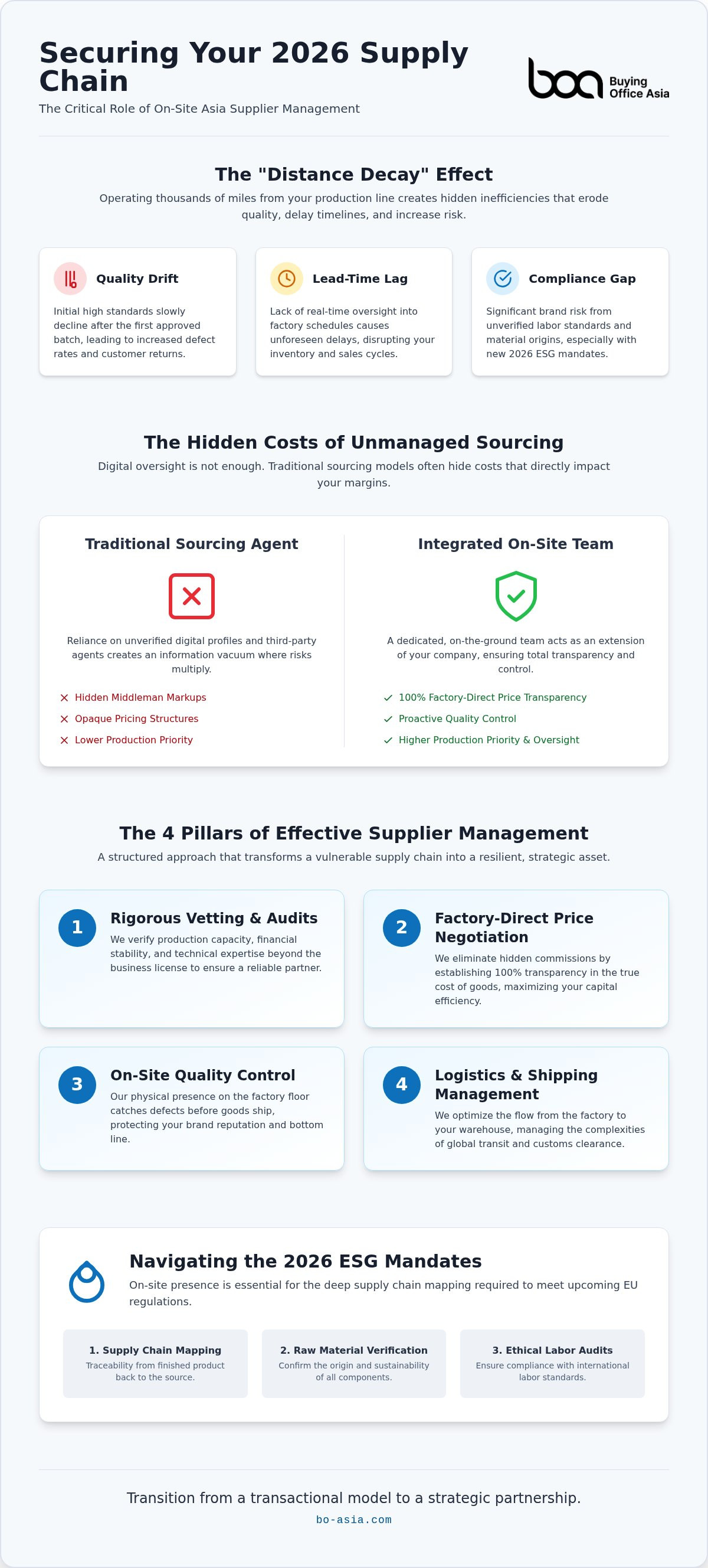
By 2026, regulatory compliance is no longer a secondary concern; it's a fundamental requirement for market access. Professional asia supplier management now demands a rigorous four step framework to ensure your supply chain meets escalating global standards. This proactive approach transitions your procurement from a state of vulnerability to one of documented reliability.
You must ensure 100% transparency of raw material origins. This involves verifying every tier of production, from the source of the raw materials to the final assembly line, to eliminate any blind spots in your tier 2 and tier 3 networks.
These physical inspections focus on carbon footprint data and ethical labor standards. Digital self assessments are insufficient; you need on site verification to prove that factory conditions align with your brand's ethical commitments.
Regulations in the EU and globally are shifting rapidly. You need a system that monitors these changes and applies them to your supplier's production processes immediately to avoid non compliance penalties.
Move beyond price as the sole driver. Make environmental and social performance a primary weight in your supplier scorecard to build a resilient, future proof partner network.
Ethical sourcing is a powerful tool for protecting your brand reputation in the European market. Today's consumers and regulators demand proof of integrity. By shifting your focus from the lowest possible price to the most compliant and reliable partner, you create a defensive shield against operational and reputational risks. Our Buying Office Asia ESG Policy provides a clear roadmap for how we integrate these rigorous standards into every procurement cycle, ensuring your business remains a leader in corporate responsibility.
The EU Deforestation Regulation (EUDR) introduces strict documentation requirements for Asian exports that you cannot afford to ignore. Managing chain of custody requirements for customs clearance in 2026 requires precise geolocation data and production history for specific commodities. BOA ensures all suppliers meet these rigorous 2026 standards by conducting on the ground audits and verifying all necessary documentation before goods leave the port. This level of oversight prevents costly delays and legal exposure at the border. If you're concerned about how these new mandates affect your current production, contact our Helsinki leadership team to arrange a comprehensive compliance audit of your supply chain.
The BOA model isn't just an external service; it's a structural integration of on-the-ground expertise into your own company hierarchy. Most sourcing agents operate as traditional middlemen, often profiting from the information gap between you and the factory. In contrast, our approach to asia supplier management provides you with a dedicated sourcing team that acts as an extension of your own office. This European-managed firm, led by Helsinki leadership with a central hub in Hong Kong, provides a unique trust bridge. We don't just find vendors. We manage the entire procurement ecosystem with the same rigor you'd expect from your home office, ensuring your interests are defended in every manufacturing hub across the region.
Traditional sourcing models are frequently built on obscured costs. Middlemen often hide commissions within unit prices, making it impossible to know the true cost of your goods. BOA rejects this model entirely. Our Sourcing and Procurement Service Fee structure ensures that our team remains objective and unbiased. We have no incentive to steer you toward a specific factory based on kickbacks. Instead, we focus on establishing factory-direct pricing that reveals the authentic cost of production. Paying a management fee rather than a percentage of order value aligns our interests with yours. This model prioritizes cost reduction, quality stability, and financial transparency over transactional volume.
Transitioning from unmanaged or agent-led sourcing to a professional procurement framework requires a disciplined approach. You can't fix a fragmented supply chain overnight, but you can secure it through a structured 90-day transition. We begin by auditing your current suppliers to identify immediate quality and compliance risks. Once the baseline is established, we move into negotiations to unkink the supply chain and reclaim lost margins. By the end of this initial period, your operations shift from reactive crisis management to a steady, predictable production cycle. This proactive oversight is the only way to safeguard your brand as you scale. If you're ready to secure your 2026 ROI, contact Buying Office Asia to audit your current supplier performance and begin the transition to a dedicated team model.
The landscape of international manufacturing is undergoing a fundamental shift where digital oversight is no longer enough to protect your margins. By implementing professional asia supplier management, you replace the risks of quality drift and opaque pricing with a model of total accountability. You've seen how physical proximity in Hong Kong and manufacturing hubs ensures that your production remains a priority while meeting the strict ESG mandates of 2026.
Our European-managed team provides a defensive shield for your brand, offering 100% transparency and factory-direct pricing with no hidden markups. This approach doesn't just solve immediate logistical knots; it builds a foundation for scalable, long-term growth. It's time to move beyond the limitations of traditional intermediaries and integrate a partner who acts as a true extension of your own procurement office. Secure your supply chain with a Dedicated Asia Procurement Team and gain the calm assurance that comes from expert regional oversight. We're ready to help you stabilize and optimize your global operations.
A sourcing agent often acts as a middleman who profits from hidden commissions, whereas a dedicated procurement team functions as an integrated extension of your own company. Our model prioritizes long term partnership and total transparency over transactional markups. We operate with a flat service fee structure, ensuring our interests align with yours. This allows for deeper factory integration and more rigorous oversight than typical commission based agents provide.
We establish factory direct price negotiations where every cost component is visible to you. By removing the traditional middleman, we uncover hidden markups and ensure you pay the actual production cost. Our revenue comes from a transparent management fee rather than a percentage of the order value. This model guarantees that our recommendations are based on quality and reliability, not on which supplier offers the highest kickback.
Yes, we provide end to end sourcing and procurement across major Asian manufacturing hubs, including Vietnam and India. The sophistication of these markets is evident in the growth of established technical partners like Luvina Software, which highlights the region's capacity for complex engineering and software integration. Our Hong Kong headquarters serves as a strategic base for regional oversight. We apply the same rigorous vetting and auditing standards to these markets as we do in China. This regional reach allows you to diversify your supply chain while maintaining a consistent level of European managed quality control and operational security.
If a factory fails an inspection, we immediately implement a Corrective Action Plan (CAP) on the factory floor. We don't just report the failure; we stay on site to oversee the necessary production adjustments. This proactive approach prevents batch defects from reaching your warehouse. We verify the fixes through re-inspections and hold the supplier accountable for maintaining the agreed upon quality standards before the goods are cleared for shipment.
Professional asia supplier management typically utilizes a fixed service fee or a monthly management retainer rather than hidden commissions. This structure covers end to end services, including factory audits, quality inspections, and logistics management. While exact costs depend on the volume and complexity of your production, this model is designed to be self funding through the savings achieved via factory direct price negotiations and reduced defect rates.
We assist by mapping your entire supply chain to verify raw material origins and ethical labor standards. Our on the ground teams conduct physical ESG audits to ensure compliance with the 2026 EU Deforestation Regulation (EUDR). We help manage the complex chain of custody documentation required for customs clearance. This rigorous oversight protects your brand from non compliance penalties and ensures your manufacturing partners meet evolving European regulatory standards.
We provide comprehensive support for custom product and tooling development. Our on site engineers work directly with factory technical teams to optimize designs for mass production efficiency. We also manage the prototyping and sampling phase to ensure your intellectual property is protected. By overseeing the tool making process at the source, we reduce the risk of technical errors and ensure the final product meets your exact specifications.
The Helsinki office provides a local point of contact that understands the specific business culture and regulatory requirements of Nordic brands. It acts as a trust bridge between European leadership and Asian manufacturing hubs. Having management in the same time zone simplifies communication and strategic planning. This structure ensures your asia supplier management strategy is executed with the high level of transparency and ethical rigor expected in the Nordic market.

What if your biggest supply chain risk isn’t the supplier you chose, but what you can’t see after the order is placed? Asia procurement services can connect supplier selection with factory follow-through, giving you clearer visibility into production, product quality, and responsibilities along the...

A supplier listing can open a door, but it can’t show whether a factory is right for your order. Choosing a ningbo sourcing agent means looking beyond access to local suppliers: you need clear oversight of supplier vetting, production follow-up, and quality checks. Without defined responsibilities,...

What if the supplier with the strongest online profile isn’t the factory best suited to your shoes? In footwear manufacturing in China, a directory listing can start your search, but it can’t confirm who will make your product, whether the factory can handle its construction and materials, or how cl...