


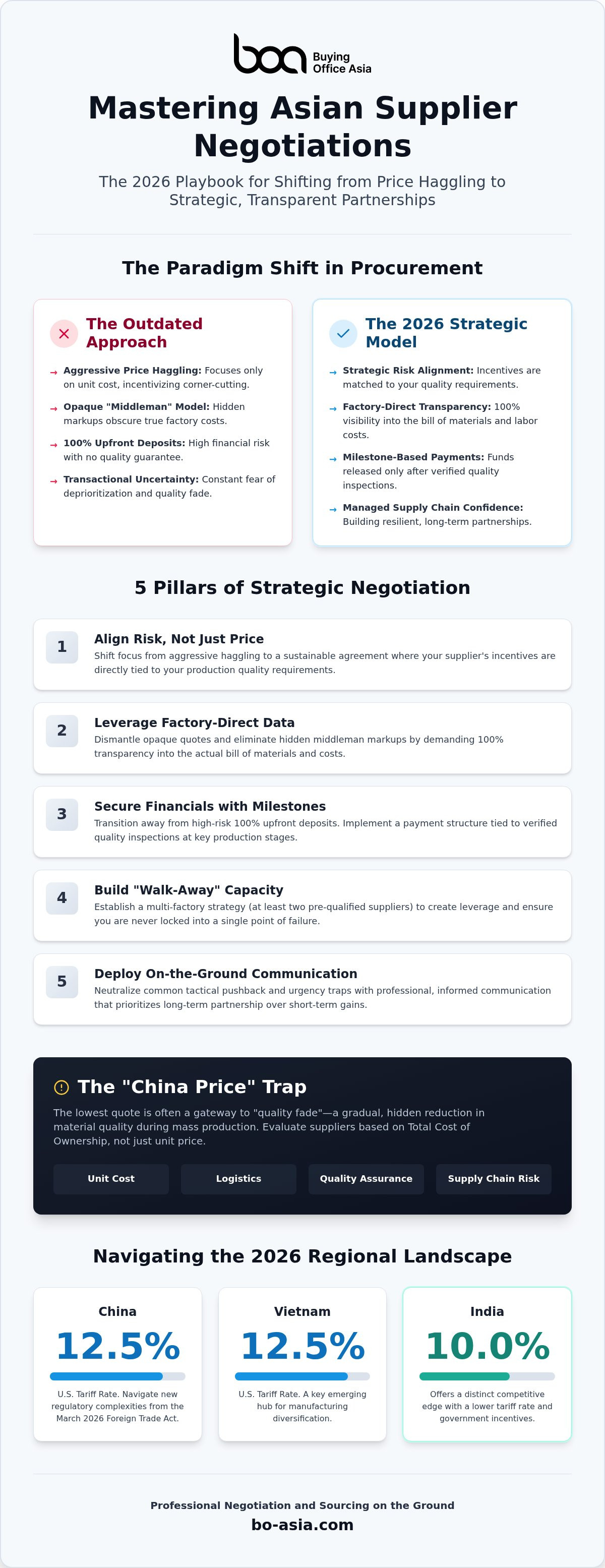
The most expensive price you'll ever pay in Asia isn't the unit cost on your invoice; it's the hidden tax of a "yes" that actually means "no." In a market where the 12.5% U.S. tariffs implemented in July 2026 have tightened margins, many importers are discovering that traditional haggling is no longer a viable strategy. You're likely tired of opaque cost structures and the constant fear that your production will be deprioritized the moment a larger order arrives at the factory gate.
Learning how to negotiate with asian suppliers in 2026 requires moving beyond simple price-squeezing toward a model of 100% transparency. This guide provides a strategic roadmap for mastering high-stakes procurement by eliminating middlemen and building resilient, factory-direct partnerships. We'll show you how to secure competitive pricing while maintaining rigid quality benchmarks in a volatile trade climate. You'll learn how to decode cultural communication barriers, navigate the complexities of China's amended Foreign Trade Act, and position your business as a stabilizing force in your supplier's portfolio. It's time to move from transactional uncertainty to the steady confidence of a managed, insider-led supply chain.
• Shift your focus from aggressive price haggling to strategic risk alignment, ensuring your supplier's incentives match your production quality requirements.
• Discover how to negotiate with asian suppliers by leveraging factory-direct cost data to dismantle opaque quotes and eliminate hidden middleman markups.
• Secure your financial viability by transitioning from 100% upfront deposits to milestone-based payments tied to verified quality inspections.
• Establish a resilient supply chain through a multi-factory strategy that provides the walk-away leverage necessary to maintain control over your production timelines.
• Learn to neutralize common tactical pushback and urgency traps by deploying professional, on-the-ground communication strategies that prioritize long-term partnership.
Effective negotiation in Asia isn't about winning a shouting match over pennies; it's a meticulous process of risk alignment. If you focus solely on driving the price down, you aren't winning. You're likely incentivizing the factory to cut corners on your raw materials to protect their own margins. In the Fundamentals of Strategic Negotiation, success is defined by achieving a sustainable agreement where both parties are incentivized to perform. For 2026, this means moving beyond the traditional "Guanxi" model. While relationships remain a cornerstone of business, they must be anchored in professional rigor and verifiable data to survive the current economic climate.
Many importers still fall into the "Middleman Model," where hidden markups and a lack of transparency obscure true factory costs. To truly master how to negotiate with asian suppliers, you must transition to a Factory-Direct Model. This approach, championed by Buying Office Asia, prioritizes 100% transparency. It gives you direct visibility into the actual bill of materials and labor costs. By eliminating intermediaries, you reclaim control over your margins and your quality standards, transforming the supplier from a distant vendor into a transparent partner.
The lowest quote is often a trap. When a factory offers a price that seems too good to be true, they usually plan to recover their margins through "quality fade," which is a gradual reduction in material quality during mass production. You must evaluate quotes based on the Total Cost of Ownership. In an Asian procurement context, Total Cost of Ownership is the comprehensive calculation of all direct and indirect expenses, including unit cost, logistics, quality assurance, and the financial risk of supply chain disruptions. Understanding the components of a factory quote, from raw material fluctuations to labor overhead, allows you to challenge unrealistic figures with confidence.
Understanding how to negotiate with asian suppliers requires a deep dive into regional differences. In China, the March 2026 amendments to the Foreign Trade Act have introduced new regulatory complexities that require a dedicated Asia procurement team to navigate safely. Meanwhile, in emerging hubs like Vietnam or India, government incentives often influence supplier pricing structures. The 10% tariff rate currently applied to Indian goods offers a distinct competitive edge over the 12.5% rate applied to Chinese and Vietnamese imports. Success depends on matching your order volume to the right factory size. A massive enterprise factory will deprioritize a mid-sized brand, while a small workshop may lack the infrastructure to handle high-volume mass production oversight.
Leverage is the silent engine of every successful procurement deal. If you enter a negotiation with only one viable option, you aren't negotiating; you're pleading. True power comes from walk-away capacity. This begins with a multi-supplier strategy that ensures your business is never "locked in" to a single point of failure. By maintaining active relationships with at least two pre-qualified factories, you create a competitive environment where performance is the only currency. This dual-sourcing approach provides the security needed to reject unfavorable terms without jeopardizing your retail launch dates.
Factories often use market complexity to justify inflated quotes, but data is the ultimate equalizer. When you understand current market conditions, such as the fact that three major shipping alliances control over 80% of container capacity in 2026, you can better navigate logistics-based price hikes. Using factory-direct pricing data allows you to challenge unrealistic markups with surgical precision. If a supplier claims raw material costs have spiked, your ability to cite specific market indices proves you aren't an outsider to be exploited. Knowing how to negotiate with asian suppliers involves showing that you are as informed about their costs as they are.
A pre-vetted supplier is significantly easier to manage because you've already removed the primary source of negotiation friction: uncertainty. Negotiating with an unknown entity is a gamble; negotiating with a factory whose capacity and compliance have been physically verified is a strategic exercise. You must identify "red flags" that suggest a supplier is a middleman in disguise, including:
• A refusal to allow on-site audits or on-site quality control & inspections.
• Vague answers regarding specific machinery or production line capacity.
• Pricing that fluctuates wildly without a clear link to raw material indices.
For a deeper look at this process, see our guide on Supplier Vetting in Asia. On-site audits are the only way to confirm that the "factory" you're communicating with isn't just a trading office with a clever website.
In B2B procurement, the "Grand Bazaar" rule means you must communicate your options without burning bridges. You need to let the supplier know that while you value the partnership, you have other verified leads ready to move. This requires a delicate understanding of cultural nuances in Asian negotiations, where saving face is as important as the bottom line. You must identify the point of diminishing returns where further haggling risks damaging the product quality. Utilizing a dedicated Asia procurement team ensures you always have alternative leads in the pipeline. If a deal doesn't align with your financial health, we can help you by discussing your procurement strategy to find a more viable partner. Mastering how to negotiate with asian suppliers effectively means knowing exactly when to walk away to protect your brand's integrity.
Fixing your attention solely on the unit price is a strategic error that often invites hidden costs. When you're learning how to negotiate with asian suppliers, you must realize that the lowest invoice price often conceals expensive operational risks. Strategic procurement involves shifting from 100% upfront payments to milestone-based structures. By tying the final 70% of the payment to a passed on-site quality inspection, you maintain financial control until the goods are physically verified. This approach is a core part of Building Leverage in a high-volume manufacturing environment.
Beyond payments, you must integrate penalty clauses for production delays into your initial agreement. In 2026, where shipping alliances control 80% of capacity and ocean freight rates are subject to 40-80% peak season surcharges, a two-week delay at the factory can cascade into a two-month delay at retail. Locking in firm lead times with liquidated damages ensures the factory prioritizes your order over less rigorous clients. Similarly, ESG and compliance standards should be non-negotiable. Ethical manufacturing isn't just a branding choice; it's a defense against the regulatory sanctions being implemented across major trade hubs like China and Vietnam.
Protecting your intellectual property is paramount during the contract phase. When negotiating OEM manufacturing in 2026, you must secure written confirmation of your ownership of custom molds and tooling. Without this, your supplier effectively holds your product's DNA hostage. You should also define "Golden Samples" as the absolute benchmark for mass production. Establishing an Acceptable Quality Level (AQL) with clear defect rates in the initial deal prevents the quality fade that often plagues unmanaged supply chains.
The "DDP trap" is a common pitfall when discovering how to negotiate with asian suppliers. While Delivered Duty Paid sounds convenient, it often hides inflated shipping costs and leaves you with zero control over the customs process. Negotiating Incoterms like FOB (Free on Board) allows you to use your own logistics partners and consolidate shipments. Shipping consolidation is a hidden win; by grouping orders from multiple factories into a single container, you significantly reduce your total landed cost. Our procurement services ensure these logistics nuances are handled before the first deposit is ever paid.
Tactical communication is the final bridge between a robust procurement strategy and a successful production run. Many businesses struggle with how to negotiate with asian suppliers because they allow the factory to dictate the emotional and operational speed of the deal. Success in 2026 requires you to maintain a posture of calm authority, where technical data replaces emotional appeals. If a supplier pushes back with the common "That’s not how we do it" rebuttal, you must be prepared to counter with specific industry benchmarks and transparent cost breakdowns. This directness demonstrates that you're an informed partner who understands the difference between genuine operational constraints and standard negotiation posturing.
The "rush trap" is a favorite tool of factories looking to force signatures on unfavorable terms. They may claim that raw material prices are about to spike or that a major production slot is closing. You must resist this artificial urgency. Setting a clear, non-negotiable timeline for the sampling and negotiation phases establishes you as a professional partner rather than a desperate buyer. Silence is a powerful tool in this context. In many Asian business cultures, rushing to fill a silence during a meeting often leads to over-explaining your budget. This mistake inadvertently reveals your maximum price ceiling and weakens your leverage before you've even discussed quality benchmarks.
There is a fundamental difference between transactional sourcing agents and a professional procurement partner who acts as an extension of your own team. Having a local, on-the-ground presence fundamentally shifts the power dynamic at the table. It moves the relationship from a digital exchange to a physical reality. An unannounced on-site factory visit during the final stages of negotiation signals a level of oversight that immediately discourages the use of standard stalling tactics. This physical proximity functions as a signature promise of accountability. It ensures the factory management knows that their performance is being monitored in real-time by experts who understand their true operational costs and labor overhead. This level of oversight is usually reserved for major enterprises, but it's essential for any high-volume business looking to protect its financial health. If you're ready to secure this level of professional oversight for your next production run, you can connect with our Hong Kong team today to discuss your specific requirements.
Remote negotiation creates a visibility gap that traditional sourcing models fail to bridge. While digital communication is efficient, it cannot replace the leverage of physical proximity. By maintaining a permanent presence in Hong Kong and active on-site oversight at factories across the region, we dismantle the information asymmetry that often works against international buyers. This is how to negotiate with asian suppliers with the authority of a local insider. We combine European leadership and professional rigor with deep regional expertise to ensure your procurement strategy is both culturally nuanced and financially optimized.
Our model is designed to protect your margins by eliminating the layers of middlemen who typically obscure true factory costs. We don't just find a supplier; we manage the entire ecosystem from product development and sampling support to mass production oversight. This hands-on approach ensures that the strategic advantages negotiated at the start of the project are actually delivered during the final production run. This transparency is the only reliable way to master how to negotiate with asian suppliers while maintaining 100% control over your financial health.
We explicitly reject the conventional intermediary model characterized by hidden markups and undisclosed commissions. These obscured costs are the primary source of supply chain inefficiency and risk. Our 100% transparency model provides you with full visibility into the factory selection process and a complete cost breakdown of every component. You see exactly what the factory is charging for materials, labor, and overhead. This clarity allows for honest, data-driven discussions that prioritize long-term stability over short-term price squeezing. You can view the financial impact of this model in our pricing and savings examples.
We don't function as a third-party vendor; we operate as an integrated extension of your own procurement department. This distinction is critical for high-volume businesses that require consistent, elite-level oversight of their OEM and contract manufacturing. Having a dedicated team means you have advocates on the ground who possess the networks and technical knowledge to resolve production bottlenecks before they affect your bottom line. The real-world ROI of this model is documented in our analysis of the ROI of a dedicated Asia procurement team. If you're ready to move beyond unmanaged sourcing and secure your supply chain for 2026, book a consultation with our procurement experts to begin building a more resilient, transparent partnership.
Success in international manufacturing is no longer determined by who can shout the loudest at a trade fair. It's defined by who possesses the most accurate data and the strongest on-the-ground presence. By shifting your focus from unit price to total cost of ownership and embracing a model of 100% transparency, you eliminate the hidden risks that cripple unmanaged supply chains. You've learned that how to negotiate with asian suppliers effectively requires a balance of tactical patience, rigorous vetting, and the leverage of a multi-factory strategy.
Buying Office Asia serves as your stabilizing force in this complex market. Our European-managed team, based in Finland and Hong Kong, provides the elite oversight typically reserved for major enterprises. We reject hidden commissions and middlemen to ensure you receive factory-direct pricing with zero obscured costs. With a proven track record in high-volume sourcing and rigorous quality control, we transform your procurement from a source of anxiety into a competitive advantage. It's time to reclaim control over your margins and build a resilient partnership that scales with your business goals.
Secure Factory-Direct Pricing with Buying Office Asia and take the first step toward a transparent, risk-managed supply chain today.
No, walking away is a final tactical lever rather than a default response. If you've verified the factory's overhead and raw material costs, a refusal to budge may indicate that you've reached the floor of financial viability. In these cases, focus on negotiating non-price terms like milestone payments or lead time guarantees. Walking away is only effective if you have a pre-vetted alternative factory ready to begin production immediately.
Demand a transparent cost breakdown tied to verified market indices. In 2026, global commodity prices are volatile, so you must verify claims against independent data sources like the London Metal Exchange or regional material exchanges. If the increase is legitimate, negotiate a temporary price adjustment with a clear "sunset clause" that reverts to the original price once material indices stabilize. This prevents temporary spikes from becoming permanent margin erosion.
You should utilize bilingual contracts where the local language version is legally binding in the factory's jurisdiction. While English is common for initial discussions, a Chinese or Vietnamese court will prioritize the local language text during a dispute. Working with a dedicated Asia procurement team ensures that your legal protections are accurately translated and enforceable. This dual-language approach eliminates the "yes" that actually means "no" caused by linguistic misunderstandings.
Look for obscured costs in logistics, packaging, and tooling amortizations. Middlemen often hide commissions within these line items to avoid direct price scrutiny. Other common hidden expenses include export license fees, palletization charges, and local trucking costs from the factory to the port. Our 100% transparency model eliminates these markups by providing full visibility into the factory selection and cost breakdown, ensuring you only pay the true production price.
An on-the-ground presence provides the insider data needed to challenge inflated quotes in real-time. When a factory knows your representatives can perform unannounced supplier vetting and factory audits, they are less likely to include buffer margins for risk. Proximity allows for face-to-face discussions that build trust faster than remote emails. This physical accountability often results in more favorable payment terms and priority scheduling that digital-only buyers simply cannot access.
Use WeChat for rapid tactical updates but always confirm final terms via formal email or a signed contract. WeChat is the standard for daily communication in many Asian hubs, and it's essential for building the relationship. However, it lacks the legal weight and paper trail required for high-stakes procurement. Maintaining a steady, organized communication rhythm across both platforms ensures that no detail is lost and that every verbal agreement is documented for mass production oversight.
You must have a pre-negotiated quality agreement that links final payment to a passed inspection. If a factory fails to meet the Golden Sample benchmarks, our on-site quality control and inspections team identifies the root cause before the goods leave the floor. You shouldn't pay the remaining balance until defects are corrected or a credit is issued. Learning how to negotiate with asian suppliers includes establishing these rigid quality benchmarks before the first deposit is paid.

A factory audit can look reassuring while leaving a critical question unanswered: will the same materials, processes and controls be used for your production run? Responsible toy manufacturing in China requires more than reviewing a certificate. You need to understand factory conditions, subcontract...

A final inspection can show you what came off the production line, but it can’t change the decisions that shaped it. That’s the key distinction in standalone quality inspections vs procurement services: one checks product output at a defined point, while the other can coordinate work across supplier...

A factory quote is not a shipment plan. Sourcing products from China to USA involves more than finding a manufacturer and agreeing on a unit price. Unclear specifications, samples that differ from production, or overlooked packaging and freight details can put quality and commercial viability at ris...