


A digital profile on a global sourcing platform is not a business credential; it's a marketing brochure. Relying on unverified online data is the fastest way to compromise your margins and your brand reputation. To move beyond the inherent uncertainty of offshore manufacturing, you need a rigorous, physical China factory vetting process that replaces guesswork with documented reality. This level of oversight is the only way to navigate a market where stricter enforcement of labor laws and new 2026 ESG reporting standards demand absolute supply chain clarity.
You likely recognize the anxiety of wiring capital to an entity that might just be a trading company masquerading as a manufacturer. It's a common frustration that leads to obscured costs and batch-to-batch quality inconsistency. This article provides the roadmap to mastering a multi-layered, on-the-ground vetting strategy designed to secure factory-direct pricing and eliminate operational risks. We'll examine how 100% transparency and local proximity allow you to build a repeatable, low-risk supply chain that functions as a strategic defense for your bottom line.
• Learn why a rigorous China factory vetting process is the only way to bypass middlemen and secure true factory-direct pricing.
• Identify the "showroom factory" tactics used by trading companies and learn the physical checks required to expose them.
• Prepare for 2026 regulatory shifts by integrating ESG and automation readiness into your standard audit protocols.
• Transform vetting from a one-time event into a continuous defense system through dedicated, on-site procurement oversight.
In the current manufacturing climate, a business license is merely the price of entry. It doesn't guarantee operational competence or financial stability. A truly robust China factory vetting process is a multi-stage risk mitigation strategy that moves beyond surface-level documentation. It's the tactical execution of supply chain risk management, designed to ensure that the partner you choose today can actually deliver tomorrow. Without this physical verification, you're operating on "blind trust," a model that frequently leads to quality fade and catastrophic delivery failures.
Effective vetting serves as the fundamental requirement for achieving factory-direct pricing. When you lack visibility on the ground, you're often unknowingly paying a premium to intermediaries who add zero value to the production cycle. By verifying the factory's direct ownership and production capacity, you strip away these hidden margins. This transparency doesn't just save money; it establishes a "Trust but Verify" relationship where performance is measured against documented reality rather than sales promises.
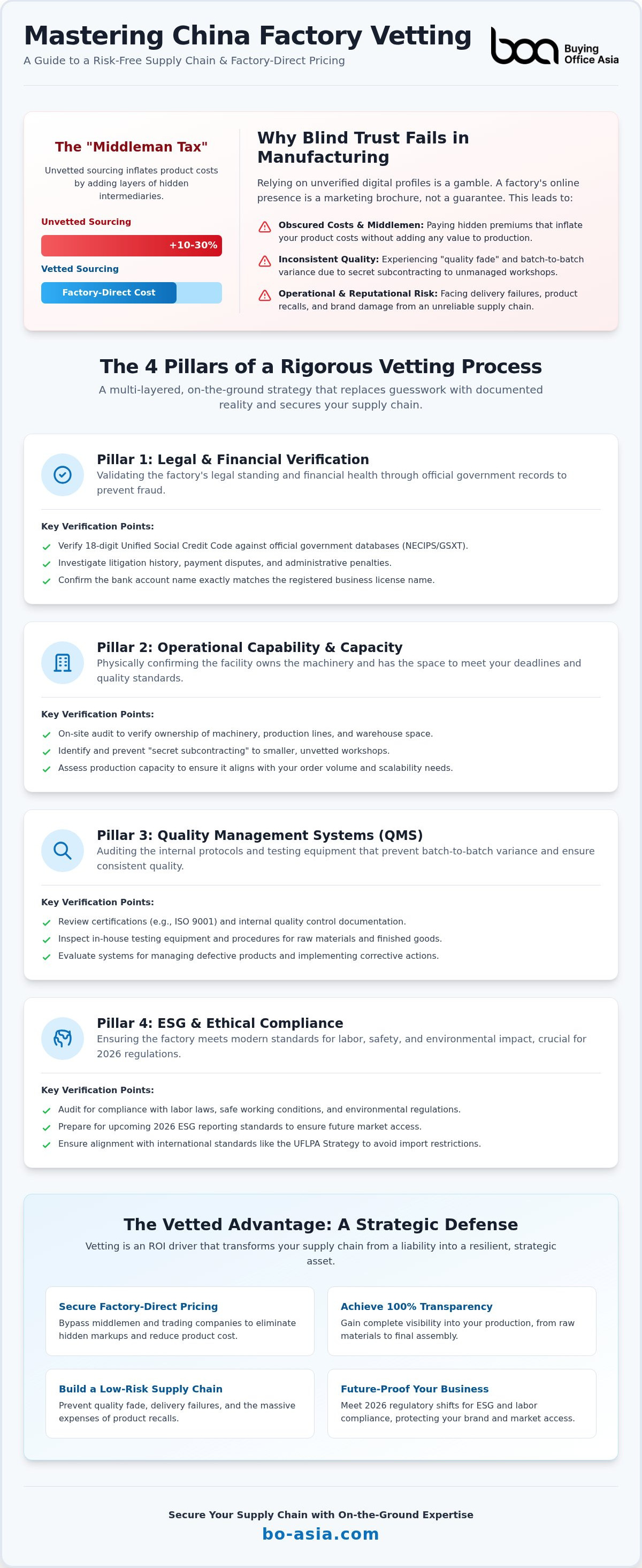
Skipping the vetting stage introduces a "middleman tax" that typically inflates product costs by 10% to 30%. These obscured expenses are rarely visible on a quote but manifest through inflated unit prices or kickback schemes. Beyond the immediate financial drain, unvetted sourcing exposes your brand to inconsistent quality and shipping delays that can erode customer loyalty. In 2026, supply chain transparency is no longer a luxury; it is a prerequisite for financial viability. Protecting your reputation requires a defense against the shortcuts that unmanaged factories often take when they believe no one is watching.
Smart procurement leaders view vetting as an ROI driver rather than a cost center. A small upfront investment in a rigorous audit prevents the massive expenses associated with product recalls or emergency supplier switches. This proactive approach is essential for high-volume sourcing scalability. As your order volumes grow, the risks associated with an unvetted supplier grow exponentially. By identifying and developing high-performing manufacturers early, you create a stable foundation for long-term growth. This process transforms a transactional relationship into a strategic partnership, ensuring your supply chain remains resilient against market volatility and regulatory shifts.
A resilient supply chain isn't built on a single inspection. It's supported by a four-pillar architecture that scrutinizes every facet of a manufacturer's existence. The China factory vetting process must be clinical, objective, and physically verified to transform a potential liability into a verified asset. This framework ensures that your procurement strategy rests on a foundation of legal legitimacy, technical competence, consistent quality, and ethical integrity.
Validating the factory's legal standing and financial health through official government records.
Confirming the facility owns the machinery and floor space required to meet your specific deadlines.
Auditing the internal protocols and testing equipment that prevent batch-to-batch variance.
Ensuring the factory meets modern standards for labor and environmental impact, which is essential for alignment with the UFLPA Strategy.
Every legitimate entity in China is assigned a 18-digit Unified Social Credit Code. You must verify this code against the National Enterprise Credit Information Publicity System (NECIPS), also known as GSXT. This database, operated by the State Administration for Market Regulation (SAMR), holds records for over 190 million market entities. It allows us to investigate litigation history, payment disputes, and administrative penalties that could signal operational instability. You must also ensure the bank account entity matches the name on the business license exactly; any discrepancy here is a major red flag for fraud or tax evasion.
A common pitfall in unmanaged sourcing is "secret subcontracting," where a vetted factory offloads your order to a smaller, unmanaged workshop to save costs. A physical audit is the only way to confirm that the machinery on the factory floor is actually the equipment used for your production. This verification is particularly vital for custom product and tooling development, where specialized precision and R&D expertise are non-negotiable. We evaluate machinery maintenance schedules and technical investment to ensure the factory isn't running on obsolete hardware that risks your product's integrity. If you're concerned about a potential supplier's true technical readiness, contact our team for a professional audit briefing.
Digital verification accounts for roughly 20% of a comprehensive China factory vetting process. While reviewing business licenses and export permits is a necessary first step, these documents only confirm that a company exists, not that it actually manufactures the goods it sells. Many Western importers fall into the trap of relying on "Gold Supplier" status or similar badges on global B2B platforms. It's vital to understand that these designations are often paid marketing tiers rather than indicators of verified manufacturing capability. They don't protect you from the "showroom factory" tactic, where a trading company leads visitors through a partner facility while claiming ownership of the floor.
To expose these deceptions, on-site quality control and physical inspections must occur during the vetting phase. A physical presence allows you to cross-reference the production floor with the entity named on your contract. If the factory signage doesn't match the business license, or if the staff seems unfamiliar with the technical specifications of the machinery, you've likely identified an intermediary masquerading as a factory-direct source. This distinction is the difference between securing direct pricing and paying an invisible 20% markup to a middleman who adds no operational value.
Intermediaries often rely on obfuscation to maintain their margins. Identifying these signals early saves months of negotiation with the wrong entity. Watch for these indicators during your initial engagement:
Vague or delayed answers regarding raw material sourcing, machinery maintenance schedules, or specific production tolerances.
Claims that the factory is "under renovation" or requires weeks of notice for a simple walkthrough.
A business license that lists "Trading," "Consulting," or "Wholesale" in the business scope instead of "Manufacturing" or "Processing."
Regional presence is the ultimate defense against operational setbacks. Operating from Hong Kong provides a strategic advantage, allowing for rapid, often unannounced visits to mainland facilities. Unannounced inspections provide a "real-world" view of production conditions, labor standards, and safety protocols that are often sanitized for scheduled tours. This boots-on-the-ground approach is a core component of our Supplier Vetting in Asia methodology. It ensures that the factory you see on paper is the factory producing your goods, protecting your brand from the quality inconsistencies inherent in unmanaged supply chains.
Advanced auditing represents the final line of defense in a modern China factory vetting process. By 2026, the criteria for a qualified supplier have shifted from simple output metrics to complex assessments of sustainability and technical resilience. You must verify if a factory can maintain its operational integrity under increased regulatory scrutiny and fluctuating market demands. This involves a clinical look at raw material traceability and deep supply chain tiering to ensure no hidden risks exist in the lower levels of your production cycle. Identifying these vulnerabilities early prevents the cascading failures that often plague unmanaged supply chains.
The regulatory environment in 2026 has made ethical auditing a non-negotiable requirement for Western enterprises. With the first mandatory ESG reports under the Chinese Sustainability Disclosure Standards (CSDS) due by April 30, 2026, large-cap companies must now prove their adherence to "double materiality" principles. Your vetting must include deep verification of labor contracts, social insurance records, and waste management protocols. ESG auditing in 2026 is an empirical assessment of a factory’s long-term operational sustainability and ethical risk profile. It serves as a brand shield against the legal and reputational fallout of non-compliance. You can review our specific approach to ESG compliance and ethical sourcing to see how we mitigate these risks on the ground.
A factory that can deliver 1,000 units may fail catastrophically at 5,000. Capacity stress-testing is a vital component of advanced vetting; you need to know if they can handle five times your current volume without compromising quality. We evaluate a facility's "Industry 4.0" readiness, looking for automation levels that reduce human error and digital twins that allow for real-time reporting. This technical depth is essential for effective mass production oversight. We also scrutinize the factory’s internal quality control lab, checking calibration records and the sophistication of their testing equipment. A comprehensive China factory vetting process must confirm that a supplier’s technological infrastructure is capable of supporting your long-term growth. If you need a technical partner to evaluate a factory’s technological readiness, reach out to our procurement experts for a detailed assessment.
The initial validation of a supplier is merely the starting point of a secure supply chain. Vetting doesn't end when the first purchase order is signed; it's a continuous defensive posture that adapts to changing market conditions and factory performance. A truly effective China factory vetting process requires ongoing monitoring to prevent the gradual erosion of standards. Without a permanent local presence, even the most promising manufacturers can succumb to operational drift, leading to unforeseen risks and financial setbacks for your business.
By utilizing a dedicated Asia procurement team, you gain an integrated extension of your own office that remains active on the ground. This team manages the entire source-to-contract lifecycle, ensuring that the transparency achieved during the vetting phase is maintained throughout the production relationship. This level of oversight is what allows you to transition from simple supplier selection to aggressive factory-direct price negotiations, as you're negotiating from a position of documented technical knowledge and local authority.
One of the most significant risks in international manufacturing is "Quality Fade." This is a phenomenon where a factory provides excellent samples and first-batch results, only to slowly substitute cheaper raw materials or skip critical QC steps in subsequent runs to pad their margins. Annual re-audits and unannounced spot checks are non-negotiable for any high-volume importer. These physical interventions ensure the manufacturer remains compliant with the rigorous standards set during the initial China factory vetting process. You can view our documented success in maintaining these standards across various industries by reviewing our BOA Cases, which highlight the measurable outcomes of continuous oversight.
Traditional sourcing models often rely on intermediaries who charge hidden commissions, creating a conflict of interest that compromises your financial health. We replace this opaque system with a transparent fee structure that prioritizes your bottom line. By building a "Defense-in-Depth" supply chain, we act as your local guardian, shielding you from the obscured costs and operational failures of unmanaged sourcing. This partnership transforms your supply chain into a stable, high-performance asset rather than a source of constant anxiety. To secure your manufacturing interests and establish a repeatable, low-risk procurement model, book a consultation with our Helsinki or Hong Kong leadership today.
Transitioning from unmanaged risk to a stable, scalable supply chain requires a fundamental shift in perspective. You've seen that a robust China factory vetting process is a physical defense system, not a one-time administrative task. By focusing on the four pillars of verification and maintaining constant on-site proximity, you eliminate the "middleman tax" and protect your brand from the quality fade that often follows initial success. This proactive approach ensures your operations are ready for the technological and ESG demands of 2026.
Our European-managed team provides the professional rigor and 100% transparency you need to navigate the complexities of the global market without hidden markups. With our strategic presence in Hong Kong, we offer immediate factory access and the steady confidence of a seasoned partner. It's time to replace manufacturing anxiety with the financial viability of a verified, high-performance supply chain. Secure your supply chain with a dedicated Asia procurement team today and build a foundation for long-term growth.
You must use the National Enterprise Credit Information Publicity System (NECIPS), also known as GSXT, to verify a manufacturer's legal status. Check the 18-digit Unified Social Credit Code against official records to confirm the legal representative, registered capital, and business scope. In 2026, it's also vital to verify beneficial ownership filings and check if the entity is among the 450 large companies required to file mandatory ESG reports.
A factory owns the physical production assets, machinery, and employs the manufacturing workforce directly. A trading company acts as an intermediary that sources from various suppliers and adds a profit margin to the unit cost. You can often distinguish them by checking the business scope on their license; factories list "Manufacturing" or "Processing," while trading companies typically list "Wholesale," "Consulting," or "Retail" as their primary activities.
Professional audit fees depend on the technical complexity of the production line and the depth of the required compliance checks. These costs typically cover the auditor's time on-site, travel expenses, and the delivery of a comprehensive verification report. While these fees are an upfront investment, they represent a small fraction of the potential losses associated with quality failures or the "middleman tax" charged by unverified intermediaries.
Remote vetting through B2B platforms is a preliminary step that only covers about 20% of a comprehensive China factory vetting process. While platform badges like "Gold Supplier" indicate a marketing investment, they don't guarantee operational capability or ethical compliance. True vetting requires physical, on-the-ground verification to expose "showroom factories" and ensure that the entity you're paying is the one actually producing your goods.
Major red flags include a business license name that doesn't match the bank account, vague responses to technical machinery questions, and a refusal to allow unannounced site visits. You should also be wary if the registered address on the license differs from the actual production site. These discrepancies often signal "secret subcontracting" or the presence of a trading company masquerading as a direct manufacturer, both of which increase your supply chain risk.
ISO 9001 certification proves a quality management system exists on paper, but it doesn't guarantee the system is followed during mass production. Many manufacturers treat these certifications as marketing tools rather than operational mandates. A rigorous China factory vetting process must include a physical audit of the factory's internal QC lab, machinery maintenance records, and real-world testing procedures to ensure that batch-to-batch consistency is actually maintained on the floor.
You should conduct a comprehensive re-audit at least once per year to defend against "Quality Fade" and ensure continued compliance with 2026 ESG standards. Frequent spot checks are also necessary to verify that the factory hasn't offloaded production to unmanaged sub-contractors. Ongoing oversight by a dedicated local team is the only way to prevent operational drift and maintain the high standards established during the initial supplier selection phase.
Request the business license, export permits, and recent third-party audit reports for quality and ESG compliance. You should also ask for a detailed machinery list, the factory's organizational chart, and proof of mandatory social insurance contributions for their employees. These documents provide the necessary "paper trail" to cross-reference against physical reality during an on-site audit, ensuring the factory's claims align with their actual manufacturing capabilities.

A factory audit can look reassuring while leaving a critical question unanswered: will the same materials, processes and controls be used for your production run? Responsible toy manufacturing in China requires more than reviewing a certificate. You need to understand factory conditions, subcontract...

A final inspection can show you what came off the production line, but it can’t change the decisions that shaped it. That’s the key distinction in standalone quality inspections vs procurement services: one checks product output at a defined point, while the other can coordinate work across supplier...

A factory quote is not a shipment plan. Sourcing products from China to USA involves more than finding a manufacturer and agreeing on a unit price. Unclear specifications, samples that differ from production, or overlooked packaging and freight details can put quality and commercial viability at ris...