

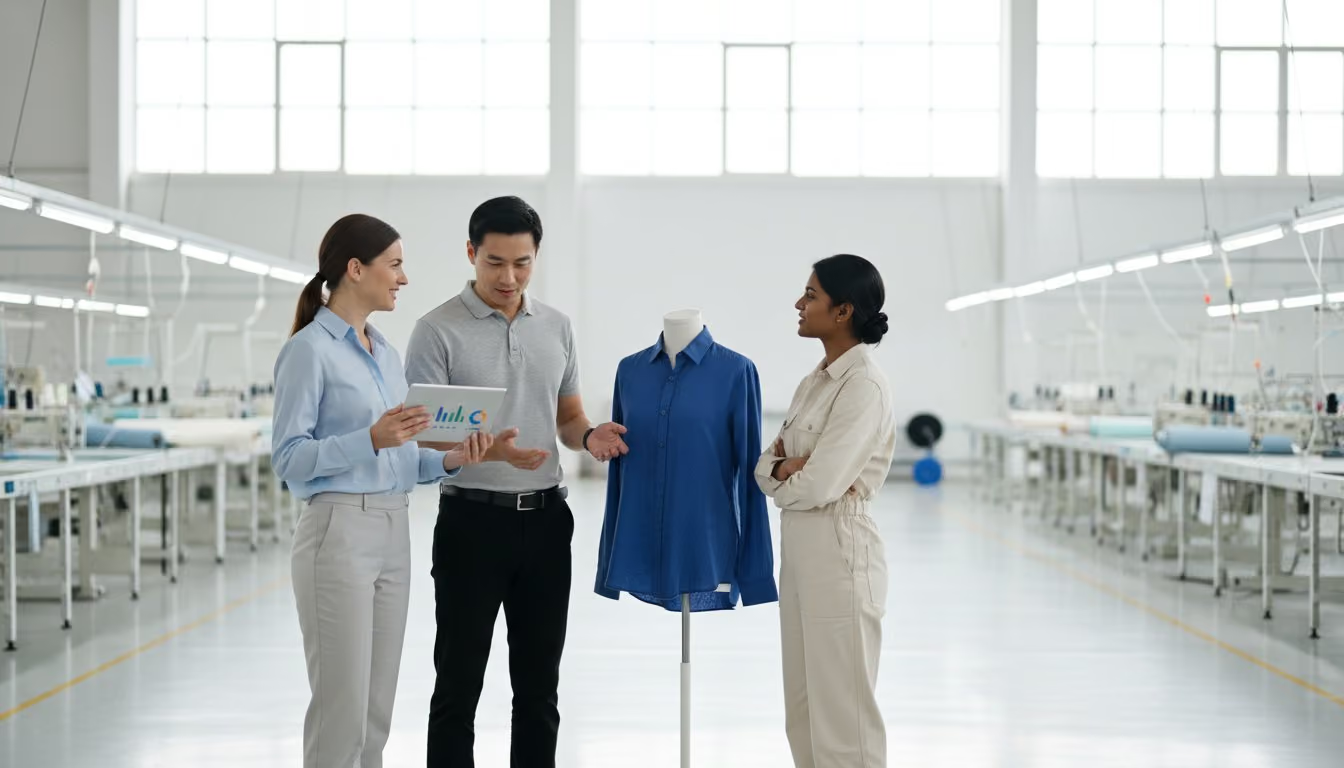
Your clothing factory audit is not a bureaucratic hurdle; it is a strategic defense mechanism against the hidden middlemen and quality failures that erode your bottom line. With the July 19, 2026, ban on destroying unsold apparel in the EU, production precision is now a legal mandate. We recognize the anxiety that comes with international procurement, where obscured pricing and social compliance risks can threaten your brand's financial health. Utilizing a rigorous factory audit checklist for clothing manufacturing is the only way to transform your supply chain from a source of stress into a competitive advantage.
You need a partner who views transparency as a non-negotiable standard. This guide promises to help you master the essential criteria for vetting apparel suppliers, allowing you to eliminate production risks before they manifest as costly defects. We'll provide a clear pass/fail framework that incorporates the updated SA8000:2026 standards and Digital Product Passport requirements. You're about to learn how to secure factory-direct relationships that prioritize both ethical integrity and operational efficiency, ensuring every shipment meets the highest global standards.
Article at a Glance:
• Identify how a strategic audit serves as your primary defense against the financial risks of batch defects and unmanaged production delays.
• Utilize a definitive factory audit checklist for clothing manufacturing to verify business legitimacy, export permits, and raw material inventory controls.
• Evaluate suppliers against the five pillars of professional auditing, including Quality Management Systems and the updated SA8000:2026 social responsibility standards.
• Bypass the "Potemkin Village" effect by prioritizing on-site inspections over remote audits to uncover hidden subcontracting and structural hazards.
• Move beyond simple pass or fail metrics by implementing Corrective Action Plans that foster long-term supplier development and supply chain resilience.
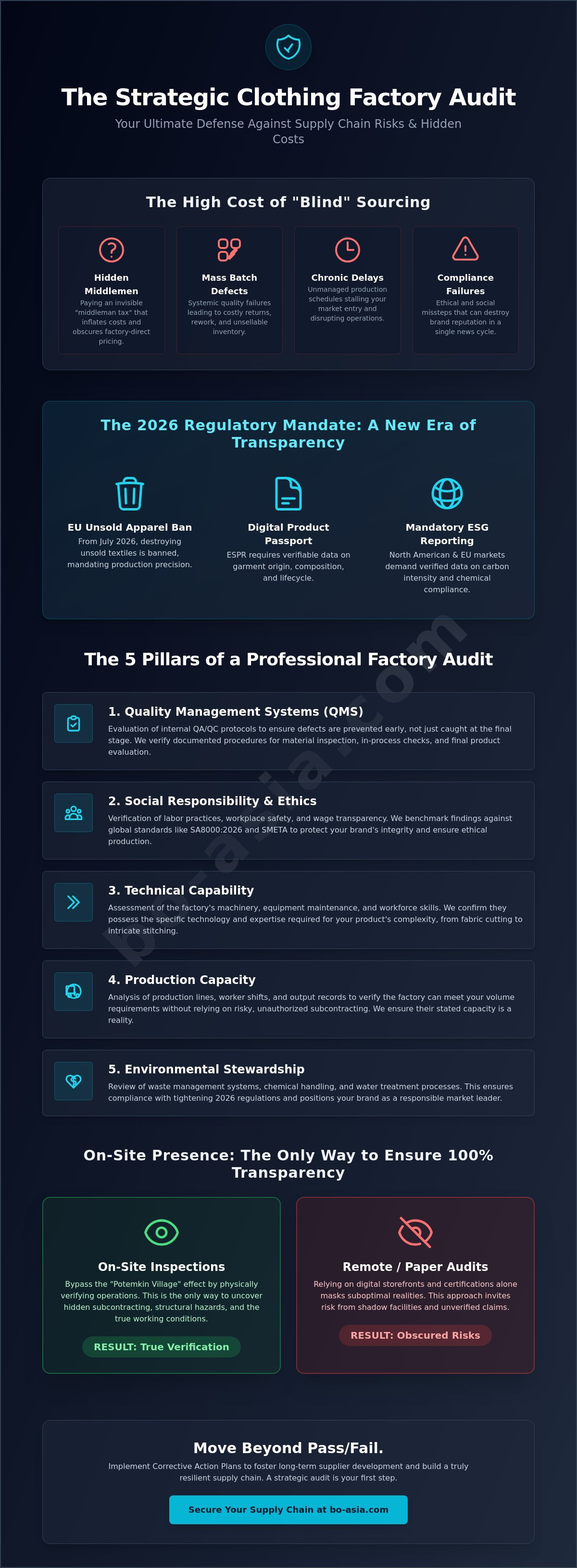
In the complex ecosystem of global trade, a clothing factory audit serves as your primary intelligence-gathering tool. It's a comprehensive evaluation of a supplier’s operational systems, technical capabilities, and ethical standards. Relying on "blind" sourcing—the practice of placing orders without physical verification—often leads to catastrophic results. Unvetted factories frequently suffer from systemic failures that manifest as mass batch defects or chronic delivery delays. These aren't just minor inconveniences; they're operational setbacks that can drain your capital and stall your market entry.
Digital storefronts and high ratings on sourcing platforms often mask suboptimal production realities. A factory might present a polished online profile while operating a shadow facility with substandard conditions. Protecting your brand equity requires a deeper dive. A single social compliance failure can destroy a decade of meticulous brand building in a single news cycle. To mitigate this risk, we verify adherence to the SA8000 social certification standard, ensuring your partners respect labor rights and workplace safety. This proactive defense is why a factory audit checklist for clothing manufacturing is indispensable for any serious apparel brand.
The true cost of poor quality control extends far beyond the price per unit. You must account for the high cost of returns, consumer rework, and the logistical nightmare of handling defective inventory. Effective factory-direct price negotiations are only possible when you have an accurate audit of factory overhead and capacity. Without this transparency, you're likely paying a "middleman tax." Conventional intermediaries often hide their own inefficiencies or markups within their quotes, obscuring the actual production costs. A strategic audit peels back these layers to reveal the financial viability of your partnership.
As of June 2026, international import regulations have shifted toward radical transparency. The EU's Ecodesign for Sustainable Products Regulation (ESPR) now mandates a Digital Product Passport for textiles. This means you need verifiable data on every garment's origin and composition. Labeling such as "Made in PRC" versus "Made in China" now requires factory-level verification to ensure compliance with strict origin rules. Preparing for mandatory ESG reporting is no longer optional for North American and European markets. You need a factory audit checklist for clothing manufacturing that specifically addresses carbon intensity and chemical compliance to avoid being delisted by major retailers.
A professional audit isn't a cursory walkthrough; it's a deep-tissue examination of a supplier's operational health. To secure your supply chain, your factory audit checklist for clothing manufacturing must be built upon five non-negotiable pillars. These categories allow you to move from subjective "feelings" about a supplier to objective, data-driven decisions that protect your capital. By evaluating these areas, you ensure your partner isn't just a vendor, but a scalable extension of your own production team.
We look beyond the finished product to evaluate the factory’s internal QA/QC protocols. A robust QMS prevents defects from reaching the packing stage.
This involves verifying labor practices, safety standards, and wage transparency. We often benchmark these findings against the SMETA Social Compliance Audit framework to ensure global alignment.
We assess whether the factory possesses the specific machinery and technical skills required for complex apparel construction.
It's vital to ensure the factory can meet your high-volume scaling needs without resorting to unauthorized subcontracting.
With 2026 regulations tightening, we review waste management and chemical usage in fabric processing to ensure legal compliance.
Technical vetting starts with the raw materials. We verify the implementation of the "Four-Point System" for fabric inspection. This ensures that defects are identified before the first cut is made, saving thousands in wasted labor. We also scrutinize maintenance logs for specialized machinery, such as seam sealers or embroidery units. A factory that neglects its equipment will inevitably produce inconsistent results. This level of technical scrutiny is essential for successful OEM and contract manufacturing, where precision is the only currency that matters.
Paper trails are easily forged; physical reality is not. Our auditors conduct unannounced worker interviews to verify actual working conditions and wage structures. We inspect fire safety systems, dormitory conditions, and canteen hygiene to ensure they meet the updated SA8000:2026 requirements. Linking these audit results directly to your brand’s ESG commitments provides the transparency that modern consumers and regulators demand. If you're ready to secure a transparent partnership, consult with our regional experts to begin your on-site vetting process.
Remote audits are a dangerous compromise that many brands accept to save on travel costs, but the hidden price is often catastrophic. A video call is a curated performance. It's impossible to detect the pungent smell of banned chemical dyes or identify the structural risks of a poorly maintained facility through a smartphone lens. Relying on digital tours leaves your brand vulnerable to the "Potemkin Village" effect. This is where factories stage a single, perfect production line for the camera while hiding the chaotic reality of their actual operations in the background.
True accountability requires an unyielding physical presence. Our approach integrates European management oversight directly onto the factory floor. This ensures that every line item on your factory audit checklist for clothing manufacturing is verified against physical evidence, not just verbal promises. We don't just look at what the management wants us to see; we investigate the corners they try to hide, ensuring that your production standards are upheld without exception. This protective layer of oversight transforms the audit from a simple check-box exercise into a robust defense for your business.
Unauthorized subcontracting is a major threat to both quality and brand reputation. "Shadow factories" often operate without basic safety protocols or ethical labor standards, and they do so entirely without your knowledge. During a physical walk-through, our experienced auditors identify subtle red flags, such as unfamiliar branding on raw material crates or workers who lack proper facility identification. Thorough supplier vetting isn't a one-time digital check. It requires local boots on the ground to ensure your production stays within the audited facility and never slips into an unmanaged third-party site.
An on-site audit serves as your most effective tool for financial optimization. It allows you to verify a factory's direct operational costs, effectively cutting through the inflated quotes often provided by traditional sourcing agents. When you have a clear view of the actual overhead, utility costs, and labor rates, you gain a significant advantage in factory-direct price negotiations. Our dedicated Asia procurement team functions as a seamless extension of your own headquarters. We provide the regional expertise and physical proximity needed to bypass the "middleman tax," ensuring your capital is invested in production quality rather than obscured commission fees.
A checklist is your field manual for operational security. While previous sections established the strategic importance of on-site presence, this factory audit checklist for clothing manufacturing provides the granular data points required for a final pass or fail decision. We don't just ask if a factory has a license; we verify the official government chop and ensure the ownership documents align with the bank accounts used for your transactions. This level of rigor prevents you from accidentally funding a shell company or an unmanaged intermediary.
Your inspection must begin at the warehouse. Raw material control is a leading indicator of final product quality. We check for elevated storage racks to prevent moisture damage and review fabric testing reports for colorfastness and shrinkage. On the cutting and sewing floor, we measure lighting standards; 500 to 700 lux is the professional benchmark for high-precision apparel work. Efficiency isn't just about speed; it's about a logical workflow that minimizes handling and reduces the risk of garment soiling or snagging during the assembly process.
The final stages of production are where safety and compliance risks are most visible. Our auditors scrutinize the finishing and packing stations for metal detection protocols and carton labeling accuracy. We also evaluate the management structure and personnel files. A healthy factory maintains clear training records and functional grievance mechanisms for its staff. If you want to ensure your production meets these elite standards, schedule a comprehensive on-site audit with our regional experts today.
A strict Needle Control Policy is a non-negotiable safety standard that prevents hazardous metal fragments from reaching the final consumer. Beyond basic safety, we verify the calibration of color-matching light boxes and tension meters to ensure consistent seam strength. We don't settle for a final inspection at the end of the line. Instead, we assess the frequency of "In-line Inspections." This proactive approach identifies stitching errors while the garments are still on the machines, allowing for immediate correction before a minor issue becomes a systemic defect across thousands of units.
Structural integrity is a foundational requirement for any sustainable partnership. We demand to see valid structural integrity certificates for the factory building to mitigate the risk of catastrophic facility failure. Our physical walkthrough includes a rigorous check for blocked emergency exits and the presence of functional, recently serviced fire extinguishers. Furthermore, chemical storage areas must be inspected for proper ventilation and secondary containment systems. These checks ensure that your supply chain is not only efficient but also resilient against the legal and ethical fallout of industrial accidents.
A pass/fail result from your factory audit checklist for clothing manufacturing is merely a snapshot in time; it isn't a guarantee of future performance. Real supply chain resilience is built in the months following the initial inspection. We view the audit as the diagnostic phase of a long-term supplier development program. If a factory shows potential but falls short in specific areas, we don't simply walk away. Instead, we implement rigorous Corrective Action Plans (CAPs) to address systemic weaknesses, turning a risky vendor into a reliable partner.
Maintaining high standards requires constant vigilance. This is where mass production oversight becomes your most valuable asset. It ensures that the operational protocols verified during the audit don't degrade once the pressure of a high-volume deadline hits the sewing floor. Strategic sourcing also requires you to weigh the audit's risk profile against your broader logistics strategy. By analyzing these risks, you can make informed decisions when choosing between nearshoring vs offshoring, ensuring your choice aligns with both your financial goals and your brand's tolerance for risk.
Moving from transactional auditing to long-term supplier management is the hallmark of a sophisticated brand. We use historical audit data to help you negotiate better terms for high-volume sourcing, rewarding factories that demonstrate consistent improvement with larger order allocations. Our documented success stories highlight how this collaborative approach works in practice. In one instance, we identified a factory with superior technical skills but poor social compliance records. Through a 12-month development plan, we helped them achieve full certification, transforming them into a top-tier partner for our clients.
Our presence in Hong Kong and Helsinki allows us to bridge the cultural and professional gap between Asian production hubs and European quality standards. You don't have to manage the complexities of international manufacturing alone. By utilizing a dedicated Asia procurement team, you gain 365-day oversight and a protective shield against the operational setbacks that plague unmanaged supply chains. We function as an integrated extension of your own team, ensuring that every garment produced meets your exact specifications and ethical requirements.
Protect your production—Contact Buying Office Asia for a professional factory audit today.
Mastering the factory audit checklist for clothing manufacturing is your most effective strategy for eliminating the operational risks that plague unmanaged supply chains. A professional audit is not a static document; it's a dynamic defense mechanism. It requires physical, on-site verification to bypass the deceptions of hidden middlemen and ensure your production adheres to the strict 2026 transparency mandates. By prioritizing technical capability and social compliance, you transition from a vulnerable buyer to a sophisticated procurement leader.
As a European-managed firm with over 15 years of experience in Asia, we provide the steady confidence you need in a complex market. Our team maintains a constant on-site presence in Hong Kong and China to offer 100% transparency with no hidden commissions. We function as your protective partner, ensuring your financial health and brand reputation remain secure. Secure your supply chain with our on-the-ground experts today. You now have the strategic framework to build a resilient, ethical, and highly profitable manufacturing network.
The most critical component of a clothing factory audit is the verification of the factory’s internal Quality Management Systems (QMS) and its physical technical capability. While social compliance is vital for brand safety, a factory that cannot consistently produce high-quality goods will ultimately drain your capital. You must ensure the facility possesses the specific machinery and workflow efficiency required for your particular apparel construction.
A professional apparel factory audit typically requires one to two full business days on-site. This duration allows our auditors to conduct a thorough walkthrough, review technical documentation, and perform unannounced worker interviews. Complex facilities with multiple production lines or integrated fabric mills may require additional time to ensure every element of your factory audit checklist for clothing manufacturing is verified against physical evidence.
You should never rely solely on third-party audit reports provided by the factory management. These documents are often curated or outdated; they frequently fail to reflect the current operational reality of the facility. Factories often stage auditor-ready environments that mask systemic issues. True transparency requires independent, on-site verification by your own dedicated team to ensure the data you receive is accurate and current.
The cost of a factory audit in China or Southeast Asia varies based on the facility’s location, size, and the specific depth of the inspection required. While pricing fluctuates with regional logistics and labor rates, the expense is a minor investment compared to the financial risk of a mass production failure. We focus on providing comprehensive oversight that eliminates hidden costs and protects your long-term profit margins.
If a factory fails an audit, the immediate next step is to issue a formal Corrective Action Plan (CAP) that outlines specific improvements and deadlines. This allows the supplier an opportunity to address critical non-conformities under our supervision. However, if the failure involves fundamental ethical violations or severe structural risks, we recommend immediately delisting the supplier to protect your brand from legal and reputational damage.
A social audit is distinct from a technical quality audit, though both are essential for a secure supply chain. Social audits focus on labor practices, workplace safety, and ethical standards like the SA8000:2026 revision. In contrast, a technical quality audit evaluates the factory’s machinery, production capacity, and Quality Management Systems. Both pillars must be integrated into your factory audit checklist for clothing manufacturing to ensure total operational security.
Active clothing manufacturers should undergo a comprehensive re-audit at least once every twelve months. For high-volume suppliers or those operating in regions with higher regulatory risks, semi-annual inspections are often necessary. Regular oversight prevents the standard creep where quality and safety protocols gradually erode over time. Consistent monitoring ensures your partners remain aligned with your brand’s evolving ESG and quality requirements.
Key red flags during a virtual tour include restricted camera angles that avoid the facility’s corners and a lack of live, spontaneous interaction with workers. If the management refuses to show specific areas like chemical storage or dormitories, they are likely hiding non-compliance issues. A scripted, overly polished presentation often signals that the factory is staging a performance rather than showing you the reality of their production floor.

A technical drawing isn't just an engineering reference; it's your primary legal baseline against cost-driven supplier compromises. When sourcing abroad, vague manufacturing product specification sheets inevitably invite unauthorized material substitutions, delayed timelines, and sudden quotation in...

The traditional commission-based sourcing agent in India is no longer an asset; they're often your greatest financial risk in a market rapidly scaling toward a $2 trillion export target. You likely recognize the inherent conflict when an agent's income rises alongside your factory costs, or the anxi...

If your current sourcing agent claims their services are free, you're likely paying a hidden tax of 10% to 30% through inflated unit prices and factory kickbacks. This lack of transparency doesn't just erode your margins; it creates a dangerous barrier between you and the factory floor. Finding a re...